













 Lietuvių
  English
  Русский
Can You Keep Lithuanian Citizenship If You Get Another One?
Many Lithuanians who moved abroad after March 11, 1990 are now considering obtaining citizenship in another country – for example, the United Kingdom, the United States, or Australia. Naturally, the question arises: can you keep Lithuanian citizenship if you get another one? Is dual citizenship in Lithuania allowed?
The issue of Dual citizenship is especially important for those who wish to freely travel and work within the European Union, maintain a strong connection with Lithuania, and at the same time enjoy the rights and responsibilities in another country.
Lithuanian citizenship grants the right to live and work anywhere in the EU, access healthcare services, and pursue education opportunities. Therefore, it is understandable that Lithuanians living abroad wish to retain their Lithuanian citizenship.
When Can You Keep Lithuanian Citizenship After Getting Another One?
According to the Law on Citizenship of the Republic of Lithuania, dual citizenship is allowed only in specific cases. You can retain Lithuanian citizenship after acquiring another citizenship if:
-
You, your parents, grandparents, or great-grandparents were citizens of Lithuania before June 15, 1940, and
-
You or your ancestors left Lithuania before March 11, 1990 (between February 16, 1918 and March 11, 1990); or
-
You or your ancestors were exiled from occupied Lithuania before March 11, 1990 (between June 15, 1940 and March 11, 1990).
In these cases, Lithuanian citizenship may be retained even after naturalization in another country.
Lithuanian Dual Citizenship: When Is It Allowed?
If you are wondering how to retain Lithuanian citizenship after getting another one, it’s important to know that, in general, dual citizenship in Lithuania is not permitted.
However, the exceptions listed above allow you to keep Lithuanian citizenship together with another – for example, that of the United Kingdom or the United States.
This is particularly relevant for Lithuanians who live abroad and want to obtain another citizenship without losing their Lithuanian identity.
Each case is assessed individually, as the right to retain Lithuanian citizenship depends on personal and historical circumstances.
Main conditions for dual citizenship:
-
Lithuanian citizenship before June 15, 1940
-
Departure from Lithuania before March 11, 1990 (February 16, 1918 – March 11, 1990), or
-
Deportation (exile) from occupied Lithuania before March 11, 1990 (June 15, 1940 – March 11, 1990)

Documents Required to Retain Lithuanian Citizenship
Depending on your circumstances, the process of keeping Lithuanian citizenship after getting another one can be complex. It is crucial to gather all necessary documents proving your right to dual citizenship. To ensure you understand Can You Keep Lithuanian Citizenship If You Get Another One?, make sure all supporting documents are collected and verified.
In order to prove the right to Dual citizenship, you must provide documents confirming:
-
Lithuanian citizenship before June 15, 1940
-
Deportation or departure before March 11, 1990
-
Family relationship with the person who held Lithuanian citizenship
-
Any name changes (if applicable)
-
Other records related to your or your family’s history
If you do not have these documents, they can often be found in Lithuanian archives.
We can assist you with this process – contact us at info@migration.lt for help.

Step-by-Step: How to Keep Lithuanian Citizenship After Naturalization
Following these steps will help you understand Can You Keep Lithuanian Citizenship If You Get Another One? in practice.
-
Collect all documents proving your right to dual citizenship.
-
Contact Lithuanian archives if any documents are missing.
-
Submit an application to the Migration Department for confirmation and a conclusion that dual citizenship is possible in your case.
-
Obtain the citizenship of another country.
-
Inform the Migration Department about acquiring another citizenship to ensure the retention of Lithuanian citizenship.
Practical Tips on Keeping Lithuanian Citizenship
Here are some practical recommendations that can help you retain Lithuanian citizenship after acquiring another one and avoid unnecessary delays:
-
Start gathering documents early – archive searches can take several months.
-
Collect as much information about your relatives as possible (names, birth dates, places).
-
Prepare official translations and notarized copies in advance.
-
Follow the official document submission procedure carefully.
FAQ: Can You Keep Lithuanian Citizenship If You Get Another One?
-
Can all Lithuanians have dual citizenship?
Many people ask, Can You Keep Lithuanian Citizenship If You Get Another One? even if they have no ancestors who were deported.
No, dual citizenship is allowed only in exceptional cases – for deportees, their descendants, and those who left Lithuania before March 11, 1990.
-
What if I don’t have my grandparents’ or great-grandparents’ documents?
You can request a document search in Lithuanian archives by providing available information such as name, surname, birth date, or place of residence.
We can help you with this – contact us at info@migration.lt
-
Where should I apply to retain Lithuanian citizenship?
Submit your application to the Migration Department, including all necessary documents.
-
Do I need to renounce my other citizenship to keep Lithuanian citizenship?
No, if you qualify for one of the exceptions in Lithuanian law, you can hold both citizenships simultaneously.
-
How long does the process take?
The timeframe depends on how quickly you can collect all required documents. Generally, the process takes from a few months to one year.
-
Can I get a free legal consultation about retaining Lithuanian citizenship?
Yes. If you wish to learn more about dual citizenship in Lithuania, retaining Lithuanian citizenship, or need help with document preparation and submission, contact us for a free consultation.
We provide full support — document searches in archives, translations, notarization, preparation of applications for the Migration Department, and legal representation.
We can also review your documents before official submission.
Contact us for a free consultation:
📧 Email: info@migration.lt
📞 Phone: +370 685 63053
Conclusion: Keeping Your Lithuanian Citizenship and Staying Connected to Lithuania
The issue of dual citizenship in Lithuania often raises many questions among Lithuanians living abroad. The key is to understand how to keep Lithuanian citizenship if you get another one and prepare all required documents in advance.
By submitting your application to the Migration Department, you can maintain your connection to Lithuania even after obtaining another citizenship.
Retaining Lithuanian citizenship offers real benefits — the freedom to live, work, and travel in the EU, the right to own property in Lithuania, and the opportunity to preserve your Lithuanian identity and cultural roots. If you are considering citizenship in another country, it is crucial to know Can You Keep Lithuanian Citizenship If You Get Another One? to protect your rights and connections to Lithuania.
If you are considering naturalizing elsewhere, make sure to know Can You Keep Lithuanian Citizenship If You Get Another One? — this will help you preserve your rights and Lithuanian heritage.

Can a Child Obtain Lithuanian Citizenship After the Age of 18?
This article answers the question: Can a child obtain Lithuanian citizenship after the age of 18, who is eligible, and how the application process works. Under the legal regulation previously in force and the long-standing administrative practice, it was considered that the issue of a child’s Lithuanian citizenship had to be resolved before the child reached the age of 18. If no application for Lithuanian citizenship was submitted before reaching adulthood, it was assumed that the right to Lithuanian citizenship had been lost. As a result, many children of Lithuanian descent who were born and lived abroad were no longer able to acquire or confirm Lithuanian citizenship after turning 18.
This naturally raises the question: Can a child obtain Lithuanian citizenship after the age of 18?
The answer — and the procedure — are explained below.
Current Legal Situation
The situation has now changed. Lithuanian law currently provides the possibility to apply for Lithuanian citizenship after the age of 18, if the issue of the child’s Lithuanian citizenship was not resolved earlier.
This means that an adult person whose at least one parent was a citizen of the Republic of Lithuania at the time of the person’s birth, and who acquired the citizenship of another state either at birth or before the age of 18 (not by birth), has the right to submit an application requesting to be recognized as a citizen of the Republic of Lithuania — even if this right was not exercised before reaching adulthood.
This provision is particularly relevant to the Lithuanian diaspora and to individuals born abroad whose parents are or were Lithuanian citizens, but who, due to living abroad, lack of information, or administrative obstacles, did not arrange Lithuanian citizenship documents for their child before the child turned 18. Today, such individuals may obtain Lithuanian citizenship after reaching adulthood and, if the legal requirements are met, may hold dual citizenship.
Lithuanian Citizenship After the Age of 18: Who Is Eligible and How to Apply?
Current legislation allows applications for Lithuanian citizenship even after the age of 18 if the issue of the child’s citizenship was not resolved before adulthood. Below we explain who this right applies to and how it can be exercised.
Who Is Eligible to Apply After the Age of 18?
Before reviewing the documents and procedure, let us return to the key question:
Can a child obtain Lithuanian citizenship after the age of 18?
If you meet the criteria, the answer is yes.
You are eligible to apply if:
-
You were born between 11 March 1990 and 21 July 2008, and
-
At the time of your birth, one or both of your parents were citizens of the Republic of Lithuania, and
-
You acquired the citizenship of another country either at birth or before the age of 18 (not by birth).
In other words, this right applies to persons who:
-
Were born during the above-mentioned period;
-
Had at least one parent who was a Lithuanian citizen at the time of birth;
-
Acquired another citizenship at birth or before the age of 18.
Important: this option applies only if the issue of Lithuanian citizenship was not examined or resolved before the age of 18.
Is Dual Citizenship Allowed in These Cases?
A common question is:
Can a child obtain Lithuanian citizenship after the age of 18 and keep dual citizenship?
Yes — an exception applies.
If you acquired Lithuanian citizenship by birth, and acquired another country’s citizenship by birth or before the age of 18 (not by birth), you are entitled to hold dual (multiple) citizenship for life.
You may retain dual citizenship for life if:
-
Lithuanian citizenship was acquired by birth;
-
Another citizenship was acquired by birth or before the age of 18 (not by birth).
This most commonly applies to children of Lithuanian descent born abroad — in the United States, the United Kingdom, Canada, Australia, and other countries.
How to Submit the Application
The application must be submitted electronically via the MIGRIS system.
After submitting the application, you must:
-
Appear within 4 months at the Migration Department or a Lithuanian consulate,
or -
Have the documents submitted by an authorized representative in Lithuania.
If the original documents are not submitted within the prescribed time limit, the application is considered invalid.
Required Documents
To confirm eligibility to obtain Lithuanian citizenship after the age of 18, the following documents must be submitted:
-
A valid passport;
-
Documents proving the family relationship with the parents;
-
Documents confirming that one or both parents were citizens of the Republic of Lithuania at the time of birth;
-
Documents confirming the acquisition of another country’s citizenship at birth or before the age of 18 (not by birth), such as:
-
a foreign document stating that you have been a citizen of that country since birth, or
-
a foreign passport issued before the age of 18, or other equivalent evidence.
-

Translation and Legalization of Documents
All documents must be translated into Lithuanian, and the translation must be certified by a qualified translator.
Foreign documents must be legalized or certified with an Apostille, except for documents issued by Latvia, Estonia, Ukraine, Moldova, and in certain humanitarian situations.
Key Rules at a Glance
| Question | Answer |
|---|---|
| Can you apply after the age of 18? | Yes |
| Who is eligible? | Persons born between 1990-03-11 and 2008-07-21 whose parent(s) were Lithuanian citizens at the time of birth |
| Is dual citizenship allowed? | Yes — if Lithuanian citizenship was acquired by birth and another citizenship was acquired by birth or before age 18 |
| Is a physical visit required? | Migration Department / Lithuanian consulate or authorized representative |
| Is Apostille required? | Yes, in most cases |
Final Summary
In summary, can a child obtain Lithuanian citizenship after the age of 18?
Yes — if the issue of the child’s citizenship was not resolved before the age of 18 and the statutory requirements are met.
If you were born into a Lithuanian family in Lithuania or abroad but your Lithuanian citizenship documents were not arranged during childhood, you may still apply for Lithuanian citizenship as an adult. This legal right exists to maintain ties with Lithuania and to protect the citizenship rights of children of the Lithuanian diaspora.

Need Assistance?
Would you like to find out whether Lithuanian citizenship after the age of 18 applies to you?
Contact us — we will evaluate your situation and assist with the application.
We help with:
-
Assessing eligibility for Lithuanian citizenship;
-
Collecting documents;
-
Translations and Apostille;
-
Completing the MIGRIS application;
-
Submitting documents to the Migration Department.
Contact us — we will assess your case free of charge.
Frequently Asked Questions (FAQ)
Q1: Can a child obtain Lithuanian citizenship after the age of 18 if the application was not submitted earlier?
Yes. Lithuanian law allows you to apply after the age of 18 if your citizenship status was not resolved before adulthood and you meet the statutory requirements.
Q2: Does this mean I lost my right if my parents did not apply before I turned 18?
No. If the issue of your Lithuanian citizenship was not examined before you turned 18, you may still apply as an adult.
Q3: Is dual citizenship allowed in this situation?
Yes. If you acquired Lithuanian citizenship by birth and another citizenship by birth or before the age of 18, you may hold dual citizenship for life.
Q4: Do I need to travel to Lithuania to apply?
Not necessarily. You can submit the application online via MIGRIS and later appear at a Lithuanian consulate or authorize a representative in Lithuania.
Q5: What is MIGRIS?
MIGRIS is the official electronic system of the Lithuanian Migration Department used for submitting citizenship applications.
Q6: What if I am unsure whether I meet the criteria?
You can contact us for a free eligibility assessment. We will review your situation and advise you on the next steps.

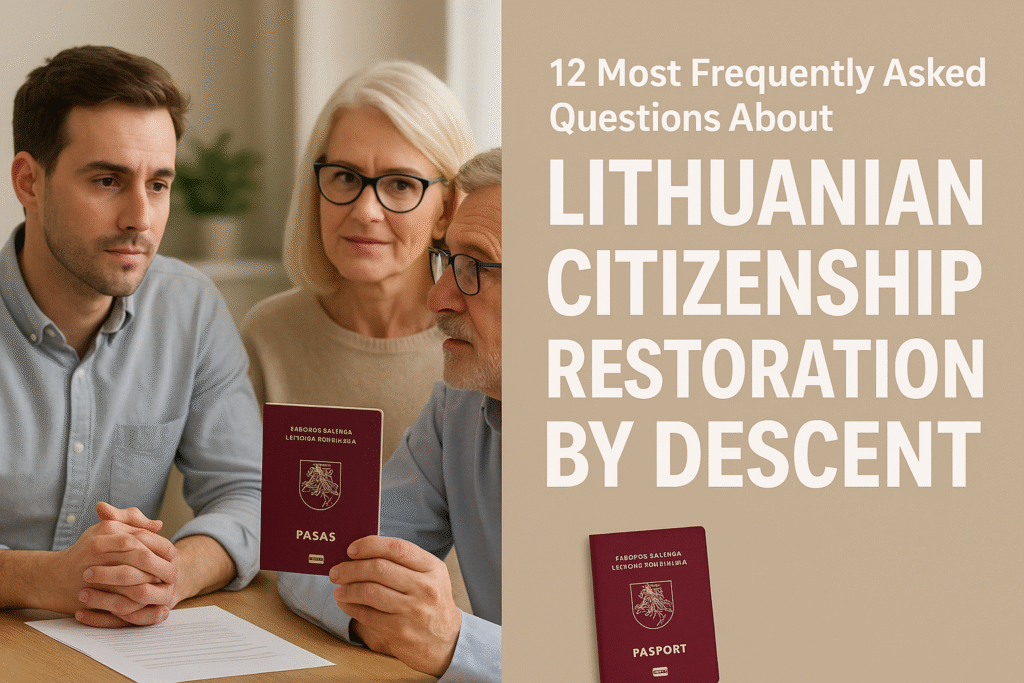
12 Most Frequently Asked Questions About Lithuanian Citizenship Restoration by Descent
If you are looking for answers to the 12 Most Frequently Asked Questions About Lithuanian Citizenship Restoration by Descent, you are in the right place. This article on the 12 Most Frequently Asked Questions About Lithuanian Citizenship Restoration by Descent will help you better understand the process, benefits, and steps involved. This comprehensive guide covers the essential information about restoring Lithuanian citizenship by descent, including eligibility criteria, required documents, dual citizenship rules, timelines, and legal support.
Restoring Lithuanian citizenship by descent offers many benefits for people with Lithuanian roots, including access to European Union rights and opportunities. Understanding the process of Lithuanian citizenship restoration (Reinstatement of Lithuanian citizenship) is key to successfully reclaiming your citizenship.
If you’re unsure where to begin, these 12 Most Frequently Asked Questions About Lithuanian Citizenship Restoration by Descent will give you a clear starting point.
1. Who is eligible for Lithuanian citizenship restoration by descent?
You may qualify if you can prove that your parent, grandparent, or great-grandparent was a Lithuanian citizen before June 15, 1940.
To be eligible for dual citizenship, you must also prove that you or your ancestor left Lithuania before March 11, 1990, or were forcibly removed due to war, occupation, or deportation.
2. Can I apply for Lithuanian citizenship restoration if my ancestor left Lithuania due to war or persecution?
Yes. As explained in these 12 Most Frequently Asked Questions About Lithuanian Citizenship Restoration by Descent, those whose ancestors left Lithuania due to war, the Holocaust, Soviet deportation, or political persecution are often eligible.
3. What documents are needed for Lithuanian citizenship restoration by descent?
To apply for Lithuanian citizenship restoration, you will need documents proving your ancestor’s Lithuanian citizenship, such as passports, ID cards, military documents, or census records. Additionally, birth and marriage certificates are required to establish family links. For dual citizenship eligibility, documents confirming the date of departure or deportation are also necessary.
4. Do I need to speak Lithuanian or live in Lithuania to apply for citizenship restoration?
No, there are no language or residency requirements to apply for Lithuanian citizenship restoration by descent.
5. Can I keep my current citizenship when restoring Lithuanian citizenship?
In most cases, yes. Lithuania allows dual citizenship when restoring citizenship lost due to occupation-related reasons.
To qualify, you must prove that your ancestor held Lithuanian citizenship before June 15, 1940 and left Lithuania before March 11, 1990, or was deported during the Nazi or Soviet occupation.

6. How long does the Lithuanian citizenship restoration process take?
The timeframes discussed in these 12 Most Frequently Asked Questions About Lithuanian Citizenship Restoration by Descent are based on typical cases and may vary. The application process usually takes between 6 and 12 months, depending on the complexity of the case and the availability of documents.
7. What if I don’t have original Lithuanian documents?
If you lack original documents, you can request help from Lithuanian or related archives.
Our team at Migration Law Center can help you with the archival search, document analysis, and evidence collection if needed.
8. What if my ancestor’s name was changed or spelled differently?
Name changes or different spellings due to immigration or language differences (e.g., Yiddish, Hebrew, Cyrillic) are common. Submit supporting documents explaining these changes when applying for citizenship restoration.
9. Can I apply for Lithuanian citizenship restoration from abroad?
You can apply from abroad through the Lithuanian embassy or consulate in your country.
Applications must be submitted via Lithuania’s online system Migris, and original documents are later presented in person during an appointment at the Migration Department or consulate.
You can complete the process yourself or authorize a legal representative to act on your behalf.
10. Should I hire a lawyer for Lithuanian citizenship restoration?
You can apply on your own, but legal support is often helpful — especially in cases with missing records, complex family histories, or if you’re seeking dual citizenship. Lawyers experienced in Lithuanian citizenship restoration by descent can provide valuable guidance.
At Migration Law Center, we guide clients through every step, including document preparation, translation, and legal representation.
Many of the 12 Most Frequently Asked Questions About Lithuanian Citizenship Restoration by Descent involve legal complexities where professional assistance is useful.
11. How much does it cost to restore Lithuanian citizenship?
The official government fee (state fee) for submitting the citizenship restoration application is €120.
If you choose to work with legal professionals, service fees vary depending on the complexity of the case, the documents involved, and the level of support you need.
It’s important to choose experienced professionals who can handle archive research, translations, and legal submissions to ensure a smooth process.
12. Can Lithuanian citizenship be passed on to children after restoration?
Yes. If you restore Lithuanian citizenship, your children born after you officially become a Lithuanian citizen may acquire citizenship by birth. Citizenship is not automatically passed to children born before your restoration.
Following this 12 Most Frequently Asked Questions About Lithuanian Citizenship Restoration by Descent guide will help you understand the process and requirements. If you need assistance, legal experts in Lithuanian citizenship restoration can support you every step of the way.
Need help?
Contact our team at Migration Law Center for professional assistance with restoring Lithuanian citizenship. We work with clients from the US, Israel, South Africa, and beyond — making the process clear and efficient.

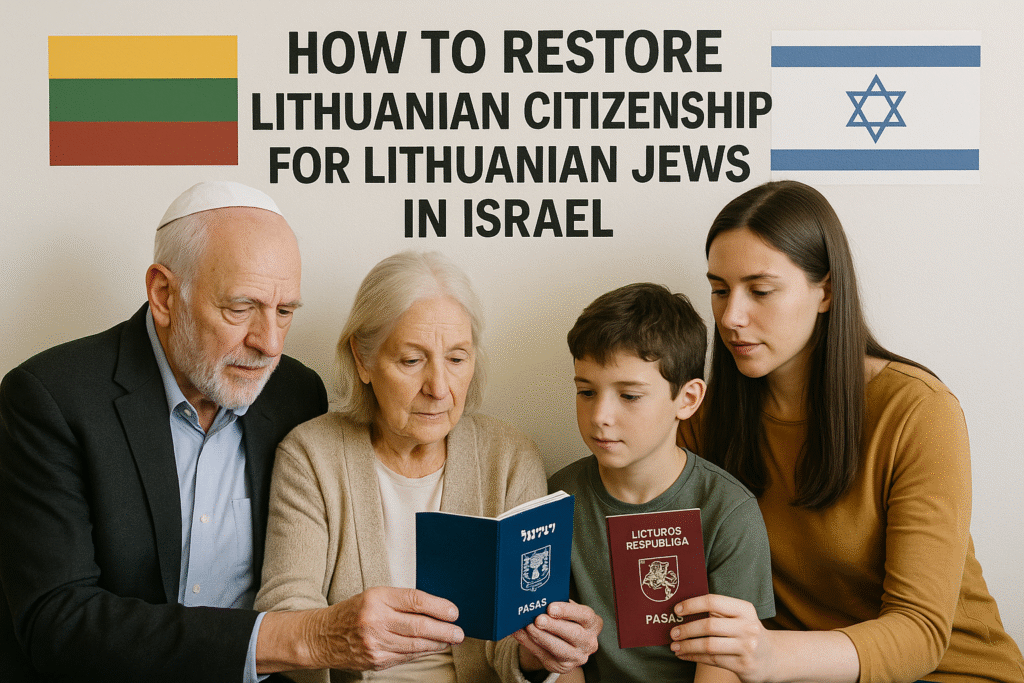
How to Restore Lithuanian Citizenship for Lithuanian Jews in Israel?
This guide explains how to restore Lithuanian citizenship for Lithuanian Jews in Israel, covering eligibility, documents, and the application process. Restoring Lithuanian citizenship (Reinstatement Lithuanian citizenship) offers a unique opportunity for descendants of Lithuanian Jews living in Israel to reconnect with their heritage and gain access to the benefits of European Union citizenship. Many Litvak families were forced to leave Lithuania before 1990 due to war, persecution, or deportation. Understanding how to restore Lithuanian citizenship for Lithuanian Jews in Israel is the first step toward reclaiming your heritage and rights. This guide explains the legal requirements, necessary documents, and step-by-step process to help you successfully restore your Lithuanian citizenship and reclaim your family’s legacy.
Learning how to restore Lithuanian citizenship for Lithuanian Jews in Israel can give your family access to European rights and reconnect you with your historical roots.

Who Is Eligible to Restore Lithuanian Citizenship?
If you want to learn how to restore Lithuanian citizenship for Lithuanian Jews in Israel, it is important to know the eligibility criteria.
You may be eligible to restore Lithuanian citizenship if:
- You yourself were a Lithuanian citizen before June 15, 1940, or
- Your parent, grandparent, or great-grandparent was a Lithuanian citizen before that date, and
- Either you or your ancestor left Lithuania before March 11, 1990
- Or was forcibly removed from Lithuania due to political persecution, war, deportation, or the Holocaust (e.g., sent to concentration camps, Siberian exile, or other forced displacement).
This applies to many Lithuanian Jews (Litvaks) whose families fled or were deported during WWII or Soviet occupation.
What Is “Litvak” and Why It Matters for Restoring Lithuanian Citizenship
The term Litvak refers to Jews of Lithuanian origin — a rich heritage rooted in Vilnius, Kaunas, and surrounding regions.
The Lithuanian government recognizes the historical connection of Litvaks and enables them to restore (or reinstate) Lithuanian citizenship through ancestry.

Required Documents to Restore Lithuanian Citizenship
If you’re preparing to apply, you’ll need to understand how to restore Lithuanian citizenship for Lithuanian Jews in Israel, including gathering historical documents and personal records.
To successfully restore Lithuanian citizenship, you will need:
- Proof your ancestor was a Lithuanian citizen (passport, ID, military record, census data, etc.)
- Your own birth certificate and those linking each generation
- Valid personal ID or passport
- Translations and apostille (depending on origin country)
Tip: Many Jewish records are available via Yad Vashem, JewishGen, or Lithuanian Central Archives.
Step-by-Step Guide to Restore Lithuanian Citizenship
This section details the essential steps in the process of how to restore Lithuanian citizenship for Lithuanian Jews in Israel, helping you navigate documentation and submission.
- Gather documents – both ancestral and personal
- Get certified translations and Apostille
- Submit application to the Migration Department in Lithuania or via Lithuanian Embassy in Israel
- Wait for review (usually 6–12 months)
- Receive approval and official citizenship confirmation
Some families in Israel use legal assistance to speed up or simplify the process. Services specializing in Litvak claims can help with archives and official paperwork.
Dual Citizenship – Can You Restore Lithuanian Citizenship and Keep Israeli Citizenship?
Many wonder about how to restore Lithuanian citizenship for Lithuanian Jews in Israel while keeping their Israeli citizenship, and the good news is that Dual citizenship is allowed in most cases.
Lithuanian law allows dual citizenship for those restoring their citizenship lost under occupation (i.e., due to WWII, Holocaust, or Soviet annexation).
This applies to most Litvak descendants from Israel.
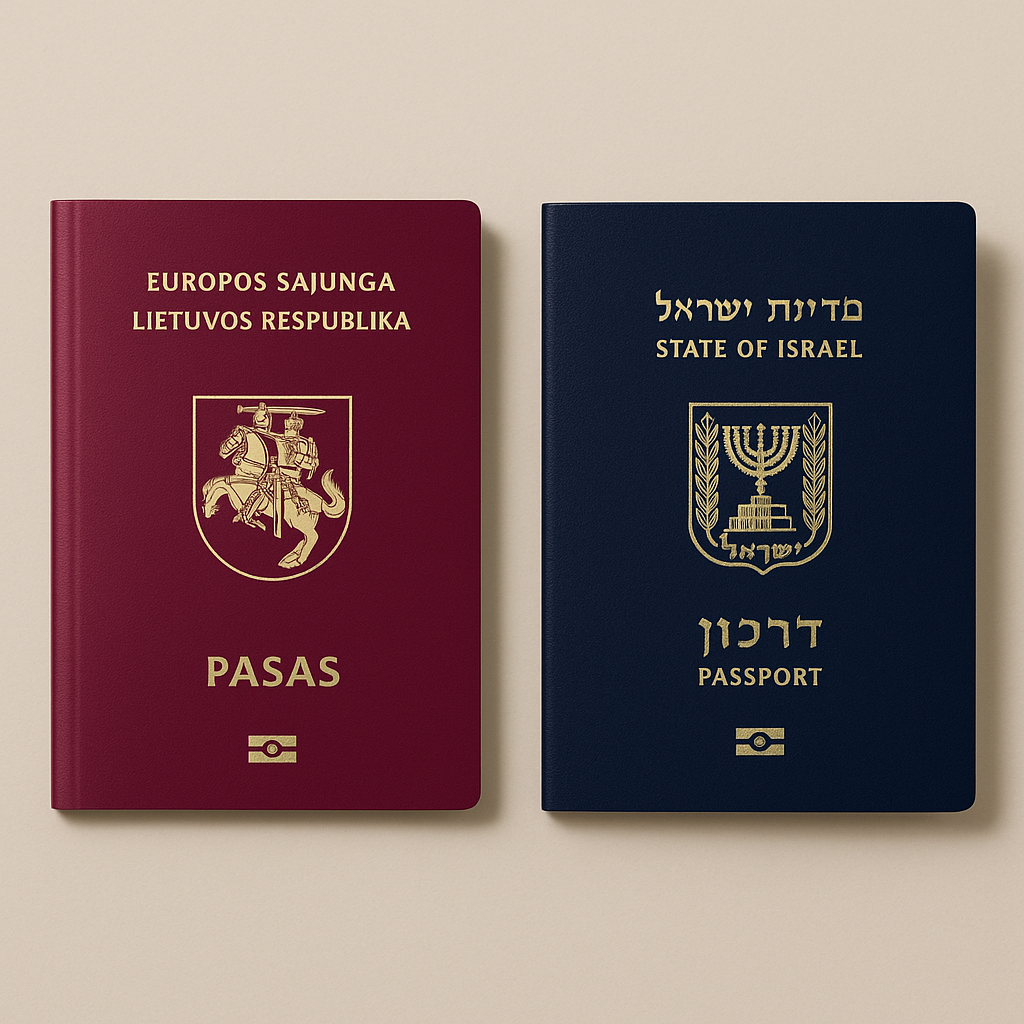
Key Conditions for Dual Lithuanian Citizenship for Lithuanian Jews in Israel
- Lithuanian Citizenship Before June 15, 1940
You or your parent, grandparent, or great-grandparent must have been a citizen of Lithuania before June 15, 1940. - Departure from Lithuania Before March 11, 1990
You or your ancestor must have left Lithuania before March 11, 1990 — the date Lithuania restored its independence. - Forced Exile or Deportation During Occupation
Alternatively, your ancestor may have been forcibly removed from Lithuania (e.g., deported to Siberia, sent to concentration camps, imprisoned, or exiled for political, ethnic, or religious reasons) during the Nazi or Soviet occupations.
Common Challenges When Restoring Lithuanian Citizenship and How to Overcome Them
- ❌ Missing documents? → Contact Lithuanian archives or use genealogical researchers
- ❌ Name variations? → Explain changes due to immigration or Hebrew/Yiddish translations
- ❌ Apostille delays (e.g., due to war or unrest)? → Include a written explanation in your application (especially relevant for current conditions in Israel)
Knowing how to restore Lithuanian citizenship for Lithuanian Jews in Israel includes understanding common challenges and preparing proper explanations for delays or missing documents.
Why It’s Worth Restoring Lithuanian Citizenship as a Litvak
Restoring Lithuanian citizenship offers more than just a legal status — it’s a powerful way to honor your roots as a Litvak and reconnect with a rich cultural heritage. For many descendants of Lithuanian Jews, citizenship is a symbolic and personal act that restores a piece of history lost through war, displacement, and persecution.
In practical terms, Lithuanian citizenship provides access to all the benefits of European Union membership, including the ability to live, work, study, and travel freely across 27 EU countries. This is especially valuable for younger generations seeking international opportunities in education or employment.
For Litvaks in Israel, restoring Lithuanian citizenship is also a legacy for future generations — an inheritance of identity, history, and global mobility. It’s both a tribute to the past and an investment in the future.
Real Stories – Litvak Families Who Restored Lithuanian Citizenship
These stories show that how to restore Lithuanian citizenship for Lithuanian Jews in Israel is not only possible, but often deeply meaningful for those reclaiming lost heritage.
Many Jewish families in Israel have successfully restored Lithuanian citizenship — both to reconnect with their roots and to access EU benefits (education, healthcare, travel freedom).
Some use the process as a way to honor their family’s memory, especially considering the Holocaust and Soviet deportations.
Need Help to Restore Lithuanian Citizenship? Legal Assistance for Israeli Applicants
At Migration Law Center, we assist individuals and families with how to restore Lithuanian citizenship for Lithuanian Jews in Israel, even in complex legal or historical situations.
If you’re unsure where to start or face document issues, consider professional help. At Migration Law Center (www.migration.lt), we specialize in restoring and reinstating Lithuanian citizenship for Litvak descendants living in Israel. Our expert team can assist you with complicated paperwork, archival research, translations, and legal procedures to make your citizenship application process smooth and successful.

Lithuanian Citizenship for Americans
Many Americans with Lithuanian roots are exploring this opportunity to reclaim their ancestral rights. This guide covers two key pathways — Reinstatement (for those with Lithuanian heritage before 1940) and Naturalization (long-term residency). Whether through ancestry or residence, we highlight criteria, timelines, and tips to simplify the process.
Understanding the process of Lithuanian citizenship for Americans helps avoid common mistakes and ensures a smoother application journey.
Reinstatement of Lithuanian Citizenship by Descen
If your family left Lithuania before March 11, 1990, and had citizenship before June 15, 1940, you may be eligible for Reinstatement of Lithuanian citizenship — even while retaining U.S. citizenship.
- Eligibility: Must prove ancestry through parents/grandparents/great-grandparents with Lithuanian citizenship prior to June 15, 1940.
- No renunciation required: Dual citizenship is allowed if your family was exiled or fled Lithuania before that 1990 date.
- Timeline: Lithuanian law specifies a decision within 6 months, though in practice expect 6–12 months.

Required Documents for Reinstatement of Lithuanian Citizenship
These are the required documents for Lithuanian citizenship for Americans applying through reinstatement.
A person shall submit the following documents:
- The application for reinstatement of citizenship of Lithuania completed in Lithuanian;
- The person’s identification document;
- The document certifying that the person was a citizen of Lithuania prior to 15 June 1940 or is a descendant of a person who was a citizen of Lithuania prior to 15 June 1940;
- A document evidencing the change of name or surname where such personal data have been changed;
- The document certifying that the person is not a citizen of another state, except of cases when the person may be simultaneously a citizen of another state;
- The documents certifying that at least one of the provisions specified in the Subparagraphs 2, 3 and 4 of the Article 7 of the Law of Republic of Lithuania is satisfied, if the person is a citizen of another state.
Where to Submit Documents for Reinstatement of Lithuanian Citizenship
The documents shall be submitted to:
- a diplomatic mission or a consular institution in a foreign state – Lithuanian diplomatic missions and Consular institutions;
- the Migration department in Lithuania – Migration department.
Naturalization Based on Residence in Lithuania
For U.S. citizens who have legally and permanently lived in Lithuania for at least 10 years, a naturalization path is available:
- Residency Requirement: Must reside continuously—no single leave beyond five months per year.
- Supporting Criteria: Proof of legal income, a clean criminal record, and passing an exam in basic Lithuanian language and knowledge of the Constitution.
- Spouse Exemption: If married to a Lithuanian citizen, the required residence drops to 7 years, or even 5 years for descendants of deportees or political prisoners.
Documentation includes permanent residency proof, exam results, and statutory declarations regarding dual citizenship. The process can span up to 12 months across Migration review, Commission approval, Presidential decree, and oath-taking.
Document Requirements for Naturalization of Lithuanian Citizenship
To apply for Lithuanian citizenship through naturalization, you must submit the following documents:
- A completed application form in Lithuanian;
- Valid passport;
- Proof of permanent residence in Lithuania;
- Documents confirming lawful permanent residence in Lithuania for at least 10 years;
- Proof of legal means of subsistence;
- Certificate of passing the examination on the basics of the Lithuanian language and the Constitution of Lithuania;
- Certificate confirming the absence of criminal convictions.
Meeting these document requirements is essential to ensure a smooth naturalization process.
Where to Submit Documents for Naturalization
The documents shall be submitted to:
- the Migration department in Lithuania – Migration department.
Dual Citizenship: Can You Keep Both?

Dual Lithuanian citizenship for Americans is permitted in many reinstatement cases, especially for those descended from exiles, Holocaust survivors, or anyone whose ancestors left Lithuania before March 11, 1990.
- Descent-based reinstatement: Dual nationality is automatically allowed if your ancestry qualifies.
- Naturalization: You may need to renounce other citizenships—unless a treaty or your spouse’s status provides an exception.
- Practical explanation: The difference often lies in whether you’re regaining citizenship by heritage or applying freshly via residence and integration.
Typical Timeline Comparison
| Pathway | Estimated Timeline |
|---|---|
| Reinstatement | 6–12 months |
| Naturalization | Up to 12 months (Migration department review + Commission + Presidential decree + oath) |
Why Americans Are Reclaiming Lithuanian Citizenship?
There are many reasons why Lithuanian citizenship for Americans has become so appealing — from emotional ties to practical EU rights.
In recent years, more and more Americans of Lithuanian descent are choosing to reclaim their Lithuanian citizenship. For many, this is a way to reconnect with their family heritage, preserve cultural ties, and honor the legacy of their ancestors who emigrated from Lithuania decades ago. Beyond emotional and cultural reasons, Lithuanian citizenship also offers tangible benefits—such as the ability to live, work, and study freely across the European Union.
Benefits of Dual Lithuanian Citizenship for U.S. Citizens
For Americans, Lithuanian citizenship opens doors across Europe – this is one reason why Lithuanian citizenship for Americans continues to rise in popularity.
Dual citizenship can provide U.S. citizens with greater global mobility, access to affordable healthcare and education in the EU, and new opportunities for business and investment in Lithuania and other EU countries. It also means that your children and grandchildren may inherit the right to EU citizenship, expanding their opportunities across Europe.
How We Help You Through the Process?
Applying for Lithuanian citizenship — whether through reinstatement or dual citizenship—requires navigating legal documents, proving your ancestry, and ensuring full compliance with the law. Our experienced legal team assists clients every step of the way: from reviewing eligibility and gathering documentation, to submitting a well-prepared application to the Migration Department or Presidential Office. We offer personalized guidance to ensure a smooth, stress-free process.
Why Choose MIGRATION LAW CENTER?
- Specialized U.S.-Lithuania guidance
- Free eligibility assessment – Free Legal Assessment Form
- Comprehensive legal support from document collection through to final decision
Get Started Today
Whether you’re seeking dual citizenship or looking to reconnect with your Lithuanian roots, our team specializes in the legal process surrounding Lithuanian citizenship for Americans. We make the journey as simple and efficient as possible.
If you believe you may be eligible for Lithuanian citizenship, take the first step by contacting our legal team for a free legal assessment. We will review your case and provide clear guidance on your options.
📞 Phone: +370 685 63053
📩 Email: info@migration.lt
📝 Fill out our Free Legal Assessment Form
Let us help you navigate the process and submit a strong, well-prepared application.
Conclusion:
Whether through heritage or long-term residence, both citizenship routes are accessible to U.S. residents. With the right legal help, dual citizenship can be secured in under a year. Contact us to explore your path.
Lithuanian Citizenship by Descent in 2026
Lithuanian citizenship by descent has become a highly sought-after opportunity for individuals of Lithuanian ancestry. As we move into 2026, this pathway remains one of the most accessible ways to reconnect with your Lithuanian heritage while obtaining the rights and benefits of an EU citizen. This article will guide you through the essential details of obtaining Lithuanian citizenship by descent in 2026.
What Is Lithuanian Citizenship by Descent?
Lithuanian citizenship by descent allows individuals with Lithuanian ancestry to reclaim their citizenship rights. It is especially popular among descendants of Lithuanian emigrants who wish to re-establish ties with their ancestral homeland.

Lithuanian Citizenship by Descent in 2026
Key Eligibility Criteria
To qualify for Lithuanian citizenship by descent, you must meet specific eligibility requirements. Here are the main criteria:
- Proof of Ancestry: Applicants must demonstrate that they have Lithuanian ancestors who were citizens of Lithuania before June 15, 1940, prior to the Soviet occupation.
- Documentary Evidence: Acceptable documents include birth certificates, passports, military records, or other official documents proving your ancestor’s Lithuanian citizenship.
- Connection to Emigration: Your ancestor or ancestors must have emigrated from Lithuania before March 11, 1990, or been exiled from Lithuania before March 11, 1990. This requirement applies specifically to cases of dual citizenship.
Dual Citizenship in 2026
One of the most significant aspects of Lithuanian citizenship by descent is the possibility of retaining dual citizenship. Lithuania’s laws permit dual citizenship for individuals reclaiming citizenship by descent, making it an attractive option for those who wish to retain their current citizenship.
Conditions for Dual Citizenship
- Lithuanian citizenship before 15 June 1940;
- departure from Lithuania before 11 March 1990; or
- exile from Lithuania before 11 March 1990.
Application Process
Obtaining Lithuanian citizenship by descent involves several steps:
- Gather Documents: Collect all necessary documents proving your Lithuanian ancestry and your connection to your ancestor. This might require retrieving records from Lithuanian archives or other sources.
- Submit an Application: Applications must be filed with the Migration Department of Lithuania. Ensure that all documents are translated into Lithuanian by a certified translator.
- Wait for Approval: The review process can take 4-12 months, and in certain cases, even longer. The Migration Department will verify the authenticity of your documents and assess your eligibility.
For more detailed information, visit the Lithuanian citizenship section on our website.
Free Legal Assessment for Lithuanian Citizenship Eligibility
Free Legal Assessment: Lithuanian Citizenship Eligibility
The lawyers of MIGRATION LAW CENTER offer a free legal Assessment (analysis) of your options for obtaining Lithuanian citizenship. To receive a detailed analysis, please complete an application form by clicking this link – FORM.
Following a thorough legal analysis of your options that would allow to obtain Lithuanian citizenship, our lawyers will provide you with a written response (analytical results) regarding your options of obtaining Lithuanian citizenship and further requirements as well as procedure processes.
Benefits of Lithuanian Citizenship
By obtaining Lithuanian citizenship, you gain several advantages:
- EU Citizenship: Access to live, work, and study in any EU country.
- Cultural Reconnection: An opportunity to reconnect with your Lithuanian heritage and participate in the country’s cultural and social life.
- Visa-Free Travel: Enjoy visa-free or visa-on-arrival access to numerous countries worldwide.
Common Challenges and Tips
While the process is straightforward, applicants may face challenges such as:
- Locating Documents: Historical records can be challenging to find, especially if your ancestors emigrated long ago.
- Language Barriers: Documents must be translated into Lithuanian, which requires certified translators.
- Legal Complexities: Understanding the nuances of Lithuanian citizenship laws can be daunting without professional guidance.
Tips for Success:
- Work with a genealogist or a professional familiar with Lithuanian archives.
- Consult an immigration attorney if you encounter legal uncertainties.
- Start the process early to account for potential delays.
Your Path to Lithuanian Citizenship
Lithuanian citizenship by descent in 2026 offers a unique opportunity to reconnect with your roots while enjoying the benefits of EU citizenship. By understanding the eligibility criteria and following the application process carefully, you can successfully reclaim your Lithuanian heritage. Start your journey today and embrace the possibilities of dual citizenship in Lithuania.
Lithuanian passport. Order of issuing and deadlines
Lithuanian passports and identity cards are issued at the Migration Department in Lithuania or at Lithuanian consulates abroad. In 2026, the cost of issuing a Lithuanian passport ranges from €50 (standard) to €200 (urgent), while identity cards range from €10 to €100, depending on the chosen issuing deadline. Documents can be issued according to the following deadlines: 1 month (standard), 5 working days (expedited), or 1 working day (urgent). A 50% state fee discount applies to minors and pension-age individuals.
The Lithuanian passport is one of the most important personal documents, confirming both Lithuanian citizenship and identity. This article provides updated information for 2026 on the issuance of passports and identity cards (ID cards), including deadlines, applicable state fees, and the possibility of obtaining documents both in Lithuania and abroad. You will also learn about expedited services and available discounts.
Quick Overview of Lithuanian Passport and and ID Card Issuance (2026)
Lithuanian citizens can obtain a passport or identity card according to the following order of issuing:
-
Standard procedure – within 1 month
-
Expedited service – within 5 working days
-
Urgent service – within 1 working day
State fees (2026):
-
Passport: €50 (standard), €100 (expedited, 5 working days), €200 (urgent, 1 working day)
-
Identity card: €10 (standard), €60 (expedited, 5 working days), €100 (urgent, 1 working day)
-
50% discount applies to minors and pension-age individuals
-
Applications are accepted at Migration department offices in Lithuania or Lithuanian consulates abroad.
Official fees for Lithuanian passports and identity cards can be checked on the Migration Department website – Lithuanian Passport Fees.
What Is a Lithuanian Passport?
A Lithuanian passport is a personal document confirming the holder’s Lithuanian citizenship. Both the passport and identity card contain essential personal information, including full name, date of birth, gender, personal identification number, and citizenship. Each document has a unique number to verify authenticity. All entries in a Lithuanian passport are in Lithuanian, English, and French.
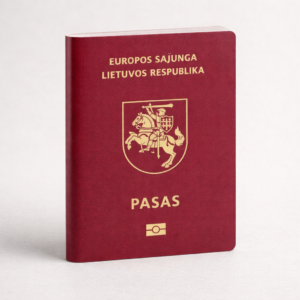
Who Must Apply for a Lithuanian Passport?
All individuals aged 16 or older who reside in Lithuania must have a valid passport or identity card. Upon request, passports and ID cards may also be issued to persons under 16.
In such cases, the application must be submitted by one of the parents (or guardians). If the application is submitted on behalf of a child older than 1 year, the child must also participate in the application process.
Validity of Lithuanian Identity Documents
Identity documents are issued for the following periods:
-
Up to 5 years old: maximum 2 years
-
5 to 16 years old: up to 5 years
-
16 to 75 years old: 10 years
-
75 years and older: 20 years
A Lithuanian citizen can apply for a passport or ID card at any Migration Department office, regardless of their registered place of residence.
Obtaining a Lithuanian Passport While Living Abroad
Lithuanian citizens living abroad must apply for a passport or identity card at the nearest Lithuanian embassy or consulate. It is also possible to travel to Lithuania and submit an application at the Migration Department.
Abroad, only the standard issuing deadline is usually available (no expedited services).
Replacing a Lithuanian Passport or Identity Card
To replace a passport or ID card (expired, lost, damaged, or with updated personal data), the old document must be submitted to the Migration Department or consulate. After processing, the old document is either returned or destroyed according to official procedures.
What to Do If a Lithuanian Passport or ID Card Is Lost?
If a document is lost, it must be reported immediately to:
-
the police;
-
the Migration Department;
-
a Lithuanian embassy or consulate (if abroad).
It is also possible to submit a report via the Electronic Services System. Once the report is received, the document is declared invalid.
Lithuanian Passport Issuance Deadlines and Fees (2026)
📅 Issuance Deadlines
-
Standard: within 1 month
-
Expedited: within 5 working days
-
Urgent: within 1 working day (if application is submitted by 12:00 in Vilnius or by 9:00 in other cities)
Note: If submitted later, the document can be collected the following working day after 11:00 at the Vilnius Migration Department (Vytenio St. 18).
💶 State Fees for Lithuanian Passport
| Document | Standard (1 month) | Expedited (5 working days) | Urgent (1 working day) |
|---|---|---|---|
| Lithuanian Passport | €50 | €100 | €200 |
Discounts: 50% for minors and pension-age individuals.
Lithuanian Identity Card Issuance Deadlines and Fees (2026)
📅 Issuance Deadlines
-
Standard: within 1 month
-
Expedited: within 5 working days
-
Urgent: within 1 working day
💶 State Fees for Identity Card
| Document | Standard (1 month) | Expedited (5 working days) | Urgent (1 working day) |
|---|---|---|---|
| Identity Card | €10 | €60 | €100 |
Discounts: 50% for minors and pension-age individuals.
Information is based on the fees applied by the Migration Department and current practice. Fees are set by the Government of the Republic of Lithuania and may be subject to change.

Name or Surname Change in the Lithuanian Population Register
Is it possible to change the spelling of your name or surname in the Lithuanian Population Register? Yes, it is possible if there is a valid reason and your personal data in another country—such as on your birth certificate or passport—is recorded differently than in the Lithuanian register. A common case is the desire to restore the original spelling, especially when the name or surname contains letters not found in the Lithuanian alphabet, such as “W” or “Q.”
When can you change your name or surname?
According to the Lithuanian Civil Status Acts Registration Law, changing your name or surname is allowed when:
- Your name or surname is recorded differently in documents of other countries;
- You are registered in the Lithuanian Population Register and are a Lithuanian citizen;
- Your name or surname was changed by a foreign authority and is supported by official documents;
- You want to restore the original historical or ethnic form;
- There is a spelling mistake in your name or surname;
- You want to unify the spelling with foreign documents for practical reasons (e.g., travel, international registration);
- Your name or surname is unusual or causes inconvenience, and you want a simpler or more international version.
Common case: Using the letter “W”
Persons with Dual citizenship or born and raised abroad often apply to change the spelling of their name or surname when it was adapted in the Lithuanian register according to Lithuanian language rules (e.g., changing “Warren” to “Varren”). If your birth certificate or passport shows the spelling with “W,” this spelling can be restored in the Lithuanian register.
Previously, the letter “W” was not allowed in official Lithuanian documents because it is not part of the Lithuanian alphabet. However, since 2021, legal amendments permit the use of certain foreign letters (e.g., W, Q, X) if justified by the person’s origin or foreign documents. This change allows restoring the original form of names and surnames in the Lithuanian register more accurately.
Required documents
To change the spelling of your name or surname, you will need to submit:
- An application for name/surname change;
- An identity document (Lithuanian passport or ID card);
- Foreign birth certificate (legalized or with Apostille);
- Foreign passport or other documents showing the desired spelling;
- Translations into Lithuanian (if documents are in another language);
- If your name or surname was officially changed abroad – a document confirming this change (e.g., court decision or civil status certificate).
Where to apply?
- Civil Registry Office (Civilinės metrikacijos skyrius);
- Migration Department (in some cases);
- Lithuanian embassy or consulate (if residing abroad).
- Online through the relevant electronic services, if available.
How long does the process take?
The processing time for a name or surname change depends on the specific situation, completeness of documents, and workload of the institutions. Typically, it takes from 1 to 3 months. If documents from abroad need legalization or translation, the process may take longer. In complex cases or if additional clarifications are required, it may take up to 6 months.
How much does it cost?
Official state fees for name or surname changes generally range from 10 to 50 euros, depending on the case. Additionally, costs may occur for translations or legal representation. Our team will provide you with a detailed fee quote tailored to your situation.
Our assistance
The Migration Law Center team helps clients worldwide with name or surname changes in the Lithuanian Population Register. We can assist you with:
- Consulting on the possibility to change your name/surname;
- Preparing applications and gathering necessary documents;
- Representing you before Lithuanian authorities;
- Ensuring a smooth process compliant with legal requirements;
- Providing official translations and document legalization if needed;
- Offering personalized support based on your specific situation and foreign country requirements.
Contact us
If you want to change your name or surname, please contact us by email at info@migration.lt or via the contact form on our website. We will reply and provide all necessary information and a quote.


Lithuanian archives are state institutions that collect, preserve, and manage documentary heritage. They ensure the long-term preservation and accessibility of important historical, legal, administrative, and cultural documents to the public.
LITHUANIAN STATE HISTORICAL ARCHIVES
This is the largest and most important repository of archival documents for the Lithuanian history from the 13th century up to the declaration of the Independence of Lithuania in 1918, which is located in Vilnius, Mindaugo Str. 8. The documents stored in the Lithuanian State Historical Archives are the following:
- A set of documents of offices of the Grand Duchy of Lithuania (GDL), which is comprised of funds of offices of GDL in the 15th-18th These are book microfilms of GDL Chancellery (Lithuanian Metrics) of the 15th-18th century, GDL King’s Manor Board (the 16th-19th century), GDL Chief Tribunal (the 15th-19th century), GDL Treasury Commission (the 16th-18th century), GDL War Commission (the 18th century) funds, funds of various land, castle, magdeburger, submarine, compromise, ex-division, caprine, confederative courts (the 15th-19th century).
- A complex of documents of offices of the Russian Empire, which consists of funds of the Tsarist Russia offices and organizations in Lithuania at the end of the 18th century – beginning of the 20th century and funds of commissions responsible for the liquidation of offices to be evacuated to the Soviet Russia. The following funds shall be distinguished by their significance: The Lithuanian Chief Board; Vilnius General Governor’s Chancellery; Vilnius Civilian Governor and the Suwalki Governor’s Chancelleries; authorities, courts, banks, treasury chambers, gendarmerie and military institutions operating in Vilnius, Augustow, Suwalki Governorates; Vilnius City Magistrate, Duma and Board; Meeting of deputies of nobles from the Vilnius Governorate; the nobles of Vilnius and Kaunas Governorate counties; year 1831 and 1863-1864 insurrectionists, political investigation commissions; Agriculture and State Property Board funds of the Vilnius and Kaunas Governorates. This complex of documents also embraces documents significant to the Lithuanian history of science, culture and education, accumulated in the funds of the Society of Friends of Science in Vilnius, Vilnius Education District, Vilnius University and other offices.
- A set of documents of offices relating to the period of occupation by Kaiser Germany (year 1915-1918) is probably the smallest in the Archives. It consists of four funds of offices which operated during the First World War, i.e. funds of the Commander of the Lithuanian Military Board and the German courts of Vilnius Region.
- A complex of documents of confessional institutions and communities includes funds of the Lithuanian religious communities, the oldest documents whereof are of the 15th The largest part of the complex is made up of funds of the Roman Catholic Church institutions: Vilnius, Telšiai (Žemaičiai), Seinai Roman Catholic Dioceses, Kaunas Metropolitan Archdiocese, document funds of Panevėžys Diocese Curia, churches, monasteries, church books of birth, marriage and death records of year 1599-1941. This complex also includes document funds from other confessions: Lithuanian Bishopric of Units, Vilnius Orthodox Bishopric and its separate Orthodox churches, Evangelical Reformers and Evangelical Lutherans, Judaism religious, Muslim (Tartar) and Karaim religious communities.
- Various documents are collected in thirty funds of private persons, families and kins, the documents whereof comprise the period from the 15th century up to year 1941. Various documents accumulated reflect the history of famous Lithuanian kins and families and persons of vital importance to that region, as well as their political and cultural activities. It is worth to mention the funds of families of dukes Radvilos (1416-1939), Sapiegos (1524-1830), Oginskiai (1447-1915), counts Pliateriai (1501-1905) and Tiškevičiai (1451-1915).
- A set of document collections (the 15th-20th century) consists of 10 funds kept in the Archives. One collection is made up by collectors and transferred to the archives as a set of documents, while others are formed in the Archives, by selecting one characteristic. Noteworthy are privileges and writings of the heads of Lithuania and Poland for the Vilnius Jesuit Academy and the Jesuit colleges of Vilnius and Gardin (1578-1767), documents of Vilnius University professors (1738-1858), a collection of various documents (1489-1936), and the collection of Rekašius (1579-1914).
- A complex of Civil Vital Records is comprised of civil status act books made up in civil registry offices of towns and districts which operated in Lithuania from 15 August 1940.
- Collections of microfilms of documents consist of microfilms of written historical sources of the 13th-20th century kept in the archives and libraries of Belarus, Russia, Latvia, Poland, Ukraine, Sweden.
LITHUANIAN CENTRAL STATE ARCHIVES
The Lithuanian Central State Archives is situated in Vilnius, O. Milašiaus Str. 21. The Archives preserves the following records:
- Written documents
- Documents of the institutions of the Republic of Lithuania (1918–1940): funds of the Lithuanian State Council, Council of Ministers, Chancellery of President, ministries and departments, diplomatic missions abroad, offices of county heads, municipalities, scientific, cultural, educational institutions and public organizations, personal funds of public figures and diplomats.
- Documents of the institutions of the Klaipėda region: funds of offices of President of Karaliaučius District Administration and President of Gumbinė District Administration, Klaipėda Magistrate and Šilutė County Administration, cadastral office of the Klaipėda Region and other funds.
- Documents of the institutions of South East Lithuania occupied by Poland in 1919–1939: funds of civil administrations of Eastern Lands, Provisional Management Commission of Central Lithuania, funds of Vilnius Magistrate, Stephen Bathory University, funds of organizations and schools.
- Documents relating to the Nazi occupation period (1941–1944): funds of Commissar-General Office in Kaunas, district commissariats, district administrations, police stations, municipalities, offices of county heads, prisons, and Jewish Ghetto in Vilnius.
- Documents relating to the Soviet occupation periods (1940–1941 and 1944–1990): funds of the Supreme Council Presidium of the Lithuanian SSR, Council of Ministers, ministries, boards and committees, editorial offices, organisations, personal funds of famous people in science and culture.
- Video and audio documents
- Photographic documents (from the 6th-7th decade of the 19th century until nowadays): photographs, negatives, photographic glass plates, albums, vignettes, slides, digital pictures; among old photographs are the works of A. Strauss, J. Čechavičius, A. Fleury, V. Zatorskis; stored photographic documents by J. Bulhakas, M. Smečechauskas, J. Karazija, J. Miežlaiškis, B. Buračas, A. Varnas, A. Mickus, V. Janiselis. The Soviet period is reflected in the photographic material of the Lithuanian News Agency ELTA and editorial offices of newspapers. More than 100,000 photographic documents of the Lithuanian Monument Restoration and Designing Institute are stored, including numerous collections of documentary photography works of J. Juknevičius, V. Kapočius. Modern-day documentary photographs are also being accumulated.
- Audio documents: the 20th-21th century sound recordings on gramophone records, magnetic tapes, audio cassettes, CDs. The oldest sound record is a series of songs performed by Lithuanian male quartet from Riga and recorded in Riga in 1907. There are also voice recordings of the presidents of Lithuania A. Smetona and K. Grinius, and of famous Lithuanian figures, audio recordings testifying the events of 1940 in Lithuania, a collection of recordings of Kaunas Radiophone (Radio of the Reich) programmes relating to the war period, public speeches of Lithuanian figures of the Soviet period, lectures, recordings of conventions of various organizations and official celebrations of state holidays. Recordings of Vilnius Recording Studio are also worth mentioning. Voice recordings of representatives of Lithuanian Reform Movement Sąjūdis, scientists, artists, politicians, Lithuanian expatriates, former political prisoners and deportees reflect the course of restoration of the Independence and the period of restored Independent Lithuania. Recordings of the programmes of Lithuanian radio service in Chicago, Los Angeles, Baltimore (USA), Adelaide, Melbourne (Australia) and recordings of the Voice of America Lithuanian Radio Service of 1951–1995 are kept in the Archives.
- Video documents: Accumulation of video recordings started in 1988. They were mostly video clips filmed by cameramen of the Archives. They testify to the activities of the National Liberation Movement Sąjūdis, the restoration of independence of Lithuania, the events of January 1991. There are also video recordings of reminiscences of the former deportees, political prisoners, partisans submitted to the Archives by the Lithuanian National Foundation, Inc. Video documents in the Archives have been created until these days.
- Cinematographic documents: from the 2nd decade of the 20th century up to these days. Copies of the films made by the brothers Lumieres in 1895 – the earliest films ever made – are preserved in the Archives. There is also a valuable collection of the Lithuanian newsreels from 1918 – 1940 and the works of the first Lithuanian cameramen – K. Lukšys, J. Milius, brothers Motūza-Beleckas, S. Vainalavičius, S. Uzdonas and J. Miežlaiškis. Cinematographic material relating to the World War II period, the largest part of collection of cinematographic documents consists of documentaries made in the Lithuanian Film Studios and Lithuanian Television in 1946 – 1990. The first Lithuanian feature films “Blue Horizon” (Žydrasis horizontas), “The Bridge” (Tiltas), “Ignotas Returned Home” (Ignotas grįžo namo), “The Turkeys” (Kalakutai), etc. are stored in the Archives. Funds are constantly supplemented with the latest cinematic works.
KAUNAS REGIONAL STATE ARCHIVES
The Archives is situated at Maironio Str. 28B, Kaunas. The following records are accumulated and stored therein:
- Documents of offices of the Kaunas Governorate which operated at the 19th century- the beginning of the 20th century;
- Documents of municipalities and their divisions, education and medical institutions, private enterprises of Kaunas city and its district in 1919-1944;
- Documents of the soviet state and local self-administration institutions, industry, agriculture, education, medical institutions, public organizations that functioned in the territories of Jonava, Kaišiadorys, Kaunas, Kėdainiai, Prienai, Raseiniai districts in 1944-1990;
- Documents of the state and municipal institutions, offices, enterprises, non-state organizations which have been operating during the period of 1990-2003 in the current territory of the Kaunas Region; funds of personals documents.
LITHUANIAN SPECIAL ARCHIVES
The Archives situated in Vilnius, Gedimino ave. 40, preserves documents of the State Security Committee of the Lithuanian SSR (NKGB-MGB-KGB), records of the Ministry of Interior of the Lithuanian SSR (NKVD-MVD), documents of the Lithuanian Communist Party (LKP), and documents of the first divisions of institutions, enterprises and organizations of the Lithuanian SSR, anti-Soviet and anti-Nazi resistance documents.
- The complex of documents of the State Security Committee of the Lithuanian SSR (KGB) accumulated documents of year 1940-1941, 1944-1990 of activities of the NKVD-NKGB-MVD-MGB-KGB Central Unit and Territorial Units of the Lithuanian SSR, operational and agency work documents, personnel and labor files of KGB agents, filtering and spec. inspection files of Lithuanian residents, criminal cases of persons who have been convicted of political motives, criminal files proceeded due to acts of terror committed against Soviet-party assets and institutions, SSRS OGPU-GUGB-NKVD-MGB-KGB territorial units and LSSR NKVD-NKGB-MVD-MGB-KGB counter-intelligence divisions, interwar Lithuanian state, society and culture figures, Catholic clergy, insurrectionists of year 1941, post-war Lithuanian partisans, heads of anti-Soviet organizations, dissidents, refugees from the USSR and operational retrieval cases for other persons who were considered as state criminals.
- Also, the Special Archives comprises criminal cases of persons of Lithuanian origin who were convicted in the Soviet Russia during the period of 1919-1939. Personal documents confiscated from arrested persons during searches at the 19th century – the beginning of the 20th century, “trophy” documents taken by security agents from the Lithuanian partisans, as well as documents of SSRS NKVD-MVD-KGB military units deployed in the Lithuanian SSR are also stored in this Archives.
Documents kept in the Archives reflect the entire activity of KGB in Lithuania during the period of 1940-1991, the objectives, structure and methods of the operation of the Soviet repression apparatus. Documents comprise information not only about Lithuanian people and events, the fight against the Lithuanian national underground, but also about Lithuanian communities in different countries of the world and more famous Lithuanian emigrants. Documents which were preserved in the former KGB Archives, which the KGB was not able to export to Russia or destroy in place, are also stored in this complex.
MIGRATION LAW CENTER

Lithuanian citizenship for persons, who departed from Lithuania to the United States of America, and for their descendants
Lithuanian emigrants are scattered all over the world. Since the end of the 19th century, Lithuania has been one of the Eastern European countries providing the largest number of emigrants to the world.
Four Major Waves of Lithuanian Emigration
In Lithuania, the following four waves of emigration from Lithuania are distinguished:
- economic emigration at the end of the 19th century and the beginning of the 20th century;
- Emigration from Lithuania during the period 1920-1940;
- Emigration of political refugees, who moved from Lithuania at the end of World War II (Displaced Persons);
- Contemporary emigration from Lithuania.
Four Major Waves of Lithuanian Emigration
| Wave Number | Time Period | Main Reason | Main Destination(s) |
|---|---|---|---|
| 1st Wave | Late 19th – Early 20th century | Economic, political, ideological | United States of America |
| 2nd Wave | 1920-1940 | Economic, political, historical | Canada, South America (Argentina, Brazil, Uruguay), Palestine, South Africa |
| 3rd Wave | End of WWII | Political refugees (Displaced Persons) | Germany, Austria, USA, Canada, Australia, South America |
| 4th Wave | Post-Independence (after 1990) | Economic | Various worldwide |
First Wave: Economic Emigration to the United States
A large number of residents of the Lithuanian territory emigrated from Lithuania to the United States of America after the 1831 and 1863 uprisings. Emigration of Lithuanians to the United States of America has mostly increased at the end of the 19th century and the beginning of the 20th century. The largest emigration of Lithuanians to the United States of America occurred on the 9th decade of the 19th century. Most frequently, this emigration was influenced by economic reasons (redundancy, weak industrial development), nevertheless, in certain cases the impact on emigration was also made by ideological, political and historical motives: Czarist policy of Russification, growing national movement, defeat of the Revolution in 1905, wars, etc. This massive emigration into the United States of America has continued from the 9th decade of the 19th century until World War I.
Second Wave: Interwar Emigration to South America and Beyond
During Lithuania’s independence period (1918-1940), Lithuania experienced a second huge wave of emigration. The causes of this emigration were also mostly economic, but in some cases historical and political. During this period, emigration of Lithuanians to the United States of America decreased due to immigration quotas introduced in the United States of America. During this period, the majority of Lithuanians emigrated to Canada and South America (Argentina, Brazil, Uruguay), a part (mostly persons of Jewish nationality) emigrated to Palestine and South Africa. On the 3rd-4th decade of the 20th century, up to 60% of all Lithuanian emigrants departed from Lithuania to South America.
Third Wave: Post-War Displacement and Political Emigration
At the end of World War II, Lithuania experienced the third wave of emigration, when political refugees began to depart from Lithuania. The reasons of such emigration were political and historical: World War II, its outcomes, Lithuanian occupation. The Lithuanians were forced to leave Lithuania and found themselves in refugee camps wherefrom they did not return to the occupied homeland. These persons were forced political emigrants.
Displaced Persons and Lithuanian Refugee Camps
After World War II, most Lithuanians gathered in German DP camps, also, in Austrian DP camps, where political refugees were protected by international organizations UNRA and IRO, which took care of the relief, placement of war refugees and later on of their further emigration. All persons who moved from their countries were named by the term Displaced Persons.
Lithuanian Diaspora Expansion After 1948
During years 1948-1950, Lithuanians from German and Austrian DP camps spread all over the world: a small part of Lithuanians left in Europe (the Great Britain, Germany, Austria), the huge wave of Lithuanian emigrants settled down in the United States of America, the rest part – in Canada, Australia, South American countries.
Fourth Wave: Modern Economic Emigration
From the restoration of Lithuanian independence up to these days, Lithuania has experienced emigration influenced by economic reasons.
Citizenship Loss and Dual Citizenship Opportunities
Lithuanians who emigrated from Lithuania used to acquire the citizenship of foreign country and their children, grandchildren and great-grandchildren in most cases became non-Lithuanian citizens. It should be noted that in accordance with Lithuanian legislation persons who emigrated from Lithuania before 11.03.1990 and who were citizens of Lithuania before 15.06.1940, as well as desdendants of such persons (children, grandchildren and great-grandchildren), may reinstate citizenship of Lithuania without renouncing the held citizenship of foreign country (Dual citizenship).
Requirements to Reinstate Lithuanian Citizenship Without Renunciation
In such case, in order to reinstate Lithuanian citizenship without renouncing the held citizenship of foreign country (Dual citizenship), it is necessary to prove the following main circumstances:
- Lithuanian citizenship before 15.06.1940;
- Departure from Lithuania before 11.03.1990 (1918-1990);
- Other circumstances (relationship, change of name, surname, etc.).
Legal Grounds for Dual Citizenship Under Lithuanian Law
Lithuanian Law on Citizenship stipulates that persons who held citizenship of Lithuania before 15.06.1940 and their descendants, who have not acquired citizenship of Lithuania before the entry into force of this law, shall have an indefinite right to reinstate Lithuanian citizenship, irrespective of whether they are permanently resident in Lithuania or in any other state.
Article 7 of the Lithuanian Citizenship Law
| Condition | Eligibility for Dual Citizenship |
|---|---|
| Person left Lithuania before 11.03.1990 (exile or flight) | Eligible to restore citizenship without renouncing other citizenship |
| Descendants of the above persons | Also eligible |

Lithuanian Citizenship for Canadians of Lithuanian Descent
Lithuanian citizenship for Canadians of Lithuanian descent offers an opportunity to reconnect with your heritage and obtain European Union citizenship. Many Canadians with Lithuanian roots are eligible to restore (reinstate) Lithuanian citizenship based on their ancestry, particularly if their parents, grandparents, or great-grandparents emigrated from Lithuania before 1990.
Due to historical events, including World War II and the occupation of Lithuania, a large number of Lithuanians settled in Canada. Today, their descendants may have the right to reclaim Lithuanian citizenship without renouncing their current citizenship, provided they meet the legal requirements and can prove their lineage.
History of Lithuanian Emigration
Lithuania has experienced four major waves of emigration. Emigration of Lithuanians was influenced by different causes, including economic, historical, and political factors.

Main Waves of Emigration from Lithuania
The major waves of emigration from Lithuania are the following:
- Economic emigration at the end of the 19th century and the beginning of the 20th century;
- Emigration from Lithuania during the period 1920–1940;
- Emigration of political refugees at the end of World War II (Displaced Persons);
- Contemporary emigration from Lithuania.
Lithuanian Emigration to Canada
A significant wave of Lithuanian emigration to Canada occurred during the second and third periods.
During 1920–1940, emigration to Canada was mainly driven by economic reasons, although in some cases political and historical factors also played a role.
At the end of World War II, emigration was strongly influenced by historical and political circumstances, including the war, its consequences, and the occupation of Lithuania.
Displaced Persons and Post-War Migration 
Lithuanians who fled as political refugees were placed in DP (Displaced Persons) camps, primarily in Germany and Austria. These camps were administered by international organizations such as UNRRA and IRO, which were responsible for relief, protection, and resettlement.
From these camps, many Lithuanians emigrated to independent countries, including Canada. All such individuals were referred to as Displaced Persons.
Global Resettlement of Lithuanians (1948–1950)
Between 1948 and 1950, Lithuanians from DP camps dispersed across the world:
- Some remained in Europe (United Kingdom, Germany, Austria)
- A large number settled in the United States
- Others emigrated to Canada, Australia, and South America
Lithuanian Citizenship for Descendants in Canada
Lithuanians who emigrated to Canada typically acquired Canadian citizenship. Their children, grandchildren, and great-grandchildren also became Canadian citizens.
To maintain a legal connection with Lithuanian emigrants, Lithuania established the legal framework for restoring (reinstatement) Lithuanian citizenship.
Individuals of Lithuanian descent residing in Canada have the opportunity to apply for reinstatement of Lithuanian citizenship. This process recognizes the ancestral ties and cultural heritage of those who can demonstrate their Lithuanian lineage. Eligible applicants must provide documentation supporting their descent, thereby facilitating the reconnection with their heritage and enabling them to participate fully in Lithuanian society. It is essential to adhere to the legal requirements set forth by Lithuanian authorities to ensure a smooth application process.
Lithuanian citizenship by descent
Lithuanian citizenship by descent is a significant opportunity for Canadians with Lithuanian ancestry to reconnect with their heritage. This process allows individuals to obtain citizenship based on their Lithuanian lineage, fostering a deeper connection to their family’s roots. Applicants must provide appropriate documentation to establish their descent, ensuring a smooth application process. Embracing Lithuanian citizenship by descent not only honors one’s heritage but also opens doors to the benefits of EU citizenship.
Eligibility for Restoration of Lithuanian Citizenship
A person may be eligible to restore (reinstate) Lithuanian citizenship (while retaining another citizenship) if:
- They held Lithuanian citizenship before June 15, 1940
- They departed from Lithuania before March 11, 1990
This right also extends to their descendants (children, grandchildren, great-grandchildren).
Legal Basis for Dual Citizenship
According to the Lithuanian Law on Citizenship, individuals who held Lithuanian citizenship before June 15, 1940, and their descendants, have an indefinite right to restore Lithuanian citizenship, regardless of their current place of residence.
Cases Where Dual Citizenship is Allowed
Article 7 of the Lithuanian Law on Citizenship provides that a person may hold Lithuanian citizenship and citizenship of another state (Dual citizenship) simultaneously if they:
- Departed from Lithuania before March 11, 1990, or
- Are a descendant of such a person
Key Requirements to Restore Lithuanian Citizenship
To qualify for the restoration of Lithuanian citizenship, applicants must provide proof of their Lithuanian ancestry, demonstrating a direct lineage to a Lithuanian citizen. Additionally, individuals are required to present valid identification and any relevant documentation that supports their claim. It is essential to adhere to the legal procedures established by the Lithuanian government, including the submission of applications within designated timeframes. Finally, applicants should be prepared to fulfill any additional requirements set forth by the authorities during the review process.
In order to restore Lithuanian citizenship without renouncing another citizenship, it is necessary to prove:
- Lithuanian citizenship before June 15, 1940
- Departure from Lithuania before March 11, 1990
- Additional circumstances (family relationship, name or surname changes, etc.)
Free Legal Assessment for Lithuanian Citizenship Eligibility
Free Legal Assessment: Lithuanian Citizenship Eligibility
The lawyers of MIGRATION LAW CENTER offer a free legal Assessment (analysis) of your options for obtaining Lithuanian citizenship. To receive a detailed analysis, please complete an application form by clicking this link – FORM.
Following a thorough legal analysis of your options that would allow to obtain Lithuanian citizenship, our lawyers will provide you with a written response (analytical results) regarding your options of obtaining Lithuanian citizenship and further requirements as well as procedure processes.
Can I get free legal advice on Reinstatement of Lithuanian citizenship?
Yes, to learn more about Reinstatement of Lithuanian citizenship, the process of preparing and submitting documents to competent state institutions, or to order legal assistance, please contact us:
• Email: info@migration.lt
• Phone: +37068563053


The Constitutional Court of the Republic of Lithuania has begun to hear the case regarding the retention of dual citizenship for persons who departed from Lithuania to live in other states after 11 March 1990. The Constitutional Court of the Republic of Lithuania will decide whether a right of such persons to have dual citizenship can be established by law, and whether they will have to choose a citizenship of the state they want to reserve.
The Constitution of the Republic of Lithuania hereby states that nobody can be both a citizen of Lithuania and of other state at the same time, i.e. to have dual citizenship, except for individual cases provided for by law. The majority of such cases are intended for persons who moved from Lithuania until 11 March 1990. For those persons who left Lithuania later, already after the restoration of independence, and who acquired citizenship of other state, even international obligations do not form the basis for retention of the Lithuanian citizenship.
Individual and exceptional cases when a dual citizenship is permitted in Lithuania are stipulated in Article 7 of the Law on Citizenship of the Republic of Lithuania:
A citizen of the Republic of Lithuania may be a citizen of another state at the same time, provided he meets at least one of the following conditions:
1) he has acquired citizenship of the Republic of Lithuania and citizenship of another state at birth;
2) he is a person who was exiled from occupied Lithuania before 11 March 1990;
3) he is a person who departed from Lithuania before 11 March 1990;
4) he is a descendant of a person referred to in subparagraph 2 or 3 of this Article;
5) by virtue of marriage to a citizen of another state he has ipso facto acquired citizenship of that state;
6) he is a person under 21 years of age, provided he was adopted by citizens (citizen) of Lithuania before reaching 18 years of age and, as a result of the adoption, acquired citizenship of the Republic of Lithuania;
7) he is a person under 21 years of age, provided he, being a citizen of the Republic of Lithuania, was adopted by citizens (citizen) of another state before reaching 18 years of age and, as a result of the adoption, acquired citizenship of that state;
8) he has acquired citizenship of the Republic of Lithuania by way of exception while being a citizen of another state;
9) he is a person who preserved Lithuanian citizenship or the Lithuanian citizenship thereof was restored for his outstanding merits to the Republic of Lithuania;
10) he has acquired citizenship of the Republic of Lithuania while having refugee status in the Republic of Lithuania.
The Seimas of the Republic of Lithuania hereby declares that this article limits the acquisition of dual citizenship for persons of younger generation, who moved from Lithuania after 11 March 1990.
Nowadays when after the restoration of independence of Lithuania and after the entry of Lithuania to the European Union, the emigration of Lithuanians to other countries has increased, consequences of emigration began to be the issues of concern, which also embraces a number of increased mixed marriages. For a long time, the Constitutional Court of the Republic of Lithuania has held the opinion that dual citizenship cannot be a widespread phenomenon, and has limited the right of the Seimas of the Republic of Lithuania to amend this provision by law. Previously, the Constitutional Court of the Republic of Lithuania had explained that such extension of limits of dual citizenship would contradict to the Constitution of Lithuania and this may be made only by way of referendum.
Many persons believe that even though the free movement of Lithuanian citizens in the countries of the European Union is encouraged, however, the provisions of the Constitution of Lithuania restrict this freedom of Lithuanian citizens without entitling to simultaneously acquire citizenship of another state.
The issue of legalization of dual citizenship has arisen and become most relevant after the withdrawal of the United Kingdom from the European Union. The Seimas of Lithuania became scared that those Lithuanians who live in the United Kingdom and have their families therein, would choose passports of the Great Britain and therefore Lithuania will lose a large part of its citizens.
Having in mind the fear of such consequences, the Seimas of Lithuania has recently appealed to the Constitutional Court of Lithuania with a petition to alter by law the provision of the Constitution of Lithuania and to legalize an acquisition of dual citizenship for persons who departed from Lithuania after the restoration of independence to live in a state of the European Union or NATO. It is maintained that this cannot be only rare exceptions and the emigrated young generation must be allowed to have dual citizenship.
Nevertheless, the Constitutional Court of Lithuania still persists that limits of dual citizenship can only be extended by way of referendum. The Constitutional Court of Lithuania asserts that it is impossible to change by law the provision of the Constitution of Lithuania regarding the legalization of dual citizenship for persons who departed from Lithuania after the restoration of independence to a state of the European Union or NATO. If the Constitutional Court of Lithuania will not change its position – both parliamentarians and emigrated Lithuanians, who are afraid of the lack of votes for the alteration of the Constitution of Lithuania, will have to be disappointed. The referendum must be approved by more than a half of the citizens who are entitled to vote and entered on the electoral registers.
The studies have revealed that 60 percent of Lithuanian residents agree that emigrants, who departed from Lithuania after 1990, would be allowed to have dual citizenship (according to a research ordered by the news agency BNS, a survey carried out by the company RAIT in April).
It is planned that the referendum regarding provisions of the Constitution of Lithuania will be held in 2019.
MIGRATION LAW CENTER
The dual citizenship in Lithuania is possible only in certain exceptional cases provided for by law. Such exceptional cases are determined in Article 7 of the Law on Citizenship of the Republic of Lithuania. It is established by Article 7 of the Law on Citizenship of the Republic of Lithuania that a citizen of the Republic of Lithuania may be a citizen of another state at the same time, provided he meets at least one of the following conditions:
1) he has acquired citizenship of the Republic of Lithuania and citizenship of another state at birth;
2) he is a person who was exiled from occupied Lithuania before 11 March 1990 and acquired citizenship of another state;
3) he is a person who departed from Lithuania before 11 March 1990 and acquired citizenship of another state;
4) he is a descendant of a person referred to in subparagraph 2 or 3 of this Article;
5) by virtue of marriage to a citizen of another state he has ipso facto acquired citizenship of that state;
6) he is a person under 21 years of age, provided he was adopted by citizens (citizen) of Lithuania before reaching 18 years of age and, as a result of the adoption, acquired citizenship of the Republic of Lithuania;
7) he is a person under 21 years of age, provided he, being a citizen of the Republic of Lithuania, was adopted by citizens (citizen) of another state before reaching 18 years of age and, as a result of the adoption, acquired citizenship of that state;
8) he has acquired citizenship of the Republic of Lithuania by way of exception while being a citizen of another state;
9) he has acquired citizenship of the Republic of Lithuania while having refugee status in the Republic of Lithuania.
Person exiled from the occupied Republic of Lithuania before 11 March 1990 means a person who held citizenship of the Republic of Lithuania before 15 June 1940 or his descendant, who were forcibly expelled from Lithuania by decisions of institutions or courts of occupation regimes in the period from 15 June 1940 to 11 March 1990 for reasons of resistance to occupation regimes, political or social reasons or reasons of origin.
Person who fled Lithuania before 11 March 1990 means a person who held citizenship of the Republic of Lithuania before 15 June 1940 or his descendant, who left the current territory of the Republic of Lithuania before 11 March 1990 to reside permanently in another state, if their permanent residence on 11 March 1990 was outside Lithuania.
Descendant of a citizen of the Republic of Lithuania means a child, grandchild or great-grandchild of a person who held citizenship of the Republic of Lithuania before 15 June 1940.
On the basis of the aforementioned provisions of the Law on Citizenship of the Republic of Lithuania, which provide for exceptional cases of possible dual citizenship, persons who moved from Lithuania after the restoration of independence after 11 March 1990 and acquired foreign citizenship, can retain dual citizenship only in exceptional cases. A person who departed from Lithuania and acquired a citizenship of other state, must inform about the acquisition of foreign citizenship the Migration Department under the Ministry of the Interior of the Republic of Lithuania, territorial police station or Lithuanian diplomatic mission, or consular post, no longer than within two months after the acquisition of foreign citizenship.
After the receipt of notification on the acquisition of foreign citizenship, an issue of loss of citizenship of the Republic of Lithuania shall be considered. If it is determined that there are no grounds for preserving dual citizenship a person loses citizenship of Lithuania.
A dual citizenship can be preserved after having determined exceptional cases of possible dual citizenship, whereof stipulated in Article 7 of the Law on Citizenship of the Republic of Lithuania.
It should be noticed that while assessing the issue of dual citizenship, the moment of acquiring foreign citizenship in each particular case is significant. If the person has acquired foreign citizenship within a period from 01 January 2003 to 15 November 2006, the loss of citizenship of the Republic of Lithuania shall not be applicable and the person preserves dual citizenship, i.e. the citizenship of Lithuania and the acquired foreign citizenship (applies to descendants of a person who held Lithuanian citizenship before 1940 06 15 and for persons of Lithuanian descent).
MIGRATION LAW CENTER
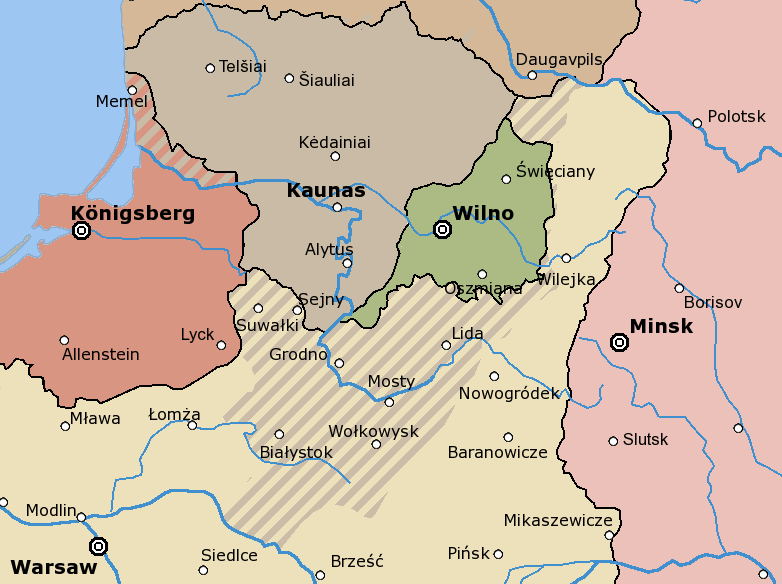
According to 12 July 1920 the Soviet–Lithuanian Peace Treaty, the Vilnius region has been recognized for Lithuania. Since the moment of signing of the Suwalki Treaty, Lithuania has gained legal sovereignty over the region of Vilnius. Residents of the Vilnius region who met the requirements of Article 1 of the Provisional Law on Lithuanian Citizenship and the requirements of Article 6 of the Soviet–Lithuanian Peace Treaty were considered to be citizens of Lithuania.
On 09 October 1920, Poland having broken the Lithuanian-Polish Treaty signed in Suwałki on 07 October 1920, occupied the Vilnius region. This occupation de facto became an annexation.
Having occupied the Vilnius region and started to actually control it, Poland has begun to consider its residents as its citizens and “did not allow them to be seen as citizens of a foreign country”.
The legal situation arose when, basically, Lithuania considered the same people to be Lithuanian citizens, while Poland considered them to be citizens of Poland.
According to 10 October 1939 Agreement on the transmission of Vilnius and Vilnius Region to the Republic of Lithuania and the Soviet–Lithuanian Mutual Assistance Treaty, Vilnius and the Vilnius region were transferred to Lithuania.
Whilst considering the issue of citizenship of the Vilnius region residents, the provision was followed that some of the residents of this region are citizens of Lithuania and the fact of their citizenship of Lithuania is only required to be stated. Lithuanian citizenship is not granted to these persons – after the actual return of the Vilnius region to the composition of the Lithuanian state, residents of this region regained Lithuanian citizenship. Other residents of this region are considered to be citizens of another state or as stateless persons.
Which residents of the Vilnius region are considered to be Lithuanian citizens, was established in the introductory law on the management of Vilnius city and its area adopted on 27 October 1939. Article 3 of this law provided for the following:
The residents of Vilnius city and its area, who on the day of the changeover of the documents of ratification of the Soviet–Lithuanian Peace Treaty on 12 July 1920 were considered to be citizens of Lithuania and on the day of the entry into force of this Law had a place of residence in the city of Vilnius or in its area, shall be considered to be Lithuanian citizens.
The wives of these Lithuanian citizens and their children under the age of 21 are also considered to be citizens of Lithuania; children over the age of 21 of these persons are considered to be Lithuanian citizens, provided they had a place of residence in the city of Vilnius or its area on the day of the entry into force of this Law”.
Therefore, according to the specified law, residents of Vilnius and its area were considered to be citizens of Lithuania, who: 1) in accordance with Article 6 of the Soviet–Lithuanian Peace Treaty of 14 October 1920, were considered to be citizens of Lithuania and 2) on 27 October 1939 had a permanent place of residence in the city of Vilnius or its area.
It should be noted that according to the introductory law mentioned herein, on 27 October 1939 the person should have lived not in that territory of the Vilnius region, which was defined in 12 July 1920 the Soviet–Lithuanian Peace Treaty, but in the “narrower” territory of the Vilnius region, which was established in the agreement signed between Lithuania and Russia on 10 October 1939 and in 1939 October 27 the Supplementary Protocol between the Republic of Lithuania and the Union of Soviet Socialist Republics. “Persons who come from areas not covered by the last agreement with S.S.S.R. not recognized as Lithuanian citizens. The place of permanent residence of a person was considered to be “where one lives due to his/her service, occupation, craft or real estate or has a home farm” (Note 1 of Article 9 of the Passport Statutes).
The residents of Vilnius city and its area were able to prove Lithuanian citizenship by documentation specified in the amendment to Passport Statutes, adopted by the Seimas on 20 November 1939. Such documents included acts of civil status (for example, birth certificates, baptismal certificates, marriage metrics, children’s legalization decisions); documents on recording in the villages, cities or caste communities (for example, books of general population lists, marks on recording into the community in old Russian passports); documents about the time spent in the city of Vilnius or in its area, as well as documents evidencing a permanent residence in the city of Vilnius or in its area on 06 October 1920 and on 27 October 1939.
Citizenship issues of the Vilnius region residents were resolved by issuing passports to them.
On 03 May 1940, the Seimas amended the introductory law on the management of Vilnius city and its area and determined that “Citizens of Lithuania are also those residents of the city of Vilnius and its area who, at any time until 01 August 1914 had a residence in the city of Vilnius and its area, and real estate or work, and who lived in that area for at least five years during the time span from 06 August 1920 to 27 October 1939, if they had a place of residence in that area on 06 August 1920 and on 27 October 1939”.
Therefore, according to the specified amendments to the law, the right to be treated as Lithuanian citizens was acquired by those persons who were related to the Vilnius region until 01 August 1914. They were not required to have been living in Lithuania for at least ten years before 1914, as provided for in Article 6 of the Soviet–Lithuanian Peace Treaty. On the other hand, the law has introduced new additional conditions, for example: the requirement to live in the Vilnius region and on 06 August 1920 and on 27 August 1939, “in other words, during the period of the largest drop in the population due to war, evacuation and call-up.”
On 15 June 1940, the Vilnius region was occupied by Russia.
Citizens of Lithuania according to the Soviet–Lithuanian Peace Treaty of 12 July 1920
The Soviet–Lithuanian Peace Treaty of 12 July 1920 also provided for which persons are recognized as citizens of Lithuania.
Part 1 and 2, Article 6 of the Soviet–Lithuanian Peace Treaty established the following:
“Persons who lived on the territory of Lithuania during the day of ratification of this Treaty and who themselves or their parents permanently lived in Lithuania or were registered in the villages, towns or caste communities in the territory of Lithuania, as well as persons who had been living in Lithuania for at least the last ten years before 1914, having the permanent job there, leaving former civilians and military servicemen, not of the Lithuanian descent, with their families – at the same time recognized as citizens of the state of Lithuania.
Persons of the same category who, during the ratification time of this agreement, lived in the territory of a third country, but have not been naturalized there, were equally recognized as citizens of Lithuania”.
Thus, Article 6 of the Peace Treaty distinguishes four categories of persons who are treated as citizens of Lithuania:
- persons who themselves or their parents permanently lived in Lithuania;
- persons who were recorded in villages, towns or caste communities in the territory of Lithuania;
- persons who have been living in Lithuania for at least the last ten years before 1914 and had the permanent job thereto;
- persons belonging to the abovementioned categories of persons who, when ratifying this Treaty, lived in the territory of a third country and have not acquired citizenship of that state by way of
Persons referred to in Article 6 of the Peace Treaty may have resided either in the territory of Lithuania or in the territory of a third state at the date of ratification of this Treaty.
Persons who lived in the territory of Lithuania were immediately considered to be Lithuanian citizens. Persons who lived in the territory of Russia were considered to be Lithuanian citizens only when they opted for Lithuanian citizenship under the conditions laid down in the Treaty. Persons who lived in the territory of a third state were considered to be Lithuanian citizens only if they were not naturalized in that country.
It should be noted that the Supreme Administrative Court of Lithuania, when investigating the administrative case No A11-421 / 2005 on 19 April 2005 indicated that “the territory of Lithuania (Vilnius region) was occupied by Poland in 1920-1939, therefore, persons lived in it during this period could not objectively be considered Lithuanian citizens and accordingly could not receive documents confirming this citizenship. The specifics of this situation was discussed in the introductory law on the management of Vilnius city and its area (which came into force on 27 October 1939), Article 3 whereof indicated that residents of Vilnius and its area who on the day of the changeover of the documents of ratification of the Soviet–Lithuanian Peace Treaty on 12 July 1920 and on the day of the entry into force of this law, had a place of residence in the city of Vilnius or in its area, are considered to be Lithuanian citizens. According to this article of the law, children of such persons under the age of 21 (on the day of entry into force of the law) were also considered to be Lithuanian citizens. It should be noted that, according to this legal norm, a circumstance is significant whether on the day of the changeover of the documents of ratification of the Soviet–Lithuanian Peace Treaty on 12 July 1920 residents indicated therein may be considered to be citizens of Lithuania. Therefore, when resolving this issue, it is necessary to follow the relevant provision of the Provisional Law on Lithuanian Citizenship (09 January 1919) in force in Lithuania at that time regarding what is considered to be a citizen of Lithuania. According to Article 1 of the latter law, Lithuanian citizens were considered to be persons whose parents and grandparents lived in Lithuania from the old days and who themselves have always been living in Lithuania.
Article 1 of the Provisional Law on Lithuanian Citizenship of 09 January 1919 stipulated that “Citizens of Lithuania shall be: 1) persons whose parents or grandparents lived in Lithuania from the old days and who themselves have always been living in Lithuania; 2) children of persons indicated in section 1 who, even though did not always live in Lithuania, but returned to live there; 3) persons who have lived in Lithuania for at least ten years before 1914 and who had: a) their own real estate, b) or permannet job; 4) children of the Lithuanian citizen; 5) his wife or widow; 6) children of unmarried Lithuanian citizen, provided they were not accepted by a foreigner as his children; 7) foreigners newly accepted as Lithuanian citizens”.
The amendment to Article 3 of the introductory law on the management of Vilnius city and its area adopted on 03 May 1940 stipulates that “Citizens of Lithuania are also those residents of the city of Vilnius and its area who, at any time until 01 August 1914 had a residence in the city of Vilnius and its area, and real estate or work, and who lived in that area for at least five years during the time span from 06 August 1920 to 27 October 1939, if they had a place of residence in that area on 06 August 1920 and on 27 October 1939”.
MIGRATION LAW CENTER
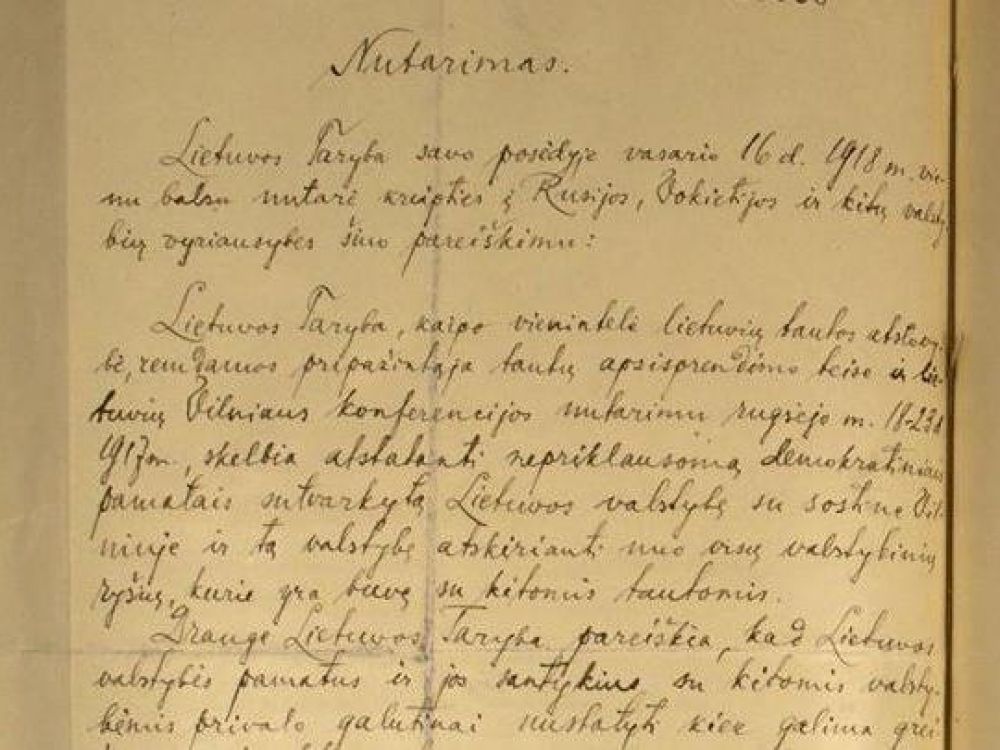
According to the Provisional Law on Lithuanian Citizenship of 09 January 1919, citizens of Lithuania shall be deemed to be: “1) persons, whose parents and grandparents have lived in Lithuania since ancient times and who themselves always live in Lithuania; 2) children of persons indicated in the first subsection, who even though did not always live in Lithuania, but returned to live thereto; 3) persons who have lived in Lithuania no less than ten years before 1914 and who had: a) either their own real property, b) or permanent job; 4) children of a citizen of Lithuania; 5) his wife or widow; 6) children of a not married citizen of Lithuania, if they have not been accepted by the alien as his children”.
Persons were not naturally considered as citizens of Lithuania, who “even had a permanent job, but their job was solely serving for the Russian State, i.e. Russian clerks”.
Under the law, persons were treated as citizens of Lithuania who have lived in Lithuania no less than ten years before 1914 and who had either their own real property, or job. It was not stipulated in the law what was meant by “to live in Lithuania no less than ten years”. When applying the law, a condition “to live in Lithuania no less than ten years before 1914” was explained as a necessity to live without a break in Lithuania during years 1904-1914. The person was not treated as living in Lithuania for the last decade before 1914, if he “only had the purpose to study”. Russian clerks indicated in the law (besides, the concept of “clerk” was explained as embracing both civilians and soldiers) were not entitled to the citizenship of Lithuania, “if they lived until 1914 and have lived without a break for the last ten years”. Nevertheless, if former Russian clerks “had a real property in Lithuania during that last decade, then they could be treated as citizens of Lithuania”. The provision of law regarding Russian clerks was interpreted as having “in mind only such former Russian clerks, who are not natives of Lithuania”.
Under the Statutes of Passports which entered into force on 01 July 1919, each citizen of Lithuania who reached 17 years old had to have a passport. The passport could not be issued to a non-Lithuanian citizen.
A person willing to obtain a passport had to “attest his personality: either by submitting a passport issued by the German occupational government or other documents, or witnesses, who were known to the issuing person”.
New Statutes of Passports were adopted on 05 December 1919, wherein differently from the previous ones it was not identified with which documents a person can prove that he is a citizen of Lithuania. Furthermore, it was not provided for that in such cases when a person is not able to submit documents evidencing his Lithuanian citizenship, he can rely on testimonies of witnesses. In accordance with the Statutes of Passports, passports were issued on the basis of Instruction of the Ministry of the Interior. It can be concluded thereof that the minister of the interior had to establish the procedure and ways of evidencing citizenship. “This instruction was very liberal and found many ways of proof”, also, including the fact that statements of two wittnesses were sufficient in order to prove the citizenship and that the applicant of passport is from Lithuania.
By Law of 22 November 1921, the Statutes of Passports were replaced and amended. It was determined that passports were issued only to those persons who will prove their Lithuanian citizenship with the following documents: “a) old Russian passports; b) Ob-Osto passports; c) common books of population lists of Russian times; d) birth or marriage certificates”.
It was established in the Statutes of Passports that each citizen of Lithuania must “obtain passports” until 31 March 1922. From this day “all other passports and personal testimonials shall be ceased”. Although a deadline of passport acquisition was extended several times, but a number of persons who “needed to obtain passport and clarify their citizenship” constantly increased with exiles from Russia.
MIGRATION LAW CENTER
The independent state of Lithuania was restored on 16 February 1918.
The citizenship of Lithuania during years 1919-1940 was regulated by Lithuanian laws, legal acts issued by public authorities and Lithuanian international contracts.
Lithuanian laws and legal acts issued by public authorities shall be referable to: 1) Constitution of Lithuania; 2) Provisional Law on Citizenship of Lithuania of 09 January 1919, Law on Citizenship of Lithuania of 08 August 1939; 3) Introductory Law on the Management of Vilnius City and its Area of 27 October 1939; 4) Statutes of Passports; 5) legal acts issued by the minister of the interior and by both the minister of the interior and minister of justice, and explanations on issues of citizenship; 6) circulars of the Department of Civil Rights Protection and the Department of Administration under the Ministry of the Interior, as well as explanations on issues of citizenship; 7) circulars of the Ministry of Foreign Affairs on issues of citizenship.
Lithuanian international contracts regulating relations of citizenship shall be referable to the following contracts: Soviet-Lithuanian Peace Treaty (signed on 12 July 1920); Treaty on the Establishment of the Procedure for Opting for Lithuanian Citizenship between Lithuania and Russia (signed on 28 June 1921); Treaty on the Establishment of the Procedure for Opting for Lithuanian Citizenship between Lithuania and Ukraine (signed on 28 January 1921); Convention between Latvia and Lithuania regarding the Rights of the Citizens (signed on 14 May 1921); Declaration concerning the Protection of Minorities in Lithuania of 12 May 1922; Convention of the Klaipėda Region (signed on 08 May 1924); Agreement regarding the Execution of the Convention between Lithuania and Germany on the Klaipėda Region of 08 May 1924, Articles 8-10 (signed on 10 February 1925); Treaty on the Transfer of Klaipėda Region between the Government of Lithuania and the Government of Germany (signed on 22 March 1939); Treaty between the Republic of Lithuania and the German Reich on Citizenship of the Residents of the Town of Klaipėda (signed on 08 July 1939); Treaty on Naturalisation and Military Service between the Republic of Lithuania and United States of America (concluded on 18 October 1937).
The first legal act which regulated citizenship of Lithuania was the Provisional Law on Citizenship of Lithuania adopted by the Cabinet of Ministers on 09 January 1919.
MIGRATION LAW CENTER

The Soviet-Lithuanian Peace Treaty of 12 July 1920 also provided for which persons were recognized as Lithuanian citizens.
It has been established in part 1 and 2 of Article 6 of the Soviet-Lithuanian Peace Treaty that:
“Persons who lived on the territory of Lithuania during the day of ratification of this Treaty and who themselves or their parents permanently lived in Lithuania or were registered in the village, town or caste communities in the territory of Lithuania, as well as persons who had been living in Lithuania for at least the last ten years before 1914, having the permanent job there, leaving former civilians and military servicemen, not of the Lithuanian descent, together with their families shall be ipso facto recognized as citizens of the state of Lithuania.
Persons of the same category who, while ratifying this Treaty, live in the territory of a third state but have not been naturalized there, are equally recognized as citizens of the state of Lithuania”.
Article 6 of the Soviet-Lithuanian Peace Treaty distinguished four categories of persons who were treated as citizens of Lithuania:
- persons who themselves or their parents permanently lived in Lithuania;
- persons who were recorded in village, town or caste communities in the territory of Lithuania;
- persons who have been living in Lithuania for at least the last ten years before 1914 and had the permanent job thereto;
- persons belonging to the abovementioned categories of persons who, when ratifying this Treaty, lived in the territory of a third country and have not acquired citizenship of that state by way of naturalization.
Persons referred to in Article 6 of the Soviet-Lithuanian Peace Treaty may have resided either in the territory of Lithuania or in the territory of a third state at the date of ratification of this Treaty.
Persons who lived in the territory of Lithuania were immediately considered to be Lithuanian citizens. Persons who lived in the territory of Russia were considered to be Lithuanian citizens only when they opted for Lithuanian citizenship under the conditions laid down in the Treaty. Persons who lived in the territory of a third state were considered to be Lithuanian citizens only if they were not naturalized in that country.
The Provisional Law on Lithuanian Citizenship and the Soviet-Lithuanian Peace Treaty were considered to be sources of law for citizenship.
MIGRATION LAW CENTER

From 2025 01 21 Documents Issued in Russia Require Apostille in Lithuania. An increasing number of Lithuanian residents face situations where documents issued in Russia need to be submitted for use in Lithuania. Whether it is a marriage certificate, birth certificate, notarized confirmation, or another official document, such documents often require additional certification – an Apostille.
New Requirements Effective January 21, 2025
Please note that starting January 21, 2025, a new requirement will take effect: all documents issued in Russia must be certified with an Apostille to be used in Lithuania. This is due to the termination of the bilateral agreement between Lithuania and Russia, which regulated the mutual recognition of documents without additional legalization. According to the latest legal acts of Lithuania, an Apostille is now mandatory to ensure the authenticity and legal recognition of Russian documents.
What is an Apostille?
An Apostille is an international certificate that verifies the authenticity of a document. This process is regulated by the 1961 Hague Convention, which simplified the recognition of documents between different countries. Both Lithuania and Russia are members of the Hague Convention, making apostillation the primary method for using documents internationally.
For more detailed information about the process of document legalization and certification by Apostille, please refer to the section Legalization of documents; certification of documents by an Apostille
When is an Apostille Required?
Documents issued in Russia must be apostilled if they are to be used in Lithuania. For example:
- Personal documents: birth, marriage, or death certificates.
- Legal documents: notarized confirmations, court rulings.
- Business documents: certificates of legal entity registration, contracts.
It is important to note that Apostilles cannot be applied to documents issued by private individuals or organizations. They are only applicable to official documents issued by state institutions or notaries.
Where to Obtain an Apostille?
In Russia, Apostilles are issued by the relevant state institutions:
- For court documents – through the Ministry of Justice.
- For notarized documents – through the Federal Chamber of Notaries.
- For educational documents – through the Ministry of Education.
The Apostille process usually takes from a few days to several weeks, depending on the institution and type of document.
How is an Apostille Recognized in Lithuania?
A document with an Apostille is considered valid in Lithuania; however, proper translation must be ensured. Documents must be translated into Lithuanian and certified by a translator’s signature or a notary.
What to Do If a Document Lacks an Apostille?
If a document issued in Russia lacks an Apostille, it will not be recognized in Lithuania. In such cases, you must contact the relevant Russian institution to complete the apostillation process. Some intermediary companies offer assistance in handling these matters, but it is crucial to choose reliable partners.
Why is Proper Documentation Important?
Improperly prepared or insufficiently certified documents can cause various issues: delays in handling legal matters, unfavorable decisions by institutions, or even additional expenses. Therefore, it is essential to ensure that documents comply with all Lithuanian and international requirements in advance.
An Apostille is a critical step to ensure that your documents are recognized and valid in Lithuania. If you have any questions about this process, it is always advisable to consult with specialists or contact the competent authorities.


On May 12, 2024, referendum on the retention of Lithuanian citizenship will be held in tandem with
the first round of the presidential election of the Republic of Lithuania.
Last time such referendum was held in 2019, however, there were not enough votes to adopt amendment to the Constitution. 71.78 percent of voters participating in the referendum have voted in favour of dual citizenship, i.e., 927,410 of the voting-eligible population, but there was a shortage of approx. 300,000 votes in order to adopt amendment to Article 12 of the Constitution. For the change of Article 12 of the Constitution to take effect, no less than a half of all the voters had to vote in favour thereof.
The referendum will raise the following question – whether Lithuanian citizens who have acquired Lithuanian citizenship by birth will be able to retain it upon acquisition of citizenship of another country friendly to Lithuania.
The Constitutional Court has clarified that only a referendum amending the Constitution can open up the possibility of dual citizenship if the citizenship of another country was acquired after the restoration of independence.
It will be proposed to approve the amendment of Article 12 of the Constitution, consolidating the following text: “Citizenship of the Republic of Lithuania is acquired by birth or on other grounds and procedures established by constitutional law; grounds and procedures for the loss of Lithuanian citizenship are also established by constitutional law.”
Currently, Article 12 of the Constitution provides for that “Citizenship of the Republic of Lithuania shall be acquired by birth and other grounds established by law. With the exception of individual cases provided for by law, no one may be a citizen of both the Republic of Lithuania and another state at the same time. The procedure for the acquisition and loss of citizenship shall be established by law.”
Due to various circumstances, most often family, work or other purposes, Lithuanians are forced to make a choice whether to renounce Lithuanian citizenship and accept citizenship of another state.
A question raised in the referendum talks about the possibility to retain Lithuanian citizenship in such a case when an individual acquires citizenship of that country which is friendly to Lithuania. Such countries include those belonging to the European Union (EU), European Economic Area, or to the Organisation for Economic Co-operation and Development.
It should be noted that at present such possibility of retaining citizenship is offered in 22 EU countries out of 27. There are only 5 countries, i.e., Lithuania, Estonia, the Netherlands, Slovakia, and Austria, that do not allow citizens to hold citizenship of another country at the same time.
MIGRATION LAW CENTER
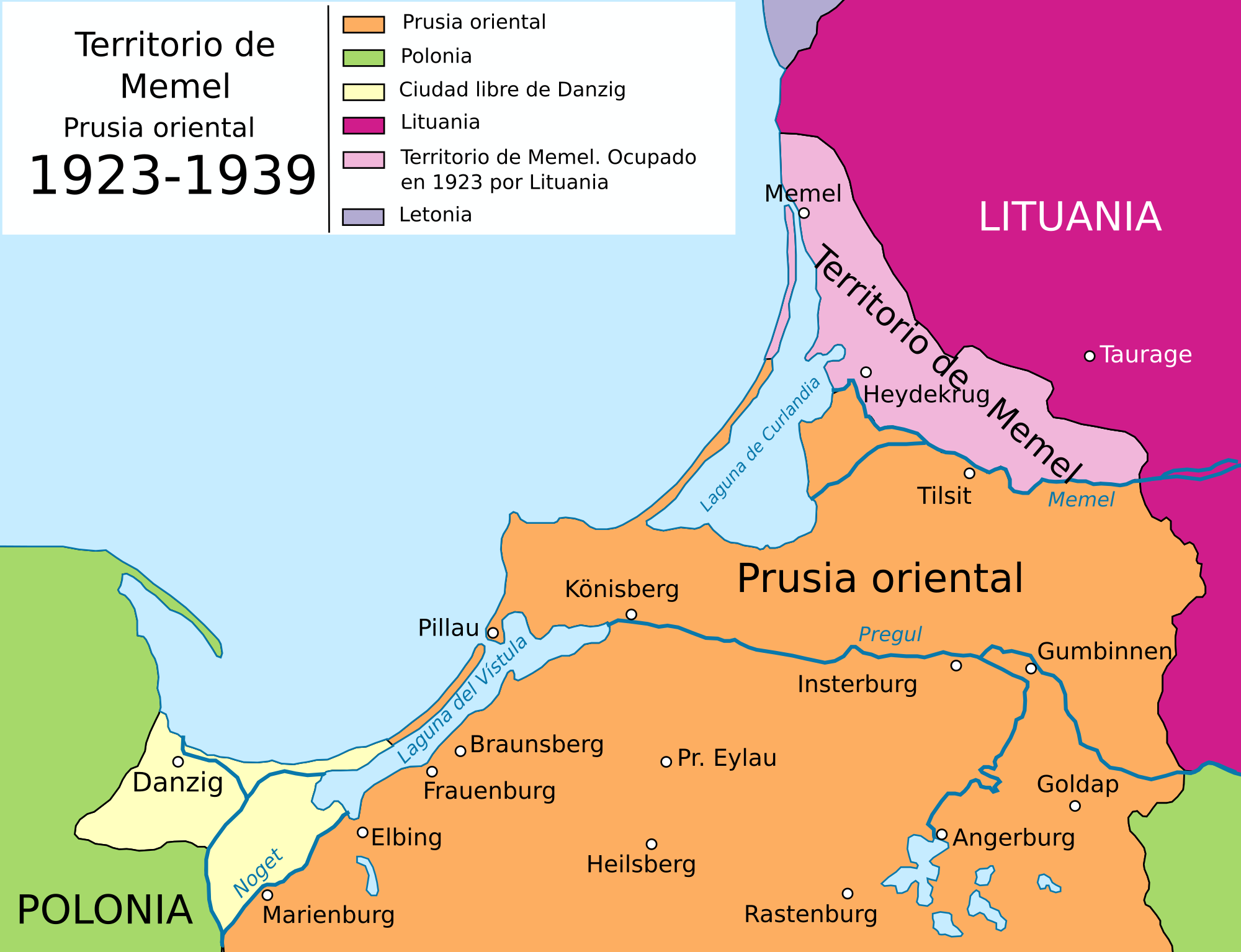
The Klaipėda Region was separated from Germany under Article 99 of the Treaty of Versailles of 28 June 1919. After the ratification of the Treaty of Versailles and its entry into force on 10 January 1920, execution of sovereign rights in the Klaipėda Region was transferred to the Triple Entente countries. On 16 February 1923, the Conference of Ambassadors recognized Lithuania’s sovereignty over the Klaipėda Region. In this way the Klaipėda Region became a part of the territory of Lithuania. Its legal status in the state of Lithuania has not been formally recorded yet, because under the Resolution of the Conference of Ambassadors of 16 February 1923 this should have been established in the Klaipėda Region Convention, which had to be prepared by the Conference of Ambassadors together with the representatives of Lithuania.
The Klaipėda Region Convention was signed in Paris on 08 May 1924. The Seimas of Lithuania ratified the Convention on 30 July 1924. Signatory States ratified it later. The Convention came into force on 25 August 1925, when ratification documents of England, Italy and Japan were deposited.
It has been established in Article 2 of the Convention that “the Klaipėda Region will form a unit of Lithuanian sovereignty, which will use the legislative, judicial, administrative and financial autonomy established by the Statute of the Supplement 1”.
Articles 8, 9 and 10 of the Klaipėda Region Convention determined which residents of the Klaipėda Region acquire Lithuanian citizenship and established the procedure of acquisition thereof.
According to part 1 of Article 8 of the Convention, Lithuanian citizenship is acquired ipso facto by those “former German citizens who, upon ratification of this Convention by Lithuania, would have been over 18 years of age and who would definitely have lived in the Klaipėda Region at least since 10 January 1920”.
Germany has committed to recognize the residents of the Klaipėda Region as citizens of that country, to which the Region will be joined. Therefore, the residents of the Klaipėda Region, upon acquisition of Lithuanian citizenship, shall lose German citizenship.
The Convention has also provided for the possibility of opting for Lithuanian citizenship. Opting for Lithuanian citizenship could be carried out by: a) each person who has born in the Klaipėda Region and lived there for more than ten years, who, upon ratification of this Convention by Lithuania, would have been over 18 years of age; b) each person who, upon ratification of this Convention by Lithuania, would have been over 18 years of age and who got a permanent residence permit from the Intereliant Administration, provided he has settled in the Klaipėda Region no later than on 01 January 1922 (part 2 of Article 8).
The opting for Lithuanian citizenship could be implemented within six months from the day Lithuania will ratify this Convention. When opting for Lithuanian citizenship, persons lost citizenship of other state.
Under Article 10 of the Convention, married women used to acquire the same citizenship as their husbands, and children under 18 years old used to acquire the same citizenship as of their parents.
The decisive period for a change of citizenship and reaching 18 years old is 30 July 1924. Until that date the residents of the Klaipėda Region (not including aliens) were considered to be German citizens.
“The Rules for issuing passports to citizens of the Klaipėda Region” were intended for implementation of the provisions of the Klaipėda Region Convention regarding citizenship and option agreement. Attention should be drawn to the fact that a name of the Rules is not legally correct, as it can be assumed that the Klaipėda Region citizenship and citizens have already been there. Neither the Klaipėda Region Convention, nor the option agreement provided for the citizenship of the Klaipėda Region, passports were also issued not to citizens of the Klaipėda Region, but to those who lived in the Klaipėda Region, who were immediately regarded as citizens of Lithuania under the Convention or were opted for Lithuanian citizenship. Such a provision was also consolidated in Article 1 of the aforementioned Rules, wherein its was established that “passports are issued only to citizens of Lithuania”.
According to Article 34 of the Klaipėda Region Statute, passports for the residents of the Klaipėda Region were issued by the Regional Directory, however, not on behalf of itselt, but in the name of the Republic of Lithuania and in accordance with the Rules laid down by the Government of Lithuania.
It has been established in the Rules that a person applying for the issue of a passport “must prove to the issuing institution that he has acquired Lithuanian citizenship”. The acquisition of citizenship must have been proven by documents. In individual cases, when a person was unable to submit documents specified in the Rules or circumstances or data indicated in those documents had to be supplemented or explained, “evidence of local residents characterized as reliable in a small rural distrist or town approved by their own signatures” could be accepted.
The Klaipėda Region Convention and the Option Agreement provided for which persons are considered to be Lithuanian citizens and which persons are entitled to opt for Lithuanian citizenship. Persons meeting the requirements established by the Convention had to be considered as Lithuanian citizens (they should have been regarded as Lithuanian citizens). Similarly, persons who opted for Lithuanian citizenship should have been considered Lithuanian citizens. The persons specified in the Convention and the Option Agreement could not be subject to the requirements established in the Provisional Law on Lithuanian Citizenship.
Nevertheless, this did not mean that the Law on Citizenship could not establish norms according to which other persons residing in the Klaipėda Region, who were not mentioned in the Convention and the Option Agreement, would be considered Lithuanian citizens or would acquire Lithuanian citizenship.
On 20 March 1939, Germany threatening by force presented its ultimatum to Lithuania to return the Klaipėda Region to Germany.
On 22 March 1939, the Treaty on the Transfer of Klaipėda Region between the Republic of Lithuania and the German State was signed, Article 1 whereof indicated that “From this day, the Klaipėda Region separated from Germany by the Treaty of Versailles is reunited with the German Reich.“
The Treaty between the Republic of Lithuania and the German Reich regarding citizenship of residents of Klaipėda was concluded on 08 July 1939. Under Article 1 hereof, “Lithuanian citizen who
- on 30 July 1924 or by opting Lithuanian citizenship has lost German citizenship, or
- is of German nationality and acquired Lithuanian citizenship by way of opting or birth, legitimacy or marriage, who derived their citizenship from indicated persons No. 1 and No. 2,
shall be considered as acquired German citizenship on 22 March 1939″.
These provisions were not applied to those persons of Lithuanian nationality who, before the signing of this Treaty, transferred their place of residence from the Klaipėda Region to Lithuania. The place of residence was “considered as transferred, if a person has left his permanent place of residence without any intention to return thereto” (part 2 of Article 1).
Therefore, under the Treaty, those residents of the Klaipėda Region, who until the moment of signing the Treaty, i.e. until 08 July 1939, left the Klaipėda Region without any intention to return thereto and settled in the Great Lithuania, were considered as not lost Lithuanian citizenship, provided Lithuanian state institutions will recognize that they are of Lithuanian nationality.
The Treaty provided for that persons of Lithuanian nationality, who have acquired German citizenship according to Article 1 of this Treaty, may until 31 December 1939 apply for the Consulate General of Lithuania in Klaipėda that they want to have Lithuanian citizenship. The Lithuanian citizenship was considered acquired after the issue of certificate that the application has been granted (Article 2).
Under the Treaty, a person could not have both Lithuanian and German citizenship at the same time: if in accordance with the provisions of the Treaty a person acquired citizenship of one state, he ipso facto lost the citizenship of another state (Article 3).
Attention should be drawn to the fact that when deciding whether a person is Lithuanian, not only his origin, but also national attitude was taken into account.
In order to prevent the use of Lithuanian passports for persons who were not considered to be citizens of Lithuania in accordance with the provisions of the Treaty, the Rules established that the internal or foreign passports or documents issued instead of them by the Klaipėda Regional Directory or its offices or the Klaipėda Regional Governorate, notwithstanding the expiry date specified therein, have been “withdrawn” since 01 January 1940.
MIGRATION LAW CENTER


The Lithuanian Parliament Seimas endorsed revision of the Law on Citizenship expanding the possibilities for children born abroad to Lithuanian parents to acquire Lithuanian citizenship.
Until now, it has been established in Paragraph 1 of Article 7 and Section 10 of Article 45 of the Law on Citizenship that children of Lithuanian parents who acquired citizenship of another state by birth between 11 March 1990 and 22 July 2008, can apply for Lithuanian citizenship before they turn 18 themselves or this may be made by their legal representatives. According to the provided exception, persons who reached the age of majority no longer have such a possibility to apply for the Lithuanian citizenship.
The adopted amendments revoked a term stipulated in Section 10 of Article 45 of the Law on Citizenship to file an application until the child reaches the age of 18.
The newly adopted amendments broaden the right to apply for Lithuanian citizenship for adult persons, provided they held citizenship under the aforesaid exception. From now on, Lithuanians residing abroad may file applications to preserve citizenship at Lithuanian diplomatic missions or consular posts.
This change rebounds on requirements of the foreign Lithuanians to abolish the present restriction. Some persons, despite their wish to be Lithuanian citizens, have lost this opportunity due to ignorance of the law. Therefore, this amendment to the law is of considerable importance to foreign communities until constitutional changes take place.
MIGRATION LAW CENTER
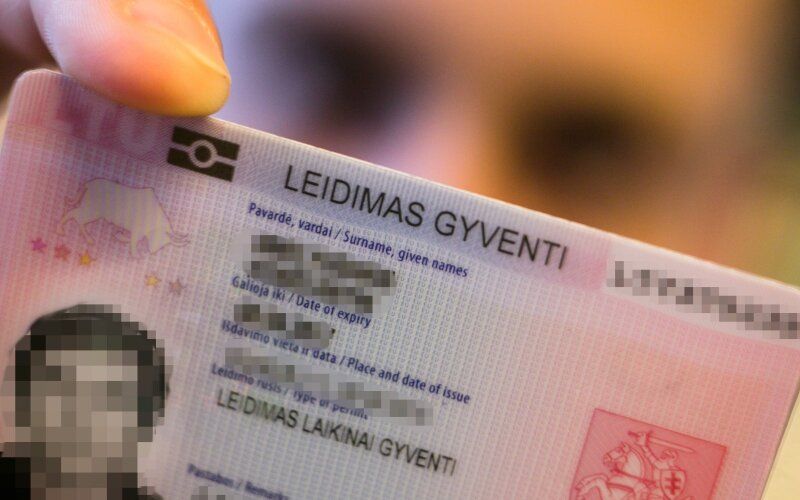
From 05 April 2023, the Migration Department has started to provide additional document collection services for foreigners.
Now when applying for issuance of a residence permit in Lithuania, a certificate confirming the right of an EU citizen to reside in Lithuania, or a residence permit card of a family member of an EU citizen, a foreign national will be able to collect the produced card at a different division of the Migration Department than the one where the application was submitted.
Until now, it was possible to collect such documents only at the division where the person submitted the application for the issue or replacement of the residence permit.
The foreigners will be able to express their wish to collect a document from another division by filling in the application for the issue of the document at MIGRIS system or upon arrival at the customer service unit of the Migration Department.
One more novelty is the possibility for foreigners to choose the delivery of the produced residence permit card by courier at their preferred address. Until now, such a service was available only to Lithuanian citizens, who wished to receive the ordered personal documents.
MIGRATION LAW CENTER


From the beginning of 2023, a new service will come into force together with amendments to the Republic of Lithuania Law on the Legal Status of Foreigners, namely, an issue of temporary residence permits in Lithuania through an external service provider.
The Migration Department has chosen VFS Global bureaus as the provider of such service, through which documents regarding visas were also submitted until now.
The following amendment to Article 28 of the Republic of Lithuania Law on the Legal Status of Foreigners concerning the issue, change and revocation of the residence permit has been adopted:
A foreigner who is staying outside the Republic of Lithuania shall lodge an application for the issue of a temporary residence permit in Lithuania through the external service provider selected by the Migration Department. A foreigner who is legally staying in the territory of the Republic of Lithuania shall submit an application for the issue of a residence permit with the Migration Department, however, the lodging of such an application shall not entitle the foreigner to stay in the territory of the Republic of Lithuania pending the examination of the foreigner’s application and a taking of a decision thereon.
Foreigners will be able to submit applications for temporary residence permits in Lithuania in 34 different foreign countries, where such bureaus will be open. The Migration Department also provides a list of such countries: Albania, Argentina, Armenia, Australia, Azerbaijan, Brazil, Canada, Sakartvel, India, Israel, Japan, Jordan, Kazakhstan, Kyrgyzstan, Lebanon, Malaysia, Moldova, Nepal, New Zealand, Philippines, Singapore, Republic of South Africa, South Korea, Sri Lanka, Taiwan, Tajikistan, Thailand, Turkey, Ukraine, United Arab Emirates, United Kingdom, United States of America, Uzbekistan, Venezuela.
VFS Global bureaus in the specified countries will be authorized to accept from persons their applications for temporary residence permits and documents which are mandatory to be submitted herewith. Moreover, individuals will have an opportunity to provide their biometric data which will be transferred to the specialists at the Migration Department who take decisions thereon.
It should be noted that the documents submitted together with an application and procedure for legalization thereof remains the same.
The estimated terms of examination of the applications lodged while staying abroad and decision-making thereof – 1-3 months.
When submitting an application, a foreigner will be able to choose where he/she will collect the produced residence permit card. After the decision is taken to issue a temporary residence permit, the produced card will be able to be sent abroad, so that the foreigner could arrive in Lithuania with an already valid temporary residence permit. Thereby, foreigners will not have to additionally apply for visa. Nevertheless, it will take extra time to send a document abroad and a time during which the external service provider contacts the foreigner in order to hand over a document to him/her.
Those foreigners who need no visas to arrive in Lithuania (either having a valid visa, or enjoying a visa-free regime) will be able to order a temporary residence permit card while being abroad and collect it in Lithuania, provided there is a need to come earlier.
It is worth mentioning that foreigners will be able to apply to VFS Global bureaus regardless of the fact whether they reside in that country.
The Migration Department has clarified that, as long as the state of emergency applies, national visas D shall not be issued to citizens of Russia and Belarus who are staying abroad. Besides, citizens of such countries will not be able to lodge applications for the issue of temporary residence permits through an external service provider.
MIGRATION LAW CENTER
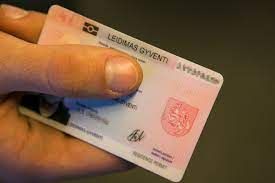
The Lithuanian Migration Department, while improving the quality of the provided electronic services and the operation of the information system MIGRIS, has introduced an improvement.
This novelty will allow a foreigner, who has temporarily departed from Lithuania and has lost, damaged, or otherwise lost his/her temporary residence permit card in Lithuania, to apply for reissuance of this permit through the external service provider VFS Global.
Firstly, a foreigner will have to log in to his/her MIGRIS account, submit a notice on the lost document and fill out an application for processing a new temporary residence permit. When filling out the application, the foreigner will have to specify the branch of the external service provider, where he/she intends to arrive to submit the application and afterwards collect the issued card.
Currently, the aforesaid services are provided at VFS Global offices in 34 world countries:
Albania, Argentina, Armenia, Australia, Azerbaijan, Brazil, Canada, Kazakhstan, India, Israel, Japan, Jordan, Kazakhstan, Kyrgyzstan, Libya, Malaysia, Moldova, Nepal, New Zealand, Philippines, Singapore, Republic of South Africa, South Korea, Sri Lanka, Taiwan, Tajikistan, Thailand, Turkey, Ukraine, United Arab Emirates, United Kingdom, United States of America, Uzbekistan, Venezuela.
Applications regarding processing of a new temporary residence permit will be examined within 10 working days and a foreigner will be informed about the issued permit in a separate notice. The produced temporary residence permit will be sent to the VFS Global office by courier; therefore, it should be noted that the forwarding of a document itself to a foreign country may take additional time.
MIGRATION LAW CENTER


The Migration Department has announced new fees for services provided by the Department. Under 26 July 2023 Resolution of the Government of the Republic of Lithuania, the Migration Department will charge the state fees of new sizes for the services rendered from the 28th of July. The published updated list of the state fees is provided hereunder:
|
Name of the fee |
New size of the fee |
|
Issuance and renewal of a certificate of the right of temporary or permanent residence in the Republic of Lithuania |
10.00 |
|
Issuance of a temporary or permanent residence card of a family member of a Union citizen |
60.00 |
|
Approving and examination of application for issuance of temporary or permanent residence card of a family member of a Union citizen, taking a decision, issuance (non-issuance) of the card |
40.00 |
|
Issuance of a temporary residence permit in the Republic of Lithuania in general order |
160.00 |
|
Issuance of a temporary residence permit in the Republic of Lithuania in urgent order |
320.00 |
|
Renewing a temporary residence permit in the Republic of Lithuania in general order |
160.00 |
|
Renewing a temporary residence permit in the Republic of Lithuania in urgent order |
320.00 |
|
Processing of a new temporary residence permit in general order |
45.00 |
|
Processing of a new temporary residence permit in urgent order |
90.00 |
|
Issuance of a permit of a long-term resident of the Republic of Lithuania to reside in the European Union (permanent residence permit) in general order |
160.00 |
|
Issuance of a permit of a long-term resident of the Republic of Lithuania to reside in the European Union (permanent residence permit) in urgent order |
320.00 |
|
Renewing a permit of a long-term resident of the Republic of Lithuania to reside in the European Union (permanent residence permit) in general order |
45.00 |
|
Renewing a permit of a long-term resident of the Republic of Lithuania to reside in the European Union (permanent residence permit) in urgent order |
90.00 |
|
Issuance and renewal of an identity card in general order |
10.00 |
|
Issuance and renewal of an identity card in urgent order within 5 working days |
60.00 |
|
Issuance and renewal of an identity card in urgent order within 1 working day |
100.00 |
|
Issuance and renewal of a passport of the Republic of Lithuania in general order |
50.00 |
|
Issuance and renewal of a passport of the Republic of Lithuania in urgent order within 5 working days |
100.00 |
|
Issuance and renewal of a passport of the Republic of Lithuania in urgent order on the same workday |
200.00 |
|
Issuance or renewal of a stateless person’s travel document |
50.00 |
|
Issuance or renewal of a stateless person’s travel document in urgent order |
100.00 |
|
Issuance or renewal of an alien’s passport |
65.00 |
|
Issuance or renewal of a refugee travel document |
50.00 |
|
Issuance or renewal of a refugee travel document in urgent order |
100.00 |
|
Application to issue a certificate confirming the right to reinstate the citizenship of the Republic of Lithuania |
50.00 |
|
Approving and examination of an application to change a certificate confirming the right to reinstate the citizenship of the Republic of Lithuania, taking a decision, and issuance (non-issuance) of the changed certificate |
25.00 |
|
Approving and examination of an application to issue a certificate confirming Lithuanian descent, taking a decision, and issuance (non-issuance) of this certificate |
50.00 |
|
Approving and examination of an application to change a certificate confirming Lithuanian descent, taking a decision, and issuance (non-issuance) of the changed certificate |
25.00 |
|
Examination of applications to issue national visa, taking decisions to issue or deny a national visa in the Republic of Lithuania |
140.00 |
|
Examination of an application concerning reinstatement of LT citizenship |
120.00 |
|
Examination of an application concerning granting LT citizenship by way of simplified procedure |
120.00 |
|
Examination of an application concerning granting LT citizenship by way of naturalization |
120.00 |
|
Examination of an application concerning granting LT citizenship by way of exception |
120.00 |
|
Examination of an application concerning restoration of LT citizenship |
120.00 |
|
Examination of an application concerning renouncement of LT citizenship |
60.00 |
|
Examination of an application regarding the preservation of LT citizenship |
90.00 |
|
Examination of applications and taking decisions regarding changing employer or a job function with the same employer |
100.00 |
MIGRATION LAW CENTER

Citizens of the Republic of Lithuania, whose real property was nationalised under the laws of the USSR (Lithuanian SSR), or which was otherwise unlawfully made public, can apply due to the restoration of rights of ownership to the existing real property, which is regulated by the Republic of Lithuania Law on the Restoration of the Rights of Ownership of Citizens to the Existing Real Property.
This law shall also regulate the procedure and conditions of the restoration, as well as the recognition of continuity of the restoration of the rights of ownership to the citizens of the Republic of Lithuania to the real property, restoration whereof has been initiated according to the Law of the Republic of Lithuania on the Procedure and Conditions of Restoration of the Rights of Ownership to the Existing Real Property, while evaluating the established objective public economic relations.
Ownership rights to the real property shall be restored to the following citizens of the Republic of Lithuania:
- the owner of the property;
- the persons to whom the now-deceased owner of the property left his property by a will, irrespective of the fact that there is no evidence in the will of a devise of land or other real property, and upon their death – their spouses, parents, children or the spouses and children of such persons;
- the spouse, parents, children, if they are citizens of the Republic of Lithuania, of the owner of the property who died without making a will or emigrated abroad during the occupation period (1939-1990) and there received the citizenship of another country, upon losing the citizenship of the Republic of Lithuania – to a part of the existing real property falling to them;
- the spouse of the now-deceased child of the owner of the property – to a part of the existing real property falling to the deceased;
- the persons to whom the property is transferred by a will (holographic will) without adhering to the form and manner established by law or by a contract (purchase-selling, donation or any other written document), as well as the persons to whom successors to the rights of ownership left the property by a will. Citizens who wish to restore the rights of ownership must apply to the court regarding the establishment of a fact of legal significance.
These citizens can restore rights of ownership to the following real property:
- land;
- forests;
- water bodies;
- structures used for economic and commercial purposes together with their appurtenances;
- residential houses together with their appurtenances.
Applications for the restoration of the rights of ownership to the land, forest and water bodies shall be examined by the National Land Service under the Ministry of Agriculture of the Republic of Lithuania.
Rights of ownership to residential houses, their parts, apartments, structures used for economic and commercial purposes shall be examined by the director of municipal administration or other institution authorized by the Government in accordance with the procedure established by the Government.
It is established in part 1 of Article 10 of the Republic of Lithuania Law on the Restoration of the Rights of Ownership of Citizens to the Existing Real Property that applications for the restoration of the rights of ownership to the existing real property had to be submitted until 31 December 2001. It is stipulated in part 4 of the same Article that together with an application for the restoration of the rights of ownership, a document certifying citizenship shall be submitted and the documents confirming the rights of ownership and relation by blood with the owner shall be enclosed.
Citizens, who submitted applications for the restoration of the rights of ownership to the existing real property, but failed to provide the documents confirming the rights of ownership and relation by blood with the owner, had to submit such documents until 31 December 2003.
A missed deadline can be renewed for those citizens, who missed a set deadline due to reasons which are recognized by the Court as significant.
A provision is formulated in the Law that all documents specified had to be submitted together with an application for the restoration of the rights of ownership, and only the documents confirming the rights of ownership and relation by blood with the owner might be submitted later.
In the opinion of the Court, the Law does not provide for that a document certifying citizenship, which has not been submitted together with an application for the restoration of the rights of ownership within a term indicated by Law, should be submitted later, i.e. within a term during which the documents confirming the rights of ownership and relation by blood with the owner can be submitted. Citizenship of the Republic of Lithuania is one of those assumptions established by Law, the signs whereof a person must comply with in order to be recognized as a suitable subject of legal relations of the rights of ownership to the existing real property. Hereby, a person had to acquire citizenship of the Republic of Lithuania and also to become a suitable subject until 31 December 2001.
Therefore, the rights of ownership to the existing real property cannot be restored to persons who did not have and failed to submit to certain institutions a document certifying citizenship within terms established by law for the submission of applications for the restoration of the rights of ownership.
– the rights of ownership shall be restored only to citizens of the Republic of Lithuania, if applications thereof for the restoration of the rights of ownership have been submitted until a certain term which may be renewed by the Court, provided it had been missed due to important reasons;
– the rights of ownership shall not be restored to the persons having no citizenship of the Republic of Lithuania, such persons shall not be entitled to submit applications for the restoration of the rights of ownership until the aforementioned term, and the Court cannot renew this term for them.
Documents which must be submitted for the restoration of rights of ownership:
– application;
– documents approving Lithuanian citizenship;
– Documents confirming the rights of ownership and relation by blood with the owner. Documents confirming the rights of ownership can be as follows: extracts from mortgage books or asset transfer agreements, judicial decisions, property nationalisation acts, wills or other documents established by the Government.
A citizen must submit documents confirming the rights of ownership and relation by blood with the owner to the Land Use Department of the County Governor’s Administration according to the location of land, forest, water bodies.
Applications of citizens shall be examined and a decision regarding the restoration of the rights of ownership shall be taken within 6 months from the date of submission of documents. Decisions taken may be appealed to the court within 30 days from the day of delivery of decisions.
MIGRATION LAW CENTER


ANCESTRY www.ancestry.com
Ancestry is a program that, for a certain fee, provides you with an opportunity to find out the history of your family’s genealogical tree.
By providing information about several of your family members, the program will select what your ancestors could be. The more family members will be added, the more hints you will receive about your ancestors.
The program has access to various records around the world that are difficult to access for yourself, therefore, it can greatly facilitate searches in order to find out the history of your family.
You will also be able to find out the uniqueness of yourself, where you came from, to what ethnic group your ancestors belonged and many other interesting facts.
JEWISHGEN www.jewishgen.org
Jewishgen is a non-profit organization, which committed to ensure the continuity of the Jews for the present and future generations and to preserve Jewish history and heritage.
The website of Jewishgen organization provides thousands of databases, tools for research and other resources to help find Jewish ancestors and family members. All databases and tools are easily accessible to everyone.
On the page of this organization you can use Jewishgen’s multifunctional search, which embraces the following databases containing over 2 million entries from the entire Lithuania:
• JewishGen Family Finder – more than 38,000 entries provided by Jewish genealogists investigating families in Lithuania.
• JewishGen Online Worldwide Burial Registry – more than 38,000 entries of the Register of Deceased Persons from Lithuania and Lithuanian Jewish Cemeteries all over the world.
• Yizkor Book Necrologies – 22,000 entries from the lists of Holocaust martyrs in Yizkor’s books about cities in Lithuania.
• HaMagid Lithuanian Donors 1871-72 – Hebrew periodical presenting 5000 names of victims in the Persian period of famine in 1871-1872.
• HaMelitz Lithuanian and Latvian Donors – Hebrew periodical presenting nearly 20,000 names of victims of the Jews of Lithuania and Latvia from 1893 to 1903.
• Lithuanian Medical Personnel – Information on 874 Jewish medical personnel found in two Lithuanian medical catalogues in 1923 and 1925.
• Sugihara Database – 2,139 Lithuanian, Polish and Russian Jewish names, whose passports were preserved by the Japanese diplomat Chiune Sugihara in 1940.
• 1897 Census for Lithuania – 1,465 names of Jews living in the Kaunas and Vilnius Governorates obtained from the population census of the Russian Empire in 1897.
• Lithuania Internal Passports, 1919-1940 – Detailed information about 150,000 persons who applied for a passport in Lithuania during the interwar period.
• Jewish Religious Personnel in the Russian Empire, 1853-1854 – List of 400 Jewish religious workers who worked in the Vilnius and Kaunas Governorates in 1853-1854.
LitvakSIG www.litvaksig.org
LitvakSIG is the main research system of Lithuanian-Jewish genealogy around the world.
The aim of this system is to preserve the Litvak heritage by discovering, collecting, documenting and disseminating information about the Jewish community in Lithuania.
LitvakSIG has been working closely with Lithuanian archives for some time. It translates various recordings significant to the entire Lithuania, as well as supports and maintains the geographic-specific research groups exploring the genealogy of Lithuanian Jews.
Groups of researchers are divided into districts of Disna, Kaunas, Klaipėda, Lida, Ašmena, Panevėžys, Raseiniai, Šiauliai, Suvalkai, Švenčionys, Telšiai, Trakai, Ukmergė, Vilnius, Zarasai.
The main mission of the groups of researchers is to identify and collect information about a certain territory from available records of Lithuania from the Russian Empire (from 1795 to the World War I) until the restoration of Lithuania’s independence (1919-1940), including the times of the Vilnius Governorate.
The main results of activities of LitvakSIG are available at www.litvaksig.org, as well as in the All Lithuania Database.
The All Lithuania Database (ALD) is a free, searchable database that currently has more than 277000 records. The system contains entries in various languages and alphabets, including Cyrillic, Modern Russian, Yiddish, Hebrew, Lithuanian, Polish and Old German.
LitvakSIG’s online magazine contains various articles and other sources on a topic of Litvak heritage.
MIGRATION LAW CENTER
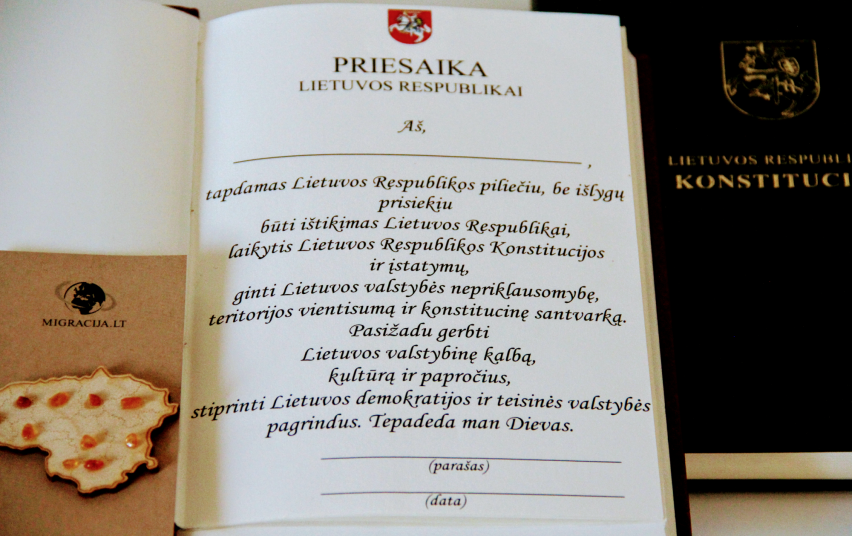
A person who has been granted citizenship of the Republic of Lithuania under the simplified procedure, through naturalisation, by way of exception or by restoring it, as well as on the grounds established by international treaties to which the Republic of Lithuania is a party, must take a public and solemn oath of allegiance to the Republic of Lithuania.
You may apply due to an oath of allegiance to the Republic of Lithuania to the territorial office of the Migration Department or the diplomatic mission or consular post of the Republic of Lithuania, upon the direct arrival to the relevant institution, through an authorized person or other representative, or by electronic means.
If you will submit documents through an authorized person or other representative, or by electronic means, you must also submit copies of documents confirming that you are not a citizen of another state, if you had citizenship thereof upon acquisition of citizenship of the Republic of Lithuania, whereas the originals will have to be presented to the person taking an oath of allegiance to the Republic of Lithuania on the day of the oath thereof. At the same time, a copy of the document approving personal identity must be provided herewith.
Documents issued by foreign states, personal statement that a person renounces citizenship of another state, and its official translation into the state language of the country of which the person is a citizen shall be legalized or approved by a certificate (Apostille) in accordance with the procedure laid down by legislation, unless international treaties of the Republic of Lithuania or European Union legislation provide for otherwise.
In the Republic of Lithuania, a person shall take an oath of allegiance at the Ministry of the Interior of the Republic of Lithuania or at a diplomatic mission or consular post of the Republic of Lithuania. If a person cannot arrive at the Ministry of the Interior due to the disability thereof, the oath of allegiance to the Republic of Lithuania may be taken at home or in a medical institution.
A person’s oath at the Ministry of the Interior shall be administered by the Minister of the Interior or the Vice Minister authorised by the Minister of the Interior, whereas an oath at a diplomatic mission or consular post shall be administered by the head of the respective diplomatic mission or consular post.
The time period to take an oath of allegiance shall be as follows:
1. You must take an oath of allegiance within six months from the effective date of the decree of the President of the Republic on the granting of citizenship of the Republic of Lithuania, if you are:
a stateless person;
a person who is a citizen of a state under the law of which he/she shall lose citizenship of that state on acquiring citizenship of the Republic of Lithuania;
a person who has been granted citizenship of the Republic of Lithuania by way of exception.
2. You must take an oath of allegiance within two years from the effective date of the decree of the President of the Republic on the granting or restoration of citizenship of the Republic of Lithuania, if you are a person:
who has expressed his/her will in writing to renounce his/her citizenship of another state after he/she is granted citizenship of the Republic of Lithuania.
Underage and disabled persons shall have no obligation to take an oath of allegiance to the Republic of Lithuania.
The determined date, time and place for an oath at the Ministry of the Interior or at the consular post shall be no later than:
within 2 months – if you are a stateless person;
within 4 months – if you are a person who has expressed his/her will to renounce his/her citizenship of another state.
A person shall be notified hereof in writing, by telephone or e-mail no later than within 5 working days from the time determined thereto.
If you are a person, who has expressed his/her will in writing to renounce his/her citizenship of another state, however, the law of another state whose citizen you are does not stipulate the procedures for renouncing or losing citizenship upon acquisition of citizenship of another state, or, in your opinion, these procedures do not meet the criteria of reasonableness.
You must provide the following documents:
1. An application to allow to take an oath of allegiance to the Republic of Lithuania;
2. Document confirming personal identity;
3. Statement approved by the notary public that you renounce to have the citizenship of another state and its official translation;
4. Explanation with reasons why you cannot renounce citizenship of another state;
5. Statement (You undertake to immediately inform the competent foreign state institutions about the voluntary decision to become a citizen of the Republic of Lithuania and an oath of allegiance taken to the Republic of Lithuania that a decision on the loss of your foreign citizenship would be taken in accordance with the provisions of the Law on Citizenship of the foreign country and, no later than within one year from the date of the oath of allegiance to the Republic of Lithuania was taken, submit to the Lithuanian authorities a document confirming the loss of citizenship of another state);
6. Documents confirming the reasons stated in your explanation;
7. Document evidencing the disability (if the person due to his/her disability cannot arrive to take an oath of allegiance to the Republic of Lithuania).
Upon the decision of the Minister of the Interior to allow you to take an oath of allegiance to the Republic of Lithuania having failed to provide evidence of the loss of the citizenship of another state, you will be informed in writing of the decision taken no later than the next working day after the decision is made, by sending you a copy of this decision. Then you will be invited to take an oath of allegiance to the Republic of Lithuania.
You will become a citizen of the Republic of Lithuania and acquire rights, freedoms and responsibilities as a citizen of the Republic of Lithuania only after having taken the oath of allegiance to the Republic of Lithuania.
You must choose one of the texts determined for an oath of allegiance to the Republic of Lithuania:
1) “I, (name, surname), on becoming a citizen of the Republic of Lithuania, do solemnly, without reservation, swear my allegiance to the Republic of Lithuania, to observe the Constitution and laws of the Republic of Lithuania, to defend the independence, territorial integrity and constitutional order of the State of Lithuania. I pledge to respect the state language, culture and customs of Lithuania, to strengthen the basic principles of democracy and the rule of law in Lithuania. So help me God.”;
2) “I, (name, surname), on becoming a citizen of the Republic of Lithuania, do solemnly, without reservation, swear my allegiance to the Republic of Lithuania, to observe the Constitution and laws of the Republic of Lithuania, to defend the independence, territorial integrity and constitutional order of the State of Lithuania. I pledge to respect the state language, culture and customs of Lithuania, to strengthen the basic principles of democracy and the rule of law in Lithuania.”
Applications for granting citizenship of the Republic of Lithuania repeatedly submitted by persons who failed to take an oath of allegiance to the Republic of Lithuania shall not be considered, except for the cases when a person misses this term due to very important reasons.
MIGRATION LAW CENTER

From the beginning of 2015, the conscripted army has been renewed in Lithuania. At present, all Lithuanian men aged 18-26 can be invited to perform compulsory military service in the Lithuanian Armed Forces for a period of 9 months. The priority shall be given to volunteers. Generally, only 2 percent of men are randomly selected to complete vacancies in the army within the year. The lists of military conscripts are published on the Internet at www.sauktiniai.kam.lt.
Upon receipt of the call, a military conscript will be assigned to compulsory initial military service only after determining that his health is appropriate to carry out the service.
A person called to the army can postpone it only in case of important reasons and when having documents evidencing hereof.
A military conscription can be postponed in the following cases:
– a person studies at a secondary, professional or higher education school;
– by military conscription, a disproportionate damage to his public or private interests will be incurred;
– persons are raising a minor child alone or are on parental leave;
– in case of temporary health problems;
– in other cases provided for.
A military conscript who is on the list of conscripts may submit a claim based on evidence to the Regional Military Conscription and Compilation Division regarding a postponement of his military service due to disproportionate damage to his interests and his application would be considered by a special commission.
Penalties are stipulated for a non-entry into compulsory military service or alternative national defence service, as well as for a non-compliance with military obligations established by the Law on Military Conscription of the Republic of Lithuania.
If a person has citizenship of the Republic of Lithuania, he is a military conscript and must fulfill all the rights and obligations arising therefrom. The military conscription shall also be applicable to persons who restored Lithuanian citizenship and acquired dual citizenship, as well as to persons residing abroad who have received a call. Military conscripts shall be all adult citizens of the Republic of Lithuania who have a military obligation (regardless of whether they live in Lithuania or abroad).
An exception shall be made and it is allowed to exempt from the military conscription the following persons: incapable persons; the disabled; persons, who were recognized as unsuitable for service due to their health; persons transferred to demission; women (except for those who expressed their will in writing to become military conscripts).
A person who received a call accidentally, can postpone it only due to important reasons: studies, work, huge financial damage, health problems, etc. Important reasons shall also include no knowledge of the Lithuanian language – it would be too expensive and too difficult to ensure that a person who does not have Lithuanian language skills would complete military service without an interpreter. If a person does not live in Lithuania – high travel costs may also be a justifiable reason to postpone the call.
Upon the postponement of the military service, a person may be randomly selected in subsequent years. Upon receipt of a repeated call and non-disappearance of important reasons, the opportunity to request a postponement of the call shall be granted again. The decision to authorize a postponement is taken by a special commission, therefore, each time it is necessary to write an explanation and enclose additional documents evidencing why you cannot join the army if you are randomly selected.
The amendments to the Law on Military Conscription provide for that military conscripts who have departed to other state permanently or temporarily, for a period longer than 6 months, must immediately, but no later than within one month from the day of departure thereof, inform by e-mail the authority of the national defence system administering the military obligation about their actual place of residence, work or studies.
MIGRATION LAW CENTER
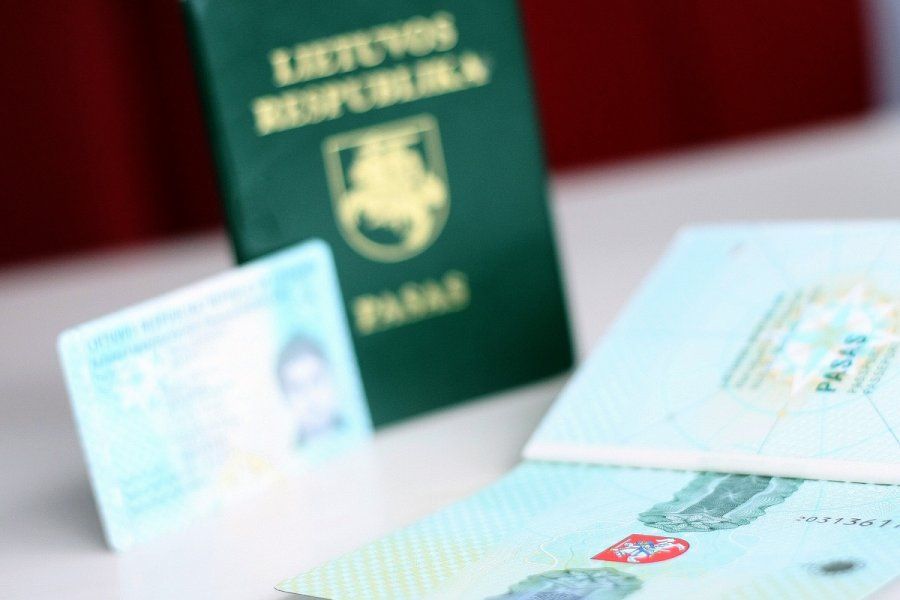
Persons whose parents or grandparents or one of the parents or grandparents is or was Lithuanian and who consider themselves Lithuanian and declare that in writing, shall be entitled to obtain a certificate confirming the Lithuanian descent. This document shall form a basis for the application due to the issuance of an annual multiple-entry Schengen visa.
A temporary multiple-entry Schengen visa (C) may be issued to aliens who have submitted documents confirming the Lithuanian descent, as well as to family members of these aliens. This visa can be valid up to 2 years.
When applying for the issuance of multiple-entry Schengen visa as a person of the Lithuanian descent, the person, along with documents which are usually submitted to obtain Schengen visa and a document confirming the Lithuanian descent, must also prove his/her honesty and credibility, i.e. a lawful usage of previous visas, as well as his/her economic status, allowing to travel to another states and return thence, and an intention to depart from the territory of the Member States before the expiry of the visa applied for.
Usually, a consular fee of 60 euros shall be charged for the acceptance and investigation of documents to obtain visa in Diplomatic Missions of the Republic of Lithuania and Consular Offices abroad. Exceptions are granted to persons of the Lithuanian descent. They shall be exempt from the consular fee.
A person must submit the application for the issuance of the certificate confirming the Lithuanian descent in person upon the arrival at the Reception of the Migration Department or the Diplomatic mission of the Republic of Lithuania or the Consular office in a foreign country, if the person lives abroad. If a person lives in the Republic of Lithuania, the application and other accompanying documents shall be submitted through the territorial police office by the person’s place of residence.
Documents to be submitted by the person applying for the certificate confirming the Lithuanian descent:
The person, who applies for the issuance of a document confirming the Lithuanian descent, along with the application, must submit:
1. Travel document or other document confirming personal identity;
2. Documents evidencing the Lithuanian descent. The Lithuanian descent shall be approved by documents, wherein it is stated that the person’s parents or grandparents or one of the parents or grandparents is or was Lithuanian, as well as a written statement of the person, whereby he/she declares that he/she considers himself/herself Lithuanian;
3. Documents certifying a kinship relationship with a person who is or was Lithuanian, if his/her child or grandchild applies for the issuance of certificate;
4. Documents confirming the change of name or surname if these personal data in the documents submitted do not match the data of the travel document or other document confirming personal identity;
5. Two identical photos of a person, each of 4 x 6 mm size.
The documents issued by foreign countries must be legalized or confirmed by a certificate (Apostille), unless international treaties of the Republic of Lithuania and legislative acts of the European Union provide otherwise, and translated into Lithuanian language.
The person can take a certificate confirming the Lithuanian descent in the following places: in the Migration Department, Consular office or the territorial police office by the person’s place of residence, in person or through the representative.
MIGRATION LAW CENTER
Upon re-establishment of an independent state of Lithuania on 11 March 1990, the Provisional Basic Law of the Republic of Lithuania was adopted, Part 1 of Article 13 whereof stipulated that “The attributes of Lithuanian citizenship, conditions and procedures for receiving and losing it shall be defined by the Law on Lithuanian Citizenship”.
It has been established in Article 3 of the Law “Regarding the Provisional Basic Law of the Republic of Lithuania” adopted on 11 March 1991 that “Laws and other legal acts valid in Lithuania until this moment that do not contradict the Provisional Basic Law of the Republic of Lithuania shall remain in force.” There were no legal norms in the Law on Citizenship of the Lithuanian SSR that would contradict the Provisional Basic Law, therefore this Law, which became the Law on Citizenship of the Republic of Lithuania after 11 March 1991, was valid until 10 December 1991. The concepts “Lithuanian SSR”, “Citizenship of the Lithuanian SSR”, “Citizen of the Lithuanian SSR” of this Law have been interpreted as changed into the concepts “Republic of Lithuania”, “Citizenship of the Republic of Lithuania”, “Citizen of the Republic of Lithuania”, respectively.
The Law on Citizenship adopted in 03 November 1989 was changed only once, i.e. Article 18 of this Law was amended by a new paragraph 4 in 16 April 1991, whereby the citizenship of the Republic of Lithuania was lost upon acquisition of citizenship of another state. This amendment did not alter the essence of legal regulation established by law. Thus, during the period from 11 March 1990 to 10 December 1991 citizenship of the Republic of Lithuania was acquired, lost and issues of citizenship were resolved in accordance with the Lithuanian Soviet Socialist Republic Law on Citizenship enacted by the Lithuanian SSR institution – the LSSR Supreme Council.
The Lithuanian SSR Law on Citizenship was adopted by the LSSR Supreme Council on 03 November 1989. According to Article 1 of the Law on Citizenship, the following persons shall be citizens of the Lithuanian SSR:
“1) Persons who were citizens of the Republic of Lithuania, children and grandchildren of such persons, as well as other persons who were permanent residents on the current territory of the Lithuanian SSR prior to 15 July 1940, and their children and grandchildren who now are or have been permanent residents on the territory of the Lithuanian SSR;
2) Persons who have a permanent place of residence in the Lithuanian SSR, provided they were born on the territory of the Lithuanian SSR, or have provided evidence that at least one of their parents or grandparents was born on said territory, and provided that they are not citizens of another state;
3) Other persons who, up to and including the date of entry into force of this Law, have been permanent residents on the territory of the Republic and have here a permanent place of employment or another constant legal source of support; such persons shall freely choose their citizenship during two years following the entry into force of this Law;
4) Other persons who have acquired citizenship of the Lithuanian SSR under this Law.”
Part 2, Article 2 of this Law provided for that “Persons referred to in paragraphs 1, 2, and 3 of Article 1 of this Law who wish to acquire the passport of a citizen of the Lithuanian SSR, shall sign a pledge to the Republic promising to observe the Constitution and laws of the Lithuanian SSR, and to respect the sovereignty and territorial integrity of Lithuania”.
On 05 December 1991, a new Law on Citizenship of the Republic of Lithuania was adopted.
MIGRATION LAW CENTER


As Brexit approaches and a transition period comes to an end, on 10 November 2020, the Seimas of the Republic of Lithuania approved a Draft Law on Amending the Law on the Legal Status of Aliens prepared by the Ministry of the Interior of the Republic of Lithuania. The provisions of the draft attempt to harmonize the law with the provisions of the Agreement on the Withdrawal of the United Kingdom of Great Britain and Northern Ireland From the European Union.
The draft law is aimed at providing more information to the United Kingdom nationals and their respective family members and giving them clarity on their legal status in Lithuania at the end of the transition period, i.e., after 31 December 2020.
The United Kingdom nationals and their family members who acquired a right to reside in the Republic of Lithuania by the end of this year, can still enjoy the same conditions and are subject to the same requirements as nationals of the Member States of the European Union and their family members. Pursuant to the draft law, the United Kingdom nationals who arrive to reside in Lithuania after the new year, i.e. after the transition period, will have to comply with the preferential provisions applicable to third-country nationals.
Persons who have acquired documents confirming the right to reside in the Republic of Lithuania before the end of this year will be able to use these documents until expiry or replacement thereof. It should be noted that after the transition period such documents will entitle to reside in the Republic of Lithuania, however, the right of free movement of persons in the Schengen area will not be exercised.
The United Kingdom nationals and their family members, residing in the Republic of Lithuania and willing to move freely in the Schengen area after new year, will have to apply to the Migration Department for the change of documents in their possession.
When applying for the document change, the Migration Department will make a decision therefore no later than within one month from the date of submission of an application. The United Kingdom nationals and their family members, who acquired the right to reside in the Republic of Lithuania until the end of the transition period, will be exempt from the state fee for examination and processing of applications regarding the issue of permits to reside in the Republic of Lithuania.
MIGRATION LAW CENTER


The Migration Department has prepared the methodology for processing applications for the reinstatement of citizenship of the Republic of Lithuania, which sets out the principles and order of processing applications for the reinstatement of citizenship of the Republic of Lithuania.
The aforementioned methodology states the following:
Direct evidence approving that a person or his/her parents, grandparents, great-grandparents or one of them had Lithuanian citizenship before 15 June 1940 inclusive, are documents provided for in paragraph 4 of Article 38 of the Republic of Lithuania Law on Citizenship:
1) internal or foreign passports of the Republic of Lithuania issued before 15 June 1940;
2) foreign passports of the Republic of Lithuania issued by diplomatic missions and consular posts of the Republic of Lithuania after 15 June 1940;
3) documents attesting to the person’s service in the Lithuanian armed forces or employment in the civil service;
4) birth certificates or other documents containing direct reference to citizenship of the Republic of Lithuania held by the person concerned;
5) personal certificates issued before 15 June 1940 in Lithuania or personal certificates issued on the basis of documents issued before 15 June 1940.
If a civil servant authorized by the Migration Department establishes that direct evidence was annexed to the application, it shall be considered that there were submitted sufficient documents substantiating that a person had Lithuanian citizenship before 15 June 1940, except for the cases when a person lost Lithuanian citizenship (ceased to be a citizen) or died before 15 June 1940.
If a person lost Lithuanian citizenship (ceased to be a citizen) before 15 June 1940 or died before 15 June 1940, such a person, although direct evidence was provided, shall not be considered a person who had citizenship of the Republic of Lithuania before 15 June 1940.
Indirect evidence shall be documents specified in paragraph 5 of Article 38 of the Republic of Lithuania Law on Citizenship suggesting that a person may have had citizenship of the Republic of Lithuania before 15 June 1940:
documents concerning studies, work and life in Lithuania before 15 June 1940, as well as a passport of a foreign state and other documents.
If a civil servant authorized by the Migration Department establishes that there is no direct evidence, but indirect evidence is present, the evaluation of documents, on the basis of the set of documents, shall be initiated.
If a person lost Lithuanian citizenship (ceased to be a citizen) before 15 June 1940 or died before 15 June 1940, such a person shall not be considered a person who had citizenship of the Republic of Lithuania before 15 June 1940.
If no direct evidence was submitted, citizenship of the Republic of Lithuania held by a person shall be determined on the basis of the date and place of birth of that person, citizenship held by the person’s parents and the following documents:
1. If a person was born before 09 January 1919, the following documents must be submitted:
- a document certifying birth in the current territory of Lithuania, and:
- or documents attesting a fact of life of person/ person’s parents, if a person was under-age (who have lived in Lithuania for a long time) in Lithuania before 09 January 1919 and documents approving a fact of life thereof before 15 June 1940 (e.g., documents on the birth of children when children were born since 09 January 1919 until 15 June 1940, documents on the person’s marriage, work, owned real property). It should be noted that the majority of marriage records indicated that the married persons were Lithuanian citizens;
- or documents on Lithuanian citizenship held by the person’s parents before 15 June 1940;
2. If a person was born since 09 January 1919 until 15 June 1940 in Lithuania then, except Vilnius Region and Klaipėda Region, a document approving the birth in the current territory of Lithuania of a person who had citizenship of the Republic of Lithuania before 15 June 1940. In this case, a document certifying a fact of birth is usually sufficient, nevertheless, it should be noted that in case of suspicion whether the person actually had Lithuanian citizenship or whether that person is really a relative of the applicant, a civil servant authorized by the Migration Department may request to provide, and the applicant himself/herself may provide more data, i.e., documents certifying marriage, fact of life, held property, studies or work, or other documents which would eliminate possible interpretations. Furthermore, it is worth mentioning that parents of persons who were born during this period must also have been citizens of the Republic of Lithuania, therefore, documents confirming that they were citizens of the Republic of Lithuania before 15 June 1940 must be provided.
In case when a person, whereby his/her Lithuanian citizenship held before 15 June 1940 is provable, was born before 09 January 1919 in the territory of current Lithuania, but lived during the period since 09 January 1919 until 15 June 1940 or was born and lived during the period since 09 January 1919 until 15 June 1940 in Vilnius Region, which was actually controlled by Poland since 1920, the following documents must be submitted:
- documents certifying that this person and parents thereof (if the person was under-age) were treated Lithuanian citizens on the day of exchange of documents of ratification of 12 July 1920 Lithuanian-Soviet Russian Peace Treaty, and
- documents certifying that this person and parents thereof (if the person was under-age) had a place of residence in that territory of Vilnius Region, which was established in 10 October 1939 Soviet-Lithuanian Mutual Assistance Treaty and in 27 October 1939 additional Protocol. In this case, it is important for the applicant to provide documents approving that the person had a place of residence in the territory of Vilnius Region both on 12 July 1920 and on 27 October 1939. The submitted documents may include documents of marriage, birth of children, studies, work, held real property, household book census data, various applications, certificates for public authorities, data (lists) on the elections to the Seimas in 1935–1938. As an additional document which shall be evaluated together with the set of documents is population census data in 1942 (such document alone is not sufficient).
In case when a person was born before 09 January 1919 in the territory of current Lithuania, but lived during the period since 09 January 1919 until 15 June 1940 or was born and lived during the period since 09 January 1919 until 15 June 1940 in Klaipėda Region, documents must be submitted approving that he/she acquired citizenship of the Republic of Lithuania after the Lithuania’s sovereignty over the Klaipėda Region was recognized on 16 February 1923. Klaipėda Region became a part of the territory of Lithuania on 25 August 1925 after the entry into force of the Klaipėda Region Convention signed on 08 May 1924. The said Convention established who and during which time could acquire citizenship of the Republic of Lithuania.
If on the basis of the documents submitted by the applicant and/or received by the Migration Department it is established that a person, whereby his/her Lithuanian citizenship held before 15 June 1940 is provable, voluntarily renounced or deliberately sought to renounce citizenship of the Republic of Lithuania (e.g., when acquiring citizenship of another state, indicated that he/she renounced citizenship of the Republic of Lithuania), but there is no data that the person would have lost Lithuanian citizenship (ceased to be a citizen) before 15 June 1940, it shall be considered that such person has lost citizenship of the Republic of Lithuania before 15 June 1940, and a submission of non-reinstatement of citizenship of the Republic of Lithuania shall be prepared.
MIGRATION LAW CENTER


The Migration Department announced that from 01 September 2020 it will accept electronic applications (e-applications) related to the acquisition of citizenship of the Republic of Lithuania. Since 01 September 2020, applications of the persons regarding acquisition of citizenship of the Republic of Lithuania, oath of allegiance to the Republic of Lithuania, and regarding issuance of certificates approving the Lithuanian descent or the right to restore Lithuanian citizenship, also, applications regarding children’s citizenship of the Republic of Lithuania or other matters will have to be submitted electronically through the Lithuanian Migration Information System (MIGRIS).
When submitting e-applications and other documents concerning citizenship of the Republic of Lithuania through the Lithuanian Migration Information System, a customer will have to immediately reserve a visit at the Migration Department. Having submitted documents and reserved a visit, a person will have to arrive at the territorial office of the Migration Department on selected time. During visit, a person must have originals of all the documents which were submitted together with the e-application. The authorized person or other representative specified by the person in the e-application will be able to represent that person during visit at the division of the Migration Department and will be able to provide original documents regarding citizenship of the Republic of Lithuania.
In September 2020, applications regarding citizenship of the Republic of Lithuania will still be accepted in a prior procedure, by submitting a paper application and required documents. Persons willing to submit applications regarding citizenship of the Republic of Lithuania through the consular offices of the Republic of Lithuania will have such a possibility to provide paper applications and documents throughout September.
If you need legal assistance in the process of preparing and submitting to the Migration Department documents concerning the acquisition of citizenship of the Republic of Lithuania, please feel free to contact us by e-mail: info@migration.lt, phone: +370 6 1861886
MIGRATION LAW CENTER


A Draft Law on Amending Articles 2, 7, 12, 15, 16 18, 21, 23, 24, 26, 27, 33, 37, 39, 40, 41, 411, 42 and Supplementing Article 211 of the Law on Citizenship of the Republic of Lithuania No XI-1196 has been prepared in Lithuania. It intends to expand a circle of persons eligible for dual citizenship.
Recently, dual citizenship in Lithuania is only possible in exceptional cases, which have been established in Article 7 of the Law on Citizenship of the Republic of Lithuania.
Article 7 of the Law on Citizenship of the Republic of Lithuania sets out that a citizen of the Republic of Lithuania may be a citizen of another state at the same time, provided he meets at least one of the following conditions:
1) he has acquired citizenship of the Republic of Lithuania and citizenship of another state at birth;
2) he is a person who was exiled from the occupied Republic of Lithuania before 11 March 1990;
3) he is a person who fled the Republic of Lithuania before 11 March 1990;
4) he is a descendant of a person referred to in paragraph 2 or 3 of this Article;
5) by virtue of marriage to a citizen of another state he has ipso facto acquired citizenship of that state;
6) he is a person adopted by citizens (citizen) of the Republic of Lithuania before reaching 18 years of age and, as a result of the adoption, acquired citizenship of the Republic of Lithuania pursuant to paragraph 1 of Article 17 of this Law;
7) he is a person – a citizen of the Republic of Lithuania, who was adopted by citizens (citizen) of another state before reaching 18 years of age and, as a result of the adoption, acquired citizenship of that state;
8) he has acquired citizenship of the Republic of Lithuania by way of exception while being a citizen of another state;
9) he is a person who has retained citizenship of the Republic of Lithuania or who has citizenship of the Republic of Lithuania restored for his outstanding merits to the Republic of Lithuania;
10) he has acquired citizenship of the Republic of Lithuania while having refugee status in the Republic of Lithuania.
It is intended to supplement Article 7 of the Law on Citizenship of the Republic of Lithuania by paragraph 11, establishing that a citizen of the Republic of Lithuania may be a citizen of another state at the same time, provided he is a person, who has not reached 20 years of age and who acquired citizenship of the Republic of Lithuania at birth, but who, before reaching 18 years of age, acquired citizenship of another state in other way than by birth.
Nevertheless, there is also a requirement established that such a person will be able to make an independent decision, within a period of 2 years, of which country he wants to be a citizen. In such a case, a person will have an opportunity to independently choose, within a period of 2 years (until he reaches 20 years of age), which citizenship he prefers to keep, also, to make a decision, whether to renounce citizenship of another state or to lose citizenship of the Republic of Lithuania. There would be around 300 such persons per year. A 2-year term is also set regarding the fact that a person intending to renounce citizenship of another state will have to carry out certain actions and procedures provided for in law of another state (usually, the procedure for renouncing citizenship of another state may last from 6 months to 1 year).
If a citizen of the Republic of Lithuania, who is a citizen of another state at the same time, would fail to renounce citizenship of another state(-s) when he reaches 20 years of age, he will lose citizenship of the Republic of Lithuania. This ground for loss of citizenship of the Republic of Lithuania would only be applied in cases when a person acquired citizenship of the Republic of Lithuania at birth and acquired citizenship of another state in other way than by birth until he reached 18 years of age, and when he failed to renounce citizenship of another state until he reached 20 years of age.
In order to provide opportunity for all persons to take advantage of the case provided for in paragraph 11 of Article 7 of the Law on Citizenship of the Republic of Lithuania, where a person is eligible to be a citizen of the Republic of Lithuania and a citizen of another state at the same time, a proposal was made to establish that persons who have lost citizenship of the Republic of Lithuania due to the acquisition of citizenship of another state before the entry into force of the above-mentioned law, may reinstate citizenship if they have not reached 20 years of age.
Currently, a person who has acquired citizenship of the Republic of Lithuania at birth shall lose Lithuanian citizenship, if he acquired citizenship of another state in other way than by birth.
MIGRATION LAW CENTER
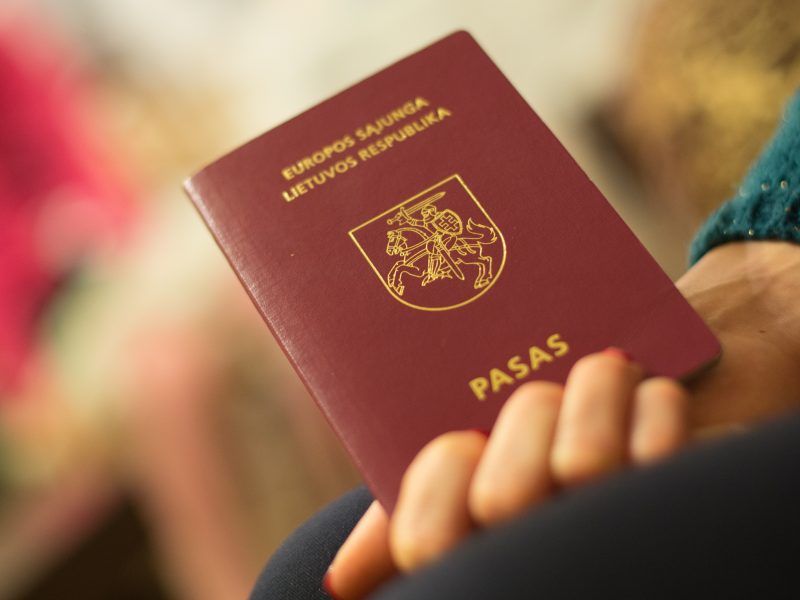
The identity and citizenship of citizens of the Republic of Lithuania shall be approved by an identity card and a passport of the Republic of Lithuania. It has been established in the Republic of Lithuania Law on Identity Card and Passport that an identity card shall be designated for use in the Republic of Lithuania and may be used to travel to foreign states where identity cards are recognized as a travel document. Citizens of the Republic of Lithuania can travel with an identity card through all the countries of the European Union, whereas a passport of the Republic of Lithuania is intended for travelling to all foreign countries, including the non-EU countries, as well as for usage in the Republic of Lithuania.
All citizens residing in the Republic of Lithuania must hold an identity card or a passport from the age of 16 years. Citizens who reside in the Republic of Lithuania and have attained the age of 16 years shall submit documents for the issue of an identity card or a passport to the division of the Migration Department not later than within one month after they attain the age of 16 years.
Citizens of the Republic of Lithuania residing abroad or citizens of the Republic of Lithuania under the age of 16 years shall also have passports issued at their request.
Identity cards and passports of the Republic of Lithuania shall be issued and replaced by the Migration Department, in certain cases – by the diplomatic missions or consular posts of the Republic of Lithuania. In order to collect a new identity document, a person must submit an identity card or a passport to be replaced. Citizens of the Republic of Lithuania may, upon request, order and hold both an identity card and a passport.
Since 04 May 2020, the Vilnius Division of the Migration Department has started to provide a new service – a collection of passport of the Republic of Lithuania on the same day, if an application is submitted before 12 p.m. Thus, it is aimed at putting forward the procedure for issuing a passport and an identity card of the Republic of Lithuania, by providing faster customer service.
Up to now, it was possible to receive a passport of the Republic of Lithuania issued in 1 working day as a matter of urgency. Such procedure shall remain in all divisions of the Migration Department, except for the Vilnius Division of the Migration Department, where a passport of the Republic of Lithuania is issued on the same day. Address of the Vilnius Division of the Migration Department: Naugarduko St. 100, Vilnius, phone for consulting: +370 707 67 000. A fee for issuance of a passport of the Republic of Lithuania on the same day is EUR 190.
After the entry into force of the amendments, the prior practice will be abandoned and there will be no longer a requirement to bring a photo of the person for a document production. A face of the person will be scanned with biometric data capture device at the division of the Migration Department, thereby ensuring photo quality and data security. Children under the age of 1 year will be subject to exceptions.
MIGRATION LAW CENTER


As of 01 January 2021, amendments to the Republic of Lithuania Law on Citizenship have entered into force, which vested the right to dual (multiple) citizenship for all minors who acquired citizenship of the Republic of Lithuania by birth. In accordance with the new provisions of the Law on Citizenship of the Republic of Lithuania, all minors until 18 years old, who acquired citizenship of the Republic of Lithuania by birth, have the right to multiple citizenship, i.e. the right to hold both Lithuanian and other country citizenship, regardless of when they acquired citizenship of other country – by birth or later, until they reached 18 years old.
Subparagraph 11 of Article 7 of the Republic of Lithuania Law on Citizenship, which regulates the cases when a citizen of the Republic of Lithuania may be a citizen of another state at the same time, establishes that a citizen of the Republic of Lithuania may be a citizen of another state at the same time, provided he is a person who acquired citizenship of the Republic of Lithuania by birth and acquired citizenship of another state until he reached 18 years old by means other than by birth.
Persons who acquired dual or multiple citizenship before 18 years old will be entitled to retain it after they reach the age of majority.
If the minors, who acquired citizenship of the Republic of Lithuania by birth, have subsequently lost it, they may have citizenship of the Republic of Lithuania reinstated.
It should be noted that a person must notify on the acquired citizenship of another state to the Migration Department or a diplomatic mission or consular post of the Republic of Lithuania, within 2 months from the date of the acquisition of citizenship of another state. The notice shall be submitted through the Lithuanian Migration Information System (MIGRIS).
Under the provisions of the Law on Citizenship of the Republic of Lithuania, regulating the matters of dual citizenship of the minors, which were effective until now, the right to multiple citizenship could only be claimed by minors who acquired citizenship of the Republic of Lithuania and of another state by birth.
MIGRATION LAW CENTER


On 22 September 2021, by the Resolution No 761, the Government of the Republic of Lithuania has changed the Resolution No 280 of 03 April 2013 of the Government of the Republic of Lithuania “On the Grant of Authority while Exercising the Law on Citizenship of the Republic of Lithuania and Approval of the Description of the Procedure for Preparing Documents Relating to Citizenship of the Republic of Lithuania” and set forth it in a new version, and approved the Description of the Procedure for Submission and Examination of Documents Relating to Lithuanian Citizenship.
The Description of the Procedure for Submission and Examination of Documents Relating to Lithuanian Citizenship alongside other matters regulates the procedure for submitting applications for Lithuanian citizenship and notices, by stipulating the following:
Applications for citizenship of the Republic of Lithuania, notices, applications for permission to swear an oath to the Republic of Lithuania, as well as applications for issuance or change of the certificate of the right to reinstate citizenship, and applications for issuance or change of the certificate of Lithuanian origin must be completed in Lithuanian or English through the Lithuanian Migration Information System (hereinafter – MIGRIS). Moreover, the documents enclosed to these applications or notices, except for travel documents, must be drawn up in Lithuanian or a translation of such documents into Lithuanian is to be provided, which must be certified by a person or institution having a right to attest a translation from one language to another.
Further, each individual document issued by the foreign states and each individual document approved by the foreign state under the notarial or equivalent procedure must be legalized or certified by Apostille, unless otherwise specified in International Treaties of the Republic of Lithuania, or EU legislation.
When filling in an application for Lithuanian citizenship through MIGRIS, the persons shall submit data specified in the Procedure and annex digital copies of original documents or copies of such originals certified under the notarial or equivalent procedure.
If a person is willing that his or her application for reinstatement of citizenship of the Republic of Lithuania would be examined by using documents annexed to an application for Lithuanian citizenship of other person, he or she shall submit a signed application of free form, wherein this person indicates that he or she requests to examine his or her application for reinstatement of citizenship of the Republic of Lithuania by using documents annexed to an application for Lithuanian citizenship of other person, and specifies this person (name, surname, date of birth).
If the representative authorized by the person will submit original documents to the Migration Department, he or she has to additionally append a representation agreement or a certified copy thereof (where the original documents are provided by lawyers), or the power of attorney certified by the notary public (where the original documents are provided by other authorized representatives).
Finally, the Description of the Procedure for Submission and Examination of Documents Relating to Lithuanian Citizenship also regulates the procedure for acceptance and examination of applications for Lithuanian citizenship and notices, the decision-making procedure, as well as the procedure for collecting a certificate of the right to reinstate Lithuanian citizenship or certificate of Lithuanian origin, and the procedure for recognizing these certificates invalid.
MIGRATION LAW CENTER


Citizens of Lithuania who have registered marriage in foreign institutions must include it into record of Lithuania.
In order to include marriage into record of Lithuania, citizens of Lithuania shall submit documents to the Civil Registry Office by residence thereof, or to the Lithuanian Embassy or Consulate.
The following documents shall be submitted:
- Document confirming the identity of a person;
- Certificate of marriage issued by the foreign institution;
- If one of the spouses is a citizen of foreign state, who is divorced or is a widower, a document issued by competent authority of the state thereof, approving his/her divorce or death of the former spouse shall be additionally provided.
Documents issued by foreign institutions must be legalized or certified with an Apostille certificate, unless specified otherwise by the International Treaties of the Republic of Lithuania and the European Union legislation, and must be translated into Lithuanian.
After a submission of documents, the Lithuanian equivalent to this document shall be issued to citizens of Lithuania.
MIGRATION LAW CENTER


On 20 January 2022, the Seimas of the Republic of Lithuania adopted the Law Amending Article 2 of the Republic of Lithuania Law on Citizenship No XI-1196, whereby it sets up the concept of a person who held citizenship of the Republic of Lithuania before 15 June 1940.
Moreover, Article 2 of the Law on Citizenship of the Republic of Lithuania was amended by paragraph 11, which establishes that
“A person who held Lithuanian citizenship before 15 June 1940 shall mean a person who held citizenship of the Republic of Lithuania at any time prior to 15 June 1940. This concept shall not embrace individuals who have lost Lithuanian citizenship after carrying out the mandatory procedures provided for in the laws of the Republic of Lithuania and for whom decisions on the loss of Lithuanian citizenship stipulated in the laws of the Republic of Lithuania have been adopted.”
This amendment to the Law on Citizenship of the Republic of Lithuania is aimed at mitigating the burden of proof for those persons who are applying for reinstatement of Lithuanian citizenship. Clarifications of legal acts provided by the Courts of the Republic of Lithuania have determined the practice applied by the Migration Department in proceedings concerning reinstatement of Lithuanian citizenship, when individuals applying for reinstatement of Lithuanian citizenship had a disproportionately high burden of proof laid on them to provide evidence that an ancestor (or the person himself) who possessed Lithuanian citizenship had not lost it by 15 June 1940. Furthermore, a person or his ancestor (parents, grandparents, great-grandparents, or one of them) had to be a Lithuanian citizen before 15 June 1940 and on 15 June 1940.
It was assessed during the process of restoration of Lithuanian citizenship on 15 June 1940 whether a person, who fled the Republic of Lithuania before 15 June 1940, acquired citizenship of a foreign state. The moment of acquiring foreign citizenship is of vital importance, as well as the basis of acquiring citizenship of a foreign state, documents with which the person who departed from the territory of the present Republic of Lithuania lived abroad, whether he has addressed the Lithuanian mission abroad for the issuance (extension) of documents evidencing Lithuanian citizenship. Until now, the person who has acquired foreign citizenship before 15 June 1940 was considered to have lost citizenship of the Republic of Lithuania prior to 15 June 1940.
The Methodology of Examining Applications for Reinstatement of Citizenship of the Republic of Lithuania prepared by the Migration Department on 10 September 2020 laid down that if, on the basis of documents submitted by an applicant and/or received by the Migration Department, it is identified that a person, by whom citizenship of the Republic of Lithuania held before 15 June 1940 is being proved, voluntarily renounced or deliberately sought to renounce citizenship of the Republic of Lithuania (e.g. when acquiring citizenship of another state, he indicated that he had renounced citizenship of the Republic of Lithuania), but there is no data that a person would have lost (ceased) citizenship of the Republic of Lithuania prior to 15 June 1940, then such a person is considered to have lost citizenship of the Republic of Lithuania before 15 June 1940, and a submission for non-reinstatement of citizenship of the Republic of Lithuania is to be prepared.
The Supreme Court of Lithuania clarified in the Resolution in the Civil Case No e3K-3-284-219/2020 dated 04 November 2020 that provisions for the legal regulation of citizenship of the interwar Republic of Lithuania provide grounds to make a conclusion that a person, who held citizenship of the Republic of Lithuania according to norms of laws effective at that time, could have been recognized as having lost citizenship of the Republic of Lithuania in the cases established by law. It should be concluded from the specified regulation that the reasons determining this may have been related to a person’s departure to another state, his failure to perform certain obligations (to register, withdraw identity documents), and loss of connection with the Lithuanian life.
Amendments to the Law on Citizenship of the Republic of Lithuania adopted by the Seimas of the Republic of Lithuania should mitigate the burden of proof for those persons who are applying for reinstatement of Lithuanian citizenship. They should also expand the possibilities of exercising the right to reinstate citizenship of the Republic of Lithuania.
The Law Amending Article 2 of the Republic of Lithuania Law on Citizenship No XI-1196 enacted by the Seimas of the Republic of Lithuania shall come into force after it is signed by the President of the Republic of Lithuania.
MIGRATION LAW CENTER

Registration of Child Birth Born Abroad in Lithuanian Civil Records
In accordance with the legislation of the Republic of Lithuania, if at least one parent of a child born abroad is a Lithuanian citizen, the child’s birth must be included in the Lithuanian Civil Registry. This requirement ensures that the child’s Lithuanian citizenship rights are properly documented and recognized by the state. It is important to understand that this obligation applies regardless of the child’s citizenship at birth, and it provides legal certainty for the child in the future.
Registering a child’s birth is not only a legal requirement but also a crucial step for families who want to ensure access to Lithuanian passports, identity documents, and other rights associated with citizenship. Many parents find this process straightforward when they are well-informed about the necessary documents, submission options, and legal steps involved.
Registration of Child Birth Born Abroad in Lithuanian Civil Records is a mandatory legal procedure for Lithuanian citizens living abroad who want their child’s birth to be officially recognized in Lithuania.
Registration of Child Birth Born Abroad in Lithuanian Civil Records: Who Must Register
This obligation is part of the Registration of Child Birth Born Abroad in Lithuanian Civil Records process and applies regardless of the child’s citizenship.
The registration requirement applies in the following cases:
-
At least one parent is a citizen of Lithuania, regardless of the child’s citizenship.
-
The child is born abroad, and the parents wish to secure Lithuanian citizenship rights and access to official documents such as passports or national ID cards.
It is advisable for parents to register the child’s birth as soon as possible after the birth, as this can prevent delays in obtaining official documents later. Early registration also simplifies procedures related to travel, healthcare, and education, as the child’s citizenship is officially documented.
Required Documents for Child Birth Registration Abroad in Lithuania
To include a child’s birth in the Lithuanian Civil Registry, the following documents are generally required:
-
Identity document of the parent(s) or legal representative, such as a passport or ID card.
-
Birth certificate issued by the foreign state. This document must be legalized or certified with an Apostille, unless specified otherwise by international treaties of Lithuania or EU legislation. Additionally, the foreign birth certificate must be translated into Lithuanian by a qualified translator to be accepted by Lithuanian authorities.
Parents should also ensure that all documents are complete, accurate, and properly certified. Missing or incorrectly prepared documents can lead to delays or the need to resubmit the application. In some cases, additional documents proving family relationships may be required, especially if one parent’s citizenship is unclear or if the child was adopted.
Where and How to Submit Documents for Registration of Child Birth Born Abroad
Documents may be submitted to:
-
The Lithuanian Civil Registry Office in Lithuania.
-
Lithuanian diplomatic missions abroad, which forward documents to the Civil Registry Office.
-
E-Government Gateway Portal (E-Government services).
Documents can be submitted in person by the parents or through an authorized representative in Lithuania. It is important to note that applications submitted through other channels may not be accepted, and missing deadlines or improper submission may invalidate the registration request.
Practical Steps for Registration of Child Birth Born Abroad
Completing the Registration of Child Birth Born Abroad in Lithuanian Civil Records is a necessary step before applying for a Lithuanian passport or identity document for the child.
After confirming Lithuanian citizenship, parents may proceed with applying for a Lithuanian passport for the child or identity card. Before applying for the passport:
-
The child’s birth must be registered in Lithuania.
-
All required documents must be properly legalized, apostilled, and translated into Lithuanian.
Once the registration is complete, parents can schedule an appointment at the Migration Department in Lithuania or at a Lithuanian consulate abroad to apply for Lithuanian passport. Obtaining the passport is an important step to ensure that the child can travel internationally and exercise all rights associated with Lithuanian citizenship.
Parents should also keep copies of all documents and official confirmations of registration, as these may be needed in the future for school enrollment, healthcare, or legal matters. Having a clear understanding of the process helps reduce stress and ensures that the child’s rights are fully protected.
Tips for a Smooth Process
-
Start the registration process as early as possible after the child’s birth.
-
Double-check all documents for completeness and correct translations.
-
Contact your local Lithuanian embassy or consulate for guidance if the child was born abroad.
-
Keep all original and certified copies organized for future use.
By following these steps, parents can ensure that their child’s Lithuanian citizenship is properly documented and that all legal rights and protections are secured.
Need Help with Registration of Child Birth Born Abroad in Lithuanian Civil Records?
We provide full legal support for Registration of Child Birth Born Abroad in Lithuanian Civil Records, including representation in Lithuania based on a power of attorney.
If you need assistance with registering your child’s birth in Lithuania, we can help. Our team can represent you in Lithuania and handle the entire registration process on your behalf, without the need to travel to Lithuania.
We work based on a power of attorney, ensuring that your child’s birth is properly included in the Lithuanian Civil Registry. This service includes:
-
Submission of all required documents to the Civil Registry Office.
-
Translation and legalization of foreign birth certificates.
-
Coordination with Lithuanian authorities.
-
Guidance on obtaining a Lithuanian passport or identity card for your child.
Contact us today via email at info@migration.lt or phone at +370 6 8563053, and we will gladly assist you every step of the way.


Reinstatement of citizenship of the Republic of Lithuania is regulated by the Republic of Lithuania Law on Citizenship, wherein paragraph 1 of Article 9 provides for that:
“Persons who held citizenship of the Republic of Lithuania before 15 June 1940 and their descendants, who have not acquired citizenship of the Republic of Lithuania before the entry into force of this law, shall have an indefinite right to reinstate citizenship of the Republic of Lithuania, irrespective of whether they are permanently residing in the Republic of Lithuania or in any other state.”
Persons referred to in paragraph 1 of Article 9 of the Republic of Lithuania Law on Citizenship may reinstate citizenship of the Republic of Lithuania, provided they are not citizens of another state. The requirement to renounce citizenship of another state shall not apply to persons who, pursuant to subparagraph 2, 3 or 4 of Article 7 of the Republic of Lithuania Law on Citizenship, may be citizens of both the Republic of Lithuania and another state at the same time.
Subparagraph 2, 3 and 4 of Article 7 of the Republic of Lithuania Law on Citizenship, regulating the cases when a citizen of the Republic of Lithuania may be a citizen of another state at the same time, establishes that a citizen of the Republic of Lithuania may be a citizen of another state at the same time, provided he meets at least one of the following conditions:
- he is a person who was exiled from the occupied Republic of Lithuania before 11 March 1990 (Subparagraph 2 of Article 7 of the Republic of Lithuania Law on Citizenship)
- he is a person who fled the Republic of Lithuania before 11 March 1990 (Subparagraph 3 of Article 7 of the Republic of Lithuania Law on Citizenship)
- he is a descendant of a person referred to in subparagraph 2 or 3 of this Article (Subparagraph 4 of Article 7 of the Republic of Lithuania Law on Citizenship)
Attention should be drawn to the fact that, in accordance with the currently valid case law of the Republic of Lithuania, a matter of the loss of citizenship of the Republic of Lithuania prior to 15 June 1940 is relevant in a process of reinstating citizenship of the Republic of Lithuania, i.e. it is important that, at the moment of departure from the current territory of the Republic of Lithuania, a person would not only be a citizen of the Republic of Lithuania, but also would not have lost citizenship of the Republic of Lithuania before 15 June 1940 due to the voluntary actions thereof.
It should be noted that the loss of citizenship of the Republic of Lithuania used to be approved by data and/or documents in the Lithuanian Central State Archives regarding the loss of person’s citizenship of the Republic of Lithuania.
On 10 September 2020, the Methodology of Examining Applications for Reinstatement of Citizenship of the Republic of Lithuania prepared by the Migration Department laid down that if, on the basis of documents submitted by an applicant and/or received by the Migration Department, it is identified that a person, by whom citizenship of the Republic of Lithuania held before 15 June 1940 is being proved, voluntarily renounced or deliberately sought to renounce citizenship of the Republic of Lithuania (e.g. when acquiring citizenship of another state, he indicated that he renounced citizenship of the Republic of Lithuania), but there is no data that a person would have lost (ceased) citizenship of the Republic of Lithuania prior to 15 June 1940, then such a person is considered to have lost citizenship of the Republic of Lithuania before 15 June 1940, and a submission for non-reinstatement of citizenship of the Republic of Lithuania is being prepared.
The Supreme Court of Lithuania clarified in 04 November 2020 Resolution in the Civil Case No e3K-3-284-219/2020 that provisions for the legal regulation of citizenship of the interwar Republic of Lithuania provide grounds to make a conclusion that a person, who held citizenship of the Republic of Lithuania according to norms of laws effective at that time, could have been recognized as having lost citizenship of the Republic of Lithuania in the cases established by law. It should be concluded from the specified regulation that the determining reasons may have been related to a person’s departure to another state, his failure to perform certain obligations (to register, withdraw personal documents), and loss of connection with the Lithuanian life.
Pursuant to the afore-mentioned case law of the Republic of Lithuania, the Migration Department has tightened up assessment of the loss of citizenship of the Republic of Lithuania before 15 June 1940. It is currently being assessed whether a person, who fled the Republic of Lithuania before 15 June 1940, acquired citizenship of another state, the moment of acquisition of foreign citizenship is relevant, as well as the basis for acquiring foreign citizenship, documents with which the person, who fled the current territory of the Republic of Lithuania, lived abroad, whether he has applied to the Lithuanian mission for the issue (renewal) of documents confirming citizenship of the Republic of Lithuania. At present, it is recognized that a person, who acquired citizenship of foreign state before 15 June 1940, shall be deemed to have lost citizenship of the Republic of Lithuania before 15 June 1940.
MIGRATION LAW CENTER


The Ministry of Foreign Affairs of the Republic of Lithuania (MFA) has submitted a proposal to the Migration Department under the Ministry of the Interior of the Republic of Lithuania to allow Lithuanian emigrants and descendants thereof to reinstate citizenship of the Republic of Lithuania, only if they come to the Republic of Lithuania to submit such applications physically. It should be noted that the Ministry of Foreign Affairs of the Republic of Lithuania has denied this fact by issuing a notice pleading an error as regards thereof.
In accordance with the Republic of Lithuania Law on Citizenship, persons who held citizenship of the Republic of Lithuania before 15 June 1940 and their descendants shall have a right to reinstate citizenship of the Republic of Lithuania. Whereas the persons shall have a right to reinstate citizenship of the Republic of Lithuania without renouncing the held citizenship of another state, provided they are persons who held citizenship of the Republic of Lithuania before 15 June 1940 and exiled from the occupied Republic of Lithuania or left the current territory of the Republic of Lithuania before 11 March 1990, and descendants of such persons.
Due to an increased number of applications for reinstatement of citizenship of the Republic of Lithuania in several regions of the world – South Africa and Latin America, a decision was made to encourage foreign Lithuanians, who are willing to reinstate citizenship of the Republic of Lithuania, to visit the Republic of Lithuania, get acquainted with its history and culture, thereby inducing them to participate in the activities of the Lithuanian community abroad.
Following the discussion and dissatisfaction concerning such obligation emerged between the Lithuanian emigrants, the Ministry of Foreign Affairs of the Republic of Lithuania has submitted an official clarification on the submission of documents of persons seeking to reinstate citizenship of the Republic of Lithuania, wherein it approved that persons willing to reinstate citizenship of the Republic of Lithuania and submit documents in this regard to competent authorities of the Republic of Lithuania, will not be obliged to arrive in the Republic of Lithuania. It should be noted that such a procedure is not provided for and arrival in person to the Migration Department under the Ministry of the Interior of the Republic of Lithuania for the matter of reinstatement of citizenship shall remain not an obligation, but rather an opportunity.
Pursuant to information provided by the Ministry of Foreign Affairs of the Republic of Lithuania, persons entitled to reinstate citizenship of the Republic of Lithuania and seeking to do hereof, will be able to continue doing this by choosing a more convenient way – coming to the diplomatic mission or consular post of the Republic of Lithuania or directly to the Migration Department under the Ministry of the Interior of the Republic of Lithuania.
The proposal of the Ministry of Foreign Affairs of the Republic of Lithuania was related to implementation of a new procedure for submitting documents regarding citizenship of the Republic of Lithuania. The Ministry of Foreign Affairs of the Republic of Lithuania offers that a person will have to fill in applications regarding citizenship of the Republic of Lithuania, in Lithuanian or English, through the Lithuanian Migration Information System (MIGRIS) and attach supporting documents to the application. The person should come to the diplomatic mission or consular post of the Republic of Lithuania and submit the originals of these documents only after receiving the confirmation of the Migration Department under the Ministry of the Interior of the Republic of Lithuania, that the application was submitted through MIGRIS and supporting documents thereof are acceptable. Thereby, a repeated arrival to the diplomatic mission or consular post of the Republic of Lithuania for submission of supporting documents would be avoided.
MIGRATION LAW CENTER
Upon restoration of independence of the Republic of Lithuania on 11 March 1990, issues of citizenship of the Republic of Lithuania were solved on the basis of the Lithuanian SSR Law on Citizenship of 03 November 1989.
Upon re-establishment of an independent state of Lithuania on 11 March 1990, the Provisional Basic Law of the Republic of Lithuania was adopted, Part 1 of Article 13 whereof stipulated that “The attributes of Lithuanian citizenship, conditions and procedures for receiving and losing it shall be defined by the Law on Lithuanian Citizenship”.
It has been established in Article 3 of the Law “Regarding the Provisional Basic Law of the Republic of Lithuania” adopted on 11 March 1991 that “Laws and other legal acts valid in Lithuania until this moment that do not contradict the Provisional Basic Law of the Republic of Lithuania shall remain in force.” There were no legal norms in the Law on Citizenship of the Lithuanian SSR that would contradict the Provisional Basic Law, therefore, this Law became the Law on Citizenship of the Republic of Lithuania after 11 March 1991. The concepts “Lithuanian SSR”, “Citizenship of the Lithuanian SSR”, “Citizen of the Lithuanian SSR” of this Law have been interpreted as changed into the concepts “Republic of Lithuania”, “Citizenship of the Republic of Lithuania”, “Citizen of the Republic of Lithuania”, respectively.
According to Article 1 of the Lithuanian SSR Law on Citizenship of 03 November 1989, the following persons shall be citizens of the Lithuanian SSR:
“1) Persons who were citizens of the Republic of Lithuania, children and grandchildren of such persons, as well as other persons who were permanent residents on the current territory of the Lithuanian SSR prior to 15 July 1940, and their children and grandchildren who now are permanent residents on the territory of the Lithuanian SSR;
2) Persons who have a permanent place of residence in the Lithuanian SSR, provided they were born on the territory of the Lithuanian SSR, or have provided evidence that at least one of their parents or grandparents was born on the said territory, and provided that they are not citizens of another state;
3) Other persons who, up to and including the date of entry into force of this Law, have been permanent residents on the territory of the Republic and have here a permanent place of employment or another constant legal source of support. Such persons shall freely choose their citizenship during two years following the entry into force of this Law;
4) Other persons who have acquired citizenship of the Lithuanian SSR under this Law.”
Part 2, Article 2 of this Law provided for that “Persons referred to in paragraphs 1, 2, and 3 of Article 1 of this Law who wish to acquire the passport of a citizen of the Lithuanian SSR, shall sign a pledge to the Republic promising to observe the Constitution and laws of the Lithuanian SSR, and to respect the sovereignty and territorial integrity of Lithuania”.
According to the Lithuanian SSR Law on Citizenship adopted on 03 November 1989, citizenship of foreign state could only be retained by citizens of another state, who acquired citizenship of the Republic of Lithuania by way of exception.
On 05 December 1991, a new Law on Citizenship of the Republic of Lithuania was adopted, which was valid until 01 January 2003. Then a new Law on Citizenship of the Republic of Lithuania was adopted on 17 September 2002.
Upon adoption of the Law on Citizenship of the Republic of Lithuania on 05 December 1991, a requirement not to have citizenship of another state was not applied to persons of Lithuanian descent who had citizenship of the Republic of Lithuania and departed from Lithuania during the period from 15 June 1940 to 11 March 1990, and to persons residing in other states, who have applied for the reinstatement of citizenship of the Republic of Lithuania.
On 04 April 2011, the Law on Citizenship of the Republic of Lithuania adopted on 02 December 2010 came into force, which clearly defined cases when a citizen of Lithuania may be a citizen of both the Republic of Lithuania and another state at the same time. This Law is also applicable now. On the basis of the Law on Citizenship of the Republic of Lithuania of 02 December 2010, the following are the cases when dual citizenship in the Republic of Lithuania is possible:
- A person was exiled from the occupied Republic of Lithuania before 11 March 1990 or is a descendant of the person who was exiled from the occupied Republic of Lithuania before 11 March 1990 (child, grandchild or great-grandchild);
- A person departed from the Republic of Lithuania before 11 March 1990 or is a descendant of the person who departed from the Republic of Lithuania before 11 March 1990 (child, grandchild or great-grandchild);
- A child has acquaired dual citizenship by birth;
- Cases of adoption;
- Cases of marriage;
- Acquisition of citizenship of the Republic of Lithuania by way of exception or while having refugee status.
Person exiled from the occupied Republic of Lithuania before 11 March 1990 means a person who held citizenship of the Republic of Lithuania before 15 June 1940 or his descendant, who were forcibly expelled from Lithuania by decisions of institutions or courts of occupation regimes in the period from 15 June 1940 to 11 March 1990 for reasons of resistance to occupation regimes, political or social reasons, or reasons of origin.
Person who fled Lithuania before 11 March 1990 means a person who held citizenship of the Republic of Lithuania before 15 June 1940 or his descendant, who left the current territory of the Republic of Lithuania before 11 March 1990 to reside permanently in another state, if their permanent residence on 11 March 1990 was outside Lithuania. This term does not embrace persons who departed from the territory of Lithuania to the territory of the former Soviet Union after 15 June 1940.
According to the data of the Migration Department under the Ministry of the Interior of the Republic of Lithuania, since April 2011 citizenship of the Republic of Lithuania has been restored to 9 661 persons having connection with citizenship of the Republic of Lithuania until 15 June 1940 – these were mostly cases of multiple citizenship. Citizenship of the Republic of Lithuania is most frequently restored by citizens of the following states: Israel, Republic of South Africa, Brazil, Argentina, Uruguay, United States of America, Russia, Ukraine, Venezuela.
MIGRATION LAW CENTER

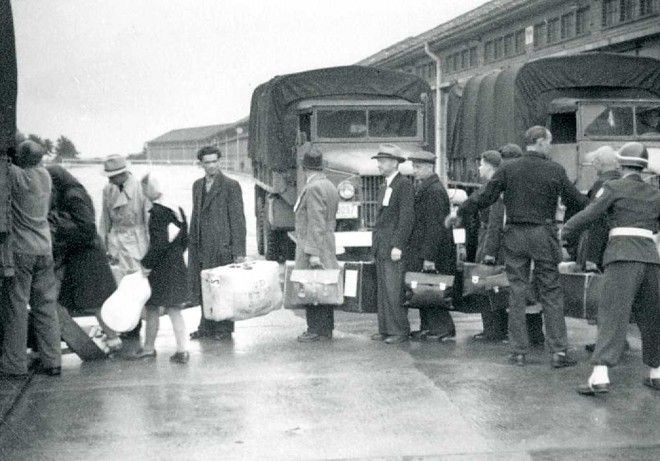
After the war between Germany and Soviet Union in 1941, Lithuania had to survive the exploitation of another occupier, atrocities and deportations, and massacres of Lithuanian citizens.
In the summer of 1944, at the approach of the German and Russian military front, Lithuanian residents massively departed to the West. It was a natural, unplanned, non-organized and unmanaged escape from home. It was thought that it would last if not days or weeks, then at least no longer than several months. These fugitives could not imagine that they would find themselves in the farthest countries of the world a few years later.
The following categories of emergence of Lithuanian residents in the West shall be distinguished:
1) Refugees who escaped due to the Soviet occupation of Lithuania on 15 June 1940. It is estimated that 1,000-2,000 people have left Lithuania.
2) Those who were moved to Germany according to the repatriation agreement concluded between Germany and the Soviet Russia on 10 January 1941. 50,141 persons departed during the period from 03 February 1941 to 25 March 1941, about 20,000 Lithuanians could be among the displaced.
3) Persons arrested under coercion and exiled during the German occupation:
a) Exiled under coercion by Germans to work in the Reich – 75,000. Their recruitment started in the middle of 1941, later on they were captured by all means. They have worked in industry and agriculture.
b) Coerted into German army or auxiliary military service – 50,000.
c) Coerted prisoners. A significant number of Lithuanian innocent victims in 1943-1944 was in prisons and concentration camps. About 10,000 Lithuanians, a total of about 30,000 Lithuanian citizens, were killed in concentration camps.
d) Evacuated to Germany, with German troops withdrawing from Lithuania, who were expelled to dig trenches, or servants escorting evacuated bodies from Lithuania.
4) Lithuanians who arrived in 1944, by saving their lives as the front and the second Soviet occupation approached.
It is estimated that about 100,000 Lithuanians were moving from their homeland at that time, but only a part of them has reached the West.
In total, more than 250,000 Lithuanians were more or less forced to leave their homeland during the war.
On 31 December 1946, 58,805 Lithuanians were patronized by UNRRA in Germany, about 6,500 Lithuanians were in other regions. Most of them consisted of refugees of 1944. There were also refugees from the Klaipėda region, that until 1939 was the territory of Lithuania. Part of those refugees should be considered Lithuanians, even though they had German citizenship and were not accepted to camps.
Under general census of Germany carried out in 1950, 49,000 people who came from the Klaipėda region were counted. Only 3 per cent of them have lived in camps and received UNRRA welfare. Thus, at least 10,000 of Lithuanians from the Small Lithuania should be added to 70,000 Lithuanians from the Great Lithuania.
Most of Lithuanians, who arrived to the West after war, settled themselves in camps of various sizes in Germany and Austria.
Provisions of the Lithuanian legislation shall entrench the right of persons who held Lithuanian citizenship until 15 June 1940 and departed from Lithuania until 11 March 1990, and the right of their descendants to restore Lithuanian citizenship upon preservation of the current citizenship (right into dual (multiple) citizenship).
A person willing to restore Lithuanian citizenship upon preservation of the current citizenship must prove the following main circumstances:
1. Lithuanian citizenship until 15 June 1940;
2. The fact of departure from Lithuania until 11 March 1990, or the fact of exile;
3. Family relationship;
4. Data change, if personal data was altered.
Documents confiming Lithuanian citizenship until 15 June 1940 are as follows:
1. Lithuanian internal or foreign passports issued until 15 June 1940;
2. Lithuanian foreign passports issued by the Lithuanian diplomatic missions or consular posts after 15 June 1940;
3. Documents certifying the person’s service in the Lithuanian Armed Forces or work in the civil service;
4. Birth certificates or other documents, wherein the held Lithuanian citizenship is directly indicated;
5. Personal certificates issued before 15 June 1940 in Lithuania, or personal certificates issued in accordance with documents that have been issued before 15 June 1940.
If the abovementioned documents are not available, the following documents can be submitted: documents about learning, work, life in Lithuania until 15 June 1940, as well as a foreign passport, and other documents.
An application for the restoration of Lithuanian citizenship shall be completed in Lithuanian. The documents enclosed thereto must be translated into Lithuanian and approved in accordance with the procedure established by legislation (Apostille or legalization procedure shall be applied).
Documents shall be submitted to the Migration Department or Lithuanian Embassy, or Consular Office abroad.
MIGRATION LAW CENTER
Citizens of the Republic of Lithuania shall have all rights, freedoms and responsibilities established by the Constitution, laws and other legal acts of the Republic of Lithuania, as well as international treaties to which the Republic of Lithuania is a party.
Citizen of the Republic of Lithuania must comply with the Constitution, laws and other legal acts of the Republic of Lithuania, as well as international treaties to which the Republic of Lithuania is a party, fulfil the responsibilities set forth therein, protect the interests of the Republic of Lithuania, help strengthen its power and authority, and be loyal to it.
Citizens of the Republic of Lithuania shall be entitled to freely leave the territory of Lithuania and return to it.
Citizens of the Republic of Lithuania shall freely move within the EU Member States, reside and work therein, under the same conditions as nationals of those Member States.
Citizens of the Republic of Lithuania can participate in political life of Lithuania, i.e. shall have a suffrage in Presidential elections, elections to the Seimas of Republic of Lithuania, municipal elections, and elections to the European Parliament.
The Republic of Lithuania shall defend and protect its citizens outside the territory of the Republic of Lithuania.
A citizen of the Republic of Lithuania may not be expelled from the territory of the Republic of Lithuania.
A citizen of the Republic of Lithuania may not be extradited to another state, except in cases provided for in international treaties to which the Republic of Lithuania is a party.
MIGRATION LAW CENTER
Read more:


The possession of citizenship of the Republic of Lithuania grants to a person certain rights, freedoms and guarantees, the aliens residing in Lithuania are not granted whereby, or are granted to a narrower extent. Therefore, it is a merit to be a citizen of the Republic of Lithuania for the following reasons:
– The possession of citizenship of the Republic of Lithuania shall be considered as the person’s permanent legal relationship with the State of Lithuania, which is based on mutual rights and obligatios. Citizens of the Republic of Lithuania shall have all rights, freedoms and responsibilities established by the Constitution, laws and other legal acts of the Republic of Lithuania, as well as international treaties to which the Republic of Lithuania is a party.
– The State of Lithuania shall defend and protect its citizens not only in the territory of the Republic of Lithuania, but also outside boundaries thereof.
– A citizen of the Republic of Lithuania may not be expelled from the territory of the Republic of Lithuania.
– A citizen of the Republic of Lithuania may not be extradited to another state, except in cases provided for in international treaties to which the Republic of Lithuania is a party.
– Citizens of the Republic of Lithuania shall be entitled to freely leave the territory of Lithuania and return to it.
– Citizens of the Republic of Lithuania shall freely move within the EU Member States, reside and work therein, under the same conditions as nationals of those Member States.
– Citizens of the Republic of Lithuania can benefit from visa issue privileges when travelling to countries, with which Lithuania has entered into agreements regarding an application of such privileges to its citizens (for instance, when travelling to Ukraine, Belarus, Russia).
– Citizens of the Republic of Lithuania shall participate in political life of the Republic of Lithuania, i.e. shall have a suffrage in Presidential elections, elections to the Seimas of Republic of Lithuania, municipal elections, and elections to the European Parliament.
– Citizens of the Republic of Lithuania can use services provided by the state health and social security systems, and other rights established by law.
MIGRATION LAW CENTER
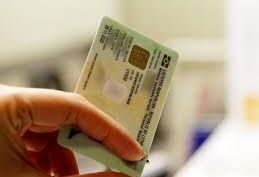
Since 01 March 2019, amendments to the Republic of Lithuania Law on the Legal Status of Aliens and Order No 1V-194 of the Minister of the Interior of the Republic of Lithuania “Regarding the Approval of the Description of the Procedure for Issuing a Certificate of the Right of Temporary or Permanent Residence in the Republic of Lithuania” as of 22 February 2019 have entered into force.
By this Order, from 01 March 2019, citizens of the Member States of the European Union and of the European Free Trade Association entitled to temporarily or permanently reside in the Republic of Lithuania will be issued with certificates of the new format – documents in the card form, wherein biometric data – facial image and two fingerprints – of EU citizens for the confirmation of identity will be electronically recorded.
Up to now, A4 format paper certificates approving the right of citizens of the European Union of temporal or permanent residence in the Republic of Lithuania were issued. Nevertheless, very often due to a document of such form EU citizens used to confront with problems in public, as well as in private life, when it was necessary to provide the certificate.
Certificates already issued will be valid for the entire specified term, however, from 01 March 2019, EU citizens will be able to replace them with the document of a new type – certificate. Terms of validity of this document remain the same, certificates confirming the right of temporal residence in the Republic of Lithuania are being issued for the duration of 5 years or for the shorter stipulated period of residence in the Republic of Lithuania, whereas the certificates confirming the right of permanent residence in the Republic of Lithuania are being issued for the period of 10 years.
The certificates will be issued no later than within one month after the submission of the application. The public fee for the issue or renewal of the certificate is EUR 8.6.
Moreover, other amendments on the convenience of EU citizens have been adopted, precisely, not only the citizen of EU himself, but also a person authorized by him/her will be able to collect certificates. In certain cases, documents may be presented not only translated to Lithuanian, but also to English.
MIGRATION LAW CENTER
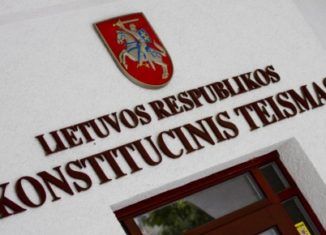
On 19 February 2019, the Constitutional Court of the Republic of Lithuania has adopted the ruling, whereby the referendum on dual citizenship cannot take place in two days. Such a ruling reduces the chances of adopting the necessary constitutional amendment, allowing more people to acquire dual citizenship.
In order for the referendum on dual citizenship to take place, the majority or about 1.3 millions voters residing in Lithuania must vote therein.
Most analysts agree that votes would be given for the amendment, allowing more people to acquire dual citizenship, however, a concern arises that it may be considered invalid due to an insufficient number of votes. The Seimas put efforts to increase the chances of success of the referendum on dual citizenship, allowing the voters to vote in two days together with the Presidential Elections in May 2019. After the Ruling of the Constitutional Court of the Republic of Lithuania allowing voters to vote only during one day, the chances of successful referendum on dual citizenship have dramatically reduced, as the set requirements are very high.
The Chairman of the Seimas Viktoras Pranckietis believes that in such a case the referendum on dual citizenship should be held on 12 May 2019, together with the first round of the Presidential Elections.
The Seimas of the Republic of Lithuania will have to adopt a new resolution regarding the procedure for referendum on dual citizenship.
MIGRATION LAW CENTER


Since the end of the 19th century, Lithuania has been one of the Eastern European countries providing the largest number of emigrants to the World.
Lithuania has experienced four waves of emigration therefrom:
- economic emigration at the end of the 19th century and at the beginning of the 20th century;
- Emigration from Lithuania during the period 1920-1940;
- Emigration of political refugees who fled Lithuania at the end of World War II (Displaced Persons);
- Contemporary emigration from Lithuania.
A large number of residents emigrated from the territory of Lithuania to the present South African Republic at the end of the 19th century and at the beginning of the 20th century. Frequently, such emigration was influenced by economic reasons, as well as by ideological, political and historical motives: Czarist policy of Russification, growing national movement, defeat of the Revolution in 1905, wars, etc.
During the period of Independence of Lithuania (1918-1940), Lithuania experienced the second huge wave of emigration. The causes of such emigration were also mostly economic, but in certain cases historical and political.
In 1918–1940, after introduction of immigration quotas in the United States of America, the hugest flow of emigrants from Lithuania turned to South America. Lithuanians comprised the majority of emigrants, Jews were the second. The most part of emigrants of Jewish nationality departed to Palestine and the present South African Republic.
During the period 1920–1940, 102.511 residents emigrated from Lithuania, wherefrom 30.869 moved to the United States of America, 24.982 – to Brazil, 16.794 – to Argentina, 7.942 – to Canada, 4.437 – to Uruguay, and the rest 5.264 departed to other countries. 7.215 of all emigrants of Lithuania departed to the South African Republic, and 5.008 – to Palestine. The vast majority of those who departed to the South African Republic and Palestine were of Jewish origin. During years 1923–1939, approx. 25.000 Jews left Lithuania. During the period of 1920–1940, 7.200 Jews moved to the territory of the present South African Republic, and 5.000 Jews departed to Palestine. On the 4th decade of the 20th century, the emigration of Jews would have been much greater, but it was hindered by emigration restrictions in the United States of America and other countries, and by the policies of the English administration that restrained Jewish emigration to Palestine. The economic situation of the state was extremely difficult, at that time it was risky to set up a business, therefore, Jewish people emigrated to Palestine and the present South African Republic. The founders of the Jewish Community in the South African Republic were Jews who arrived there from Lithuania in the 19th century. In the South African Republic, the majority of Jews were comprised of aliens from Kaunas governorate. Currently, about 80 per cent of Jews in the South African Republic are Litvaks, i.e. Jews who came from Lithuania. More than a half of Litvaks in the South African Republic arrived from Panevėžys, Rietavas, Palanga, Joniškis and Šiauliai. The history of Lithuania’s Jews (Litvaks) reaches the early Middle Ages. A larger number of Jews arrived to the present territory of Lithuania at the end of the 11th century, while running from persecution of Jews during the period of Crusades, local massacre of Jews and exiles from German-speaking territories. At first, they moved to lands inhabited by Slavic people, and then reached Lithuania.
At the end of World War II, Lithuania has experienced the third wave of emigration, when political refugees started to depart from Lithuania. Reasons of such emigration were mainly political and historical, namely, World War II, consequences thereof, occupation of Lithuania. Lithuanians who forcibly fled Lithuania receded to camps for refugees, wherefrom they did not come back to the occupied homeland. These persons were forced political expatriates. After World War II, most Lithuanians settled down in German DP camps, also, in Austrian DP camps, where political refugees were protected by international organizations UNRA and IRO, which took care of the relief, placement of war refugees and later on of their further emigration. All persons who moved from their countries were named by the term Displaced Persons.
The Lithuanian Jewish Community was almost completely destroyed during the Holocaust in Lithuania. Due to the Jewish Holocaust during World War II, Lithuania has lost more than 90 per cent of its Jewish community.
After Restoration of Independence of Lithuania until now, Lithuania has experienced emigration influenced by economic reasons.
Persons who emigrated from Lithuania used to acquire citizenship of foreign state, whereas their children, grandchildren and great-grandchildren in most cases used to become non-Lithuanian citizens. It should be noted that, in accordance with Lithuanian legislation, citizenship of the Republic of Lithuania can be reinstated without renouncing the present citizenship of foreign state (dual citizenship) for persons, who held Lithuanian citizenship before 15 June 1940 and departed from Lithuania before 11 March 1991, as well as for descendants of such persons (children, grandchildren, great-grandchildren).
In such case, in order to reinstate Lithuanian citizenship without renouncing the present citizenship of another state, the following main circumstances must be proved:
- Lithuanian citizenship until 15 June 1940;
- Departure from Lithuania before 11 March 1990;
- Other circumstances (family relationship, change of name, surname, etc.).
It is established in the Law on Citizenship of the Republic of Lithuania that persons who held Lithuanian citizenship before 15 June 1940, and their descendants, who have not acquired Lithuanian citizenship before the entry into force of this law, shall have an indefinite right to reinstate Lithuanian citizenship, irrespective of whether the country of habitual residence thereof is Lithuania or another state.
Article 7 of the Law on Citizenship of the Republic of Lithuania provides for cases when the Lithuanian citizenship may be reinstated without renouncing the present citizenship of foreign state. It is established in this Article that a citizen of the Republic of Lithuania may be a citizen of another state at the same time, provided he is a person who fled the Republic of Lithuania before 11 March 1990, or is a descendant of such person.
MIGRATION LAW CENTER
A long-awaited referendum on dual citizenship in Lithuania was held on 12 May 2019, alongside the first round of the presidential elections.
Although the referendum on dual citizenship is considered to have taken place, but votes of electors in favour thereof were insufficient. Therefore, Article 12 of the Constitution of the Republic of Lithuania regarding the retention of dual citizenship will not be amended.
Currently, there are approx. 2.4 million citizens in Lithuania who are included in the electoral register. For the referendum on dual citizenship in Lithuania to take place, a voter turnout voting in favour thereof had to be at least 1.2 million.
After having counted votes from all electoral districts, it turned out that 52.58 per cent of all eligible voters has voted in the referendum on dual citizenship. Nevertheless, in order to amend Article 12 of the Constitution of the Republic of Lithuania, 50 per cent of all registered voters of Lithuania had also to vote in favour thereof.
71.78 per cent of voters participating in the referendum has voted for the retention of dual citizenship, 26.04 per cent has voted against it. According to data of the CEC, 927,410 voters voted in favour of amendment of Article 12 of the Constitution of the Republic of Lithuania, whereas at least 1.2 million of all voters had to vote in favour thereof. It is therefore considered that this number of votes is insufficient and Article 12 of the Constitution of the Republic of Lithuania will not be amended.
MIGRATION LAW CENTER


In Lithuania the Lithuanian Migration Information System will start operating. This system is aimed at simplifying and quickening the process of submission and examination of applications and documents.
Applications of third-country nationals and EU citizens regarding documents listed thereunder will be provided to the Migration Department only by electronic means via the MIGRIS Information System:
– Applications of third-country nationals to issue/change a temporary or permanent residence permit in Lithuania;
– Applications of EU citizens to issue/change a certificate certifying the right to temporarily or permanently reside in the Republic of Lithuania;
– Applications of EU citizen’s family members to issue/change a card of permit of EU citizen’s family members to temporarily or permanently reside in Lithuania.
When submitting an application regarding the permit to reside in the Republic of Lithuania, the natural or legal person will have to sign in to the Lithuanian Migration Information System MIGRIS at address www.migracija.lt and provide all necessary documents. Application forms will have to be selected according to the alien’s nationality and purpose of arrival. Necessary documents can be provided by the alien himself or by his authorized representative, employee, higher school, etc.
When applying for an issue of permit to reside in Lithuania for the first time, the alien will have to create his personal account on a website www.migracija.lt. In order to create account, the e-mail address must be used, where the person will receive a password and will have to change it immediately, and other mandatory data.
Aliens having the right to reside in Lithuania and personal code granted herein will be able to log in the abovementioned system in the same way as Lithuanian citizens, i.e. by using e-signature, e-banking, and other opportunities. The natural or legal person of the Republic of Lithuania submitting the application for the alien will also have to use these usual means of authentication and recognition in electronic space.
When submitting an application by electronic means, the alien will have to book the time of arrival at the territorial unit of the Migration Department, arrive at the territorial unit of the Migration Department, irrespective of the declared place of residence thereof, and provide facial image and biometric data. The system will allow to choose the time of visit to the territorial unit of the Migration Department within a period of 2 months. The person will not be able to apply if he has not reserved his visit time.
Upon arrival for a visit at the territorial unit of the Migration Department, the person will have, alongside biometric data, provide originals of documents submitted electronically that were enclosed to the application. Originals will be returned after being verified by a specialist.
The alien will be able to pay the state fee for an issue of residence permit by bank transfer or cash, or bank card, upon arrival to the territorial unit of the Migration Department. There will no longer be a separate fee for document processing.
When the alien arrives at the specialist, he will check the documents submitted by the person with copies of documents submitted by e-mail, and will register the application. From the date of registration of the application, its examination term will start to be counted.
During the application examination terms which were valid until now, not only the application will be examined, but also a document will be produced.
After a positive decision is made, the person will have to come to the territorial unit of the Migration Department only to take a produced document.
If you need legal aid of lawyers of Migration Law, when submitting applications and other documents regarding an issue or change of temporary or permanent permits to reside in Lithuania, certificate of EU Citizen, or an issue or change of the card of permit of EU citizen’s family members to temporarily or permanently reside in Lithuania via the Lithuanian Migration Information System MIGRIS, please write at the following e-mail address: info@migration.lt or call by phone: +370 618 61886.
MIGRATION LAW CENTER


Lithuania has experienced four major waves of emigration of Lithuanians from Lithuania. Emigration of Lithuanians was influenced by different reasons, both economic, historical and political.
The major waves of emigration of Lithuanians from Lithuania shall be the following:
- economic emigration at the end of the 19th century and at the beginning of the 20th century;
- Emigration from Lithuania during the period 1920-1940;
- Emigration of political refugees who fled Lithuania at the end of World War II (Displaced Persons);
- Contemporary emigration from Lithuania.
The greatest emigration of Lithuanian residents to South America (Brasil, Argentina, Uruguay, Venezuela or other country in South America) occurred during the period of Independence of Lithuania. At this period, Lithuania experienced the second huge wave of emigration. The causes of this emigration were mostly economic, but in certain cases historical and political. During this period, emigration of Lithuanians to the United States of America decreased due to immigration quotas introduced in the United States of America. At that time, the majority of Lithuanians emigrated to Canada and South America (Brazil, Argentina, Uruguay, Venezuela or other country in South America), a part (mostly persons of Jewish nationality) emigrated to Palestine and South Africa. On the 3rd-4th decade of the 20th century, up to 60 per cent of all Lithuanian emigrants departed from Lithuania to South America.
In years 1920–1940, 102.511 residents emigrated from Lithuania. From this number, 30.869 residents departed to the United States of America, 24.982 – to Brazil, 16.794 – to Argentina, 7.942 – to Canada, 4437 – to Uruguay, and 5.264 moved to other countries. 7.215 residents emigrated to the South African Republic, to Palestine – 5.008 of all emigrants of Lithuania. The vast majority of those who departed to the South African Republic and Palestine were of Jewish origin.
Lithuanian emigration mostly increased to Brazil. In 1925, 22 residents moved to this country, in 1926 – 5.667 residents, in 1927 – 1.702, in 1928 – 1.199, and in 1929 – 4.536 emigrants from Lithuania. As emigration to Brazil decreased, the flow of emigrants shifted to Argentina. In 1928 – 2.151, in 1929 – 6.093, and in 1930 – 2.280 emigrants.
At the end of World War II, Lithuania has experienced the third wave of emigration, when political refugees started to depart from Lithuania. Such emigration was mainly influenced by the following political and historical reasons: World War II, consequences thereof, occupation of Lithuania. Lithuanians who forcibly fled Lithuania receded to camps for refugees, wherefrom they did not come back to the occupied homeland. These persons were forced political expatriates. After World War II, most Lithuanians settled down in German DP camps, also, in Austrian DP camps, where political refugees were protected by international organizations UNRA and IRO, which took care of the relief, placement of war refugees and later on of their further emigration. All persons who moved from their countries were named by the term Displaced Persons.
During years 1948-1950, Lithuanians from German and Austrian DP camps spread all over the World: a small part of Lithuanians left in Europe (the Great Britain, Germany, Austria), the huge wave of Lithuanians settled down in the United States of America, the rest part – in Canada, Australia, South American countries.
After Restoration of Independence of Lithuania until now, Lithuania has experienced emigration influenced by economic reasons.
Lithuanians who emigrated to countries in South America (Brazil, Argentina, Uruguay, Venezuela or other country in South America) used to acquire citizenship of foreign state, whereas their children, grandchildren and great-grandchildren in most cases used to become citizens of such foreign state. In order to maintain a legal relationship with Lithuanian emigrants, Lithuania provides for an institute for reinstatement of Lithuanian citizenship, which entitles a person, who held Lithuanian citizenship before 15 June 1940 and departed from Lithuania before 11 March 1991, to reinstate citizenship of the Republic of Lithuania without renouncing his present citizenship of foreign state (dual citizenship). Descendants of this person (children, grandchildren, great-grandchildren) can also use the possibility of reinstating the Lithuanian citizenship.
In accordance with the Law on Citizenship of the Republic of Lithuania, persons who had Lithuanian citizenship before 15 June 1940, and their descendants who have not acquired Lithuanian citizenship before the entry into force of this law, shall have an indefinite right to reinstate Lithuanian citizenship, irrespective of whether the country of habitual residence thereof is Lithuania or another state.
Article 7 of the Law on Citizenship of the Republic of Lithuania provides for cases when the Lithuanian citizenship may be reinstated without renouncing the present citizenship of foreign state. It is established in this Article that a citizen of the Republic of Lithuania may be a citizen of another state at the same time, provided he is a person who fled the Republic of Lithuania before 11 March 1990, or is a descendant of such person.
Subject to these provisions of the Law on Citizenship of the Republic of Lithuania, in order to reinstate Lithuanian citizenship without renouncing the present citizenship of another state, the following main circumstances must be evidenced:
- Lithuanian citizenship until 15 June 1940;
- Departure from Lithuania before 11 March 1990;
- Other circumstances (family relationship, change of name, surname, etc.).
MIGRATION LAW CENTER


According to valid legal norms of Republic of Lithuania, all enterprises established in Lithuania are provided a status of a legal entity. According to the goals of their establishment, legal entities are divided to private and public legal entities. The main goal of establishment of private legal entities is satisfaction of private interests and profit making. According to their legal form, such legal entities are considered joint-stock companies of limited liability, joint-stock companies, individual (one-man) enterprises, partnerships and so on, if the principal goal of their activities specified in the constituent documents is profit making. Public legal entities are established for satisfying the public interests. Such legal entities include state-owned and municipal enterprises and organizations as well as public institutions, religious communities and so on.
Both citizens of Lithuania and citizens of foreign states may establish a legal entity in Republic of Lithuania. Establishment of a legal entity includes the following phases: conclusion of pre-incorporation transaction, choosing a name for the enterprise, opening an accumulation account at a bank (the Authorized Capital of the enterprise shall be transferred to the said account; then the accumulation account shall be transformed into a current account), preparation and signing of the incorporation documents, notarization of the documents, and registration of the enterprise in the Register of Legal Entities.
In Republic of Lithuania, usually joint-stock companies of limited liability, joint-stock companies and individual (one-man) enterprises are established. An individual enterprise is a legal entity of unlimited civil liability; for its incorporation, no minimum value of the capital is set. The principal imperfection of the legal entity of this type is that the assets of the owner of the legal entity are not separated from the assets of the legal entity. This means that in case of a failure, the owner will be liable to the creditors both to the full extents of the assets of the legal entity and the own assets, i.e. when the assets of the legal entity are insufficient for fulfilling the liabilities, the owner of the legal entity shall use the own assets. A joint-stock company and a joint-stock company of a limited liability are the types of legal entities that incorporation requires a formation of an Authorized Capital divided to parts (shares). The minimum Authorized Capital for incorporation of a joint-stock company amounts to 40’000 EUR and the minimum Authorized Capital for incorporation of a joint-stock company of a limited civil liability amounts to 2’500 EUR. It should be emphasized that both a joint-stock company and a joint-stock company of a limited civil liability are legal entities of limited civil liability. This means that such a legal entity shall be liable to its creditors only to the extent of the assets of the legal entity (the assets of the owners are separated from the assets of the legal entity).
In addition to legal entities, their branches and representative offices may be established in Republic of Lithuania. In case of incorporation of a representative office, a branch of a legal entity, the legal norms of Republic of Lithuania allow providing all the rights of the principal legal entity to its branch; however, a branch shall not be provided any rights that are not provided to the principal legal entity. In case of incorporation of a legal entity, the legal norms of Republic of Lithuania provide it a finite list of rights of a legal entity, namely: to represent and protect the interests of the legal entity, to enter transactions and to carry out other actions on behalf of the legal entity as well as to carry out import and export operations upon certain condition.


Lithuania has experienced four major waves of emigration of Lithuanians from Lithuania. Emigration of Lithuanians was influenced by different reasons, including both economic, historical and political reasons.
The main waves of emigration of Lithuanians from Lithuania shall be as follows:
- economic emigration at the end of the 19th century and at the beginning of the 20th century;
- Emigration from Lithuania during the period 1920-1940;
- Emigration of political refugees who fled Lithuania at the end of World War II (Displaced Persons);
- Contemporary emigration from Lithuania.
The greatest emigration of Lithuanian residents to Australia occurred after World War II, during the third wave of emigration from Lithuania, together with emigration of political expatriates (Displaced Persons), who fled Lithuania at the end of World War II.
At the end of World War II, the emigration of Lithuanians to Australia was affected by historical and political circumstances, namely, World War II, consequences thereof, occupation of Lithuania. Lithuanians as political refugees receded to DP camps, wherefrom they were further transferred to regions of independent countries, including Canada. Most Lithuanians settled down in German DP camps, also, in Austrian DP camps, where political refugees were protected by international organizations UNRA and IRO, which took care of the relief, placement of war refugees and later on of their further emigration. All persons who moved from their countries were named by the term Displaced Persons. During this period, a huge part of Lithuanian emigrants departed to Australia.
In 1948-1950, Lithuanians from German and Austrian DP camps spread all over the World: a small part of Lithuanians left in Europe (the Great Britain, Germany, Austria), the huge wave of Lithuanians settled down in the United States of America, the rest part – in Canada, Australia, and South American countries.
Lithuanians who emigrated to Australia used to acquire citizenship of foreign state, whereas their children, grandchildren and great-grandchildren in most cases used to become citizens of such foreign country. In order to maintain a legal relationship with Lithuanian emigrants, Lithuania provides for an institute for reinstatement of Lithuanian citizenship, which entitles a person, who held Lithuanian citizenship before 15 June 1940 and departed from Lithuania before 11 March 1991, to reinstate citizenship of the Republic of Lithuania without renouncing his present citizenship of foreign state (dual citizenship). Descendants of this person (children, grandchildren, great-grandchildren) can also use the possibility of reinstating the Lithuanian citizenship.
In accordance with the Law on Citizenship of the Republic of Lithuania, persons who had Lithuanian citizenship before 15 June 1940, and their descendants who have not acquired Lithuanian citizenship before the entry into force of this law, shall have an indefinite right to reinstate Lithuanian citizenship, irrespective of whether the country of habitual residence thereof is Lithuania or another state.
Article 7 of the Law on Citizenship of the Republic of Lithuania provides for cases when the Lithuanian citizenship may be reinstated without renouncing the present citizenship of foreign state. It is determined in this Article that a citizen of the Republic of Lithuania may be a citizen of another state at the same time, provided he is a person who departed from the Republic of Lithuania before 11 March 1990, or is a descendant of such person.
Subject to these provisions of the Law on Citizenship of the Republic of Lithuania, in order to reinstate Lithuanian citizenship without renouncing the present citizenship of another state, the following main circumstances must be substantiated:
- Lithuanian citizenship until 15 June 1940;
- Departure from Lithuania before 11 March 1990;
- Other circumstances (family relationship, change of name, surname, etc.).
MIGRATION LAW CENTER


Lithuania has experienced four major waves of emigration of Lithuanians from Lithuania. Emigration of Lithuanians was influenced by different reasons, both economic, historical and political.
The four waves of emigration from Lithuania are the following:
- economic emigration at the end of the 19th century and at the beginning of the 20th century;
- Emigration from Lithuania during the period 1920-1940;
- Emigration of political refugees who fled Lithuania at the end of World War II (Displaced Persons);
- Contemporary emigration from Lithuania.
The greatest emigration of Lithuanian residents to New Zealand occurred after the emigration of political refugees who fled Lithuania at the end of World War II, during the third wave of Lithuanian emigration from Lithuania, when the emigration of political refugees (Displaced Persons) who fled Lithuania at the end of World War II took place.
At the end of World War II, the emigration of Lithuanians to New Zealand was influenced by the following historical and political circumstances: World War II, consequences thereof, occupation of Lithuania. Lithuanians as political refugees receded to DP camps, wherefrom they were further transferred to regions of independent countries, including Canada. Most Lithuanians settled down in German DP camps, also, in Austrian DP camps, where political refugees were protected by international organizations UNRA and IRO, which took care of the relief, placement of war refugees and later on of their further emigration. All persons who moved from their countries were named by the term Displaced Persons. During this period, a huge part of Lithuanian emigrants departed to Australia.
During years 1948-1950, Lithuanians from German and Austrian DP camps spread all over the World: a small part of Lithuanians left in Europe (the Great Britain, Germany, Austria), the huge wave of Lithuanian emigrants settled down in the United States of America, the rest part – in Canada, Australia, New Zealand, and South American countries.
Lithuanians who emigrated to New Zealand used to acquire citizenship of foreign state, whereas their children, grandchildren and great-grandchildren in most cases used to become citizens of such foreign country. In order to maintain a legal relationship with Lithuanian emigrants, Lithuania provides for an institute for reinstatement of Lithuanian citizenship, which entitles a person, who held Lithuanian citizenship before 15 June 1940 and departed from Lithuania before 11 March 1991, to reinstate citizenship of the Republic of Lithuania without renouncing his present citizenship of foreign state (dual citizenship). Descendants of this person (children, grandchildren, great-grandchildren) can also use the possibility of reinstating the Lithuanian citizenship.
In accordance with the Law on Citizenship of the Republic of Lithuania, persons who had Lithuanian citizenship before 15 June 1940, and their descendants who have not acquired Lithuanian citizenship before the entry into force of this law, shall have an indefinite right to reinstate Lithuanian citizenship, irrespective of whether the country of habitual residence thereof is Lithuania or another state.
Article 7 of the Law on Citizenship of the Republic of Lithuania provides for cases when the Lithuanian citizenship may be reinstated without renouncing the present citizenship of foreign state. It is established in this Article that a citizen of the Republic of Lithuania may be a citizen of another state at the same time, provided he is a person who fled the Republic of Lithuania before 11 March 1990, or is a descendant of such person.
Pursuant to these provisions of the Law on Citizenship of the Republic of Lithuania, in order to reinstate Lithuanian citizenship without renouncing the present citizenship of another state, the following main circumstances must be proved:
- Lithuanian citizenship until 15 June 1940;
- Departure from Lithuania before 11 March 1990;
- Other circumstances (family relationship, change of name, surname, etc.).
MIGRATION LAW CENTER


There are likely to be some occasions, when old documents are necessary, it is noticed that certificates of birth of individuals or their birth records did not remain. In such a case, there is a possibility to apply for a birth record recovery.
In order to recover any record of an act of civil status, a person may apply, personally or via the representative, to the Civil Registry Office, or via the MEP Information System.
When recovering a birth record, a person must first submit to the Civil Registry Office an application for recovery of birth record.
Together with an application for recovery of birth record, the following documents must also be attached:
- Notification/ response of the Lithuanian State Historical Archives on missing birth record;
- Identity document;
- Other documents related to a person whose record will be recovered, and to his/ her parents.
In the event that a birth record is to be recovered for the deceased person, the applicant’s identity document and documents evidencing the applicant’s family relationship with the deceased person must be submitted together with an application.
The following documents shall be considered eligible: person’s, whose record is to be recovered, baptism certificate, marriage conclusion document (if a person was married), documents of marriage dissolution, birth of children, marriage of parents, if parents are deceased, then death certificates of parents, birth certificates of brothers and sisters, other extracts from the civil status records of the deceased person and his/ her close relatives, approving existence of the record which is being recovered.
After having submitted an application for recovery of birth record, the Civil Registry Office also collects information on such documents, which the applicant cannot submit, but is able to provide information thereof.
When an authorized representative applies for recovery of a record of an act of civil status, the power of attorney must specify that a person is authorized to correct, amend, recover and receive all records related to actions carried out in the Civil Registry Office.
MIGRATION LAW CENTER


The grounds for the loss of Lithuanian citizenship were established in the Lithuanian Constitutions of 1922, 1928, 1938, also, in the Provisional Law on Lithuanian Citizenship of 09 January 1919, and in the Law on Lithuanian Citizenship of 08 August 1938. The Lithuanian citizenship could be lost on acquiring citizenship of another state, moreover, when residing abroad for more than two years without a foreign passport or with an invalid foreign passport.
The Provisional Law on Lithuanian Citizenship did not establish that a person who acquired citizenship of another state should lose Lithuanian citizenship. The principle of inadmissibility of dual citizenship was firstly consolidated in the Constitution of the Republic of Lithuania of 1922, wherein it was stipulated that “Nobody can be a citizen of Lithuania and a citizen of another state at the same time” (Article 9). The analogous provision was entrenched in the first paragraph of Article 10 of the Constitution of the State of Lithuania of 1928, wherein it was specified that “Nobody can be a citizen of Lithuania and a citizen of another state at the same time”. Nevertheless, the second paragraph of this Article has made an exception clause: “A Lithuanian citizen shall not lose his/her citizenship rights when becoming a citizen of any American region, if he/she performs certain obligations provided for by law.”
An official note of the Ministry of the Interior of 21 March 1935 stated that “The Lithuanian citizen by acquiring citizenship of another state shall not lose Lithuanian citizenship, if he/she has not withdrawn from the Lithuanian citizenship in accordance with the relevant procedure, thus, having received a consent of the Ministry of the Interior to withdraw from the Lithuanian citizenship.”
It has been established in Article 10 of the Constitution of 15 May 1928 that the Lithuanian citizen who has become a citizen of any American region shall not lose his/her citizenship rights, provided he/she performs certain obligations laid down by law. It should be noted that although in accordance with the specified constitutional provision the Lithuanian citizen did not lose his/her citizenship rights only if he/she “performs certain obligations provided for by law”, however, laws did not establish what obligations must be fulfilled by the person in order to retain the held Lithuanian citizenship. Therefore, the Lithuanian citizen, after acquiring citizenship of any American region, was considered not to have lost the Lithuanian citizenship. Such person was not required to perform any duties in order to be treated the Lithuanian citizen. Nevertheless, persons who acquired citizenship of any American region and retained the held Lithuanian citizenship were not allowed to have two passports at the same time: in such cases when “Lithuanian citizen after becoming a citizen of any American region and later on settling in Lithuania requests to issue him/her the Lithuanian internal passport, request thereof must be satisfied according to the rules for internal passports, <…> his/her American passport must be stored in the internal passport issuance file without annulment thereof, and it must be returned, at the request of the holder, clean and in such case the issued internal passport must be deprived and kept in the file.”
On the other hand, the constitutional provision that the Lithuanian citizen shall not lose Lithuanian citizenship after becoming a citizen of any American region was understood in a way that the held Lithuanian citizenship shall be retained only by such person who was Lithuanian citizen before an acquisition of citizenship of any American region. Persons who acquired citizenship of any American region by birth could not be issued with the Lithuanian internal passports.
Dual citizenship issues were discussed much more clearly in the Lithuanian Constitution of 1938. It has been established in paragraph 1 of Article 13 of the Constitution that “a citizen who acquired foreign citizenship shall lose the Lithuanian citizenship.” Thus, the principle of prohibition of dual citizenship was consolidated. Nevertheless, this prohibition was not absolute: it was specified in paragraph 2 of this Article that “in cases provided for by law, a citizen having a foreign citizenship may not cease Lithuanian citizenship.”
The provision that the Lithuanian citizenship shall be lost “after accepting citizenship of foreign state” was also set out in the Law on Lithuanian Citizenship, as of 08 August 1938 (paragraph 1, Article 20). In accordance with Article 21 of this Law, “Lithuanian citizen, having accepted citizenship of foreign state, shall be allowed to retain Lithuanian citizenship with the permission of the Minister of the Interior.” The laws did not specify other cases (except for the indicated permission of the Minister of the Interior) when the Lithuanian citizen, having accepted citizenship of another state, could also preserve the held Lithuanian citizenship.
The cases when the Lithuanian citizenship used to be lost after acquisition of citizenship of another state also embraced such cases when the Lithuanian citizenship was lost by a woman, “if she married a foreigner and hereby acquired citizenship of her husband.”
Attention should be drawn to the fact that a person willing to acquire citizenship of another state had to obtain acquittance from the Lithuanian citizenship. This institute was established neither in the Provisional Law on Lithuanian Citizenship, nor in any other law. Formation thereof was influenced by the fact that the Provisional Law on Lithuanian Citizenship did not provide for the person’s right to renounce Lithuanian citizenship. Such legal regulation caused problems to those Lithuanian citizens who wanted to acquire citizenship of another state when laws of such state forbade dual citizenship and when a person was requested to provide evidence that a person no longer was a citizen of “former” state thereof. The practice gradually formed that the Lithuanian citizen willing to acquire citizenship of another state had to submit an application to the Ministry of the Interior for acquittance from the Lithuanian citizenship.
The persons willing “to withdraw from the Lithuanian citizenship” had to submit applications to the county governor, and those living abroad – to the diplomatic mission or consulate of the Republic of Lithuania.
The issuance of the document of withdrawal from the Lithuanian citizenship alone did not mean that a person lost Lithuanian citizenship thereupon. A person was considered the Lithuanian citizen until he/she acquired citizenship of another state.
It should be noted that a declaration that a statutory basis has arisen was not enough for the loss of Lithuanian citizenship. The person was considered to have lost Lithuanian citizenship only then, when the Council of Ministers adopted a decision regarding the loss of Lithuanian citizenship. Such decision could be adopted by the Council of Ministers only on a proposal of the Minister of the Interior.
Information source: V. Sipavičius “Citizenship of the Republic of Lithuania in 1918-2001”
Read more:
MIGRATION LAW CENTER

Upon the Resolution No 633 of the Government of the Republic of Lithuania of 26 June 2019 on the change of Resolution No 280 of the Government of the Republic of Lithuania of 03 April 2013 “Concerning grant of authority while implementing the Law on Citizenship of the Republic of Lithuania and approval of Description of the procedure for preparing documents relating to citizenship of the Republic of Lithuania”, the Description of the procedure for preparing documents relating to citizenship of the Republic of Lithuania has been altered. New requirements for a preparation of documents relating to citizenship of the Republic of Lithuania shall be applied since 01 July 2019.
According to the Description of the procedure for preparing documents relating to citizenship of the Republic of Lithuania that has been valid until 01 July 2019, applications regarding reinstatement, renunciation, return of citizenship of the Republic of Lithuania and grant thereof by naturalization or in simplified procedure, applications regarding children’s citizenship of the Republic of Lithuania, as well as notices were submitted directly upon arrival at the County Chief Police Commissariat or the Migration Department under the Ministry of the Interior of the Republic of Lithuania, or diplomatic missions or consular posts of the Republic of Lithuania, through an authorized person or other representative, through a courier, also, by registered mail, or by electronic means.
Since 01 July 2019, there left no possibility to submit the aforementioned applications and notices through a courier or by registered mail.
It is specified in clause 3 of the Description of the procedure for preparing documents relating to citizenship of the Republic of Lithuania which is currently in force that applications regarding reinstatement, renunciation, return of citizenship of the Republic of Lithuania and grant thereof by naturalization or in simplified procedure, applications regarding children’s citizenship of the Republic of Lithuania, as well as notices shall be submitted directly upon arrival at the Migration Department under the Ministry of the Interior of the Republic of Lithuania, through an authorized person or other representative, also, by electronic means, whereas applications and notices mentioned hereinbefore to diplomatic missions or consular posts of the Republic of Lithuania shall be submitted directly upon arrival or by electronic means.
Legal assistance and consultations of lawyers in Lithuanian citizenship matters by e-mail: info@migration.lt or by phone +370 618 61886.
MIGRATION LAW CENTER


The Resolution of the Government of Lithuania entered into force on 14 December 2017, whereby powers to implement the Republic of Lithuania Law on Citizenship were granted to:
- Migration Department under the Ministry of the Interior of the Republic of Lithuania
- County Chief Police Commissariats
Forms of applications concerning the reinstatement of citizenship of Lithuania were approved (they cannot be followed, but the application must include information stipulated in the form); Ways of submitting applications of persons regarding citizenship of Lithuania were supplemented. Henceforth applications can be submitted:
- When directly arrived to the County Chief Police Commissariat or
- Migration Department, or
- Lithuanian diplomatic missions or consular offices,
- through an authorized person or other representative, courier,
- by registered mail,
- by electronic communications.
Also, it was established that documents on Lithuanian citizenship could be submitted to any institution authorized by the Government of Lithuania in order to ensure the implementation of the “one-stop-shop” principle.
MIGRATION LAW CENTER

During the period of Independence of Lithuania (1918-1940), Lithuania experienced the second huge wave of emigration. The causes of such emigration were mostly economic, but in certain cases historical and political ones. In 1918-1940, the vast majority of Jewish emigrants from Lithuania left to Palestine and the current territory of the Republic of South Africa. According to official data, 5,000 Jews departed to Palestine during the interwar period.
Within the World War II, the Holocaust in Lithuania resulted in the near-total destruction of the Lithuanian Jewish community. Lithuania lost more than 90 percent of its Jewish community due to the Holocaust of the Jews during the World War II.
In 1948 after the establishment of the state of Israel, the greater part of Lithuanian Jews emigrated from Lithuania to Israel. The emigration of Lithuanian Jews to Israel was predominantly determined by the anti-Jewish policy carried out at that time and by the consequences of the World War II.
Currently, Lithuanian Jews and their descendants residing in Israel may enjoy the opportunity of reinstating Lithuanian citizenship which is laid down by the Lithuanian legislation.
It should be noted that pursuant to legislation of the Republic of Lithuania, Lithuanian citizenship may be reinstated without renouncing the present citizenship of a foreign state (dual citizenship) for persons, who emigrated from Lithuania before 11 March 1990 and held Lithuanian citizenship before 15 June 1940 and, as well as for descendants of such persons (children, grandchildren, great-grandchildren). In this case, in order to reinstate Lithuanian citizenship without renouncing the present citizenship of another state, the following main circumstances must be proved:
- Lithuanian citizenship before 15 June 1940;
- Departure from Lithuania before 11 March 1990 (1918-1990);
- Other circumstances (family relationship, change of name, surname, etc.).
The Law on Citizenship of the Republic of Lithuania establishes that persons who had Lithuanian citizenship before 15 June 1940, and their descendants, who have not acquired Lithuanian citizenship before the entry into force of this law, shall enjoy an indefinite right to reinstate Lithuanian citizenship, irrespective of whether the country of their permanent residence is Lithuania or another state.
Article 7 of the Law on Citizenship of the Republic of Lithuania provides for the cases when the Lithuanian citizenship may be reinstated without renouncing the present citizenship of a foreign state. This Article stipulates that a citizen of the Republic of Lithuania may be a citizen of another state at the same time, provided he/she is a person who departed from the Republic of Lithuania before 11 March 1990, or is a descendant of such person.
MIGRATION LAW CENTER
Read more:
Reinstatement of Lithuanian citizenship
Granting the citizenship of Lithuania according to the simplified procedure
Certificate of Lithuanian descents
A certificate certifying a right for reinstatement of the citizenship of Lithuania
A citizenship of children
Dual children citizenship
The citizen of a spouse (a husband or a wife)
Lithuanian citizenship through the ethnic descent
Lithuanian Citizenship for Persons Having Lithuanian Ancestry. Lithuanian Citizenship for Descendants of Lithuanians
Citizenship of the Republic of Lithuania for those exiled from Lithuania. Dual citizenship in Lithuania
Lithuanian citizenship. Reinstatement of Lithuanian Citizenship without renouncing existing one (Dual Citizenship)
Lithuanian passport. Order of issuing and deadlines
Retention of dual citizenship in the case of the departure from Lithuania after 11 March 1990
Oath of Allegiance to the Republic of Lithuania
Reinstatement of Lithuanian citizenship and service in Lithuanian armed forces. Military service in Lithuania
For reinstatement of citizenship of Lithuania, it is necessary to retain citizenship of Lithuania on 1940 06 15
The Jews (Litvaks) and other emigrants who left Lithuania during the interwar period and their descendants will be able to reinstate Lithuanian citizenship or acquire double citizenship without bureaucratic obstacles
If you have any questions regarding Lithuanian citizenship or should you require more information or help, please contact us by e-mail: info@migration.lt or phone: + 370 6 1861886. We will gladly help you.

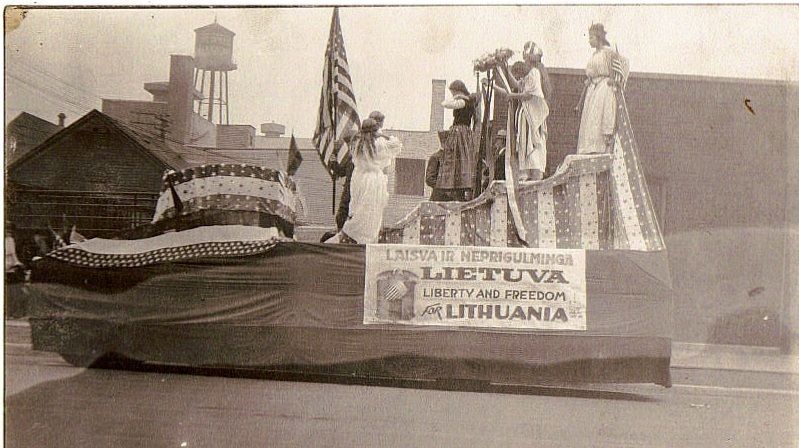
Lithuanian citizenship through the ethnic descent
Lithuanian citizenship may be acquired on certain bases provided in the Law of Republic of Lithuania on citizenship. One of the key paths is Lithuanian descent, which may entitle a person either to acquire citizenship via simplified procedure or to reinstate Lithuanian citizenship if their ancestors were citizens before June 15, 1940.
This article explains the differences between Lithuanian ethnic origin and citizenship, who qualifies, what documents are required, and how the process works under current law.
Lithuanian Origin vs. Lithuanian Citizenship
It’s important to distinguish between Lithuanian origin (ethnicity) and Lithuanian citizenship.
- Lithuanian origin should not be equalized to Lithuanian citizenship. Lithuanian origin is related to the ethnicity, the national affiliation of a person, his (her) belonging to a certain nation, ethnos or another historically developed group of people with common characteristics, such as language, culture, religion and so on, attributed to them.
- A person of Lithuanian origin can be not a citizen of Lithuania and a person of another origin (such as Jewish, Russian, Ukrainian etc.) can be a citizen of Lithuania.
Following the relevant provisions of the Law of Republic of Lithuania on citizenship, a person of Lithuanian origin is a person whose:
- parents or grandparents or at least one of the parents or the grandparents are or were of Lithuanian origin
- who self-identifies as a Lithuanian and declares this by a declaration in writing.
Simplified Procedure for Lithuanian Citizenship by Descent
A person of Lithuanian origin may be endued with Lithuanian citizenship according to the simplified procedure. In such a case, the person should renounce the previous citizenship of the other state. In addition, Certificate of Lithuanian descent and a permit for residence in Lithuania may be issued to such a person.
Reinstatement of Lithuanian Citizenship
Another way for acquisition of Lithuanian citizenship is Reinstatement of Lithuanian citizenship. Lithuanian citizenship may be reinstated for a person, if he (she) was a citizen of Lithuania before 15 June 1940 or his (her) ancestors (parents, grandparents or great-grandparents) were citizens of Lithuania before 15 June 1940. In such a case, the citizenship of the person or his (her) ancestors, not their origin, is taken into consideration. For a reinstatement of Lithuanian citizenship upon retention of the previous citizenship (Dual citizenship), the following supplemental conditions shall be satisfied:
Conditions for Dual Citizenship
- The person was deported from occupied Lithuania before 11 March 1990;
and (or) - The person had left Lithuania before 11 March 1990;
- The person is a descendant (a child, a grandchild or a great-grandchild) of the above-specified persons.
Definition of Deportation and Emigration Before 1990
A person deported from occupied Lithuania before 11 March 1990 is a person who was a citizen of Lithuania before 15 June 1940 or a descendant of such a person who were deported from Lithuania under compulsion in the period between 15 June 1940 and 11 March 1990 according to a decision of authorities or a court of the occupation regime for a resistance to the regime or political, social or origin-related reasons.
A person having left Lithuania before 11 March 1990 is a person who was a citizen of Lithuania before 15 June 1940 or a descendant of such a person having left the territory of today Lithuania for permanent residence in another state before 11 March 1990, if their place of permanent residence was out of Lithuania on 11 March 1990. This conception is not applicable to persons having left the territory of Lithuania after 15 June 1940 for any other location of the former Soviet Union.
Legal Amendments and Dual Citizenship Criteria Since 2016
Before June 2016, the Migration Department under the Ministry of Interior assessed the reasons of leaving Lithuania. For reinstatement of Lithuanian citizenship upon retaining the previous citizenship, such reasons could be historical and political (not social). After the adoption of amendments to the Law of Republic of Lithuania on 23 June 2016 by Seimas, the reasons of leaving Lithuania before 11 March 1990 ceased to be an important criterion in the process of Reinstatement of Lithuanian citizenship. If a person applies for reinstatement of Lithuanian citizenship upon retaining the previous citizenship (Dual citizenship), he (she) shall prove an existence of the following crucial circumstances:
Key Requirements for Citizenship Reinstatement
- Lithuanian citizenship before 15 June 1940;
- The fact of leaving Lithuania before 11 March 1990 and permanent residence out of Lithuania on 11 March 1990 or the fact of deportation;
- The kinship;
- The change of the personal data (the first name or the surname).
Documents Required to Prove Lithuanian Citizenship Before 1940
The documents certifying Lithuanian citizenship before 15 June 1940 include:
- Lithuanian passports (government-issued passports or passports for travelling abroad) issued before 15 June 1940;
- Lithuanian passports for travelling abroad issued by diplomatic missions or consular institutions of Lithuania after 15 June 1940;
- Documents attesting military service of the person in Lithuanian Army or his (her) involvement in civil service;
- Certificates of birth or other documents where Lithuanian citizenship of the person is specified;
- Identification documents issued in Lithuania before 15 June 1940 or identification documents issued on the base of the documents issued in Lithuania before 15 June 1940.
If the above-listed documents are absent, documents on learning, working or residing in Lithuania documents issued in Lithuania before 15 June 1940 as well as a passport of a foreign state and other documents may be submitted.
Application Requirements and Translation Guidelines
An Application for a reinstatement a Lithuanian citizenship shall be written in Lithuanian. The documents enclosed to the Application shall be translated into Lithuanian and certified according to the procedure provided in legal norms (by Apostile or according to the legalization procedure).
Where to Submit Lithuanian Citizenship Applications
The documents shall be submitted to:
- the Migration department in Lithuania – Migration department
- a diplomatic mission or a consular institution in a foreign state – Lithuanian diplomatic missions and Consular institutions
Lithuanian Citizenship Through the Ethnic Descent Benefits
Acquiring Lithuanian citizenship through the ethnic descent offers a unique opportunity for individuals of Lithuanian heritage to reconnect with their ancestral roots. This pathway allows descendants of Lithuanians — regardless of where they currently live — to obtain Lithuanian citizenship based on their lineage. One of the key benefits is the right to live, work, and study anywhere in the European Union, as Lithuania is an EU member state. In addition to EU rights, successful applicants gain access to social services, simplified property acquisition in Lithuania, and a stronger cultural and personal connection to their Lithuanian identity. Unlike other routes to naturalization, the ethnic descent process may be faster and more flexible, especially for those who can prove their Lithuanian origin through documentation. This is a powerful legal and emotional benefit for families looking to preserve their heritage for future generations.
Free Legal Assessment for Lithuanian Citizenship Eligibility
Free Legal Assessment: Lithuanian Citizenship Eligibility
The lawyers of MIGRATION LAW CENTER offer a free legal Assessment (analysis) of your options for obtaining Lithuanian citizenship. To receive a detailed analysis, please complete an application form by clicking this link – FORM.
Following a thorough legal analysis of your options that would allow to obtain Lithuanian citizenship, our lawyers will provide you with a written response (analytical results) regarding your options of obtaining Lithuanian citizenship and further requirements as well as procedure processes.
If you have any questions regarding Lithuanian citizenship or should you require more information or help, please contact us by e-mail: info@migration.lt or phone: + 370 6 1861886. We will gladly help you.

On 18 October 2018, the Seimas of the Republic of Lithuania adopted the Resolution on calling the mandatory referendum regarding the amending of Article 12 of the Constitution that defines the acquisition of citizenship.
The referendum will take place on 12 and 26 May 2019. The two days for voting are proposed subject to the fact that the provisions of the Constitution may be altered only if more than a half of the citizens of Lithuania with the electoral right, who are entered into lists of voters, vote in favour thereof. The Presidential elections and elections to the European Parliament will also be planned on these days.
According to the present Article 12 of the Constitution, citizenship of the Republic of Lithuania shall be acquired by birth or on other grounds established by law, with the exception of individual cases provided for by law, no one may be a citizen of both the Republic of Lithuania and another state at the same time.
In the mandatory referendum the following amendment to Article 12 of the Constitution will be put to vote: “Citizenship of the Republic of Lithuania shall be acquired by birth or on other grounds established by the Constitutional Law. The citizens of the Republic of Lithuania by origin shall retain their citizenship of the Republic of Lithuania when they acquire the citizenship of the state that meets the criteria of European and transatlantic integration pursued by of the Republic of Lithuania. In other cases, no one may be a citizen of both the Republic of Lithuania and another state at the same time, with the exception of individual cases provided for by the Constitutional Law. The procedure for the acquisition and loss of citizenship shall be established by the Constitutional Law.”
The Seimas working group on the referendum concerning dual citizenship decided to recommend to the Seimas to recognize member states of the European Union, as well as states belonging to NATO and OECD organizations as countries that meet the European and transatlantic integration criteria. The European and transatlantic integration criteria of the states will be established in the Constitutional Law on Citizenship.
If enough votes are gathered by the referendum, the amendments to the Constitution adopted will come into force on 01 January 2020.
MIGRATION LAW CENTER
Search and Order of Birth Certificates in Lithuania
A birth certificate is one of the most important personal documents, containing essential information about a person’s birth. It may be required in various life situations – whether you’re applying for the restoration of Lithuanian citizenship, handling inheritance matters, or managing migration-related issues.
Since January 1, 2017, in Lithuania, certificates of civil status registration have been replaced by extracts certifying entries in the civil status register. These are official documents issued in accordance with the form approved by the Minister of Justice of the Republic of Lithuania.
These extracts can be obtained in several ways:
-
Immediately after the civil status act (e.g., birth) is registered;
-
At any time by contacting a Civil Registry Office, a Lithuanian diplomatic mission abroad, or via the State Enterprise Centre of Registers;
-
Online via www.epaslaugos.lt, if you have electronic identification or online banking.
When is it necessary to obtain a birth certificate in Lithuania?
Obtaining a birth certificate in Lithuania is required in the following cases:
- Reinstatement of Lithuanian citizenship;
- Confirmation of Lithuanian ancestry;
- Handling inheritance matters;
- Obtaining a passport or other official documents;
- Immigration procedures;
- Registration of civil status acts.
Civil Registry Office Archives: Whose Records Are Stored? 
The archives of the Civil Registry Office store birth records for individuals born after 1940.
Who Can Access Civil Registry Office Archives?
- Individuals aged 16 and older can request their own extract.
- For younger individuals, their parents or legal guardians can apply.
Do You Need to Submit an Application?
Yes, to obtain an extract, you must submit an application including the following details:
- Person’s first name(s);
- Person’s last name(s);
- Date of birth or at least the year of birth;
- Place of birth.
Obtaining Birth Certificate Extracts for Relatives
If you need a birth certificate extract for relatives such as parents, grandparents, great-grandparents, spouse, or others, it can only be issued with the consent of the individual or in the event of their death. In such cases, the following additional documents are required:
- The individual’s consent or their death certificate;
- Documents proving the family relationship (e.g., birth certificate(s), marriage certificate).
Records of Individuals Born Before 1940 
The search for birth records of individuals born before 1940 is conducted at the Lithuanian State Historical Archives, located at Mindaugo g. 8, Vilnius. These archives hold the metric books of all religious communities and churches.
While the archives contain records dating back to the 16th century, not all documents have survived. The Catholic Church has the most comprehensive collection of preserved records, while records from Orthodox, Old Believers, Lutheran, Reformed Evangelical, Muslim, and Karaite communities are less extensive.
If you are submitting a request to search for birth records of individuals born before 1940, you must provide the following information:
- First name(s);
- Last name(s);
- Date of birth or at least the year of birth;
- Place of birth;
- Father’s first and last name;
- Mother’s maiden name (first and last name before marriage);
- Religious community or denomination (if known).
How Long Does the Search Take at the Lithuanian State Historical Archives?
You can choose how quickly the search will be conducted:
- Standard processing takes approximately one month;
- Faster processing takes about 10 business days;
- The fastest option completes in approximately 5 business days.
Is a Birth Certificate Search in Lithuanian Archives Important for Acquiring Lithuanian Citizenship?
Yes, a birth certificate is a crucial document for both restoring and acquiring Lithuanian citizenship, as it serves as direct evidence of kinship ties. To learn more about the requirements and procedures for obtaining Lithuanian citizenship, we invite you to visit our Lithuanian Citizenship section.
Can My or My Ancestors’ Birth Certificate Be Ordered in Lithuania and Sent to My Address?
Yes, on the basis of legal representation, the Migration Law Center lawyers can order your or your ancestors’ birth certificate. If needed, the document can also be sent to your specified address. Additionally, the document can be translated, certified with an Apostille or legalized, if required.
Why is it worth turning to professionals?
Searching for a birth certificate, especially when documents are old or incomplete, can be a complex process. That’s why it’s advisable to consult legal professionals who are well-versed in the structure of archives, document requirements, and procedural steps. Their expertise helps avoid mistakes, saves time, and ensures that the documents are obtained properly and on time.
For more information about the birth certificate search process or to request legal assistance with obtaining a birth certificate, please contact us:
- Email: info@migration.lt
- Phone: +37068563053
Frequently Asked Questions (FAQ)
How can I obtain a birth certificate in Lithuania?
A birth certificate (extract) in Lithuania can be obtained through the Civil Registry Office, Lithuanian consulates abroad, the Centre of Registers, or online via the official e-services system. It can also be ordered through an authorized representative.
Where can I search for a birth certificate in Lithuania?
If the person was born after 1940, records are stored in Civil Registry Office archives. For individuals born before 1940, records are kept in the Lithuanian State Historical Archives.
How long does it take to obtain a birth certificate in Lithuania?
Processing times depend on the type of request. Standard processing usually takes about one month, while urgent requests may take 10 or even 5 business days.
Can I obtain a birth certificate for my relatives?
Yes, but only with the person’s consent or if the person is deceased. You must also provide documents proving the family relationship, such as birth or marriage certificates.
Is a birth certificate required for Lithuanian citizenship?
Yes, a birth certificate is a key document when applying for the reinstatement or acquisition of Lithuanian citizenship, as it confirms family lineage.
Can I order a Lithuanian birth certificate from abroad?
Yes, it is possible to order a birth certificate remotely through authorized representatives or Lithuanian institutions. The document can also be translated, apostilled, and delivered to your address if needed.


Setting up a new company is one of the first steps of a new business that requires special knowledge and skills. People who consider starting a business in Lithuania often ask themselves, whether it is better to set up a company, buy an already set-up company or invest in an already established and functioning business. All of the options are favourable when starting a business in Lithuania and all have their benefits and drawbacks.
Setting up a new company seems an attractive option to people because one can be sure that the company has no debts, no negative history, it may be given any name and registered at any address, one can define its branch of activity, etc. In the case of setting up a business a person may not always find it easy to create the company’s authorised capital, which currently, according to the requirements of the Lithuanian legislation, should not be lower than 3,000 EUR (in the case of Private Limited Liability Company), and in some cases it should even be higher. Meanwhile, the authorised capital of an already set up company is already created, and this is convenient in a way. The name is usually attributed to the company but it can be changed, or the company may be set up and sold to you with the name of your choice. The companies set up for sale usually have carried out no activities, therefore, there should be no worries with regard to their history.
Investing in the business that is active in Lithuania is a convenient choice because you do not have to worry about starting everything from the beginning. You may purchase a part of the business or an entire business, you may purchase shares of the company that carries out respective activity and continue the activity characteristic of critical mass, experience, necessary knowledge, strategy, etc. In this case it is recommended to check the company/business history, presence or absence of financial debts, obligations undertaken, leases and other agreements, etc.
Therefore, where should one start upon setting up a company in Lithuania? First of all, you should decide on the company name. Then the name should be registered in the Register of Legal Entities of Lithuania. After the name has been reserved and temporarily listed in the register, the step of documentation shall begin. After the necessary company documents are prepared, an accumulation account of the company is opened in one of the Lithuanian banks. The authorised capital of the company is placed in the accumulation account (in case when, according to the Lithuanian legislation, the authorised capital must be created). After the authorised capital is created, a bank certificate is obtained to confirm that. The set-up company must have the registry address of the residence. After the address of company residence is chosen, you should receive the consent of the owner of the immovable property to which address the company will be registered. The consent issued by a natural person should be in a notarial form, and the consent issued by a legal entity should be in a written form and confirmed with a legal entity’s stamp and signed by a representative of the legal entity. This consent along with other documents (company establishment act, articles of association, document of the director appointment, bank certificate on the created authorised capital, etc.) should be transferred to a Lithuanian notary for certification. The company establishment documents, certified by a notary, shall be transferred to the Register of Legal Entities. The company registry fee shall be paid. After registering the company, the Register of Legal Entities issues the statement which confirms this fact or the access key to the electronic system (you can login to this system and print the statement there). After the receipt of the statement the company stamp is ordered.
The procedure of purchasing a company (Private Limited Liability Company) usually begins with selecting a company from the list of companies on sale. After choosing the company, the sale documents of the company are prepared. From 01 January 2015 the sale and purchase documents of a company (Private Limited Liability Company) usually must be certified by a Lithuanian notary (in case 25 percent or more than 25 percent of the shares of a Private Limited Liability Company are for sale or the price of the shares is higher than 14,500 EUR). Later the change of data is registered in the Register of Legal Entities and the change of shareholders is registered in the electronic system JADIS.
In case of purchasing a business active in Lithuania, after the business has been found, the business purchase and sale documents are prepared. In case the company shares are not for sale and only the business is purchased, the documents do not need to be certified by a notary.
The company may be established, company shares or business may be purchased on the basis of the mandate. It is unnecessary to arrive at Lithuania.
Often the clients wonder what activity will my company set-up or purchased in Lithuania carry out. According to current practice, a company in Lithuania may carry out any activity that does not contradict the Lithuanian legislation and has this fact included in its articles of association. Certain branches of activity require licence or special permits.


An alien who intends to work legally in Lithuania must obtain a work permit and a national visa D.
An alien who wishes to work in Lithuania should first find an employer – Lithuanian company that would like to hire him/her. Once finding an employer, an alien shall apply on the issue of a work permit in the Republic of Lithuania and national visa D.
Before submitting the documents for the issue of a work permit in Lithuania, the Labour Exchange of Lithuania must register a vacant position in the Lithuanian company. The vacant position shall be registered no less than 5 working days before the submission of documents for the issue of a work permit in Lithuania. During this period, citizens of Lithuania and permanent residents of Lithuania, meeting the employer’s requirements, shall have the right to apply for the vacancy. If, during this period, the employer – Lithuanian company cannot find a suitable candidate for the vacancy, the alien may submit documents for the issue of a work permit in Lithuania to an alien.
The employer will be able to employ a foreigner who meets at least one of the following conditions:
– the foreigner has a qualification related to the work to be performed, or
– the foreigner has 1 year of work experience gained in the last 3 years related to the work to be performed, or
– the foreigner is expected to be paid a monthly wage at least equal to the last published average monthly gross wage in the country’s economy for the calendar year (including the wage data of individual companies).
Place for the submission of documents for a work permit in Lithuania – a local labour exchange office.
In order to employ the alien under the employment contract, the following documents must be submitted to the Employment Service:
- An application;
- A copy of passport;
- Employer’s information on the alien’s qualification and at least one year of working experience according to his/her qualification within the last 3 years;
The employer must make sure that the alien has documents approving his/her own qualification (diploma, certificate, etc.) and at least one year of working experience according to his/her qualification within the last 3 years (work book, certificate from the previous workplace).
- Obligation to employ a foreigner in accordance with the employment contract and the employee’s average salary, if the company has more employees working in the same job as the foreigner is requested to work for;
- A copy of the payment order or a check for the issue of work permit.
Foreign documents must be legalized or certified with an Apostille in accordance with the established procedure, unless otherwise provided for by other legislation. The translation into Lithuanian of documents drawn up not in Lithuanian must be confirmed by a signature of translator. Copies of documents must be approved by signature and stamp of the head of the company.
Time limits for the issuance of a work permit in Lithuania – up to 7 working days.
After the getting of a work permit in Lithuania, documents for the issue of a national visa D shall be submitted.
Place for the submission of documents for a national visa D – a diplomatic mission or a consular post of Lithuania abroad.
Time limits for the issuance of a national visa D – up to 15 days.


On 09 January 1919, the Provisional Law on Lithuanian Citizenship was adopted. This is the first Law on Lithuanian Citizenship. Today this Law celebrates its Centenary.
The contemporary concept of Lithuanian citizenship emerged after the restoration of the independent state of Lithuania in 1918, hereupon, the institute of Lithuanian citizenship has been established.
In 1919-1940, Lithuanian citizenship was regulated by Lithuanian laws, legislation issued by public authorities and international treaties of Lithuania.
Lithuanian laws and legal acts issued by public authorities shall be referable to: 1) Constitution of Lithuania; 2) Provisional Law on Citizenship of Lithuania of 09 January 1919, Law on Citizenship of Lithuania of 08 August 1939; 3) Introductory Law on the Management of Vilnius City and its Area of 27 October 1939; 4) Statutes of Passports; 5) legal acts issued by the minister of the interior and by both the minister of the interior and the minister of justice, and explanations on issues of citizenship; 6) circulars of the Department of Civil Rights Protection and the Department of Administration under the Ministry of the Interior, as well as explanations on issues of citizenship; 7) circulars of the Ministry of Foreign Affairs on issues of citizenship.
It has been established in the first Law on Lithuanian Citizenship, the Provisional Law on Lithuanian Citizenship of 09 January 1919, that the following persons were considered to be citizens of Lithuania: “1) persons whose parents and grandparents have lived in Lithuania since ancient times and who themselves always live in Lithuania; 2) children of persons indicated in the first subsection, who even though did not always live in Lithuania, but returned to live thereto; 3) persons who have lived in Lithuania no less than ten years before 1914 and who had: a) either their own real property, b) or permanent job; 4) children of a citizen of Lithuania; 5) his wife or widow; 6) children of a not married citizen of Lithuania, if they have not been accepted by the alien as his children.”
Both this law and the current institute of Lithuanian citizenship is based upon the principle of blood law (Ius sanguinis), which is grounded by kinship, i.e. citizenship of born person shall be determined according to citizenship held by his/her parents (or one of them). In this case, the territorial factor does not play any role, citizenship of a person shall not depend on the state where he/she was born.
The Provisional Law on Lithuanian Citizenship with amendments thereto was valid until 08 August 1939, when the Law on Lithuanian Citizenship was adopted.
MIGRATION LAW CENTER


The Seimas of Lithuania has adopted amendments to the Republic of Lithuania Law on Citizenship, which will ensure retention of Lithuanian citizenship for adopted children. After an adoption of these amendments to the Republic of Lithuania Law on Citizenship, a requirement for adopted persons to decide upon retention of Lithuanian citizenship thereof until 21 years of age will not be applied. Children who have acquired dual citizenship due to adoption will be able to retain it for life.
A version of Paragraph 6 and 7 of Article 7 of the Republic of Lithuania Law on Citizenship valid hitherto has entrenched that “A citizen of the Republic of Lithuania may be a citizen of another state at the same time, provided he is a person under 21 years of age and was adopted by citizens (citizen) of the Republic of Lithuania before reaching 18 years of age and, as a result of the adoption, acquired citizenship of the Republic of Lithuania pursuant to paragraph 1 of Article 17 of this Law. Also, if he is a person under 21 years of age, provided he, being a citizen of the Republic of Lithuania, was adopted by citizens (citizen) of another state before reaching 18 years of age and, as a result of the adoption, acquired citizenship of that state.”
On the basis of provisions of the Republic of Lithuania Law on Citizenship valid hitherto, an adopted person had to decide upon country of citizenship which he/she wants to keep until he/she reaches the age of 21 years.
Amendments to the Law on Citizenship of the Republic of Lithuania enacted by the Seimas of Lithuania on 18.10.2018, which came into force on 31.10.2018, will enable adopted persons to retain dual citizenship indefinitely.
A new version of Paragraph 6 and 7 of Article 7 of the Republic of Lithuania Law on Citizenship entrenches that “A citizen of the Republic of Lithuania may be a citizen of another state at the same time, provided he is a person adopted by citizens (citizen) of the Republic of Lithuania before reaching 18 years of age and, as a result of the adoption, acquired citizenship of the Republic of Lithuania pursuant to paragraph 1 of Article 17 of this Law. Also, if he is a person – a citizen of the Republic of Lithuania, who was adopted by citizens (citizen) of another state before reaching 18 years of age and, as a result of the adoption, acquired citizenship of that state.”
Upon enactment of amendments to the Law on Citizenship of the Republic of Lithuania adopted by the Seimas of Lithuania, rights of children who were born in a family and rights of adopted children will be equalized in respect of dual citizenship. Both types of children will be able to retain dual citizenship throughout the entire life thereof, and they will not be subject to the requirement to decide upon country of citizenship they want to keep until they reach 21 years of age.
MIGRATION LAW CENTER


As of January 1, 2017, civil registry offices in the Republic of Lithuania issue extracts confirming entries of civil status acts, as determined by the Minister of Justice of the Republic of Lithuania, instead of civil status registration certificates. Applicants can obtain this extract immediately after the registration of a civil status act— in this case, after the marriage registration— or at any later time.
The extract can be obtained by applying to the Civil Registry Office in Lithuania, a consular office, or the Center of Registers. This procedure applies not only to marriage registration but also to divorce, birth, death, or changes of name or surname.
Marriage Registered After 1940
Marriage entries registered after 1940 are kept in the archives of the Civil Registry Office. Therefore, requests for extracts must be submitted to the archive of the Vilnius Civil Registry Office at K. Kalinausko St. 21, or to the Center of Registers, or a consular office.
Documents Required to Obtain a Marriage Entry Extract:
To obtain an extract of your marriage entry, you must submit a request and provide the following details:
- Names and surnames of the individuals;
- The date of marriage or at least the year;
- The place where the marriage was registered.
If you wish to obtain a marriage entry extract for relatives, such as parents, grandparents, or great-grandparents, you must provide the following additional documents:
- The individual’s consent or a death certificate;
- Documents proving kinship (e.g., birth certificate, marriage certificate, or documents confirming name or surname changes).
How Long Does the Process Take?
Requests submitted to the Civil Registry Office archives are processed in order of receipt, usually within 1 month.
Marriage Registered Before 1940
Marriage entries registered before 1940 are searched in the Lithuanian State Historical Archives, located at Mindaugo St. 8, Vilnius. These archives hold metric books of various religious communities and churches. While some books date back to the 16th century, not all documents have survived. The majority of surviving records belong to the Roman Catholic Church, but there are also records from Jewish, Orthodox, and other religious communities.
Documents Required for Searching Marriage Records:
When submitting a request to search for a marriage record, the following details must be provided:
- The names and surnames of the spouses;
- The date of marriage or at least the year;
- The place of marriage registration;
- The religion or denomination (if known).
If the parish or religious denomination is unknown, the search can begin with the bride’s place of birth, as marriages were typically registered in the bride’s parish.
How Long Does the Search Take?
The Lithuanian State Historical Archives processes requests in order of receipt within approximately 1 month. Expedited services are available within 10 or even 5 working days for an additional fee.
Is the Marriage Entry Important for Obtaining Lithuanian Citizenship?
Yes, a marriage certificate is an important document for the process of restoring or obtaining Lithuanian citizenship. It serves as proof of the marriage and, in some cases, evidence of a name or surname change.
For more information about the requirements and procedures related to obtaining Lithuanian citizenship, we invite you to visit our Lithuanian Citizenship section.
Can My or My Ancestors’ Marriage Certificate Be Ordered in Lithuania and Sent to My Address?
Yes, with legal representation, the Migration Law Center lawyers can order your or your ancestors’ marriage certificate. If needed, the document can be sent to your specified address. Additionally, the document can be translated, certified with an Apostille, or legalized if necessary.
For more information about the marriage certificate search process or to order legal assistance, please contact us:
- Email: info@migration.lt
- Phone: +370 685 63053
MIGRATION LAW CENTER

One of the ways in which Lithuanian citizenship may be acquired is a reinstatement of citizenship of the Republic of Lithuania. Lithuanian citizenship may be reinstated for a person, whose ancestors (parents, grandparents, great-grandparents, or one of them) were citizens of Lithuania before 15 June 1940, or who himself/herself was a citizen of Lithuania before 15 June 1940.
Lithuania was established as an independent state in 1918. The first law regulating the institute of Lithuanian citizenship was the Provisional Law on Lithuanian Citizenship adopted on 09 January 1919. The Provisional Law on Lithuanian Citizenship dated 09 January 1919 establishes that the citizens of Lithuania shall be:
1. Persons, whose parents and grandparents have resided in Lithuania for quite a while, and they have always resided in Lithuania themselves;
2. Children of persons specified in the first Item, who, even though have not always resided in Lithuania, finally returned to reside there;
3. Persons, who had resided in Lithuania for not less than ten years until 1914 and:
a) either owned their own real property, or
b) had a permanent job;
4. Children of a Lithuanian citizen;
5. His wife or widow;
6. Children of an unmarried woman, who is a Lithuanian citizen, if they are not accepted by a foreigner as his children.
Pursuant to the Law on Citizenship of the Republic of Lithuania that is currently in force, documents proving that the person concerned held citizenship of the Republic of Lithuania before 15 June 1940 shall be as follows:
1. Internal or foreign passports of the Republic of Lithuania issued before 15 June 1940;
2. Foreign passports of the Republic of Lithuania issued by diplomatic missions and consular posts of the Republic of Lithuania after 15 June 1940;
3. Documents attesting to the person’s service in the Lithuanian armed forces or employment in the civil service;
4. Birth certificates or other documents containing direct reference to citizenship of the Republic of Lithuania held by the person concerned;
5. Personal certificates issued before 15 June 1940 in Lithuania or personal certificates issued on the basis of documents issued before 15 June 1940;
in the absence of above-mentioned documents, documents concerning studies, work and life in Lithuania before 15 June 1940, as well as a passport of a foreign state and other documents may be provided.
Lithuanian citizenship may be reinstated for a person, if he/she renounces citizenship of another state, or without renunciation of it (retention of dual (double) citizenship). In order to reinstate citizenship of the Republic of Lithuania without renouncing the held citizenship of another state, it is not sufficient to prove the fact that a person held Lithuanian citizenship before 15 June 1940. For retention of dual (double) citizenship, such a person shall prove the following additional circumstances:
1. The fact of exile from the occupied Lithuania before 11 March 1990 (i.e. a person or his/her parents, grandparents or great-grandparents or at least one of them were exiled from Lithuania prior to 11 March 1990 or were forcibly expelled from Lithuania by decisions of institutions or courts of occupation regimes in the period from 15 June 1940 to 11 March 1990 for reasons of resistance to occupation regimes, political or social reasons or reasons of origin);
or
2. The fact of fleeing Lithuania before 11 March 1990 (i.e. a person or his/her parents, grandparents or great-grandparents or at least one of them fled Lithuania before 11 March 1990 and
their permanent residence on 11 March 1990 was outside Lithuania. It should be noted that the said concept shall not include the persons who left the territory of Lithuania after 15 June 1940 for the territory of the former Soviet Union).
An application for reinstatement of Lithuanian citizenship shall be completed in Lithuanian. The documents enclosed to an application, if they have been drawn up in another language, shall be translated into Lithuanian and certified in accordance with the procedure established by legislation (legalisation of document or approval certificate (Apostille)).
The documents shall be submitted at the Migration Department or the Embassy of the Republic of Lithuania, or a consular post in a foreign state.
FREE analysis of your options for obtaining Lithuanian citizenship
https://www.migration.lt/nemokama_analize
MIGRATION LAW CENTER
Should you have any questions regarding Lithuanian citizenship or require further information or help, please contact us by e-mail: info@migration.lt or WhatsApp/ Viber: +370 685 63053. We will gladly help you.
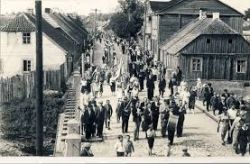
The independent Lithuanian state, re-established in 1918.
In 1919-1920, Polish and Soviet Russian troops occupied Vilnius several times in succession. Vilnius was repeatedly alternately occupied by Polish and Soviet Russian troops. In 1922, Vilnius was incorporated into Poland by military force. Over a short period between 1918 and 1922, during repeated changes of power – the Republic of Lithuania, Soviet Lithuania, the armies of Poland and Soviet Russia, the Jewish community again had to undergo significant economic hardship and national troubles.
The Lithuanian Jewish community, whose centre was the interim capital city of Kaunas, and its various representatives were actively involved in the establishment, strengthening and military defence of the Lithuanian state and in diplomatic activities aimed at its international recognition. More than 500 Jewish volunteers took part in the battles for Lithuanian independence.
The Constitution of the Republic of Lithuania of 1922 contained a provision declaring that all Lithuanian citizens were equal before the law. A special section “Rights of National Minorities” stated that to the extent prescribed by law, these minorities were autonomous in administering the affairs of their national culture, i.e. public education, charity, and mutual assistance. They elect their representative bodies to manage the affairs.
The years of 1919-1922 are marked in the historiography of Lithuanian Jews as the “golden” or “honeymoon period”. In addition to ministers, Jews had their representatives in the Sejm. The 1920 law granted the Jewish Kagals broad rights in administering spiritual religious affairs, charity, social aid, public education, and the keeping of civil status certificates.
Over a short time, Jewish organisations did a lot of work to improve the lives of thousands of Jews who had returned from Soviet Russia, to settle and provide them with work, to rebuild the devastated region, to establish a wide network of their schools, healthcare, charity, social assistance, and culture institutions.
Unfortunately, right-wing reactionary forces were strengthening in Lithuania at the time, and the liberal-democratic trend of development was weakening. The Jewish national autonomy recognized by the state, with all its organs, was gradually shrinking and was finally abolished. This also influenced the representation of Jews in the State Sejm, as well as the use of the Jewish language in state bodies. From 1924, the Minister for Jewish Affairs was no longer in government. The activities of the Jewish National Council were prohibited. In March 1926, the Jewish community kagals were abolished. The functions of civil registration were transferred to the rabbis.
After the signing of the peace treaty, about 100,000 Jews returned to Lithuania from Soviet Russia. According to the 1923 census, Lithuania (without the Klaipėda region) had 2.03 million inhabitants, including 1.7 million (84.2%) of Lithuanians and 153.7 thousand (7.6%) of Jews. As regards urban residents, 57.1% were Lithuanians, and 32% were Jews, while in rural areas, 23% of residents were Jews. In Ukmergė, they were 37%, in Panevėžys 36%, in Kaunas 27%, and in Šiauliai 25%. They lived in almost all townships.
The Jews managed to restore or re-build their homes. In many areas of trade, industry, and crafts the Jews proved to be an important force in terms of the development of new enterprises and workshops.
The unfolding of Jewish life in the environment of the Republic of Lithuania should be generally assessed positive. However, in the light of the specific historical process, it was still contradictory and dangerous tendencies had already appeared in it, the manifestations of which have initially obscured and later shook the fate of the Jews.
A military coup took place on 17 December 1926. An authoritarian-police regime was established and consolidated. Gradually, the democratic rights and freedoms, previously curtailed, were ultimately abolished. Even before the coup, in the first half of the twenties, when the Lithuanian state was consolidating, the Jewish national-cultural autonomy was liquidated in violation of international obligations and constitutional provisions.
Antisemitism became increasingly evident in Lithuania at the outbreak of the economic crisis in the late twenties and early thirties, and as Hitler came to power in neighbouring Germany in 1933. After a nine-year gap, there were no representatives of national minorities in the elected Sejms in 1936. The Constitution of 1938 no longer contained any provisions on them.
Jews became increasingly painfully aware of the uncertainty of the future under these unfavourable conditions. Concern arose about the prospects for Jewish youth in Lithuania. The only real solution was to emigrate. From 1920 to 1940, 102.5 thousand people, about 20% of them Jews, emigrated from Lithuania. Of 41.3 thousand who emigrated in 1928-1939, about 13.9 thousand (33.2% of all Lithuanian Jews) were forced to emigrate to Lithuania. Of 41,300 who emigrated in 1928-1939, 13,900 (33.6%) were Jews. In 1920-1940, 7,200 persons went to South Africa and 5,000 to Palestine, almost all of them Jewish. Jewish emigration in the 1930s could have been much greater, but it was held back by restrictions imposed by the US and some other countries, and by England’s policy of preventing Jews from moving to Palestine.
The emigration of Lithuanian Jews (Litvaks) began in the mid 19th century and continued until the late 1930s to the USA, Canada, Palestine, South America, South Africa, and Australia.
Litvaks in many places, including the US and Canada, were the first publishers, editors, and journalists of Jewish newspapers and magazines in Hebrew and Yiddish.
The first founders of the Jewish community in South Africa were Lithuanian Jews who arrived in the nineteenth century, and later a large part of the country’s Jews came from the province of Kovno. Lithuanian Jews also played an important and honourable role in the revival and expansion of the historical national hearth of Jews in Palestine.
Persons who emigrated from Lithuania commonly acquired citizenship of a foreign country, and their children, grandchildren, and great-grandchildren usually became citizens of that foreign country.
In order to maintain legal relations with Lithuanian emigrants, Lithuania provides for the institution of restoration of Lithuanian citizenship, which entitles a person who had Lithuanian citizenship before 15 June 1940 and who left Lithuania before 11 March 1990 to restore Lithuanian citizenship without giving up their existing citizenship (dual citizenship). This person’s descendants (children, grandchildren, great-grandchildren) can also benefit from the possibility to restore Lithuanian citizenship.
Under the Lithuanian Citizenship Law, persons who held Lithuanian citizenship before 15 June 1940 and their descendants who did not acquire Lithuanian citizenship before the entry into force of this Law shall have an indefinite right to restore their Lithuanian citizenship, regardless of the state in which they permanently reside.
Article 7 of the Lithuanian Citizenship Law provides for cases where Lithuanian citizenship may be restored without giving up the existing citizenship of a foreign state.
This article stipulates that a Lithuanian citizen may also be a citizen of another state if he or she is a person who left Lithuania before 11 March 1990 or is a descendant of such a person.
Considering the following provisions of the Lithuanian Citizenship Law, in order to restore Lithuanian citizenship without renouncing the citizenship held, the following key circumstances must be proven:
- Lithuanian citizenship until 15 June 1940;
- Departure from Lithuania by 11 March 1990;
- Other circumstances (kinship, change of name, surname, etc.)
MIGRATION LAW CENTER
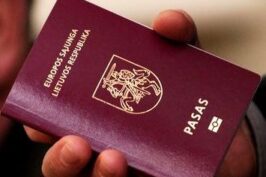
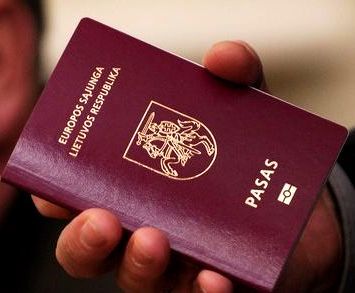
On 31 October 2017, a new resolution of the Supreme Administrative Court of Lithuania was adopted in the case of reinstatement of citizenship of Lithuania.
In the case, the applicant appealed against the order of the Minister of the Interior regarding a non-reinstatement of citizenship of Lithuania. The applicant has acquired the citizenship of another country and does not intend to renounce this citizenship. He may restore Lithuanian citizenship and have dual citizenship if he would meet the exception provided for in Subsection 7, Article 7 of the Law on Citizenship of the Republic of Lithuania – is a descendant of the person who departed from Lithuania before the restoration of independence of Lithuania on 11 March 1990. The applicant was a descendant of the person who departed from Lithuania during the World War II.
The applicant was born on 05 April 1937 not in Lithuania. His father was born on 01 January 1912 in Panevėžys and had citizenship of Lithuania. The father left Lithuania in 1935 and, in 1937, lost Lithuanian citizenship because he had voluntarily acquired the citizenship of another state. Already being a citizen of another country, he arrived in Lithuania without obstacles in 1938 and lived here until the occupation of the Soviet Union in 1941.
The applicant’s father’s departure during the World War II in 1941 may already have been influenced by political reasons. However, the father at that time was no longer a citizen of Lithuania, and the acquisition of the citizenship of another country was in 1937 due to his previous actions, not related to the political situation or the occupation regime.
The concept is entrenched in the case-law that a person who departed from Lithuania until 11 March 1990 shall be considered as a person who had Lithuanian citizenship until 15 June 1940, or as his descendant, or as persons departed from the current territory of Lithuania before 11 March 1990 to permanently live in other country, if their permanent place of residence was not in Lithuania. This concept does not embrace persons who departed from the territory of Lithuania to the former territory of Soviet Union after 15 June 1940.
On the basis of explanation of legal norms, to apply for the restoration of citizenship of Lithuania, together retaining the current citizenship of another state, can only these persons, who:
- Had citizenship of Lithuania on 15 June 1940, and the descendants of such persons.
Due to these reasons, the defendant in the case challenged the applicant’s compliance with the provisions of Section 4, Part 1, Article 7 of the Law on Citizenship of the Republic of Lithuania, and stated that they cannot be applied to the applicant as a citizen of Lithuania, who departed from Lithuania before 11 March 1990, because the departure of his father from Lithuania in 1941 does not comply with the purpose of legal regulation established by the law.
In the case-law, when applying provisions of dual citizenship exceptions, a period of Lithuanian citizenship is not defined by the date 15 June 1940 inclusive, but it is important that:
- The departure of a person from the territory of Lithuania should have been influenced by emerging or already existing unfavorable political reasons;
- At the time of departure, such person should have been Lithuanian citizen or had lost Lithuanian citizenship until 15 June 1940, not due to his volitional actions, but due to unfavorable political reasons.
Even though in the case the departure of the applicant’s father from Lithuania in 1941 could be influenced by political reasons, the Court accentuated that at that moment he was no longer a citizen of Lithuania and acquired a citizenship of other state voluntarily by previous actions, thus, he does not comply with the departure of Lithuanian citizen from Lithuania defined by law until 11 March 1990. Due to this reason, provisions of Section 4, Part 1, Article 7 of the Republic of Lithuania Law on Citizenship cannot be applied to him, regarding the exception to acquire dual citizenship as a descendant of the person who departed from Lithuania before the restoration of independence on 11 March 1990.
Therefore, the Supreme Administrative Court of Lithuania has stated in the Resolution that only those persons can apply for the restoration of citizenship of Lithuania, together retaining the current citizenship of another state, who had citizenship of Lithuania until the occupation by the former Soviet Union in 15 June 1940, and the descendants of such persons.
MIGRATION LAW CENTER


The most popular forms of legal entities (companies) in Lithuania, and their differences.
The most popular and the most common registered legal entities (companies) in Lithuania are:
Private Company Limited by Shares (LTD)
Individual Enterprise (IE)
Public Limited Company (PLC);
Other.
Since September 1, 2012, in Lithuania, it is allowed to establish a new form of a legal entity, which is Limited Liability Partnership (LLP).
The following table compares the legal entities.
| Legal form | Liability | Number of participants | Minimum amount of authorized capital | Management |
| LTD | Limited civil liability* | 1-249 sharegolders | 2500 euros | Director, also there could be an executive body, which is the board |
| IE | Unlimited civil liability** | 1 owner | undetermined | IE owner is also a director of the company, althought, other person can also be appointed for this position |
| PLC | Limited civil liability* | Number of shareholders is unlimited | 40 000 euros | Director, also there could be an executive body, which is the board |
| LLP | Limited civil liability* | 1-10 members | undetermined (amount of contributions is determined by the members of LLP) |
Meeting of members (there should be ao appointed representative) or Sole governing body (director) |
* Limited civil liability: it means that participants (shareholders, owners, or members) with their assets are not liable for the obligations of a legal entity (company).
** Unlimited civil liability: it means that if there is insufficient amount of assets to fulfill the obligations of a legal entity (company), a participant (owner) is liable for company’s obligations, and pays with his/her own assets.
Establishment of a company.Steps, expenditures, and terms.
The main stepsof establishing a company:
1. Selection and reservation of a company’s name;
2. Preparation of establishment documents;
3. Formation of the authorized capital, opening a saving account in a bank (when needed);
4. Provision of the establishment documents for the notary’s confirmation;
5. Provision of notary’s confirmed establishment documents to the Registry of Legal Entities.
Certain forms of enterprises can be established via internet, if the founder has qualified electronic signature and if other necessary conditions determined by the law are fulfilled.
Term for establishing a company: 5 – 10 working days and more.
Purchase of a company. Steps, expenditures, and terms.
The main steps of selling-purchasing a company:
1. Agreement. Preparation of documents;
2. Paying for shares;
3. Signing sale-purchase documents of the company;
4. Registration of sale-purchase documents at the Registry of Legal Entities.
Expenditures of selling-purchasing a company: about 750 euros.
Term for selling-purchasing a company: 5 – 10 working days and more.
Taxes and minimum costs for maintaining a company
The main taxes in Lithuania:

* The tax should be calculated, declared, and paid by an employer.
** If the average number of employees in the list is up to 10 people, and income of taxing period does not exceed 1 million Litas.
Monthly minimal costs for maintenance of a company:
1. Mandatory monthly taxes (indicated in the table above);
2. Employees’ wages;
3. An accountant: around 100 Euro or 950 Euro per year (when needed);
4. Office rent: by agreement (when needed).
Are there any restrictions for foreigners in order to establish or buy a company in Lithuania?
Foreigners, who want to establish or buy a company in Lithuania, have the same rights as the citizens of Lithuania, and there are no specific restrictions applied.
When establishing or buying a company in Lithuania, does a founder/buyer has to participate directly, and does he/she has to come to Lithuania?
A company can be established, and changes, related to the transaction of company’s sale-purchase, have to be registered at the Registry of Legal Entities on the basis of appropriate form of authorization, i.e. without direct participation of the founder/buyer.
The right of a foreigner, who established or bought a company in Lithuania, to be and/or live in Lithuania.
A foreigner, who has a company in Lithuania, has the right to come and be in Lithuania on the basis of visa, if he/she does not exceed a period of time indicated in the visa.
A foreigner, who legally operates in Lithuania and whose staying in Lithuania is required in order to achieve company’s aims and do business, can acquire a permit of temporary residence in Lithuania on the basis of business matters.
A temporary residence permit: it is a document granting a foreigner the right to live in Lithuania for a temporary period of time, which is indicated. A foreigner has the right to choose a place of residence in Lithuania, change it, leave from Lithuania, and come back if temporary residence permit is still valid. A foreigner, who has the permit of temporary residence in Lithuania, can travel to the Schengen countries, and be there up to 3 months. A person, who leaves Lithuania for more than 6 months, must declare his/her departure.
A temporary residence in Lithuania permit is issued to a foreigner, who is not a citizen of a European Union Member State. It is usually issued for one year.
The Government of Lithuania plans legitimizing the dual citizenship in Lithuania. It is planned to legitimize dual citizenship in Lithuania within a period of 2.5 years, i.e. by the year 2020.
Today the draft plan of measures for implementation of the governmental programme has been presented to the governing majority and it points out that dual citizenship in Lithuania should be legitimized in the fourth quarter of the year 2019. The major institutions responsible for the said process will be the Ministry of Justice and the Ministry of Interior.
This intention of the Government of Lithuania is important for the whole Lithuanian World Community, Lithuanian emigrants and their progeny who are citizens of a foreign state and strive to preserve the citizenship of Lithuania.
At present, dual citizenship is possible in Lithuania in certain exceptional cases. According to provisions of the Law of Republic of Lithuania, a person may be simultaneously a citizen of Lithuania and a citizen of another state in the following cases:
1. A person was expatriated from occupied Lithuania before 11 March 1990 and acquired a citizenship of another state;
2. A person left Lithuania before 11 March 1990 and acquired a citizenship of another state;
3. A person is a child of above-mentioned persons;
4. A person had acquired a citizenship of Lithuania and a citizenship of another state by birth or on the base of the child adoption;
5. A person had registered a marriage with a citizen of another state and acquired a citizenship of another state;
6. A person was granted a citizenship of Lithuania on an exceptional basis while being a citizen of another state;
7. A person was granted a citizenship of Lithuania while having a status of a refugee in Lithuania.
MIGRATION LAW CENTER
Tourism information centers of the relevant towns provide information on the tourism infrastructure of the town, the places of interest of the town and (or) the total region, concerts, exhibitions, museums, fiestas and other events and entertainments free of charge. In addition, Tourism information centers arrange excursions in the town and the region and provide services of ciceroni in various languages, if agreed. At Tourism information centers, both residents and visitors may be provided with tourist routes, maps and any information needed for travelling persons. In addition, some Tourism information centers provide supplemental services to tourists in the town or the district, such as bicycle rental services, internet café services, mediation services in car rental; they sell various souvenirs and things with symbolism of the town, postcards, booklets, brochures about the relevant town of Lithuania. In some towns of Lithuania, Tourism information centers, in cooperation with tourism agencies, provide nourishment and accommodation services both to individual clients and tourist groups.

A person may hold a dual citizenship in Lithuania only in individual cases provided for in the Law.
A citizen of the Republic of Lithuania may at the same time be a citizen of another state if the person or family members of the person were exiled from Lithuania before 11 March 1990, as well as if the personheld citizenship of the Republic of Lithuania prior to 15 June 1940 (the person, or his/her parents, grandparents or great-grandparents, or one of the parents, grandparents, or great-grandparents who held citizenship of the Republic of Lithuania prior to 15 June 1940).
Part 2 and 4 of Article 7 of the Law on Citizenship of the Republic of Lithuania provide that a person may have at the same time citizenship of the Republic of Lithuania and of another state (dual citizenship) if:
The person was exiled from Lithuania before 11 March 1990 and acquired citizenship of another state (Part 2, Article 7 of the Law on Citizenship of the Republic of Lithuania); or
The person considers himself a descendant of a person exiled from Lithuania before 11 March 1990 (Part 4, Article 7 of the Law on Citizenship of the Republic of Lithuania).
A person exiled from occupied Lithuania before 11 March 1990 is a person who held Lithuanian citizenship before 15 June 1940 or his/her descendant, who were exiled or withdrew from Lithuania in the period from 15 June 1940 to 11 March 1990 by institutions of the occupation regime or by a court decision for resistance to the occupation regime, as well as on political, social, or descent grounds.
To reinstate Lithuanian citizenship in the presence of the fact of repression from Lithuania, the following documents.
For reinstatement of citizenship of the Republic of Lithuania, the following documents shall be submitted:
1. Application to reinstate citizenship of the Republic of Lithuania. In the form prescribed by the Law and drawn in Lithuanian language.
2. Passport, a copy of it;
3. Documents certifying that the person held Lithuanian citizenship before June 15 1940 or proving kinship with the person who held Lithuanian citizenship before June 15 1940.
4. Documents evidencing the presence of conditions, provided for in Part 2 and 4 of Article 7 of the Law on Citizenship of the Republic of Lithuania in case the person is a citizen of another state.
5. Documents evidencing the change of name and surname of a person, if the data was changed.
The above documents, accompanying the application to reinstate citizenship of the Republic of Lithuania, shall be translated to the Lithuanian language, if they are not drawn in the Lithuanian language. Copies of the documents shall be notarized. Documents issued by foreign institutions shall be validated in the manner prescribed by law or affirmed by Apostille, if the international treaties of the Republic of Lithuania or acts of the Euro Union do not provide otherwise.
Documents certifying that the person held Lithuanian citizenship before June 15 1940 shall be:
- Passports of the Republic of Lithuania issued before 15 June 1940;
- Documents on military service in the army of the Republic of Lithuania or on being employed in state service;
- Certificate of birth or other documents giving direct reference to the citizenship of the Republic of Lithuania held;
- Identity cards issued in Lithuania before 15 June 1940, or identity cards issued according to the documents issued in Lithuania before 15 June 1940.
If there is no such documents, the documents concerning studies, work, life in Lithuania prior to 15 June 1940 may be submitted.
Documents certifying the fact of deportation can be certificates issued by the Ministry of the Interior of the Republic of Lithuania, archives, other institutions, other documents proving that the person or his/her family members were deported from Lithuania to special settlements from 15 June 1940 to 11 March 1990.
If there is no such documents, certifying that the person held Lithuanian citizenship before June 15 1940 or certifying the fact of deportation from Lithuania, their extracts or certificates of their existence or the existence of the above facts can be obtained from the archives of Lithuania or other competent institutions.
Application to reinstate citizenship of the Republic of Lithuania and accompanying documents must be considered and a decision shall be adopted no later than within 6 months after receipt of the application to reinstate citizenship of the Republic of Lithuania by Migration Service of the Republic of Lithuania.
If you have any questions regarding Lithuanian citizenship or should you require more information or help, please contact us by e-mail: info@migration.lt or phone: + 370 6 1861886. We will gladly help you.

Issuance of a Lithuanian Passport for a Child Born Abroad
In accordance with the legal acts of Lithuania currently in force, a child may simultaneously hold Lithuanian citizenship and the citizenship of another state, provided that Lithuanian citizenship was acquired by birth. This applies when, at the time of the child’s birth, both parents or at least one parent was a citizen of Lithuania. Citizenship of another state may also be acquired by birth or later, until the child reaches 18 years of age, without affecting Lithuanian citizenship rights.
This legal framework allows children born abroad to Lithuanian citizens to legally retain multiple citizenships in accordance with Lithuanian and international law.
Issuance of a Lithuanian Passport for a Child Born Abroad is a formal legal procedure that requires proper registration of birth, confirmation of citizenship, and submission of official documents to Lithuanian authorities.
Eligibility for a Lithuanian Passport
A child born abroad is eligible for the issuance of a Lithuanian passport if:
-
At least one parent is a citizen of Lithuania at the time of the child’s birth;
-
Lithuanian citizenship was acquired by birth;
-
The child’s birth has been officially registered in the Lithuanian civil records;
-
The child has a legally confirmed citizenship status.
Practical Steps for Issuance of a Lithuanian Passport for a Child Born Abroad
Before applying for the issuance of a Lithuanian passport, the child’s birth must be included in the civil records of the Republic of Lithuania.
This registration is a mandatory legal procedure and serves as the legal basis for:
-
recognition of Lithuanian citizenship;
-
issuance of personal documents;
-
inclusion in Lithuanian population registers;
-
access to Lithuanian legal and administrative services.
Without this registration, passport issuance is not legally possible.
Where to Apply for Issuance of a Lithuanian Passport for a Child Born Abroad
One of the child’s parents or a legal representative must submit the application for Lithuanian passport issuance to one of the following institutions:
-
A division of the Migration Department in Lithuania
-
The Embassy of Lithuania abroad
Applications may be submitted in person by a parent or legal representative after all legal prerequisites have been fulfilled.
The procedure of issuance of a Lithuanian passport for a child born abroad is regulated by Lithuanian migration and citizenship legislation and requires prior registration of the child’s birth in Lithuanian civil records.
For detailed guidance on obtaining a Lithuanian passport, including the order of issuing and official deadlines, please see our article on Lithuanian passport: order of issuing and deadlines
Required Documents
For the issuance of a Lithuanian passport for a child born abroad, the following key documents are required:
-
Child’s valid travel document (if available);
-
Passports or identity documents of both parents;
-
Child’s birth certificate;
-
Certificate or official document confirming acquisition of foreign citizenship (issued by a foreign state authority);
-
Proof of registration of the child’s birth in Lithuanian civil records.
All foreign documents must be properly legalized or apostilled and translated into Lithuanian in accordance with Lithuanian legal requirements.
Additional Notes for Parents Living Abroad
Parents living outside Lithuania should be aware that the issuance of a Lithuanian passport for a child born abroad may take additional time due to document verification, legalization procedures, and communication between foreign authorities and Lithuanian institutions.
In many cases, delays occur because documents are missing Apostille certification, translations into Lithuanian are incomplete, or the child’s birth has not been properly registered in Lithuanian civil records prior to submitting the passport application.
To avoid unnecessary delays, it is recommended to prepare all documents in advance, verify legalization requirements, and ensure that the child’s Lithuanian citizenship status is properly confirmed before applying for the passport.
Proper preparation for the issuance of a Lithuanian passport for a child born abroad helps avoid delays related to document legalization, Apostille requirements, and translation issues.
Legal Basis for Dual Citizenship of a Child
Under Lithuanian law, a child who acquires Lithuanian citizenship by birth is legally allowed to hold another citizenship acquired by birth or acquired before reaching adulthood. This legal protection ensures that children are not required to renounce Lithuanian citizenship due to holding another nationality (dual or multiple citizenship).
This legal framework provides stability and long-term legal certainty for families living abroad.
Practical Guidance for Parents
Parents are advised to follow this legal sequence:
-
Register the child’s birth in Lithuanian civil records;
-
Confirm Lithuanian citizenship status;
-
Prepare all legalized/apostilled and translated documents;
-
Submit the passport application to the competent authority;
-
Complete biometric and identification procedures where required.
This structured process ensures legal compliance and prevents administrative delays.
Need Professional Assistance?
We provide full legal support for families seeking the issuance of a Lithuanian passport for a child born abroad.
Our services include:
-
Registration of the child’s birth in Lithuanian civil records;
-
Legal representation in Lithuania;
-
Full document preparation and verification;
-
Representation based on a power of attorney (no need to travel to Lithuania);
-
Coordination with Lithuanian institutions and authorities;
-
Complete passport issuance process management.
Parents do not need to travel to Lithuania — all procedures can be completed remotely through legal representation.
Lithuanian Citizenship Reinstatement and Dual Citizenship Requirements
This article explains Lithuanian Citizenship Reinstatement and Dual Citizenship Requirements, including legal eligibility, dual citizenship conditions, and required documents.
Lithuanian citizenship reinstatement allows former citizens and their descendants to recover Lithuanian citizenship, in certain cases without renouncing their existing nationality. Under the Lithuanian Law on Citizenship, dual citizenship may be granted to persons who held Lithuanian citizenship before June 15, 1940, as well as to their children, grandchildren, and great-grandchildren, provided specific legal requirements are met.
This article explains Lithuanian citizenship reinstatement rules, dual citizenship conditions, legal eligibility criteria, and required documents.
What Is Lithuanian Citizenship and Reinstatement?
Lithuanian citizenship is a permanent legal relationship between a person and the Republic of Lithuania, based on mutual rights and obligations.
A person may acquire Lithuanian citizenship in accordance with the law through:
-
Birth (if one or both parents are Lithuanian citizens),
-
Naturalization (after at least 10 years of permanent residence in Lithuania),
-
Marriage,
-
Exceptional granting of citizenship,
-
Restoration or reinstatement of Lithuanian citizenship.
Lithuanian citizenship reinstatement may be carried out either with renunciation of existing citizenship or, in specific cases, without renouncing another nationality (dual citizenship).
Understanding Lithuanian Citizenship Reinstatement and Dual Citizenship Requirements is essential for former citizens and their descendants seeking to recover Lithuanian citizenship.
Reinstatement of Lithuanian Citizenship Under the Law
According to Article 9(1) of the Law on Citizenship of the Republic of Lithuania (December 2, 2010, No. XI-1196), Lithuanian citizenship may be reinstated for:
-
Persons who held Lithuanian citizenship before June 15, 1940, and
-
Their descendants.
In general, the law requires renunciation of existing citizenship. However, certain exceptions allow Lithuanian dual citizenship without renouncing current nationality.
The requirement to renounce another citizenship does not apply to persons who qualify for dual citizenship under Article 7 of the Lithuanian Citizenship Law.
Dual Citizenship in Lithuania: Legal Framework
Article 7(2), (3), and (4) of the Lithuanian Law on Citizenship provides situations where a person may be both a Lithuanian citizen and a citizen of another country.
Dual citizenship may apply if:
-
A person was deported from occupied Lithuania before March 11, 1990;
-
A person left Lithuania before March 11, 1990;
-
The person is a descendant (child, grandchild, or great-grandchild) of such individuals.
The law clearly states that descendants up to the third generation (great-grandchildren) of Lithuanian citizens who held citizenship before June 15, 1940 may reinstate Lithuanian citizenship.
Key Conditions for Lithuanian Citizenship Reinstatement Without Renouncing Existing Citizenship
To qualify for Lithuanian dual citizenship through reinstatement, one of the following conditions must apply:
-
The person held Lithuanian citizenship before June 15, 1940, or is a descendant of such a person.
-
The person was deported from occupied Lithuania before March 11, 1990 or is a descendant of such a person.
-
The person left Lithuania for permanent residence before March 11, 1990 or is a descendant of such a person.
Leaving Lithuania means departure for permanent residence abroad, where on March 11, 1990 the person’s permanent residence was no longer in Lithuania.
Current Practice Regarding Reasons for Departure
Previously, when assessing Lithuanian citizenship reinstatement applications, authorities considered the reasons for leaving Lithuania. According to a decision of the Administrative Court of Vilnius dated May 7, 2013, the motives for departure before March 11, 1990 had to be historical or political.
However, under current administrative practice, the motives for leaving Lithuania are no longer evaluated as a mandatory condition. Today, the key factor is the fact of departure for permanent residence before March 11, 1990, rather than the specific reasons for leaving.
Procedure for Reinstatement of Lithuanian Citizenship
On April 3, 2013, the Government of Lithuania adopted Resolution No. 280, which regulates:
-
The preparation of documents,
-
The application procedure,
-
The decision-making process for Lithuanian citizenship reinstatement.
An application for reinstatement of Lithuanian citizenship must be addressed to the Minister of Internal Affairs of Lithuania and submitted through:
-
A Lithuanian Consulate (if residing abroad).
All attached documents must be translated into Lithuanian and notarized. In certain cases, documents must be legalized or certified with an Apostille. A state fee or consular fee is required.
Applicants must follow the official procedures to meet Lithuanian Citizenship Reinstatement and Dual Citizenship Requirements, including document submission, translation, and notarization.
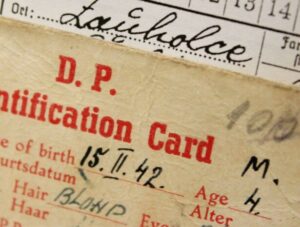
Documents Required for Lithuanian Citizenship Reinstatement
The application must include:
-
Proof of identity;
-
Documents confirming Lithuanian citizenship before June 15, 1940, or proof of descent;
-
Documents confirming change of name or surname (if applicable);
-
Confirmation that the applicant is not a citizen of another country, unless dual citizenship conditions apply under Article 7;
-
If the applicant holds another citizenship, documents proving eligibility for dual citizenship under Lithuanian law.
Legal Assistance with Lithuanian Citizenship Reinstatement
MIGRATION LAW CENTER provides professional guidance on Lithuanian Citizenship Reinstatement and Dual Citizenship Requirements to ensure a smooth application process.
If you have questions regarding Lithuanian citizenship, dual citizenship eligibility, or required documents, please contact us:
Email: info@migration.lt
Tel: +370 6 1861886
We will be glad to assist you.


Genealogy is a science that studies family relationships, and descent through a series of generations, and helps to understand the history of family. The search of ancestry in Lithuania is becoming more and more popular, people seek to find out more about their family’s past and life paths of their parents, grandparents, and ancestors. One of methods to learn more about your descent and origins is to build a genealogical/ family tree.
Lithuania has an extremely rich history and culture; therefore, genealogical research may be particularly interesting and relevant, but at the same time complex. In order to create a family tree, one should know where to look for the sources.
The first step at the beginning of genealogical research is a conversation with relatives. By talking to parents, grandparents, uncles, and aunts, it is possible to learn more about your ancestors, their life, professions, and relevant events. This may reveal interesting facts and help to expand the image of family history.
The next important step is investigation of national archives. Lithuania may boast about the variety of valuable resources, including the Lithuanian Central State Archives in Vilnius, where a huge collection of censuses and landowner documents is stored, as well as domestic and foreign passports of the Republic of Lithuania, documents of military volunteers, conscripts, soldiers, and military officers, and various others. Moreover, regional archives across the country, such as Kaunas Regional State Archives and Šiauliai Regional State Archives, store valuable regional records.
The civil registry in Lithuania has commenced in 1940, thus, in the Civil Registry Archives you can acquaint with the birth, marriage, and death records after 1940. In the events before 1940, the key role was played by the church registers, and such documents now are kept at the Office of the Chief Archivist of Lithuania, whereas the religious diversity of Lithuania is reflected by availability of Catholic, Lutheran, Russian Orthodox, and other church records.
Furthermore, as it could be prompted from the name itself, the special archive of Lithuania stores a highly important heritage of the Lithuanian history. There you can find information about ancestors who were murdered, convicted, exiled, included in the lists of exiles, persecuted by the Soviet security services.
The digital era has revolutionised the genealogical research by granting access to the variety of internet sources. Such websites like Epaveldas, Geni, Ancestry, and FamilySearch offer extensive databases and tools designed for examining ancestors and finding genealogical information.
Therefore, building a family tree is not just collecting names and dates. It is a possibility to preserve family history and traditions. Creation of a family tree and disclosure of histories of your Lithuanian ancestors is a delightful work connecting the past with the present. By accessing huge Lithuanian archives, online resources, and getting involved in local historical societies, you can take a useful journey of self-discovery, preserve your family’s heritage, pass on knowledge, and take care that future generations would cherish the history and heritage of their Lithuanian roots.
MIGRATION LAW CENTER


Searching for and Ordering a Birth Certificate in Lithuania
Obtaining a birth certificate in Lithuania is an essential step for many official processes, including Lithuanian citizenship restoration, inheritance claims, and migration matters. If you are searching for and ordering a birth certificate in Lithuania, it’s important to know the official procedures and requirements to avoid delays. Whether you are searching for and ordering a birth certificate in Lithuania for yourself or your relatives, understanding the procedures and available options can save you time and effort.. This guide explains how to search for and order birth certificates in Lithuania, highlighting recent changes in the civil registry system, archive locations, and legal requirements to help you navigate the process smoothly.
This article provides detailed information for searching for and ordering a birth certificate in Lithuania, helping applicants to understand where and how to submit their requests.
What Changed After 2017? – Birth Certificate Extracts in Lithuania
Since 01 January 2017, civil registry offices of the Republic of Lithuania have started to issue extracts confirming the record of civil status in a form set by the Minister of Justice of the Republic of Lithuania instead of registration certificates of the record of civil status. Extracts may be issued upon a receipt of the petitioner’s application immediately after registration of the civil status act (right away after birth of a child) or anytime later at the civil registry office, consular post, or the Centre of Registers.

Where Are Lithuanian Birth Records Stored?
When searching for and ordering a birth certificate in Lithuania, knowing the storage locations of birth records is crucial.
Extracts confirming the record of birth of the persons born after 1940 are stored in the Archives of the civil registry division. The extract may be issued to a person who has reached the age of 16, as well as to his parents or foster parents, regardless of age of a person.
Who Can Request a Birth Certificate Extract?
When searching for and ordering a birth certificate in Lithuania, the following details shall be specified: person’s name (names), surname (surnames), date of birth (or year of birth) and place of birth.
How to Request a Relative’s Birth Certificate
Special rules apply when searching for and ordering a birth certificate in Lithuania for relatives, which require additional documents.
Extracts confirming the record of birth of the relatives (spouse, parents, grandparents, great-grandparents) are issued only with their consent or upon their death. In such a case the hereunder mentioned documents shall be additionally submitted to an application:
-
Person’s consent or death certificate;
-
Documents evidencing kinship (birth certificate (certificates), marriage certificate).
Birth Records Before 1940 – State Historical Archives
Searches for extracts confirming the record of birth of the persons born before 1940 are carried out in the Lithuanian State Historical Archives, located at Mindaugo St. 8, Vilnius. Metrics books of all religious communities and churches are stored here. It has to be mentioned that, depending on the territory and the church, although the books stored in this Archives date back even to the 16th century, not all of them are still extant. Since the Catholic belief prevailed in Lithuania, the RKB metrics books are the most preserved, and the Jewish metrics funds are also quite abundant. Only few of metrics books of Orthodox, Old Believers, Evangelical Lutheran, Evangelical Reformers, Muslim, or Karaite have survived.
Religious Records in the Lithuanian Archives
When searching for and ordering a birth certificate in Lithuania, the following information should be indicated: person’s name (names), surname (surnames), date of birth (or year of birth), place of birth, father’s name and surname, mother’s name, and maiden name, religious community, or faith (if known).
How Long Does the Archive Search Take?
Processing an application in the Lithuanian State Historical Archives is optionally available in order of precedence (approximately per month), within 10 working days, or within 5 working days.
Why Legal Assistance Can Help with Document Retrieval
Navigating the process of searching for and ordering a birth certificate in Lithuania can be complex, especially when dealing with older records, unclear documentation, or strict procedural requirements. Legal professionals specializing in civil registry and archival research have in-depth knowledge of the archives’ structure, document standards, and administrative procedures. Their expertise helps to minimize errors, avoid unnecessary delays, and ensure that your application is correctly prepared and submitted.
By engaging legal assistance, you also gain support in cases where additional documents are required—such as proof of kinship or consent from relatives—and help with document legalization, translation, or apostille services. This comprehensive support not only saves you valuable time but also provides peace of mind that your important documents will be retrieved properly and promptly.
Need Professional Help? Contact Migration Law Center
If you need professional help with searching for and ordering a birth certificate in Lithuania or any other civil registry matters, Migration Law Center is here to assist you. Our experienced legal team can handle the entire process on your behalf, ensuring accurate and timely delivery of your documents.
Contact us today:
📧 Email: info@migration.lt
📞 Phone: +370 685 63053
Don’t hesitate to reach out — let us simplify your document retrieval and support your legal needs with expertise and care.


Since 1 January 1 2013, Migration Department of Lithuania issues certificates confirming the Lithuanian descent which replace the previously issued certificates confirming retention of the right to the citizenship of the Republic of Lithuania.
Lithuanian Descent Certificate: Your First Step Toward Citizenship
A person of the Lithuanian descent has the right to submit an application for a certificate confirming his/her descent, which enables him/her to obtain citizenship of the Republic of Lithuania in the future.
To learn more about the requirements and procedures for obtaining Certificate of Lithuanian Descent, we invite you to visit our Certificate of Lithuanian Descent section.
Eligibility for the Lithuanian Descent Certificate
This certificate is issued to a person whose parents or grandparents or one of the parents or grandparents is or was Lithuanian.
Applying for a Lithuanian Descent Certificate: Required Documents & Process
The person, along with the application, must submit documents evidencing such facts, documents certifying a kinship relationship. In addition, the person must declare that he/she considers himself/herself a Lithuanian by a written statement. Copies of the documents must be approved by a notary. The documents issued by foreign bodies must be legalized or confirmed by a note (Apostille), unless international treaties of the Republic of Lithuania and legislative acts of the European Union provide otherwise, and translated into Lithuanian language.
Where to Submit Your Application?
A person shall submit the documents for issue a certificate of Lithuanian descent to:
- a diplomatic mission or a consular institution in a foreign state
- the Migration Department in Lithuania
Do I have to submit documents in person?
The person submits the application to issue the certificate confirming the Lithuanian descent in person. The application is not accepted through a representative. However, parents, as representatives, may submit the application on behalf of their minor child.
Where to Collect the Lithuanian Descent Certificate?
The Lithuanian Descent Certificate is issued by the Migration Department under the Ministry of the Interior of the Republic of Lithuania. Depending on where you submitted your application, you can collect the certificate at the following locations:
- at the Lithuanian diplomatic mission or consular office
- at the Migration Department
Validity of the Certificate of Lithuanian Descent
This certificate has no expiry date – it shall be issued for an unlimited period of time.
Processing Time for a Certificate of Lithuanian Descent
The application to issue the certificate confirming the Lithuanian descent is considered within a maximum period of 6 months from the date of submission of the application in the Migration Department, and in case of replacing the certificate – not later than within 1 month.
Benefits of Having a Certificate of Lithuanian Descent
- No expiration date – it remains valid indefinitely
- Easier and faster citizenship or residence permit application
- Official recognition of Lithuanian ancestry
- A Basis for the Issuance of a Free Multiple-Entry Schengen Visa
The Role of the Certificate in Lithuanian Citizenship Acquisition
This certificate facilitates the acquisition of citizenship under the simplified procedure, as it is not anymore required to prove the kinship relationship with the person who held Lithuanian origin.
Lithuanian Descent Certificate and Lithuanian Citizenship: What You Need to Know
In order to obtain the citizenship under the simplified procedure on the basis of this certificate, a general procedure for renouncing a foreign state citizenship is applied. Individuals must renounce their foreign state citizenship. A person who has been granted the Lithuanian citizenship must swear an oath of allegiance to the Republic of Lithuania.
Can I get free legal advice on Certificate of Lithuanian Descent?
Yes, to learn more about Certificate of Lithuanian Descent, the process of preparing and submitting documents to competent state institutions, or to order legal assistance, please contact us:
• Email: info@migration.lt
• Phone: +37068563053
MIGRATION LAW CENTER
If you have any questions regarding Lithuanian citizenship or should you require more information or help, please contact us by e-mail: info@migration.lt or phone: + 370 6 1861886. We will gladly help you.


Since 01 January 2017, civil registry offices of the Republic of Lithuania commenced to issue extracts confirming the record of civil status in a form determined by the Minister of Justice of the Republic of Lithuania instead of registration certificates of the record of civil status. Extracts may be issued upon a receipt of the petitioner’s application immediately after registration of the civil status act (right away after the conclusion of marriage) or anytime later at the civil registry office, consular post, or the Centre of Registers. This procedure is valid not only for registration of marriages, but also in the cases of divorce, birth, death, and change of a name or surname.
Searches for extracts confirming the record of marriage of the persons married before 1940 are carried out in the Lithuanian State Historical Archives, situated at Mindaugo St. 8, Vilnius. Metrics books of all religious communities and churches are stored here. It has to be noted that, depending on the locality and the church, even though the books kept in this Archives date back even to the 16th century, not all of them are preserved. Since the Catholic belief was predominant in Lithuania, the RKB metrics books are the most preserved, and the Jewish metrics funds are also numerous. Only few of metrics books of Orthodox, Old Believers, Evangelical Lutheran, Evangelical Reformers, Muslim, or Karaite have remained.
When carrying out a search for a record of marriage in metrics books and seeking for the best search results, it is vitally important to specify the parish and religion of the married couple. If such information is missing, a search may be started from a place of birth of a bride, since the matrimonial ceremony in those days usually took place in the bride’s parish. It is worth mentioning that separate applications must be submitted to the Lithuanian State Historical Archives for a review and search in books of each parish separately.
When applying for a search the following should be detailed: names, surnames of the married couple, date of marriage (or year of marriage), place of marriage, religious community, or faith (if known).
Processing an application in the Lithuanian State Historical Archives is optionally available in order of precedence (approximately per month), within 10 working days, or within 5 working days.
Records certifying the marriage act of the persons married after 1940 are stored at the Archives of the Civil Registry Division. An application may be filed to the Archives of the Civil Registry Division of Vilnius City, located at address K. Kalinausko St. 21, Vilnius, also, to the State Enterprise Centre of Registers or a consular post.
When applying the following details should be specified: names, surnames of the persons, date (or year) and place of marriage conclusion.
Extracts confirming the record of marriage of the relatives (spouse, parents, grandparents, great-grandparents) are issued only with their consent or upon their death. In such a case the hereunder mentioned documents shall be additionally provided with an application:
- Person’s consent or death certificate;
- Documents proving kinship (birth certificate (certificates), marriage certificate, documents of change of a name and/or surname).
Applications are processed in the Archives of the Civil Registry Division in order of precedence (usually up to one month).
MIGRATION LAW CENTER

Who Can Reinstate Lithuanian Citizenship?
Each person, who held the citizenship of the Republic of Lithuania before 15 June 1940, and his/her descendants, who have not acquired the citizenship of the Republic of Lithuania, have the right to reinstate the citizenship of the Republic of Lithuania. This right is not limited in time, moreover, a person may reinstate citizenship regardless of what country he/she lives in.
What is the Certificate Confirming the Right to Reinstate Lithuanian Citizenship?
That right is supported with certificates confirming the right to reinstate the citizenship of the Republic of Lithuania issued by the Migration Department from 1 January 2013. These certificates replace the previously issued certificates confirming retention of the right to the citizenship of the Republic of Lithuania.
To learn more about the requirements and procedures for obtaining Certificate Confirming the Right to Reinstate Lithuanian Citizenship, we invite you to visit our Certificate Confirming the Right to Reinstate Lithuanian Citizenship section.
Documents Required for the Certificate to Reinstate Lithuanian Citizenship
A person willing to obtain a certificate confirming the right to reinstate the citizenship of the Republic of Lithuania must submit:
- A completed application form
- A valid identity document
- The documents, confirming that the person held the citizenship of the Republic of Lithuania before 15 June, 1940, or is the descendant of a person who held the citizenship of the Republic of Lithuania before 15 June, 1940 (internal or foreign passports of the Republic of Lithuania, the documents, testifying the person’s service at the Lithuanian army or work at the Lithuanian civil service; birth certificates or other documents, directly stating the citizenship of the Republic of Lithuania, etc.)
- Proof of kinship with the Lithuanian ancestor
- 2 photos of the person (40 x 60 mm)
Legalization and Translation of Documents: What You Need to Know
Documents issued in foreign countries must be:
- Translated into Lithuanian
- Legally certified (Apostille or legalization)
- Properly notarized copies submitted
Where to Submit the Application?
The application and required documents may be submitted to:
- a diplomatic mission or a consular institution in a foreign state
- the Migration Department in Lithuania
Processing Time for the Issuance of the Certificate to Reinstate Lithuanian Citizenship
- Certificate issuance: Up to 6 months from the application submission date
- Certificate replacement: Within 1 month
Certificate validity
The certificate confirming the right to reinstate the citizenship of the Republic of Lithuania is issued for an unlimited period of time.
Simplified Process for Citizenship Reinstatement
Holding this certificate simplifies the reinstatement of the Lithuanian citizenship procedure, since applicants no longer need to prove kinship to their Lithuanian ancestor again. In order to reinstate the citizenship on the basis of this certificate, a general procedure for renouncing a foreign state citizenship is applied. Individuals must renounce their foreign state citizenship, with the exception of cases prescribed by the Law on Citizenship of the Republic of Lithuania whereunder the right to hold dual citizenship is granted. A person who has reinstated the Lithuanian citizenship does not have to swear an oath of allegiance to the Republic of Lithuania under the current regulations; the decision regarding reinstatement of citizenship shall confirm the citizenship.
Can I get free legal advice on Certificate for the Right to Reinstate Lithuanian Citizenship?
Yes, to learn more about Certificate for the Right to Reinstate Lithuanian Citizenship, the process of preparing and submitting documents to competent state institutions, or to order legal assistance, please contact us:
• Email: info@migration.lt
• Phone: +37068563053
MIGRATION LAW CENTER
If you have any questions regarding Lithuanian citizenship or should you require more information or help, please contact us by e-mail: info@migration.lt or phone: + 370 6 1861886. We will gladly help you.


In Lithuania, new adoptions of the Citizenship Law have been adopted according to which the persons who had acquired Lithuanian citizenship and a citizenship of another state by birth will not have to choose one of those citizenships at the age of 21.
Provisions of the Citizenship Law of the Republic of Lithuania which had been valid until now provided exceptional cases when the dual citizenship had been possible in Lithuania, including the possibility of a child’s dual citizenship by determining that a child acquired Lithuanian citizenship and a citizenship of another state by birth. In such a case, a child could be a citizen of Lithuania and another state until the age of 21. Beyond that age, a person had to choose one of those citizenships. Provisions of the Citizenship Law of the Republic of Lithuania provided requirements for a person to refuse one of the citizenships he/she had.
On the 19 11 2015 the Parliament of the Republic of Lithuania adopted amendments to the Citizenship Law of the Republic of Lithuania which abolished the requirement for persons who had acquired Lithuanian citizenship and a citizenship of another state by birth, to choose one of the citizenships at the age of 21. These persons will be entitled to have a dual citizenship indefinitely. By these legal amendments, the Parliament revised the cases of dual citizenship and established wider possibilities to retain Lithuanian citizenship.
The discussed regulation is particularly relevant to the children of the emigrated Lithuanians who were not born in Lithuania and have acquired a foreign citizenship by birth, at the same time acquiring Lithuanian citizenship. Citizenship Law of the Republic of Lithuania establishes that a child born to Lithuanian citizens or Lithuanian citizen will acquire Lithuanian citizenship regardless of his/her place of birth, i. e. in Lithuania or abroad.
Parents of children who had acquired Lithuanian citizenship and a citizenship of another state by birth between 11 03 1990 and 22 07 2008 should apply to competent authorities to state the fact of a child’s Lithuanian citizenship. Application and other necessary documents should be submitted to Lithuanian diplomatic mission or consular posts abroad or the Migration Department in Lithuania, if a person resides abroad. If a person resides in Lithuania, she/she shall apply to Migration Service, according to person’s place of residence.
Applying to state the fact of a child’s citizenship, it is necessary to submit the following documents:
1. Request to consider the child as Lithuanian citizen (in Lithuanian);
2. The child’s birth certificate;
3. Documents proving that at the moment of the child’s birth both his/her parents or one parent were Lithuanian citizens;
4. Documents proving that the child has acquired a citizenship of another state by birth.
The enclosed documents should be translated into Lithuanian, if they were concluded in another language. The copies of the documents should be confirmed according to the laws. Documents issued in foreign states must be legalized or approved by Apostille, if Lithuanian international treaties or European Union legislation does not provide otherwise.
Parents of children who have acquired Lithuanian citizenship and a citizenship of another state by birth after 22 07 2008 may apply to issue a passport of a Lithuanian citizen to a child. Before this, the birth fact of a child who was born abroad must be recorded in Lithuania.
MIGRATION LAW CENTER
In accordance with the existing provisions of legislation, among the conditions under which a person may simultaneously be a citizen of Lithuania and another state, there was no condition allowing a person with outstanding merits to the State of Lithuania to hold dual citizenship.
From now on, upon the approval of amendments to the to the Law on Citizenship of Lithuania by the Seimas of Lithuania, a citizen of Lithuania with outstanding merits to the state may acquire the citizenship of another state and keep his Lithuanian citizenship. The provisions on the deprivation of citizenship of Lithuania due to the acquisition of citizenship of a foreign state will not apply to such a person and will enable him to be a citizen of more than one state, to have dual citizenship. Thus, the list of conditions under which dual citizenship in Lithuania is granted, was supplemented by additional condition.
The new amendments to the law are especially important for athletes with merits to Lithuania, who acquire the right to a foreign citizenship as a result of living abroad or on other grounds. Under the existing legislation, an athlete, who acquires a foreign citizenship, would lose the Lithuanian citizenship if no exceptions granting the right to hold dual citizenship were established. In accordance with the new provisions of legal acts, an athlete holding Lithuanian citizenship will be able to acquire a dual citizenship for his merits to Lithuania. The above amendments to the law are also important for other persons with merits to Lithuania, singers, actors, medics, or any other persons having outstanding merits to Lithuania. The outstanding merits to Lithuania are any activities of an individual which significantly contribute to the consolidation of the statehood of the Republic of Lithuania, as well as to the strengthening of its power and authority in the international community.
MIGRATION LAW CENTER
On 23 June, 2016 Lithuanian Seimas adopted amendments to the Law on Citizenship which will ensure the right of Jews (Litvaks) who left Lithuania during the interwar period, as well as other emigrants and their descendants to reinstate Lithuanian citizenship. Initiation and adoption of these amendments was stimulated by the practice formed by the Migration Department, according to which the Migration Department used to require Lithuanian Jews (Litvaks) who themselves or their ancestors left Lithuania before 1940, to provide evidence proving that they had left Lithuania due to the actual threat, political or historical reasons, resistance to the occupation regime or persecution. Such documents were extremely difficult to provide, so as the result, many Lithuanian Jews (Litvaks) could not have Lithuanian citizenship reinstated. Because of the formed practice they could not acquire a double citizenship, even though the law provides such a possibility. This practice created a problem not only to a numerous community of Litvaks in Israel, South Africa and other countries, but also to all Lithuanian emigrants and their descendants who left Lithuania before the year 1940, even though they had a right to a double citizenship according to the valid law which was adopted in the year 2011.
Up to now the Law on Citizenship established that a person who left Lithuania before 11 March, 1990, a person or his descendant who had Lithuanian citizenship before 15 June, 1940, persons who left the current Lithuanian territory for permanent residence in other country before 11 March, 1990, if on 11 March, 1990 their permanent place of residence was not Lithuania.
In the cases of reinstitution of Lithuanian citizenship or acquisition of double citizenship, the practice of the Migration Department was based on the practice formed by the Lithuanian courts according to which a person who left Lithuania before 11 March, 1990 is a person who had Lithuanian citizenship before 15 June, 1940 and left Lithuania before 11 March, 1990 due to historical or political motives, such as resistance to occupation regime or prosecution of occupation regime due to religion, origin, political opinion or membership in a particular social group who could not or was afraid to come back to Lithuania, or descendant of such person. In the practice of Lithuanian courts this “leaving” of Lithuania is explained as departure from Lithuania due to a certain threat to a person. This threat is usually associated with presupposed restrictions of the occupation regime which by their nature are serious enough to threaten the fundamental human rights. Based on this interpretation, persons who left Lithuania in during the period of 1919-1940 or their descendants were not covered by the concept of a person who left Lithuania before 11 March, 1990, as according to the Lithuanian courts during the period of 1918-1940 Lithuanian citizens were not prosecuted. Recently such persons could not have Lithuanian citizenship reinstated and they did not qualify for dual citizenship.
According to the amendments to the Law on Citizenship adopted by Lithuanian Seimas a person who left Lithuania a person who left Lithuania before 11 March, 1990, a person or his descendant who had Lithuanian citizenship before 15 June, 1940, persons who left the current Lithuanian territory for permanent residence in other country before 11 March, 1990, if on 11 March, 1990 their permanent place of residence was not Lithuania. This term does not include persons, who departed from Lithuania to the territory of the former Soviet Union after 15 June, 1940. The Law on Lithuanian Citizenship covers both leaving and departure of a person.
The amendments to the Law on Lithuanian Citizenship adopted by Lithuanian Seimas will enter into force when they are signed by the Lithuanian President.
MIGRATION LAW CENTER
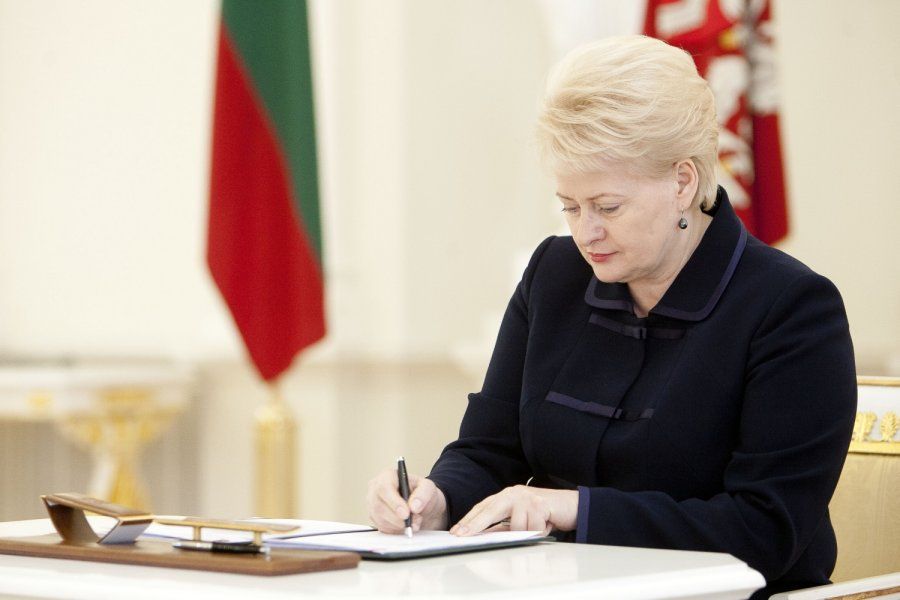
The President of Lithuania has signed amendments to the Law on Lithuanian Citizenship passed by the Lithuanian Parliament Seimas under an urgent procedure. These Amendments are expected to make the process of acquiring dual citizenship of Lithuania more liberal. Based on the previously developed practice applicable by the Migration Department of Lithuania, a person applying for a dual citizenship on the grounds that his/ her ancestors had been citizens of Lithuania by 15-Jun-1940 and left Lithuania by 11-Mar-1990, was obliged to present the Migration Department with additional evidences of the reasons why he/ she or his/ her ancestors left Lithuania. Mere facts of leaving Lithuania by 11-Mar-1990 and having the Lithuanian citizenship by 15-Jun-1940 were not considered as sufficient grounds for acquisition of a dual citizenship. The departure from Lithuania had to be determined by historical, political circumstances, and an actual threat faced by the person at the time of departure from Lithuania. A person became entitled to acquire a dual citizenship only upon proving that the person, who left Lithuania by 11-Mar-1990, faced an actual threat. Departure during the interwar period, i.e. by 1940 year, was considered as a period when a person could not have faced an actual threat based on the historical context in that period. This practice not only caused procedural difficulties for the applicants, but it also reduced the possibilities of acquiring a dual citizenship for people, who had such a right based on the effective legislations. The Lithuanian Seimas took this into consideration and passed amendments to the Law on Lithuanian Citizenship. Consequently, people applying for restoration of the Lithuanian citizenship and wishing to keep their current citizenship, i.e. to have a dual citizenship, would have to prove only two essential facts: that they themselves, their ancestors or one of them had been Lithuanian citizens by 15-Jun-1940 and that they left Lithuania by 11-Mar-1990. A person would not be entitled to a dual citizenship in cases when the person or his/ her ancestors departed from Lithuania after 1940 to the territory of the former Soviet Union. The President of Lithuania has signed the amendments.
MIGRATION LAW CENTER


Part of businessmen who wish to start a business in Lithuania need to decide, whether they should set up a company or a representative office of a foreign company. Both options have their benefits and drawbacks.
Setting up a company is a simpler, cheaper and faster process that requires less founders’ effort and participation in the process. It is enough to have a copy of passport of the founder, filled-in forms and authorisation to establish a company in Lithuania. Establishing a company takes 5-7 business days. Upon setting up a company, the authorised capital of the company must be placed in the accumulative account at a bank. The authorised capital currently in Lithuania should be no less than 3,000 EUR (in case of a Private Limited Liability Company). In case of a Sole Proprietorship or Small Partnership, the authorised capital is not created or the size of contribution is established by partners themselves. In the case when the company is purchased, the authorised capital of the company is already created.
The process of establishing a representative office or a branch is much longer. It lasts for approximately a month and is more complicated because far more documents need to be prepared and transferred to competent persons, e.g. establishment documents of the foreign country, annual financial statements end other documents that must be translated into Lithuanian. The documents issued by foreign institutions, according to the procedure established by laws, should be legalised or certified with Apostille, in case not established otherwise in the international agreements of Lithuania or legislation of the European Union. It is not necessary to come to Lithuania to set up a representative office or a branch, as it is also the case with setting up a company. It is possible to establish a company, a representative office or a branch on the basis of the mandate. Liability and property matters should not be forgotten either. The company is liable with its own property for the company duties. The property that belongs to the company by property rights is the property of the company. Meanwhile, the foreign company is liable for the duties of a representative office or a branch, and the immovable or movable property is transferred to the representative office or the branch by the foreign company.
A representative office or a branch is not a legal entity – it is a structural branch of a legal entity. However, a representative office or a branch may represent the interests of the legal entity and defend the interests, enter into transactions, and carry out other activities on behalf of the legal entity.
Steps of setting up a representative office or a branch:
- Collection of documents of the foreign company, their translation into Lithuanian, legalisation or certification with Apostille, in case not established otherwise in the international agreements of Lithuania or legislation of the European Union;
- Preparation of establishment documents;
- Certification of the establishment documents by a Lithuanian notary;
- Registering the representative office at the Register of Legal Entities of Lithuania;
- Production of a stamp.
Expenses of setting up a representative office or a branch: 1320 EUR.
Term for setting up a representative office or a branch: up to 3-4 weeks.
Arrival at Lithuania: It is not necessary to come to Lithuania to set up a representative office or a branch.
Expenses of maintaining the indicated representative office or the branch:
Taxes off an employee’s wage every month – approximately 200 EUR when the wage is minimum (400 EUR).
Minimum wage of one employee – 400 EUR.
Office lease – starting with 200 EUR a month / Virtual office – 200 EUR a year.
Accountant – 950 EUR a year or 100 EUR a month.
After tightening the conditions of immigration in Lithuania in 2014, it became more difficult for the company shareholders and members to obtain a permission to live in Lithuania: more investments and time were needed to comply with the new statutory requirements. Since 01 November 2014 the permission to temporarily live in Lithuania may be issued to a company shareholder if his/her capital of the company that belongs to him/her is no less than 28,000 EUR, 14,000 EUR is the foreigner’s investment, the value of the foreigner’s shares is no less than 1/3 of total value of shares, there are no fewer than 3 citizens of Lithuania or permanent foreign residents of Lithuania working in the company, and before the documents to obtain the permission to live in Lithuania were submitted, the company had been active for no less than 6 months.
The permission to live in Lithuania is given to the director or employee of the representative office or the branch in case the documents that confirm that the person’s professional knowledge or high professional qualification is necessary for the business of the branch and the person had worked in the foreign company for no less than 1 last year. In this case the foreigner’s family members immigrate together with him/her. The permission to live in the country is issued for the period of working in the company.
While attempting to obtain the permission to temporarily live in Lithuania, as an employee of the representative office or the branch of the foreign company, to the application for the permission to temporarily live in Lithuania the foreigner should also add the following:
- Copy of passport;
- Mediation letter;
- The certificate of the foreign company that confirms that the foreigner had worked in the foreign company for no less than 1 last year and his/her professional knowledge and high professional qualification is necessary for the business of the branch or the representative office set up in Lithuania;
- The document that confirms that the foreigner has enough money to make a living;
- The document regarding a place to live in Lithuania;
- Certificate of good conduct;
- Health insurance.
Preparation terms of the documents regarding the permission to temporarily live in Lithuania: 5-10 business days.
Price of document preparation: 1100 EUR.
Place of issuing documents: A Lithuanian diplomatic mission or a consular office in the foreign country or Migration Services in Lithuania.
Arrival at Lithuania:
In case the documents regarding the permission to live in Lithuania are submitted through the Lithuanian diplomatic mission or the consular office abroad, there will be 1 necessary visit to Lithuania – to formalise the card.
In case the documents regarding the permission to live in Lithuania are submitted through the Migration Services in Lithuania, there will be 2 necessary visits to Lithuania – to submit the documents regarding the permission to live in Lithuania and to formalise the card, after the Migration Department has decided to issue the permission for you to live in Lithuania.
The term for making a decision – 2-4 months.


For every business with its own trademark, it is important to ensure its legal protection that the trademark would not lose its prominence and reputation among customers thereof, and no one can be able to copy it. The owner of registered trademark acquires the right to prohibit other persons from using any mark, which is identical or similar to his/her registered mark, without his/her consent. The owner of trademark shall be entitled to apply to the Court due to trademark copying infringements.
In order to protect the trademark in a particular state, wherein the activity is carried out, it must be registered with the respective Intellectual Property Office of that state. For instance, in Lithuania applications to register a trademark at national level shall be examined by the State Patent Bureau of the Republic of Lithuania. In such a case, the trademark acquires protection only in the territory of Lithuania. The application fee is EUR 180 for one class of goods or services, an additional charge shall be applied for each additional class. The State Patent Bureau, after the receipt of the application, shall carry out a trademark examination and issue a trademark registration certificate according to the results of examination.
Depending on business needs, the trademark can also be registered at EU level.
If the trademark protection is necessary in all EU countries, an application must be submitted through the European registration system EUIPO. Applications are investigated by the EU Intellectual Property Office which is located in Alicante.
Applications are only accepted online, sent by registered mail or courier. The fee for this application is EUR 850, each supplementary class of goods or services will be charged additionally. The decision therefore shall be taken within 4 months.
In both cases when registering a trademark, first of all, it is necessary to carry out its assessment and to make sure that a similar trademark does not exist.
The submitted application to register a trademark shall include:
– whether this is a visual, verbal, visual with verbal elements or spatial trademark;
– which language is used;
– trademark picture in jpg format must be attached;
– specify for which class of goods and services it will be used;
– provide contact information of the trademark owner – natural or legal entity.
The trademark will not be registered, if similarities are found with already registered trademarks. Therefore, before a submission of application, it is necessary to spare some time for the analysis of already registered similar or identical trademarks and evaluate the possible risks. If a trademark application is rejected, the fee paid will not be refunded. If it is accepted, the trademark becomes protected and further actions can be taken.
After the registration of trademark, its protection shall be valid for 10 years from the day of its grant. After the expiration of trademark protection, it is possible to appy for its extension.


Republic of Lithuania is realizing the tax policy that favorable for business and the total tax system of Republic of Lithuania has been developed following the provisions of legal norms of the European Union. After the restoration of Independence of Republic of Lithuania, the tax system of Republic of Lithuania was changed in course of time, i.e. the tax system was transformed in such a way that could ensure the maximum extent of foreign investments and support for them as well as increasing development of the labour market.
The key legal norm where the principles of tax regulation are described is the Law of Republic of Lithuania on Tax Administration; in addition to the rights and duties of the tax administrator and a tax payer, the said Law regulates the procedure of tax computing as well.
In Republic of Lithuania, total seven types of key taxes may be singled out. They include: the Corporate Tax; the Income Tax; the Real Estate Tax; the Value-Added Tax; the Land Tax; the Inheritance Tax; excise duties and national social insurance contributions. In addition to the above-listed taxes, a consular fee, the gambling tax, compulsory health insurance and so on may be collected.
The Income Tax is payable by any resident of Lithuania on any income received and (or) earned in Republic of Lithuania. A resident of Republic of Lithuania is considered any physical person whose place of permanent residence is situated in Republic of Lithuania, or a person whose center of economic and social interest is in Lithuania, also any physical persons that stay in Republic of Lithuania at least 183 days (in turn or with breaks) per year. The Income Tax is computed on income of a resident from a source situated in Republic of Lithuania or abroad. The rate of the Income Tax is 15 %and it is payable to the State Tax Inspectorate.
The Corporate Tax in Republic of Lithuania is applicable both to legal entities of Republic of Lithuania and those of foreign states whose source of profit is situated in Lithuania. The rate of the Corporate Tax is 15 %. Subjects exempted from payment of the Corporate Tax in Lithuania include budgetary authorities, the state and municipalities, state and municipal institutions, organizations and agencies, as well as the Bank of Lithuania and the European Economic Interest Grouping.
The Value-Added Tax is a task payable for supply of commodities and services by the persons registered in the Register of Value-Added Tax (VAT) Payers. The said compulsory registration is performed according to the procedure provided in legal norms of Republic of Lithuania; however, it may be voluntary as well. Taxable subjects may be physical persons and legal entities of Republic of Lithuania or foreign states. A taxable person from Republic of Lithuania shall register itself as a VAT Payer in Republic of Lithuania, if the income of the person from the sold commodities or provided services within the last year was over 45’000 EUR or the person acquires in Republic of Lithuania commodities from other European Union Member States for the amount over 14’000 EUR per year. A taxable person from a foreign state shall register itself as a VAT Payer in Republic of Lithuania, if such a person is involved in selling commodities or provision of services from the beginning of its economic activities in Republic of Lithuania, or in a case when a person supplies commodities from Republic of Lithuania to other European Union Member States or third countries or is involved in remote (distance) trade in Republic of Lithuania and the value of the supplied commodities is over 35″000 EUR per year and when the person acquires in Republic of Lithuania commodities from other European Union Member States for the amount over 14’000 EUR per year.
It is notable that legal norms of Republic of Lithuania for regulation the issues related to the tax system provide certain exceptions and additional conditions or concessions, so they should be focused in any particular case.

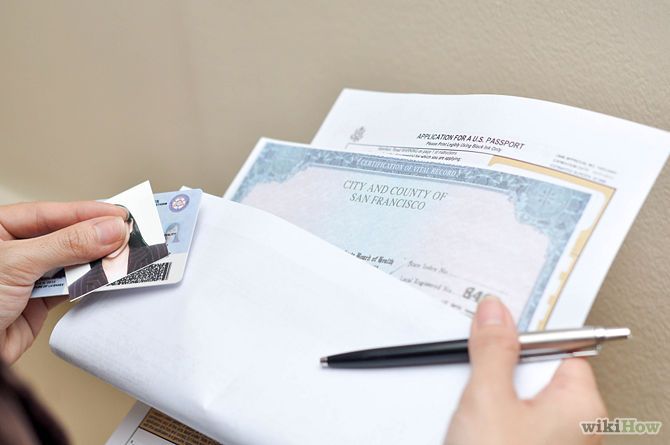
One among the documents to be submitted by an alien who wants to receive a residence permit in Lithuania is an alien’s certificate of conviction. At present, submission of the certificate is mandatory in all cases, i.e., both when an alien applies for a temporary residence permit in Lithuania and for a permanent residence in Lithuania.
Up to 14 October 2015, the requirement to submit the certificate of conviction was mandatory for individuals applying for a temporary residence permit in Lithuania only. Subparagraph 17.9 of Order No. 1V-367 as of 06-05-2015 of the Minister of the Interior of the Republic of Lithuania provides for that in cases where an application for a temporary residence permit in Lithuania is filed by an older than 14 years old alien, he/she must submit a certificate issued by a competent authority of the foreign country, which he/she has resided in before arriving to Lithuania or is currently residing, stating that he/she was or was not convicted in that country. In case an alien applying for a temporary residence permit in Lithuania was convicted in the country which he/she has resided in before, the certificate of conviction shall specify when and for what offense the person was convicted, with additional information on the type of a sentence imposed and a served sentence or a failure to serve it. An alien must obtain the said certificate before arriving to Lithuania to reside, i.e., he/she must apply to competent authorities of the country, which he/she has resided in, and to obtain the certificate of conviction. If an alien is currently staying in Lithuania, he/she may apply for the certificate to the diplomatic mission or consular post of the country, which he/she has resided in, in Lithuania. An alien should seek to obtain the certificate no earlier than 6 months prior to applying for a temporary residence permit in Lithuania.
According to the new provision, which entered into force on 14 October 2015, since now the certificate of conviction is also to be submitted in case an alien is applying for a permanent residence permit in Lithuania. Order No. 1V-809 of the Minister of the Interior of the Republic of Lithuania specifies that the Order No. 1V-445 of the Minister of the Interior is supplemented with a new provision which provides for that in cases where an application for a permanent residence permit in Lithuania is filed by an older than 14 years old alien, he/she, along with other documents, must submit a certificate of conviction to be issued no earlier than 4 months prior to the submission of an application for a permanent residence permit in Lithuania. The submission of the certificate of conviction is not mandatory in cases where the alien holds a valid temporary residence permit in Lithuania and has declared a place of residence in Lithuania.
The certificate of a person’s conviction issued by a competent authority of a foreign state must be translated into Lithuanian, validated and affirmed by Apostille, unless international treaties of the Republic of Lithuania or acts of the Euro Union provide otherwise.
MIGRATION LAW CENTER
In the recent years, the favorable opportunities for investments and trade in Lithuania attract more and more foreign enterprises and businessmen: they choose Lithuania as a stable country that offers a comparatively simple and safe investment policy. Attraction of investments to Lithuania is one the key strategic objects of the state, so, upon striving to the maximum efficiency of its accomplishment, Lithuania permanently takes every measure for improving its image and attractiveness among investors both in the country and in relations with foreign states and physical persons residing in foreign states. Upon striving for increasing the number of investments and their amounts to the maximum possible extent, Lithuania even developed a system of support to foreign investors that wish to establish and develop their activities in Lithuania. The business sector of Lithuania has been reformed and at present it conforms to all the requirements and standards set by the European Union, so Lithuania is attractive for investors because of safety, transparency and conformity to the standards. Upon striving to avoid isolation of business in Lithuania and make it global, Lithuania concluded agreements for avoidance a double taxation with 53 states of the world, including Great Britain, USA, Canada, China, Switzerland etc. So, business in Lithuania becomes global and easier accessible for investors from foreign states.
According to the relevant legal norms of Republic of Lithuania, investing in business in Lithuania is a lawful base for immigration of an alien to Lithuania. Lithuania provides an opportunity to come to Lithuania and reside here on the base of a lawful activity, i.e. investing in business, to foreigners, thus striving to attract capital, effective working procedures and new ideas. Foreigners in Lithuania may contribute to management of an existing legal entity (to become a shareholder of the enterprise) or establish a new legal entity. The conditions for establishing a new enterprise and starting a business in Lithuania are not complicated: for starting a business, only several days are enough; upon using an electronic signature, the procedure an incorporation of an enterprise in Lithuania becomes particularly simple and enables to save time and money.
With regard to the investing opportunities in Lithuania, it is notable that seven free economic zones operate in Lithuania at present. They are territories where economic and legal opportunities provided by legal norms are particularly favorable for operation of economic subjects. To enterprises registered in a territory of a free economic zone and their employees, various tax advantages are applied; they are provided consulting services etc. In addition to free economic zones, science and technology valleys where business potential is concentrated as well operate in Lithuania.
Lithuanian citizenship is a permanent legal relationship of a person with The Republic of Lithuania, based on mutual rights and obligations.
Lithuanian Citizenship is acquired by:
1. birth;
2. citizenship restoration;
3. being granted Lithuanian citizenship.
Reinstatement of Lithuanian Citizenship While Renouncing the Current Citizenship
The persons who held Lithuanian citizenship prior to 15 June 1940 and their descendants shall be able to reinstate Lithuanian citizenship if they are not citizens of a different state or they want to renounce their current citizenship.
Reinstatement of Lithuanian Citizenship While Retaining the Current Citizenship (Dual Citizenship)
The requirement to renounce citizenship of a different state is not applied to persons who can be citizens of both the Lithuania and a different state, in accordance with the Law on Lithuanian Citizenship article 7 subsections 2, 3, and 4, i.e.:
1. the person who was exiled from the occupied Republic of Lithuania prior to 11 March 1990 and has acquired citizenship of a different state;
2. the person who left Lithuania prior to 11 March 1990 and acquired citizenship of a different state;
3. the person who is a descendant of a person mentioned above.
Dual Citizenship in Lithuania can be Acquired by persons who:
- gained Lithuanian citizenship and citizenship a different state by birth;
- gained a foreign citizenship by virtue of marriage to a citizen of a different state;
- provided they were adopted by a citizen (-s) of Lithuania before reaching 18 years of age and, as a result of the adoption, acquired Lithuanian citizenship;
- provided they, being citizens of Lithuania, were adopted by a citizen (-s) of a different state before reaching 18 years of age and, as a result of the adoption, acquired citizenship of that state;
- acquired Lithuanian citizenship by way of exception while being a citizen of a different state;
- acquired Lithuanian citizenship while having a refugee status in Lithuania;
- retained Lithuanian citizenship or who has citizenship of the Republic of Lithuania restored for his outstanding merits to the Republic of Lithuania;
- acquired citizenship of the Republic of Lithuania while having refugee status in the Republic of Lithuania;
- acquired Lithuanian citizenship by birth and acquired citizenship of another state until he turned 18 in other way than by birth.
FREE analysis of your options for obtaining Lithuanian citizenship
The lawyers of MIGRATION LAW CENTER offer a free legal analysis of your options for obtaining Lithuanian citizenship. To receive a detailed analysis, please complete an application form by clicking this link – FORM.
Following a thorough legal analysis of your options that would allow to obtain Lithuanian citizenship, our lawyers will provide you with a written response (analytical results) regarding your options of obtaining Lithuanian citizenship and further requirements as well as procedure processes.
Read more:
Lithuanian citizenship for exiled citizens. Dual citizenship in Lithuania.
Lithuanian citizenship can be acquired: by birth, by naturalization, by way of exception, by restoration of Lithuanian citizenship.
Acquisition of Lithuanian Citizenship by Birth.
A child, both of whose parents are Lithuanian citizens, shall be a citizen of Lithuania regardless of whether he was born in the territory of Lithuania or beyond its borders.
A child adopted by a Lithuanian citizen (-s) shall become a Lithuanian citizen.
A child who is a Lithuanian citizen and who is adopted by a citizen (-s) of a different state retains the Lithuanian citizenship regardless if he acquired citizenship of a different state due to adoption.
A child born in the territory of Lithuania, whose parents are stateless persons habitually resident in Lithuania, shall acquire citizenship of Lithuania.
A child found in the territory of Lithuania, both of whose parents are unknown, shall be considered born in the territory of Lithuania and shall be a Lithuanian citizen, unless circumstances are disclosed whereupon the child would acquire a different status.
Naturalisation
A person can be granted Lithuanian citizenship if he:
1. Has been residing in the territory of Lithuania for the last 10 years;
2. Has the right to habitually reside in the territory of Lithuania;
3. Has passed the examination in the state language;
4. Has passed the examination in the basic provisions of the Constitution of the Republic of Lithuania;
5. Has a legal source of income;
6. Is a stateless person or notifies in writing of his will to renounce citizenship of another state held by him;
7. Meets other requirements laid down in the Law on Citizenship of the Republic of Lithuania.
Acquisition of Lithuanian Citizenship by Way of Exception
The citizenship is granted by the president of the Republic of Lithuania.
Restoration of Citizenship of the Republic of Lithuania
A person who has lost Lithuanian citizenship may have it restored to him upon his application. The request for restoration of Lithuanian citizenship shall be submitted to the president of Lithuania through competent authorities.
The application is a certain type of form that must be completed in Lithuanian language. Other foreign language documents supporting the application must be translated into Lithuanian and certified by a translator. Copies of those documents must be certified by a notary. Documents issued by foreign countries must be legalized or come with an Apostille certificate, unless international agreements of the Republic of Lithuania and European Union law do not provide otherwise.
Renunciation of Citizenship of the Republic of Lithuania
The right of a Lithuanian citizen to renounce citizenship may not be restricted.
A person’s application for renunciation of Lithuanian citizenship shall be submitted to the Minister of the Interior or the institution authorised by him.
The application for renunciation of citizenship needs to be completed in Lithuanian language. Other foreign language documents supporting the application must be translated into Lithuanian and certified by a translator. Copies of those documents must be certified by a notary. Documents issued by foreign countries must be legalized or come with an Apostille certificate, unless international agreements of the Republic of Lithuania and European Union law do not provide otherwise.
Documents that support the application for renunciation of citizenship of the Republic of Lithuania:
1. Documents certifying Lithuanian citizenship;
2. Personal identification document issued by a foreign body (if such was issued);
3. Documents issued by competent foreign authorities stating that the person is a national of that state or shall acquire citizenship of that state after losing Lithuanian citizenship.
If you have any questions regarding Lithuanian citizenship or should you require more information or help, please contact us by e-mail: info@migration.lt or tel.: + 370 6 1861886. We will gladly help you.


On 2014 01 23 Lithuania has adopted amendments to the legislation, which was amended the order of submission of documents for temporary residence permit of Lithuania and order of issuance, amendment, revocation of Lithuanian residence permits to foreigners.
1. The document confirmingthat the alien hassufficient fundsand(or) receives a regularincome;
2. The document proving thathehas alivingarea inLithuania;
When an alien intends to work requiring good professional qualification his application for the issuance of temporary residence permit must be considered no later than within two months from the lodging of the application to a Consular Post or Migration Service.
MIGRATION LAW CENTER


Vilnius is a multilingual European city that unites people of various nationalities. One of the major problems arising for persons having come to Lithuania for residence is a lack of Lithuanian skills. The language skills are particularly important, if the person plans staying in the country for a long period.
According to its intensity, Lithuanian language teaching courses are divided to ones of usual intensity, intensive courses and individual teaching. Teaching is arranged in groups or individually.
The courses in the basics of Lithuania (the level A1) are courses for beginners. The purpose of them is teaching to communicate in everyday situations (how to put a question, to answer a question, to tell something and so on); to listen and understand phrases, information, data, stories usable in communication; to read texts; to right a short text; to fill forms where personal data should be specified and so on. In the above-described ways, the person is familiarized with information that will be important for the person in future and reinforce the knowledge while executing the provided tasks.
Remote Lithuanian language teaching courses are at present one of the most popular ways for learning Lithuanian. Usually they are arranged through “Skype” programme. Such courses are convenient for persons that reside abroad. The teachers form an individual programme and method for each person. The duration of the course is agreed with the person. During lessons of visual conference type, the listeners are taught speaking, grammar and text understanding. In addition, tasks are performed; communication on topical topics is arranged thus trying to improve the person’s basics of communication skills. Such a Lithuanian language teaching course differs from the usual ones only in the following: a person may learn the language in any place and the course is adapted to the individual needs of the person.
The European Integration Fund arranges projects related not only to teaching Lithuanian, but also to introduction of persons to history, culture, national values and traditions of the country. Such projects are helpful in tackling the language problem and extend the knowledge about the country. The projects are particularly useful for citizens of third countries. In addition, the services are provided free of charge.
The pronunciation courses are provided for those who wish to improve their language skills, in particular the pronunciation. For a majority of newcomers, an elimination of the native language accent is a very serious problem. Such courses are helpful in learning to speak clearly, without an accent (or with minimized accent).
Some Lithuanian language teaching courses prepare the listeners for an examination in Lithuanian language. After completion of the course, this fact is confirmed by an issued certificate.
Some Lithuanian universities arrange courses for aliens and for speakers of other languages residing in the country.
Lithuanian language teaching courses are organized both for adults and the children of foreigners. Children are taught the basics of Lithuanian language; however, upon striving to attract attention of the children, it is tried to make the teaching more interesting. So, games, fairy-tales, songs, animated films and so on are used. Books and exercise books are used as well. In addition to tasks, the children may solidify their language skills in communication with coevals.

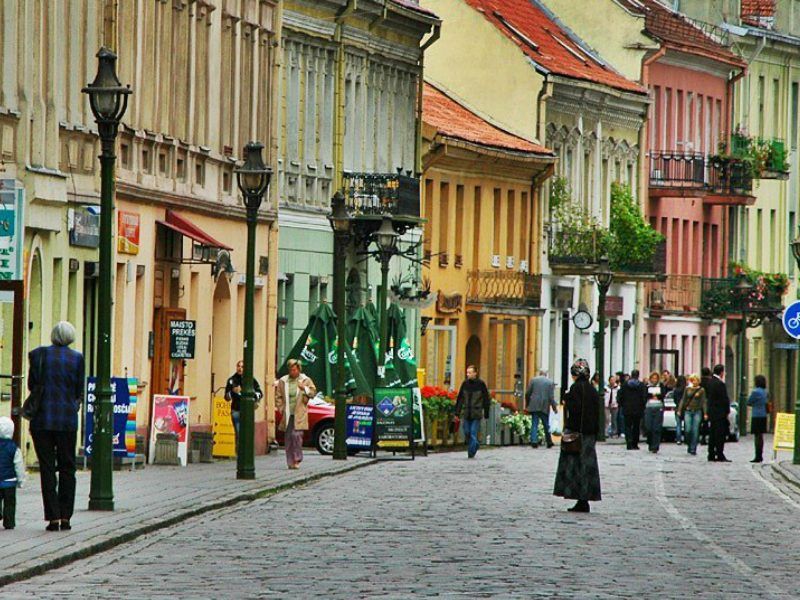
Search for a new housing is a difficult and responsible task for any person. In course of selection of a new housing, one must take into account the own needs and to analyze them thoroughly, to decide what part of the city is preferable for him(her), what area of housing should be optimum and so on. One of the most important steps will be a serious assessment of the own financial capacities at present and in future.
In Lithuania, search for housing may be carried out through real estate agencies involved in mediation services related to sale or rent. The other opportunity is conclusion of real estate (a house or a flat) transactions (on sale or rent) directly with the sellers. The most convenient way is using of websites for rental and for-sale housing. In Republic of Lithuania, the most popular websites are www.aruodas.lt, www.domo.plius.lt, and www.skelbiu.lt bei www.alio.lt .
The rent or the purchase price of housing depends on a number of different factors, such as the chosen residential area, the area of the house (flat), its equipment, the year of construction and other circumstances. In largest towns of Lithuania, the rent for a flat varies on the average from 5.4 EUR/ sq m to 8 EUR/ sq m. For example, in Vilnius, a monthly rent for one-room flat amounts on the average to 200-270 EUR, for two-room flat – on the average to 350-390 EUR. It was found that fluctuations of rents are particularly striking during summer months. With regards to acquisition of housing, the average price of a two-room flat in largest towns of Lithuania varies between 52’000 EUR and 76’000 EUR.
It should be mentioned that if real estate agencies are involved in mediation services related to sale or rent, the client, in addition to all payments arising from the sale or rental contract, shall pay a mediation fee to the agency. If a rental or sale contract is concluded directly with the seller or the renter), no mediation fee is payable, so the expenses of search for housing become less.
In case of acquisition of real estate (a house or a flat), the transaction shall be notarized according to the procedure provided in laws of Republic of Lithuania. The involved notary public, as a person authorized by the state, shall, in course of execution of the entrusted functions, verify a legitimacy of such transaction, clear up the wills of the parties and establish the legal validity of the transaction. In case of sale, the buyer and the seller may sign in the beginning a preliminary sale contract where they agree on the principal terms of the transaction and then sign the final sale contract. It should be mentioned that a housing sale contract shall be notarized in any case.


In Lithuania, you may search for job offers in various websites. The most important is the website of Lithuanian Labour Exchange: https://www.ldb.lt/en/Information/Pages/default.aspx.
In addition, you may find job offers provided by Lithuanian employers in the websites: http://www.cvmarket.lt/, http://www.cvonline.lt/english/ , https://ec.europa.eu/eures/public/homepage.
A foreigner while searching for a job in Lithuania also may directly contact with a Lithuanian employer.

A citizen of another state having a Driver’s License issued in the said state may drive a car with the same License for a period up to a half of year. If the state having issued the Driver’s License had not acceded to Vienna Convention on Road Traffic of 08 November 1968, an international Driver’s License is required. After expiry of the half-year period, the alien shall replace his (her) Driver’s License by a Lithuanian one. In Lithuania, national Driver’s Licenses conform to Driver’s Licenses of EU model (cards). With such a License, a person may drive a vehicle in any state of European Economic Area (EEA) and in any state out of European Economic Area, if such a state had acceded to Vienna Convention on Road Traffic of 08 November 1968. For replacing the Driver’s License, its bearer shall pass an examination in driving theory and practice. The examination may be arranged in Russian and English. On the examination in driving practice, the person shall drive a vehicle of the highest category specified in the Driver’s License issued in his (her) state (to be replaced).
If the Driver’s License of the alien was issued in an European Union Member State, it will be valid in all European Union Member States. A Driver’s License for the categories AM, A1, A2, A, B, BE, B1, C1, C1E, C, CE, D1, D1E, D, DE is recognized in other European Union Member States, so its replacement usually is not required. It may be used, if: the period of its validity had not expired (usually, a Driver’s License in European Union Member States remains valid for 10-15 years); the person is of at least the minimum age that conforms to the Driver’s License (for driving relevant categories of vehicles) eligibility requirements; the state having issued the Driver’s License had not annulled, suspended or otherwise restricted its validity. In a majority of European Union Member States, the minimum age that conforms to the Driver’s License eligibility requirements is 18 years; however, if a Driver’s License is issued to a younger person (in accordance with laws of the issuing state), such a Driver’s License will not be valid in states where the established minimum age for issue a Driver’s License is 18 years.
Citizens of European Union are provided an opportunity to replace their Driver’s Licenses by Driver’s Licenses of the state where they reside at present; however, they are not obliged to do so, except of certain cases when it is required by the state where they reside. If a person wishes to replace his (her) Driver’s License by Driver’s License of the state where he (she) resides at present, he (she) should prove that he (she) resides in the state and conforms to the requirement set for issuing it. In such a case, the authorized national authorities will contact the relevant authorities of the previous state of residence of the person to verify whether any restrictions were applied to the Driver’s License of the person.
A replacement of a Driver’s License is mandatory, when: the place of residence of a person in another state becomes it state of permanent residence after expiry of 2 year; if the period of validity of the person’s Driver’s License is limited; if the person violates the traffic rules in the state of residence; if the period of validity of the person’s Driver’s License expires after the person’s leaving for another European Union Member State.


In Lithuania, any physical person or legal entity of Lithuania or a foreign state may acquire a car or another vehicle. Persons residing in Lithuania and enterprises, offices & organizations registered in Lithuania may acquire a vehicle registered in Lithuania.
An alien wishing to acquire a vehicle in Lithuania should have a Permit for Residence in Lithuania. A vehicle also may be acquired and registered in Lithuania in the name of a Lithuanian enterprise owned by a foreigner. The most frequent forms of legal entities in Lithuania are a sole proprietorship and a joint-stock company of limited liability; there are some other forms of legal entities as well.
If a legal entity of Lithuania wishes to acquire a vehicle, it may apply for financing to a leasing company of Lithuania. The term set for a loan for leasing a vehicle differs dependently on the price of the vehicle. Usually it lasts up to 6 years. The first contribution amounts to 10, 20 or 30 % of the total price of the vehicle. The rate of the annual interest usually amounts up to 10 %. The vehicle shall be insured and equipped with an alarm system. The expenses related to insurance and the alarm system shall be covered by the enterprise that acquires the vehicle.
In Lithuania, a car or another vehicle shall be registered at any branch of the state-owned enterprise “Regitra”, independently on the address of residence of its bearer or the address of the Registered Office of the legal entity. After the vehicle registration, the state-owned enterprise “Regitra” issues the original vehicle registration documents and the vehicle plate number.