















 Lietuvių
  English
  Русский
 Author: zoomilar


The most popular and common company established in Lithuania is a Private limited liability company (LLC)/ Closed joint stock company. The authorised capital of the Private limited liability company/ Closed joint stock company must be not less than 2 500 Euro. The law provides for a maximum number of shareholders in the Private limited liability company/ Closed joint stock company– no more than 250 shareholders. The management body is the manager, or, a collegial supervisory body is formed – the Board.
One of the advantages of the Private limited liability company/ Closed joint stock company is that its liability is limited, i.e., the company’s participants (shareholders, owners, members) shall not be liable for its obligations to the extent of their personal property.
Apart from the Private limited liability company/ Closed joint stock company, there also exist other private legal entity forms in Lithuania, such as a Public limited liability company/ Joint stock company, individual enterprise, small partnership, etc.
Public limited liability company (PLC)/ Joint stock company. The law provides that the amount of the authorised capital of the Public limited liability company/ Joint stock company must be not less than 40 000 Euro. The number of shareholders shall not be limited; the shares may be traded in publicly. The management body of a Public limited liability company/ Joint stock company is the manager or the Board. Liability is limited, i.e., the company’s participants (shareholders, owners, members) shall not be liable for its obligations to the extent of their personal property.
Individual enterprise (IE). The law does not provide for any required minimum authorised capital for an individual enterprise. The main and sole participant in the enterprise is the owner of the enterprise. The individual enterprise is managed by the manager – a business owner or another person that may be appointed as a manager.
Liability of the individual enterprise is unlimited, i.e., the owner of the individual enterprise (IE) shall be liable for its outstanding obligations to the extent of his/her personal property. This is one of the major adverse features of this legal entity form.
Small partnership (SP). A legal form of a legal entity recently emerged but not yet popular in Lithuania. The law does not impose on members any mandatory contributions to the small partnership – they are established by the members of the small partnership themselves. A possible number of members: 1 to 10. The management body is the manager or the members’ meeting.
Liability of the small partnership is limited, i.e., its members shall not be liable for its obligations to the extent of their personal property.
Basic documents for the establishment of a company in Lithuania:
- Copy of a passport;
- Filled in questionnaires (we provide);
- Power of Attorney.
Time limits for the establishment of a company: 5-10 working days after the receipt of the required documents.
Price of the establishment of a company: 750 Euro.
Basic documentsfor the purchase of a company in Lithuania:
- Copy of a passport;
- Filled in questionnaires (we provide).
Time limits for the purchase and sale of a company: 5-10 days after the receipt of the required documents.
Price of the purchase and sale of a company: 750 Euro.
Key company taxes in Lithuania:
- Taxes that are paid on a monthly basis:
Taxes on the allocated wage accounts for about 55% of the allocated wage. The minimum wage in Lithuania – 380 Euro.
Value Added Tax (VAT) – 21%. Paid if a company is a VAT payer, registered in the VAT register. The obligation to register as a VAT payer in Lithuania arises to a company when the amount of the earnings from the supply of goods or services in the territory of Lithuania within 1 year exceeds 44 891 Euro.
- Taxes that are paid on an annual basis:
Income tax – 5% or 15%. Income tax equal to 5% is paid by a Lithuanian company, if the number of its employees is up to 10 people, and income during the tax period (1 year) is up to 289 620 Euro.
Immovable property tax – 0.3% to 1%.
Minimum company maintenance costs in Lithuania:
- Monthly charges;
- Employees’ wages;
- Accountant. If a company’s activities are minimal – about 100 Euro per month, or, 950 Euro per year;
- Office rent – according to an agreement. Virtual office – 200 Euro per year.
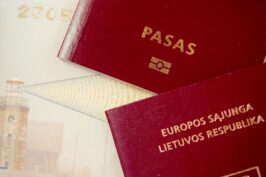
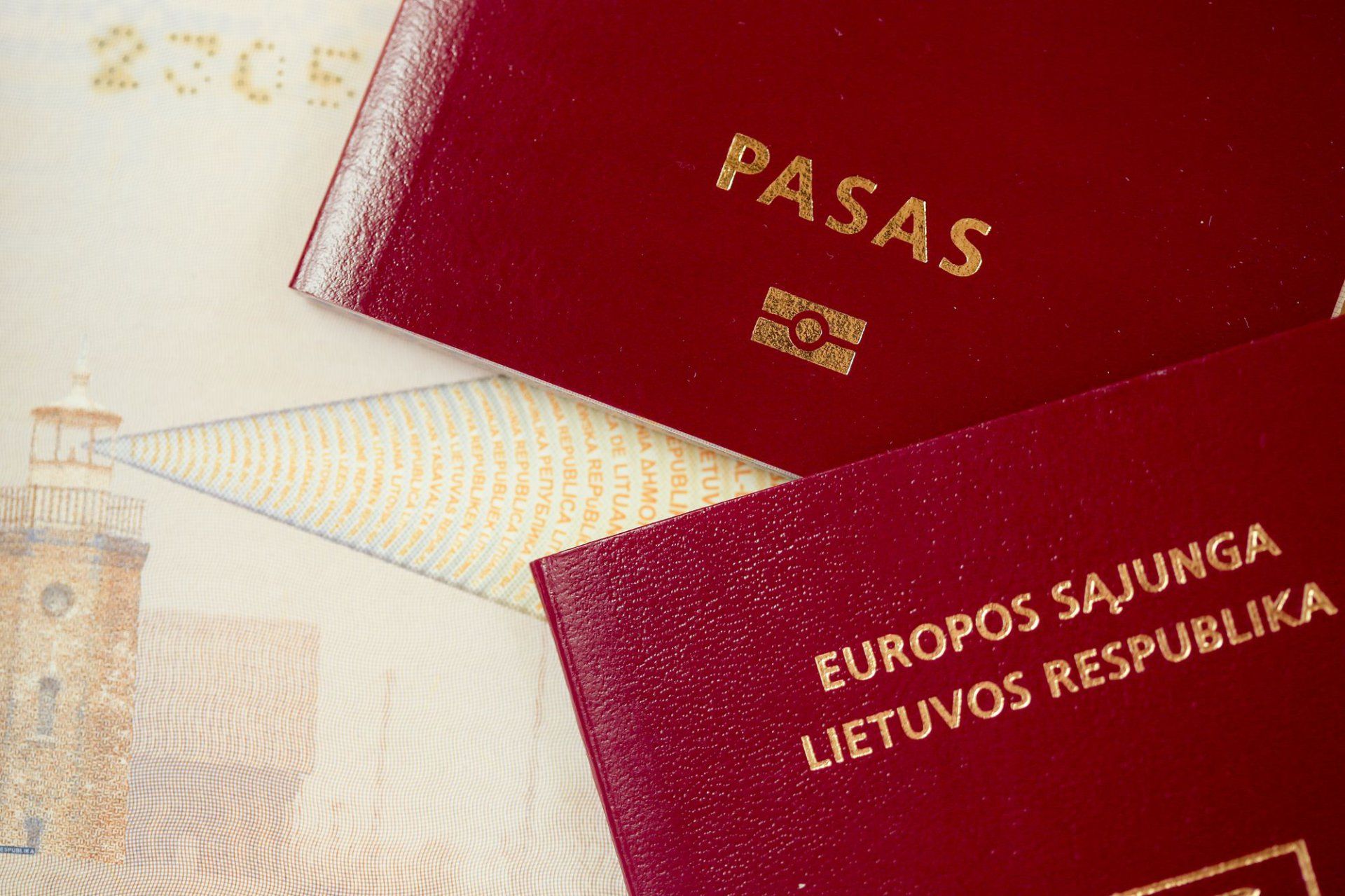
The Government of Lithuania plans legitimizing the dual citizenship in Lithuania. It is planned to legitimize dual citizenship in Lithuania within a period of 2.5 years, i.e. by the year 2020.
Today the draft plan of measures for implementation of the governmental programme has been presented to the governing majority and it points out that dual citizenship in Lithuania should be legitimized in the fourth quarter of the year 2019. The major institutions responsible for the said process will be the Ministry of Justice and the Ministry of Interior.
This intention of the Government of Lithuania is important for the whole Lithuanian World Community, Lithuanian emigrants and their progeny who are citizens of a foreign state and strive to preserve the citizenship of Lithuania.
At present, dual citizenship is possible in Lithuania in certain exceptional cases. According to provisions of the Law of Republic of Lithuania, a person may be simultaneously a citizen of Lithuania and a citizen of another state in the following cases:
1. A person was expatriated from occupied Lithuania before 11 March 1990 and acquired a citizenship of another state;
2. A person left Lithuania before 11 March 1990 and acquired a citizenship of another state;
3. A person is a child of above-mentioned persons;
4. A person had acquired a citizenship of Lithuania and a citizenship of another state by birth or on the base of the child adoption;
5. A person had registered a marriage with a citizen of another state and acquired a citizenship of another state;
6. A person was granted a citizenship of Lithuania on an exceptional basis while being a citizen of another state;
7. A person was granted a citizenship of Lithuania while having a status of a refugee in Lithuania.
MIGRATION LAW CENTER
Tourism information centers of the relevant towns provide information on the tourism infrastructure of the town, the places of interest of the town and (or) the total region, concerts, exhibitions, museums, fiestas and other events and entertainments free of charge. In addition, Tourism information centers arrange excursions in the town and the region and provide services of ciceroni in various languages, if agreed. At Tourism information centers, both residents and visitors may be provided with tourist routes, maps and any information needed for travelling persons. In addition, some Tourism information centers provide supplemental services to tourists in the town or the district, such as bicycle rental services, internet café services, mediation services in car rental; they sell various souvenirs and things with symbolism of the town, postcards, booklets, brochures about the relevant town of Lithuania. In some towns of Lithuania, Tourism information centers, in cooperation with tourism agencies, provide nourishment and accommodation services both to individual clients and tourist groups.


Within the first year when it has started to verify a legal status of the Russian and Belarusian citizens who were required to fill in a special questionnaire, wherein it is necessary to specify a certain information about themselves and express their attitude towards the war in Ukraine, the Migration Department has adopted 2,041 decisions to annul the permanent or temporary residence permits in Lithuania due to the threat posed by the Russian and Belarusian citizens to the national security.
While assessing the information gathered and before making a certain decision, the Migration Department has cooperated with the State Security Department of Lithuania, State Border Guard Service, Police, and other public authorities, where necessary.
Such questionnaires were provided to all Russian and Belarusian nationals who applied for migration services. In addition, verification of the mentioned citizens was carried out at the initiative of the Migration Department itself in a random sequence.
After the Migration Department examined the information collected and additional data obtained from various national institutions, 1,644 decisions were taken as to the threat posed by the Belarusian citizens to the national security.
According to data provided by the Migration Department, Belarusian citizens were refused a temporary residence permit in Lithuania on 562 occasions and refused a replacement of their residence permit on 343 occasions.
Belarusians had their previously valid temporary residence permits revoked on 450 occasions. Two Belarusian citizens were refused permanent residence permits in Lithuania, and eight had such documents revoked. Belarusians were refused national Lithuanian visas on 279 occasions.
Meanwhile, 397 Russian citizens were found to be a threat to national security, 76 of whom were refused a temporary residence permit in Lithuania, 84 were refused a replacement of their residence permit, 90 had their previously valid temporary residence permits revoked, and another 90 had their permanent residence permits revoked.
Two Russian citizens were denied permanent residence permits in Lithuania when applying for the first time. Russians were refused national Lithuanian visas on 55 occasions.
All citizens for whom decisions were adopted as to revocation or non-issuance of the residence permits, were also banned from entering Lithuania.
The Migration Department has also noted that such a behaviour of the foreigners when they do not disclose the significant information when filling in the questionnaire, that becomes apparent later, is treated not in their favour.
MIGRATION LAW CENTER

A person may hold a dual citizenship in Lithuania only in individual cases provided for in the Law.
A citizen of the Republic of Lithuania may at the same time be a citizen of another state if the person or family members of the person were exiled from Lithuania before 11 March 1990, as well as if the personheld citizenship of the Republic of Lithuania prior to 15 June 1940 (the person, or his/her parents, grandparents or great-grandparents, or one of the parents, grandparents, or great-grandparents who held citizenship of the Republic of Lithuania prior to 15 June 1940).
Part 2 and 4 of Article 7 of the Law on Citizenship of the Republic of Lithuania provide that a person may have at the same time citizenship of the Republic of Lithuania and of another state (dual citizenship) if:
The person was exiled from Lithuania before 11 March 1990 and acquired citizenship of another state (Part 2, Article 7 of the Law on Citizenship of the Republic of Lithuania); or
The person considers himself a descendant of a person exiled from Lithuania before 11 March 1990 (Part 4, Article 7 of the Law on Citizenship of the Republic of Lithuania).
A person exiled from occupied Lithuania before 11 March 1990 is a person who held Lithuanian citizenship before 15 June 1940 or his/her descendant, who were exiled or withdrew from Lithuania in the period from 15 June 1940 to 11 March 1990 by institutions of the occupation regime or by a court decision for resistance to the occupation regime, as well as on political, social, or descent grounds.
To reinstate Lithuanian citizenship in the presence of the fact of repression from Lithuania, the following documents.
For reinstatement of citizenship of the Republic of Lithuania, the following documents shall be submitted:
1. Application to reinstate citizenship of the Republic of Lithuania. In the form prescribed by the Law and drawn in Lithuanian language.
2. Passport, a copy of it;
3. Documents certifying that the person held Lithuanian citizenship before June 15 1940 or proving kinship with the person who held Lithuanian citizenship before June 15 1940.
4. Documents evidencing the presence of conditions, provided for in Part 2 and 4 of Article 7 of the Law on Citizenship of the Republic of Lithuania in case the person is a citizen of another state.
5. Documents evidencing the change of name and surname of a person, if the data was changed.
The above documents, accompanying the application to reinstate citizenship of the Republic of Lithuania, shall be translated to the Lithuanian language, if they are not drawn in the Lithuanian language. Copies of the documents shall be notarized. Documents issued by foreign institutions shall be validated in the manner prescribed by law or affirmed by Apostille, if the international treaties of the Republic of Lithuania or acts of the Euro Union do not provide otherwise.
Documents certifying that the person held Lithuanian citizenship before June 15 1940 shall be:
- Passports of the Republic of Lithuania issued before 15 June 1940;
- Documents on military service in the army of the Republic of Lithuania or on being employed in state service;
- Certificate of birth or other documents giving direct reference to the citizenship of the Republic of Lithuania held;
- Identity cards issued in Lithuania before 15 June 1940, or identity cards issued according to the documents issued in Lithuania before 15 June 1940.
If there is no such documents, the documents concerning studies, work, life in Lithuania prior to 15 June 1940 may be submitted.
Documents certifying the fact of deportation can be certificates issued by the Ministry of the Interior of the Republic of Lithuania, archives, other institutions, other documents proving that the person or his/her family members were deported from Lithuania to special settlements from 15 June 1940 to 11 March 1990.
If there is no such documents, certifying that the person held Lithuanian citizenship before June 15 1940 or certifying the fact of deportation from Lithuania, their extracts or certificates of their existence or the existence of the above facts can be obtained from the archives of Lithuania or other competent institutions.
Application to reinstate citizenship of the Republic of Lithuania and accompanying documents must be considered and a decision shall be adopted no later than within 6 months after receipt of the application to reinstate citizenship of the Republic of Lithuania by Migration Service of the Republic of Lithuania.
If you have any questions regarding Lithuanian citizenship or should you require more information or help, please contact us by e-mail: info@migration.lt or phone: + 370 6 1861886. We will gladly help you.

Issuance of a Lithuanian Passport for a Child Born Abroad
In accordance with the legal acts of Lithuania currently in force, a child may simultaneously hold Lithuanian citizenship and the citizenship of another state, provided that Lithuanian citizenship was acquired by birth. This applies when, at the time of the child’s birth, both parents or at least one parent was a citizen of Lithuania. Citizenship of another state may also be acquired by birth or later, until the child reaches 18 years of age, without affecting Lithuanian citizenship rights.
This legal framework allows children born abroad to Lithuanian citizens to legally retain multiple citizenships in accordance with Lithuanian and international law.
Issuance of a Lithuanian Passport for a Child Born Abroad is a formal legal procedure that requires proper registration of birth, confirmation of citizenship, and submission of official documents to Lithuanian authorities.
Eligibility for a Lithuanian Passport
A child born abroad is eligible for the issuance of a Lithuanian passport if:
-
At least one parent is a citizen of Lithuania at the time of the child’s birth;
-
Lithuanian citizenship was acquired by birth;
-
The child’s birth has been officially registered in the Lithuanian civil records;
-
The child has a legally confirmed citizenship status.
Practical Steps for Issuance of a Lithuanian Passport for a Child Born Abroad
Before applying for the issuance of a Lithuanian passport, the child’s birth must be included in the civil records of the Republic of Lithuania.
This registration is a mandatory legal procedure and serves as the legal basis for:
-
recognition of Lithuanian citizenship;
-
issuance of personal documents;
-
inclusion in Lithuanian population registers;
-
access to Lithuanian legal and administrative services.
Without this registration, passport issuance is not legally possible.
Where to Apply for Issuance of a Lithuanian Passport for a Child Born Abroad
One of the child’s parents or a legal representative must submit the application for Lithuanian passport issuance to one of the following institutions:
-
A division of the Migration Department in Lithuania
-
The Embassy of Lithuania abroad
Applications may be submitted in person by a parent or legal representative after all legal prerequisites have been fulfilled.
The procedure of issuance of a Lithuanian passport for a child born abroad is regulated by Lithuanian migration and citizenship legislation and requires prior registration of the child’s birth in Lithuanian civil records.
For detailed guidance on obtaining a Lithuanian passport, including the order of issuing and official deadlines, please see our article on Lithuanian passport: order of issuing and deadlines
Required Documents
For the issuance of a Lithuanian passport for a child born abroad, the following key documents are required:
-
Child’s valid travel document (if available);
-
Passports or identity documents of both parents;
-
Child’s birth certificate;
-
Certificate or official document confirming acquisition of foreign citizenship (issued by a foreign state authority);
-
Proof of registration of the child’s birth in Lithuanian civil records.
All foreign documents must be properly legalized or apostilled and translated into Lithuanian in accordance with Lithuanian legal requirements.
Additional Notes for Parents Living Abroad
Parents living outside Lithuania should be aware that the issuance of a Lithuanian passport for a child born abroad may take additional time due to document verification, legalization procedures, and communication between foreign authorities and Lithuanian institutions.
In many cases, delays occur because documents are missing Apostille certification, translations into Lithuanian are incomplete, or the child’s birth has not been properly registered in Lithuanian civil records prior to submitting the passport application.
To avoid unnecessary delays, it is recommended to prepare all documents in advance, verify legalization requirements, and ensure that the child’s Lithuanian citizenship status is properly confirmed before applying for the passport.
Proper preparation for the issuance of a Lithuanian passport for a child born abroad helps avoid delays related to document legalization, Apostille requirements, and translation issues.
Legal Basis for Dual Citizenship of a Child
Under Lithuanian law, a child who acquires Lithuanian citizenship by birth is legally allowed to hold another citizenship acquired by birth or acquired before reaching adulthood. This legal protection ensures that children are not required to renounce Lithuanian citizenship due to holding another nationality (dual or multiple citizenship).
This legal framework provides stability and long-term legal certainty for families living abroad.
Practical Guidance for Parents
Parents are advised to follow this legal sequence:
-
Register the child’s birth in Lithuanian civil records;
-
Confirm Lithuanian citizenship status;
-
Prepare all legalized/apostilled and translated documents;
-
Submit the passport application to the competent authority;
-
Complete biometric and identification procedures where required.
This structured process ensures legal compliance and prevents administrative delays.
Need Professional Assistance?
We provide full legal support for families seeking the issuance of a Lithuanian passport for a child born abroad.
Our services include:
-
Registration of the child’s birth in Lithuanian civil records;
-
Legal representation in Lithuania;
-
Full document preparation and verification;
-
Representation based on a power of attorney (no need to travel to Lithuania);
-
Coordination with Lithuanian institutions and authorities;
-
Complete passport issuance process management.
Parents do not need to travel to Lithuania — all procedures can be completed remotely through legal representation.
Lithuanian Citizenship Reinstatement and Dual Citizenship Requirements
This article explains Lithuanian Citizenship Reinstatement and Dual Citizenship Requirements, including legal eligibility, dual citizenship conditions, and required documents.
Lithuanian citizenship reinstatement allows former citizens and their descendants to recover Lithuanian citizenship, in certain cases without renouncing their existing nationality. Under the Lithuanian Law on Citizenship, dual citizenship may be granted to persons who held Lithuanian citizenship before June 15, 1940, as well as to their children, grandchildren, and great-grandchildren, provided specific legal requirements are met.
This article explains Lithuanian citizenship reinstatement rules, dual citizenship conditions, legal eligibility criteria, and required documents.
What Is Lithuanian Citizenship and Reinstatement?
Lithuanian citizenship is a permanent legal relationship between a person and the Republic of Lithuania, based on mutual rights and obligations.
A person may acquire Lithuanian citizenship in accordance with the law through:
-
Birth (if one or both parents are Lithuanian citizens),
-
Naturalization (after at least 10 years of permanent residence in Lithuania),
-
Marriage,
-
Exceptional granting of citizenship,
-
Restoration or reinstatement of Lithuanian citizenship.
Lithuanian citizenship reinstatement may be carried out either with renunciation of existing citizenship or, in specific cases, without renouncing another nationality (dual citizenship).
Understanding Lithuanian Citizenship Reinstatement and Dual Citizenship Requirements is essential for former citizens and their descendants seeking to recover Lithuanian citizenship.
Reinstatement of Lithuanian Citizenship Under the Law
According to Article 9(1) of the Law on Citizenship of the Republic of Lithuania (December 2, 2010, No. XI-1196), Lithuanian citizenship may be reinstated for:
-
Persons who held Lithuanian citizenship before June 15, 1940, and
-
Their descendants.
In general, the law requires renunciation of existing citizenship. However, certain exceptions allow Lithuanian dual citizenship without renouncing current nationality.
The requirement to renounce another citizenship does not apply to persons who qualify for dual citizenship under Article 7 of the Lithuanian Citizenship Law.
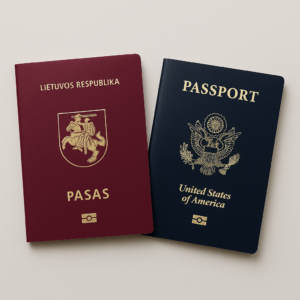
Dual Citizenship in Lithuania: Legal Framework
Article 7(2), (3), and (4) of the Lithuanian Law on Citizenship provides situations where a person may be both a Lithuanian citizen and a citizen of another country.
Dual citizenship may apply if:
-
A person was deported from occupied Lithuania before March 11, 1990;
-
A person left Lithuania before March 11, 1990;
-
The person is a descendant (child, grandchild, or great-grandchild) of such individuals.
The law clearly states that descendants up to the third generation (great-grandchildren) of Lithuanian citizens who held citizenship before June 15, 1940 may reinstate Lithuanian citizenship.
Key Conditions for Lithuanian Citizenship Reinstatement Without Renouncing Existing Citizenship
To qualify for Lithuanian dual citizenship through reinstatement, one of the following conditions must apply:
-
The person held Lithuanian citizenship before June 15, 1940, or is a descendant of such a person.
-
The person was deported from occupied Lithuania before March 11, 1990 or is a descendant of such a person.
-
The person left Lithuania for permanent residence before March 11, 1990 or is a descendant of such a person.
Leaving Lithuania means departure for permanent residence abroad, where on March 11, 1990 the person’s permanent residence was no longer in Lithuania.
Current Practice Regarding Reasons for Departure
Previously, when assessing Lithuanian citizenship reinstatement applications, authorities considered the reasons for leaving Lithuania. According to a decision of the Administrative Court of Vilnius dated May 7, 2013, the motives for departure before March 11, 1990 had to be historical or political.
However, under current administrative practice, the motives for leaving Lithuania are no longer evaluated as a mandatory condition. Today, the key factor is the fact of departure for permanent residence before March 11, 1990, rather than the specific reasons for leaving.
Procedure for Reinstatement of Lithuanian Citizenship
On April 3, 2013, the Government of Lithuania adopted Resolution No. 280, which regulates:
-
The preparation of documents,
-
The application procedure,
-
The decision-making process for Lithuanian citizenship reinstatement.
An application for reinstatement of Lithuanian citizenship must be addressed to the Minister of Internal Affairs of Lithuania and submitted through:
-
A Lithuanian Consulate (if residing abroad).
All attached documents must be translated into Lithuanian and notarized. In certain cases, documents must be legalized or certified with an Apostille. A state fee or consular fee is required.
Applicants must follow the official procedures to meet Lithuanian Citizenship Reinstatement and Dual Citizenship Requirements, including document submission, translation, and notarization.
Documents Required for Lithuanian Citizenship Reinstatement
The application must include:
-
Proof of identity;
-
Documents confirming Lithuanian citizenship before June 15, 1940, or proof of descent;
-
Documents confirming change of name or surname (if applicable);
-
Confirmation that the applicant is not a citizen of another country, unless dual citizenship conditions apply under Article 7;
-
If the applicant holds another citizenship, documents proving eligibility for dual citizenship under Lithuanian law.
Legal Assistance with Lithuanian Citizenship Reinstatement
MIGRATION LAW CENTER provides professional guidance on Lithuanian Citizenship Reinstatement and Dual Citizenship Requirements to ensure a smooth application process.
If you have questions regarding Lithuanian citizenship, dual citizenship eligibility, or required documents, please contact us:
Email: info@migration.lt
Tel: +370 6 1861886
We will be glad to assist you.


Genealogy is a science that studies family relationships, and descent through a series of generations, and helps to understand the history of family. The search of ancestry in Lithuania is becoming more and more popular, people seek to find out more about their family’s past and life paths of their parents, grandparents, and ancestors. One of methods to learn more about your descent and origins is to build a genealogical/ family tree.
Lithuania has an extremely rich history and culture; therefore, genealogical research may be particularly interesting and relevant, but at the same time complex. In order to create a family tree, one should know where to look for the sources.
The first step at the beginning of genealogical research is a conversation with relatives. By talking to parents, grandparents, uncles, and aunts, it is possible to learn more about your ancestors, their life, professions, and relevant events. This may reveal interesting facts and help to expand the image of family history.
The next important step is investigation of national archives. Lithuania may boast about the variety of valuable resources, including the Lithuanian Central State Archives in Vilnius, where a huge collection of censuses and landowner documents is stored, as well as domestic and foreign passports of the Republic of Lithuania, documents of military volunteers, conscripts, soldiers, and military officers, and various others. Moreover, regional archives across the country, such as Kaunas Regional State Archives and Šiauliai Regional State Archives, store valuable regional records.
The civil registry in Lithuania has commenced in 1940, thus, in the Civil Registry Archives you can acquaint with the birth, marriage, and death records after 1940. In the events before 1940, the key role was played by the church registers, and such documents now are kept at the Office of the Chief Archivist of Lithuania, whereas the religious diversity of Lithuania is reflected by availability of Catholic, Lutheran, Russian Orthodox, and other church records.
Furthermore, as it could be prompted from the name itself, the special archive of Lithuania stores a highly important heritage of the Lithuanian history. There you can find information about ancestors who were murdered, convicted, exiled, included in the lists of exiles, persecuted by the Soviet security services.
The digital era has revolutionised the genealogical research by granting access to the variety of internet sources. Such websites like Epaveldas, Geni, Ancestry, and FamilySearch offer extensive databases and tools designed for examining ancestors and finding genealogical information.
Therefore, building a family tree is not just collecting names and dates. It is a possibility to preserve family history and traditions. Creation of a family tree and disclosure of histories of your Lithuanian ancestors is a delightful work connecting the past with the present. By accessing huge Lithuanian archives, online resources, and getting involved in local historical societies, you can take a useful journey of self-discovery, preserve your family’s heritage, pass on knowledge, and take care that future generations would cherish the history and heritage of their Lithuanian roots.
MIGRATION LAW CENTER


Searching for and Ordering a Birth Certificate in Lithuania
Obtaining a birth certificate in Lithuania is an essential step for many official processes, including Lithuanian citizenship restoration, inheritance claims, and migration matters. If you are searching for and ordering a birth certificate in Lithuania, it’s important to know the official procedures and requirements to avoid delays. Whether you are searching for and ordering a birth certificate in Lithuania for yourself or your relatives, understanding the procedures and available options can save you time and effort.. This guide explains how to search for and order birth certificates in Lithuania, highlighting recent changes in the civil registry system, archive locations, and legal requirements to help you navigate the process smoothly.
This article provides detailed information for searching for and ordering a birth certificate in Lithuania, helping applicants to understand where and how to submit their requests.
What Changed After 2017? – Birth Certificate Extracts in Lithuania
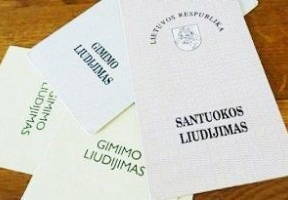
Since 01 January 2017, civil registry offices of the Republic of Lithuania have started to issue extracts confirming the record of civil status in a form set by the Minister of Justice of the Republic of Lithuania instead of registration certificates of the record of civil status. Extracts may be issued upon a receipt of the petitioner’s application immediately after registration of the civil status act (right away after birth of a child) or anytime later at the civil registry office, consular post, or the Centre of Registers.
Where Are Lithuanian Birth Records Stored?
When searching for and ordering a birth certificate in Lithuania, knowing the storage locations of birth records is crucial.
Extracts confirming the record of birth of the persons born after 1940 are stored in the Archives of the civil registry division. The extract may be issued to a person who has reached the age of 16, as well as to his parents or foster parents, regardless of age of a person.
Who Can Request a Birth Certificate Extract?
When searching for and ordering a birth certificate in Lithuania, the following details shall be specified: person’s name (names), surname (surnames), date of birth (or year of birth) and place of birth.
How to Request a Relative’s Birth Certificate
Special rules apply when searching for and ordering a birth certificate in Lithuania for relatives, which require additional documents.
Extracts confirming the record of birth of the relatives (spouse, parents, grandparents, great-grandparents) are issued only with their consent or upon their death. In such a case the hereunder mentioned documents shall be additionally submitted to an application:
-
Person’s consent or death certificate;
-
Documents evidencing kinship (birth certificate (certificates), marriage certificate).
Birth Records Before 1940 – State Historical Archives
Searches for extracts confirming the record of birth of the persons born before 1940 are carried out in the Lithuanian State Historical Archives, located at Mindaugo St. 8, Vilnius. Metrics books of all religious communities and churches are stored here. It has to be mentioned that, depending on the territory and the church, although the books stored in this Archives date back even to the 16th century, not all of them are still extant. Since the Catholic belief prevailed in Lithuania, the RKB metrics books are the most preserved, and the Jewish metrics funds are also quite abundant. Only few of metrics books of Orthodox, Old Believers, Evangelical Lutheran, Evangelical Reformers, Muslim, or Karaite have survived.
Religious Records in the Lithuanian Archives
When searching for and ordering a birth certificate in Lithuania, the following information should be indicated: person’s name (names), surname (surnames), date of birth (or year of birth), place of birth, father’s name and surname, mother’s name, and maiden name, religious community, or faith (if known).
How Long Does the Archive Search Take?
Processing an application in the Lithuanian State Historical Archives is optionally available in order of precedence (approximately per month), within 10 working days, or within 5 working days.
Why Legal Assistance Can Help with Document Retrieval
Navigating the process of searching for and ordering a birth certificate in Lithuania can be complex, especially when dealing with older records, unclear documentation, or strict procedural requirements. Legal professionals specializing in civil registry and archival research have in-depth knowledge of the archives’ structure, document standards, and administrative procedures. Their expertise helps to minimize errors, avoid unnecessary delays, and ensure that your application is correctly prepared and submitted.
By engaging legal assistance, you also gain support in cases where additional documents are required—such as proof of kinship or consent from relatives—and help with document legalization, translation, or apostille services. This comprehensive support not only saves you valuable time but also provides peace of mind that your important documents will be retrieved properly and promptly.
Need Professional Help? Contact Migration Law Center
If you need professional help with searching for and ordering a birth certificate in Lithuania or any other civil registry matters, Migration Law Center is here to assist you. Our experienced legal team can handle the entire process on your behalf, ensuring accurate and timely delivery of your documents.
Contact us today:
📧 Email: info@migration.lt
📞 Phone: +370 685 63053
Don’t hesitate to reach out — let us simplify your document retrieval and support your legal needs with expertise and care.


Since 1 January 1 2013, Migration Department of Lithuania issues certificates confirming the Lithuanian descent which replace the previously issued certificates confirming retention of the right to the citizenship of the Republic of Lithuania.
Lithuanian Descent Certificate: Your First Step Toward Citizenship
A person of the Lithuanian descent has the right to submit an application for a certificate confirming his/her descent, which enables him/her to obtain citizenship of the Republic of Lithuania in the future.
To learn more about the requirements and procedures for obtaining Certificate of Lithuanian Descent, we invite you to visit our Certificate of Lithuanian Descent section.
Eligibility for the Lithuanian Descent Certificate
This certificate is issued to a person whose parents or grandparents or one of the parents or grandparents is or was Lithuanian.
Applying for a Lithuanian Descent Certificate: Required Documents & Process
The person, along with the application, must submit documents evidencing such facts, documents certifying a kinship relationship. In addition, the person must declare that he/she considers himself/herself a Lithuanian by a written statement. Copies of the documents must be approved by a notary. The documents issued by foreign bodies must be legalized or confirmed by a note (Apostille), unless international treaties of the Republic of Lithuania and legislative acts of the European Union provide otherwise, and translated into Lithuanian language.
Where to Submit Your Application?
A person shall submit the documents for issue a certificate of Lithuanian descent to:
- a diplomatic mission or a consular institution in a foreign state
- the Migration Department in Lithuania
Do I have to submit documents in person?
The person submits the application to issue the certificate confirming the Lithuanian descent in person. The application is not accepted through a representative. However, parents, as representatives, may submit the application on behalf of their minor child.
Where to Collect the Lithuanian Descent Certificate?
The Lithuanian Descent Certificate is issued by the Migration Department under the Ministry of the Interior of the Republic of Lithuania. Depending on where you submitted your application, you can collect the certificate at the following locations:
- at the Lithuanian diplomatic mission or consular office
- at the Migration Department
Validity of the Certificate of Lithuanian Descent
This certificate has no expiry date – it shall be issued for an unlimited period of time.
Processing Time for a Certificate of Lithuanian Descent
The application to issue the certificate confirming the Lithuanian descent is considered within a maximum period of 6 months from the date of submission of the application in the Migration Department, and in case of replacing the certificate – not later than within 1 month.
Benefits of Having a Certificate of Lithuanian Descent
- No expiration date – it remains valid indefinitely
- Easier and faster citizenship or residence permit application
- Official recognition of Lithuanian ancestry
- A Basis for the Issuance of a Free Multiple-Entry Schengen Visa
The Role of the Certificate in Lithuanian Citizenship Acquisition
This certificate facilitates the acquisition of citizenship under the simplified procedure, as it is not anymore required to prove the kinship relationship with the person who held Lithuanian origin.
Lithuanian Descent Certificate and Lithuanian Citizenship: What You Need to Know
In order to obtain the citizenship under the simplified procedure on the basis of this certificate, a general procedure for renouncing a foreign state citizenship is applied. Individuals must renounce their foreign state citizenship. A person who has been granted the Lithuanian citizenship must swear an oath of allegiance to the Republic of Lithuania.
Can I get free legal advice on Certificate of Lithuanian Descent?
Yes, to learn more about Certificate of Lithuanian Descent, the process of preparing and submitting documents to competent state institutions, or to order legal assistance, please contact us:
• Email: info@migration.lt
• Phone: +37068563053
MIGRATION LAW CENTER
If you have any questions regarding Lithuanian citizenship or should you require more information or help, please contact us by e-mail: info@migration.lt or phone: + 370 6 1861886. We will gladly help you.


Genealogical/ family tree is a diagram that visually depicts family relationships and ancestry of an individual through several generations. This is the basis of genealogical research, which assists in understanding the origin of a person and the history of his/her kin. Genealogical tree may cover information about a date and place of birth of each individual, his/her relationship with other family members, the date of marriage and death, and other relevant events. This is a useful tool to obtain responds to many personal and historical questions.
Building a genealogical tree may be a quite complicated process, depending on information which you have gathered on your family and its history. The main point is to start from yourself and your relatives, then going back through the generations.
When creating a family tree, it is necessary to have as much information as possible about your family and its members. You will find hereafter some key categories from which gathered information is considered valuable:
1. Birth, marriage, and death records: date and place of birth, date and place of marriage, date and place of death.
2. Personal details: first name, last name, origin, profession, education, religion, citizenship, etc.
3. Family information: first and last names of the spouses and their parents, marriage details, names of children and birth data.
4. Historical data: military service, migration, immigration, emigration, agricultural activity, business activity, etc.
It is necessary to understand that building a precise family tree may require a great deal of time and effort, particularly, if this is a collection of old information which is not available on the internet. However, the final result may be very valuable, and helping to understand the history and descent of your family.
MIGRATION LAW CENTER


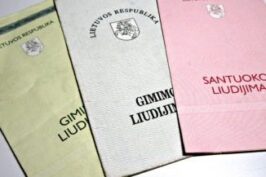
Since 01 January 2017, civil registry offices of the Republic of Lithuania commenced to issue extracts confirming the record of civil status in a form determined by the Minister of Justice of the Republic of Lithuania instead of registration certificates of the record of civil status. Extracts may be issued upon a receipt of the petitioner’s application immediately after registration of the civil status act (right away after the conclusion of marriage) or anytime later at the civil registry office, consular post, or the Centre of Registers. This procedure is valid not only for registration of marriages, but also in the cases of divorce, birth, death, and change of a name or surname.
Searches for extracts confirming the record of marriage of the persons married before 1940 are carried out in the Lithuanian State Historical Archives, situated at Mindaugo St. 8, Vilnius. Metrics books of all religious communities and churches are stored here. It has to be noted that, depending on the locality and the church, even though the books kept in this Archives date back even to the 16th century, not all of them are preserved. Since the Catholic belief was predominant in Lithuania, the RKB metrics books are the most preserved, and the Jewish metrics funds are also numerous. Only few of metrics books of Orthodox, Old Believers, Evangelical Lutheran, Evangelical Reformers, Muslim, or Karaite have remained.
When carrying out a search for a record of marriage in metrics books and seeking for the best search results, it is vitally important to specify the parish and religion of the married couple. If such information is missing, a search may be started from a place of birth of a bride, since the matrimonial ceremony in those days usually took place in the bride’s parish. It is worth mentioning that separate applications must be submitted to the Lithuanian State Historical Archives for a review and search in books of each parish separately.
When applying for a search the following should be detailed: names, surnames of the married couple, date of marriage (or year of marriage), place of marriage, religious community, or faith (if known).
Processing an application in the Lithuanian State Historical Archives is optionally available in order of precedence (approximately per month), within 10 working days, or within 5 working days.
Records certifying the marriage act of the persons married after 1940 are stored at the Archives of the Civil Registry Division. An application may be filed to the Archives of the Civil Registry Division of Vilnius City, located at address K. Kalinausko St. 21, Vilnius, also, to the State Enterprise Centre of Registers or a consular post.
When applying the following details should be specified: names, surnames of the persons, date (or year) and place of marriage conclusion.
Extracts confirming the record of marriage of the relatives (spouse, parents, grandparents, great-grandparents) are issued only with their consent or upon their death. In such a case the hereunder mentioned documents shall be additionally provided with an application:
- Person’s consent or death certificate;
- Documents proving kinship (birth certificate (certificates), marriage certificate, documents of change of a name and/or surname).
Applications are processed in the Archives of the Civil Registry Division in order of precedence (usually up to one month).
MIGRATION LAW CENTER
Who Can Reinstate Lithuanian Citizenship?
Each person, who held the citizenship of the Republic of Lithuania before 15 June 1940, and his/her descendants, who have not acquired the citizenship of the Republic of Lithuania, have the right to reinstate the citizenship of the Republic of Lithuania. This right is not limited in time, moreover, a person may reinstate citizenship regardless of what country he/she lives in.
What is the Certificate Confirming the Right to Reinstate Lithuanian Citizenship?
That right is supported with certificates confirming the right to reinstate the citizenship of the Republic of Lithuania issued by the Migration Department from 1 January 2013. These certificates replace the previously issued certificates confirming retention of the right to the citizenship of the Republic of Lithuania.
To learn more about the requirements and procedures for obtaining Certificate Confirming the Right to Reinstate Lithuanian Citizenship, we invite you to visit our Certificate Confirming the Right to Reinstate Lithuanian Citizenship section.
Documents Required for the Certificate to Reinstate Lithuanian Citizenship
A person willing to obtain a certificate confirming the right to reinstate the citizenship of the Republic of Lithuania must submit:
- A completed application form
- A valid identity document
- The documents, confirming that the person held the citizenship of the Republic of Lithuania before 15 June, 1940, or is the descendant of a person who held the citizenship of the Republic of Lithuania before 15 June, 1940 (internal or foreign passports of the Republic of Lithuania, the documents, testifying the person’s service at the Lithuanian army or work at the Lithuanian civil service; birth certificates or other documents, directly stating the citizenship of the Republic of Lithuania, etc.)
- Proof of kinship with the Lithuanian ancestor
- 2 photos of the person (40 x 60 mm)
Legalization and Translation of Documents: What You Need to Know
Documents issued in foreign countries must be:
- Translated into Lithuanian
- Legally certified (Apostille or legalization)
- Properly notarized copies submitted
Where to Submit the Application?
The application and required documents may be submitted to:
- a diplomatic mission or a consular institution in a foreign state
- the Migration Department in Lithuania
Processing Time for the Issuance of the Certificate to Reinstate Lithuanian Citizenship
- Certificate issuance: Up to 6 months from the application submission date
- Certificate replacement: Within 1 month
Certificate validity
The certificate confirming the right to reinstate the citizenship of the Republic of Lithuania is issued for an unlimited period of time.
Simplified Process for Citizenship Reinstatement
Holding this certificate simplifies the reinstatement of the Lithuanian citizenship procedure, since applicants no longer need to prove kinship to their Lithuanian ancestor again. In order to reinstate the citizenship on the basis of this certificate, a general procedure for renouncing a foreign state citizenship is applied. Individuals must renounce their foreign state citizenship, with the exception of cases prescribed by the Law on Citizenship of the Republic of Lithuania whereunder the right to hold dual citizenship is granted. A person who has reinstated the Lithuanian citizenship does not have to swear an oath of allegiance to the Republic of Lithuania under the current regulations; the decision regarding reinstatement of citizenship shall confirm the citizenship.
Can I get free legal advice on Certificate for the Right to Reinstate Lithuanian Citizenship?
Yes, to learn more about Certificate for the Right to Reinstate Lithuanian Citizenship, the process of preparing and submitting documents to competent state institutions, or to order legal assistance, please contact us:
• Email: info@migration.lt
• Phone: +37068563053
MIGRATION LAW CENTER
If you have any questions regarding Lithuanian citizenship or should you require more information or help, please contact us by e-mail: info@migration.lt or phone: + 370 6 1861886. We will gladly help you.


In Lithuania, new adoptions of the Citizenship Law have been adopted according to which the persons who had acquired Lithuanian citizenship and a citizenship of another state by birth will not have to choose one of those citizenships at the age of 21.
Provisions of the Citizenship Law of the Republic of Lithuania which had been valid until now provided exceptional cases when the dual citizenship had been possible in Lithuania, including the possibility of a child’s dual citizenship by determining that a child acquired Lithuanian citizenship and a citizenship of another state by birth. In such a case, a child could be a citizen of Lithuania and another state until the age of 21. Beyond that age, a person had to choose one of those citizenships. Provisions of the Citizenship Law of the Republic of Lithuania provided requirements for a person to refuse one of the citizenships he/she had.
On the 19 11 2015 the Parliament of the Republic of Lithuania adopted amendments to the Citizenship Law of the Republic of Lithuania which abolished the requirement for persons who had acquired Lithuanian citizenship and a citizenship of another state by birth, to choose one of the citizenships at the age of 21. These persons will be entitled to have a dual citizenship indefinitely. By these legal amendments, the Parliament revised the cases of dual citizenship and established wider possibilities to retain Lithuanian citizenship.
The discussed regulation is particularly relevant to the children of the emigrated Lithuanians who were not born in Lithuania and have acquired a foreign citizenship by birth, at the same time acquiring Lithuanian citizenship. Citizenship Law of the Republic of Lithuania establishes that a child born to Lithuanian citizens or Lithuanian citizen will acquire Lithuanian citizenship regardless of his/her place of birth, i. e. in Lithuania or abroad.
Parents of children who had acquired Lithuanian citizenship and a citizenship of another state by birth between 11 03 1990 and 22 07 2008 should apply to competent authorities to state the fact of a child’s Lithuanian citizenship. Application and other necessary documents should be submitted to Lithuanian diplomatic mission or consular posts abroad or the Migration Department in Lithuania, if a person resides abroad. If a person resides in Lithuania, she/she shall apply to Migration Service, according to person’s place of residence.
Applying to state the fact of a child’s citizenship, it is necessary to submit the following documents:
1. Request to consider the child as Lithuanian citizen (in Lithuanian);
2. The child’s birth certificate;
3. Documents proving that at the moment of the child’s birth both his/her parents or one parent were Lithuanian citizens;
4. Documents proving that the child has acquired a citizenship of another state by birth.
The enclosed documents should be translated into Lithuanian, if they were concluded in another language. The copies of the documents should be confirmed according to the laws. Documents issued in foreign states must be legalized or approved by Apostille, if Lithuanian international treaties or European Union legislation does not provide otherwise.
Parents of children who have acquired Lithuanian citizenship and a citizenship of another state by birth after 22 07 2008 may apply to issue a passport of a Lithuanian citizen to a child. Before this, the birth fact of a child who was born abroad must be recorded in Lithuania.
MIGRATION LAW CENTER
In accordance with the existing provisions of legislation, among the conditions under which a person may simultaneously be a citizen of Lithuania and another state, there was no condition allowing a person with outstanding merits to the State of Lithuania to hold dual citizenship.
From now on, upon the approval of amendments to the to the Law on Citizenship of Lithuania by the Seimas of Lithuania, a citizen of Lithuania with outstanding merits to the state may acquire the citizenship of another state and keep his Lithuanian citizenship. The provisions on the deprivation of citizenship of Lithuania due to the acquisition of citizenship of a foreign state will not apply to such a person and will enable him to be a citizen of more than one state, to have dual citizenship. Thus, the list of conditions under which dual citizenship in Lithuania is granted, was supplemented by additional condition.
The new amendments to the law are especially important for athletes with merits to Lithuania, who acquire the right to a foreign citizenship as a result of living abroad or on other grounds. Under the existing legislation, an athlete, who acquires a foreign citizenship, would lose the Lithuanian citizenship if no exceptions granting the right to hold dual citizenship were established. In accordance with the new provisions of legal acts, an athlete holding Lithuanian citizenship will be able to acquire a dual citizenship for his merits to Lithuania. The above amendments to the law are also important for other persons with merits to Lithuania, singers, actors, medics, or any other persons having outstanding merits to Lithuania. The outstanding merits to Lithuania are any activities of an individual which significantly contribute to the consolidation of the statehood of the Republic of Lithuania, as well as to the strengthening of its power and authority in the international community.
MIGRATION LAW CENTER
On 23 June, 2016 Lithuanian Seimas adopted amendments to the Law on Citizenship which will ensure the right of Jews (Litvaks) who left Lithuania during the interwar period, as well as other emigrants and their descendants to reinstate Lithuanian citizenship. Initiation and adoption of these amendments was stimulated by the practice formed by the Migration Department, according to which the Migration Department used to require Lithuanian Jews (Litvaks) who themselves or their ancestors left Lithuania before 1940, to provide evidence proving that they had left Lithuania due to the actual threat, political or historical reasons, resistance to the occupation regime or persecution. Such documents were extremely difficult to provide, so as the result, many Lithuanian Jews (Litvaks) could not have Lithuanian citizenship reinstated. Because of the formed practice they could not acquire a double citizenship, even though the law provides such a possibility. This practice created a problem not only to a numerous community of Litvaks in Israel, South Africa and other countries, but also to all Lithuanian emigrants and their descendants who left Lithuania before the year 1940, even though they had a right to a double citizenship according to the valid law which was adopted in the year 2011.
Up to now the Law on Citizenship established that a person who left Lithuania before 11 March, 1990, a person or his descendant who had Lithuanian citizenship before 15 June, 1940, persons who left the current Lithuanian territory for permanent residence in other country before 11 March, 1990, if on 11 March, 1990 their permanent place of residence was not Lithuania.
In the cases of reinstitution of Lithuanian citizenship or acquisition of double citizenship, the practice of the Migration Department was based on the practice formed by the Lithuanian courts according to which a person who left Lithuania before 11 March, 1990 is a person who had Lithuanian citizenship before 15 June, 1940 and left Lithuania before 11 March, 1990 due to historical or political motives, such as resistance to occupation regime or prosecution of occupation regime due to religion, origin, political opinion or membership in a particular social group who could not or was afraid to come back to Lithuania, or descendant of such person. In the practice of Lithuanian courts this “leaving” of Lithuania is explained as departure from Lithuania due to a certain threat to a person. This threat is usually associated with presupposed restrictions of the occupation regime which by their nature are serious enough to threaten the fundamental human rights. Based on this interpretation, persons who left Lithuania in during the period of 1919-1940 or their descendants were not covered by the concept of a person who left Lithuania before 11 March, 1990, as according to the Lithuanian courts during the period of 1918-1940 Lithuanian citizens were not prosecuted. Recently such persons could not have Lithuanian citizenship reinstated and they did not qualify for dual citizenship.
According to the amendments to the Law on Citizenship adopted by Lithuanian Seimas a person who left Lithuania a person who left Lithuania before 11 March, 1990, a person or his descendant who had Lithuanian citizenship before 15 June, 1940, persons who left the current Lithuanian territory for permanent residence in other country before 11 March, 1990, if on 11 March, 1990 their permanent place of residence was not Lithuania. This term does not include persons, who departed from Lithuania to the territory of the former Soviet Union after 15 June, 1940. The Law on Lithuanian Citizenship covers both leaving and departure of a person.
The amendments to the Law on Lithuanian Citizenship adopted by Lithuanian Seimas will enter into force when they are signed by the Lithuanian President.
MIGRATION LAW CENTER
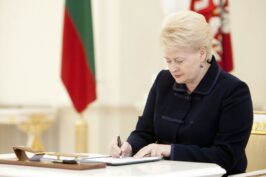
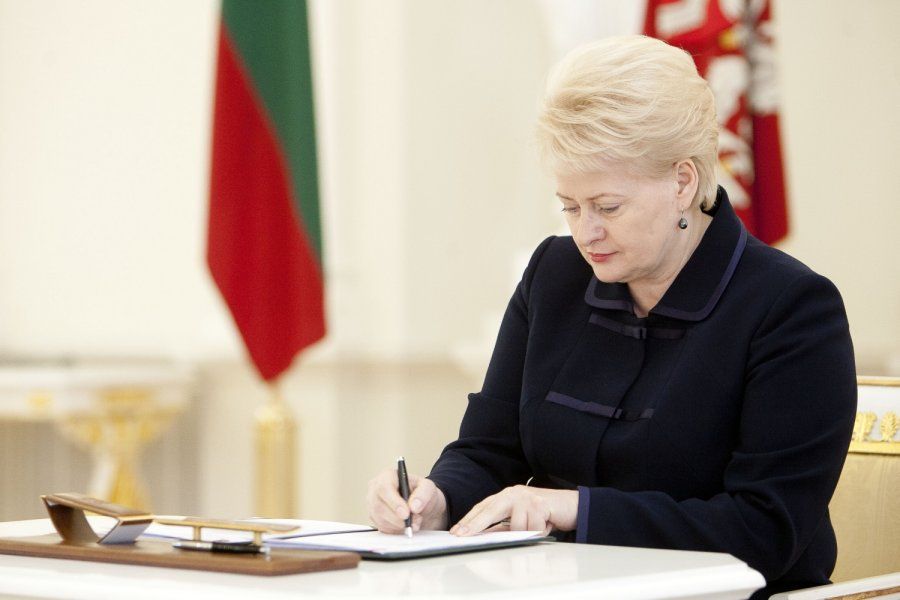
The President of Lithuania has signed amendments to the Law on Lithuanian Citizenship passed by the Lithuanian Parliament Seimas under an urgent procedure. These Amendments are expected to make the process of acquiring dual citizenship of Lithuania more liberal. Based on the previously developed practice applicable by the Migration Department of Lithuania, a person applying for a dual citizenship on the grounds that his/ her ancestors had been citizens of Lithuania by 15-Jun-1940 and left Lithuania by 11-Mar-1990, was obliged to present the Migration Department with additional evidences of the reasons why he/ she or his/ her ancestors left Lithuania. Mere facts of leaving Lithuania by 11-Mar-1990 and having the Lithuanian citizenship by 15-Jun-1940 were not considered as sufficient grounds for acquisition of a dual citizenship. The departure from Lithuania had to be determined by historical, political circumstances, and an actual threat faced by the person at the time of departure from Lithuania. A person became entitled to acquire a dual citizenship only upon proving that the person, who left Lithuania by 11-Mar-1990, faced an actual threat. Departure during the interwar period, i.e. by 1940 year, was considered as a period when a person could not have faced an actual threat based on the historical context in that period. This practice not only caused procedural difficulties for the applicants, but it also reduced the possibilities of acquiring a dual citizenship for people, who had such a right based on the effective legislations. The Lithuanian Seimas took this into consideration and passed amendments to the Law on Lithuanian Citizenship. Consequently, people applying for restoration of the Lithuanian citizenship and wishing to keep their current citizenship, i.e. to have a dual citizenship, would have to prove only two essential facts: that they themselves, their ancestors or one of them had been Lithuanian citizens by 15-Jun-1940 and that they left Lithuania by 11-Mar-1990. A person would not be entitled to a dual citizenship in cases when the person or his/ her ancestors departed from Lithuania after 1940 to the territory of the former Soviet Union. The President of Lithuania has signed the amendments.
MIGRATION LAW CENTER


Registering a company as a VAT payer may be both mandatory and voluntary procedure in Lithuania.
A voluntary registration as a VAT payer is available for legal entities who are active or are going to become active.
A registration as a VAT payer is mandatory for the company if the annual income for the goods sold or services provided is over 45,000 EUR.
In case the company wants to be included in the VAT Register, it should submit an application and other necessary documents to the State Tax Inspectorate. During the investigation of the application to include the company in the VAT Register the company activity is assessed, as well as its activity scheme, presence of residence and warehouses if they are necessary for the company activity, etc.
After all of the documents and information have been provided, the decision regarding including the company in the VAT Register is made in 3 business days.
We provide legal aid, consultations, represent our customer in State Tax Inspectorate and other institutions. We also help to register the company in the VAT Register.


Like in other countries, a licence is needed in Lithuania to carry out certain activities. Licence is a permission issued by a competent state authority to carry out a respective activity indicated in the licence. The documents required to receive a respective licence, places to go and procedures, and terms and conditions of the licence depend on type of the licence you want to obtain. Licences in Lithuania are issued by different institutions. For example, a building permit is issued by the State Territorial Planning and Construction Inspectorate under the Ministry of Environment, licences for passenger and freight transportation are issued by the State Road Transport Inspectorate under the Ministry of Transport and Communications, the licence for operation of credit institutions is issued by the Bank of Lithuania, licences to carry out activities of brokers, broker companies, management companies, investment companies, and pension funds are issued by the Securities Commission, and other.
Main businesses in Lithuania that require a licence:
- Restaurant business;
- Logistics, freight transportation;
- Passenger transportation;
- Construction works;
- Alcohol production, wholesale of alcohol drinks, alcohol products, tobacco products, wholesale of tobacco products, tobacco cultivation, purchase of undenatured ethyl alcohol, purchase and use of undenatured ethyl alcohol;
- Pharmacy business;
- Import and export of agricultural products;
- Insurance business;
- Trade of antiques;
- Business of credit institutions;
- Business of brokers, broker companies, management companies, investment companies, pension funds;
- Import of textile (from Belarus, China);
- Activity of physical culture and sports specialist;
- Activity of broadcasting and rebroadcasting.
You should look up, if your planned business is not included in the list of licensed businesses in Lithuania before you start a business. If you do not know, whether your planned activity is licensed, or if you need help to obtain a licence for your planned activity in Lithuania, come to us and we will help you, we will provide legal aid and consultations regarding the issue of the licence to be obtained, we will prepare the necessary documents to obtain a licence, and represent your interests in competent institutions.


Virtual office is a perfect solution for the businessmen who carry out activities that do not require having office premises.
There are many types of business when office premises are unnecessary and employees and a manager may perform at home or other place they find comfortable.
The businessmen who do not feel a real need for an office may use the service of a virtual office. Virtual office is a unit of common business premises with an address to which the company most often registers its residence, receives correspondence, these are the premises in which the company receives the services of a secretary, reception of calls, mail and e-mail, the premises in which there is a possibility to rent meeting rooms and conference halls.
We offer good quality virtual office services in Vilnius: Registration of your company at the office address, secretary service, reception of calls, correspondence, and packages, registration, informing you about the mail and calls received, provision of reports, and rent of a meeting room.


Good staff and suitable employees is one of the conditions of a successful company.
Upon starting and developing business in Lithuania, the companies often face the need for employees, personnel selection and hiring, many questions arise.
Search and selection of employees has become especially important for foreign businessmen of Lithuania, who plan to apply for a permission to live in Lithuania. According to the current legislation, if a foreigner, company shareholder or a member wants to apply for a permission to live in Lithuania, his/her company, apart from other requirements, such as being in business for no less than 6 months before submitting the documents for a permission to live in Lithuania, having a capital, and requirements of investment size (capital of the company that belongs to him/her is no less than 28,000 EUR, out of which no less than 14,000 EUR is the foreigner’s investment,), must fulfil the requirement of creating work positions in the company, i.e. there should be no fewer than 3 citizens of Lithuania or permanent foreign residents of Lithuania hired full time. The employees should be paid no less than a minimum wage, which now in Lithuania is 300 EUR a month. Monthly taxes off the minimum employee’s wage are approximately 150 EUR.
After selecting the best suitable candidate, a work contract is concluded with him/her, other necessary recruitment documents are signed, all necessary documents and certificates are received. The information about person’s recruitment is transferred to Sodra no later than one day before the person’s first day at work (The State Social Insurance Fund Board). According to the Lithuanian legislation, the person’s working hours should not be longer than 40 hours a week. One day should not have more than 8 hours of work. The work time, including overtime, should not exceed 48 hours a week.
Considering the needs of our customers, we help to find and select suitable employees according to the criteria provided by the customer. We prepare all necessary recruitment documents, inform the competent state authority Sodra about hiring the person in terms, consult regarding labour law, and provide other related services.
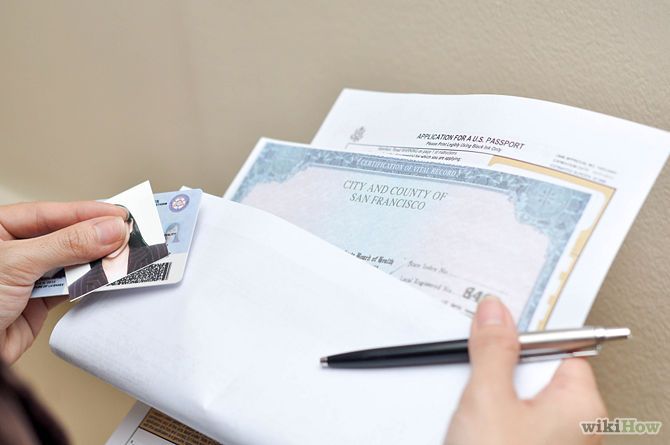
One among the documents to be submitted by an alien who wants to receive a residence permit in Lithuania is an alien’s certificate of conviction. At present, submission of the certificate is mandatory in all cases, i.e., both when an alien applies for a temporary residence permit in Lithuania and for a permanent residence in Lithuania.
Up to 14 October 2015, the requirement to submit the certificate of conviction was mandatory for individuals applying for a temporary residence permit in Lithuania only. Subparagraph 17.9 of Order No. 1V-367 as of 06-05-2015 of the Minister of the Interior of the Republic of Lithuania provides for that in cases where an application for a temporary residence permit in Lithuania is filed by an older than 14 years old alien, he/she must submit a certificate issued by a competent authority of the foreign country, which he/she has resided in before arriving to Lithuania or is currently residing, stating that he/she was or was not convicted in that country. In case an alien applying for a temporary residence permit in Lithuania was convicted in the country which he/she has resided in before, the certificate of conviction shall specify when and for what offense the person was convicted, with additional information on the type of a sentence imposed and a served sentence or a failure to serve it. An alien must obtain the said certificate before arriving to Lithuania to reside, i.e., he/she must apply to competent authorities of the country, which he/she has resided in, and to obtain the certificate of conviction. If an alien is currently staying in Lithuania, he/she may apply for the certificate to the diplomatic mission or consular post of the country, which he/she has resided in, in Lithuania. An alien should seek to obtain the certificate no earlier than 6 months prior to applying for a temporary residence permit in Lithuania.
According to the new provision, which entered into force on 14 October 2015, since now the certificate of conviction is also to be submitted in case an alien is applying for a permanent residence permit in Lithuania. Order No. 1V-809 of the Minister of the Interior of the Republic of Lithuania specifies that the Order No. 1V-445 of the Minister of the Interior is supplemented with a new provision which provides for that in cases where an application for a permanent residence permit in Lithuania is filed by an older than 14 years old alien, he/she, along with other documents, must submit a certificate of conviction to be issued no earlier than 4 months prior to the submission of an application for a permanent residence permit in Lithuania. The submission of the certificate of conviction is not mandatory in cases where the alien holds a valid temporary residence permit in Lithuania and has declared a place of residence in Lithuania.
The certificate of a person’s conviction issued by a competent authority of a foreign state must be translated into Lithuanian, validated and affirmed by Apostille, unless international treaties of the Republic of Lithuania or acts of the Euro Union provide otherwise.
MIGRATION LAW CENTER


On 1 January, 2015, an amendment to Article 45 of the Law on the Legal Status of Aliens will enter into force, it will state that:
· temporary residence permit may be issued to an alien who is engaged and intends to engage in lawful activities in the Republic of Lithuania, provided that the alien:
1) is a participant in an enterprise, which, at least the past 6 months prior to the alien’s application for the issue of a temporary residence permit, has been carrying out activities in the Republic of Lithuania, referred to in incorporating documents, which has established at least three work places, full-time occupied by citizens of the Republic of Lithuania or permanent alien residents of the Republic of Lithuania, and an equity (in case other than a stock company or a joint-stock company – assets) of which amounts to at least 28,000 Euro, not less than 14,000 Euro of which are funds or other assets invested by the alien, and he is the head or a member of a collegial management or supervisory body of the enterprise, having the right to enter into transactions on behalf of it, or is a shareholder of a stock company or a joint-stock company, in which the nominal value of his proportion of the authorised capital held in the enterprise must comprise not less than 1/3;
2) is the head or a member of a collegial management or supervisory body of the enterprise, which meets the above requirements herein, and the goal of his arrival is work in such company;
3) has been exempted from the obligation to obtain a work permit.
· A temporary residence permit is issued to an alien who is engaged and intends to continue to engage in lawful activities in the Republic of Lithuania, for the period of one year, replaced – for two years. A temporary residence permit is issued and replaced to an alien who has invested in an equity (assets) of an enterprise at least 260,000 Euro, and the enterprise has established at least five work places, full-time occupied by citizens of the Republic of Lithuania or permanent alien residents of the Republic of Lithuania, for the period of three years.
The procedure regulating the issue of temporary residence permits provides for an assessment whether there are serious grounds to believe that the enterprise, where the alien is the head or a member of a collegial management or supervisory body, is fictitious. It is important to note that the alien, having terminated lawful activities in the Republic of Lithuania, must depart.
MIGRATION LAW CENTER
In the recent years, the favorable opportunities for investments and trade in Lithuania attract more and more foreign enterprises and businessmen: they choose Lithuania as a stable country that offers a comparatively simple and safe investment policy. Attraction of investments to Lithuania is one the key strategic objects of the state, so, upon striving to the maximum efficiency of its accomplishment, Lithuania permanently takes every measure for improving its image and attractiveness among investors both in the country and in relations with foreign states and physical persons residing in foreign states. Upon striving for increasing the number of investments and their amounts to the maximum possible extent, Lithuania even developed a system of support to foreign investors that wish to establish and develop their activities in Lithuania. The business sector of Lithuania has been reformed and at present it conforms to all the requirements and standards set by the European Union, so Lithuania is attractive for investors because of safety, transparency and conformity to the standards. Upon striving to avoid isolation of business in Lithuania and make it global, Lithuania concluded agreements for avoidance a double taxation with 53 states of the world, including Great Britain, USA, Canada, China, Switzerland etc. So, business in Lithuania becomes global and easier accessible for investors from foreign states.
According to the relevant legal norms of Republic of Lithuania, investing in business in Lithuania is a lawful base for immigration of an alien to Lithuania. Lithuania provides an opportunity to come to Lithuania and reside here on the base of a lawful activity, i.e. investing in business, to foreigners, thus striving to attract capital, effective working procedures and new ideas. Foreigners in Lithuania may contribute to management of an existing legal entity (to become a shareholder of the enterprise) or establish a new legal entity. The conditions for establishing a new enterprise and starting a business in Lithuania are not complicated: for starting a business, only several days are enough; upon using an electronic signature, the procedure an incorporation of an enterprise in Lithuania becomes particularly simple and enables to save time and money.
With regard to the investing opportunities in Lithuania, it is notable that seven free economic zones operate in Lithuania at present. They are territories where economic and legal opportunities provided by legal norms are particularly favorable for operation of economic subjects. To enterprises registered in a territory of a free economic zone and their employees, various tax advantages are applied; they are provided consulting services etc. In addition to free economic zones, science and technology valleys where business potential is concentrated as well operate in Lithuania.
Lithuanian citizenship is a permanent legal relationship of a person with The Republic of Lithuania, based on mutual rights and obligations.
Lithuanian Citizenship is acquired by:
1. birth;
2. citizenship restoration;
3. being granted Lithuanian citizenship.
Reinstatement of Lithuanian Citizenship While Renouncing the Current Citizenship
The persons who held Lithuanian citizenship prior to 15 June 1940 and their descendants shall be able to reinstate Lithuanian citizenship if they are not citizens of a different state or they want to renounce their current citizenship.
Reinstatement of Lithuanian Citizenship While Retaining the Current Citizenship (Dual Citizenship)
The requirement to renounce citizenship of a different state is not applied to persons who can be citizens of both the Lithuania and a different state, in accordance with the Law on Lithuanian Citizenship article 7 subsections 2, 3, and 4, i.e.:
1. the person who was exiled from the occupied Republic of Lithuania prior to 11 March 1990 and has acquired citizenship of a different state;
2. the person who left Lithuania prior to 11 March 1990 and acquired citizenship of a different state;
3. the person who is a descendant of a person mentioned above.
Dual Citizenship in Lithuania can be Acquired by persons who:
- gained Lithuanian citizenship and citizenship a different state by birth;
- gained a foreign citizenship by virtue of marriage to a citizen of a different state;
- provided they were adopted by a citizen (-s) of Lithuania before reaching 18 years of age and, as a result of the adoption, acquired Lithuanian citizenship;
- provided they, being citizens of Lithuania, were adopted by a citizen (-s) of a different state before reaching 18 years of age and, as a result of the adoption, acquired citizenship of that state;
- acquired Lithuanian citizenship by way of exception while being a citizen of a different state;
- acquired Lithuanian citizenship while having a refugee status in Lithuania;
- retained Lithuanian citizenship or who has citizenship of the Republic of Lithuania restored for his outstanding merits to the Republic of Lithuania;
- acquired citizenship of the Republic of Lithuania while having refugee status in the Republic of Lithuania;
- acquired Lithuanian citizenship by birth and acquired citizenship of another state until he turned 18 in other way than by birth.
FREE analysis of your options for obtaining Lithuanian citizenship
The lawyers of MIGRATION LAW CENTER offer a free legal analysis of your options for obtaining Lithuanian citizenship. To receive a detailed analysis, please complete an application form by clicking this link – FORM.
Following a thorough legal analysis of your options that would allow to obtain Lithuanian citizenship, our lawyers will provide you with a written response (analytical results) regarding your options of obtaining Lithuanian citizenship and further requirements as well as procedure processes.
Read more:
Lithuanian citizenship for exiled citizens. Dual citizenship in Lithuania.
Lithuanian citizenship can be acquired: by birth, by naturalization, by way of exception, by restoration of Lithuanian citizenship.
Acquisition of Lithuanian Citizenship by Birth.
A child, both of whose parents are Lithuanian citizens, shall be a citizen of Lithuania regardless of whether he was born in the territory of Lithuania or beyond its borders.
A child adopted by a Lithuanian citizen (-s) shall become a Lithuanian citizen.
A child who is a Lithuanian citizen and who is adopted by a citizen (-s) of a different state retains the Lithuanian citizenship regardless if he acquired citizenship of a different state due to adoption.
A child born in the territory of Lithuania, whose parents are stateless persons habitually resident in Lithuania, shall acquire citizenship of Lithuania.
A child found in the territory of Lithuania, both of whose parents are unknown, shall be considered born in the territory of Lithuania and shall be a Lithuanian citizen, unless circumstances are disclosed whereupon the child would acquire a different status.
Naturalisation
A person can be granted Lithuanian citizenship if he:
1. Has been residing in the territory of Lithuania for the last 10 years;
2. Has the right to habitually reside in the territory of Lithuania;
3. Has passed the examination in the state language;
4. Has passed the examination in the basic provisions of the Constitution of the Republic of Lithuania;
5. Has a legal source of income;
6. Is a stateless person or notifies in writing of his will to renounce citizenship of another state held by him;
7. Meets other requirements laid down in the Law on Citizenship of the Republic of Lithuania.
Acquisition of Lithuanian Citizenship by Way of Exception
The citizenship is granted by the president of the Republic of Lithuania.
Restoration of Citizenship of the Republic of Lithuania
A person who has lost Lithuanian citizenship may have it restored to him upon his application. The request for restoration of Lithuanian citizenship shall be submitted to the president of Lithuania through competent authorities.
The application is a certain type of form that must be completed in Lithuanian language. Other foreign language documents supporting the application must be translated into Lithuanian and certified by a translator. Copies of those documents must be certified by a notary. Documents issued by foreign countries must be legalized or come with an Apostille certificate, unless international agreements of the Republic of Lithuania and European Union law do not provide otherwise.
Renunciation of Citizenship of the Republic of Lithuania
The right of a Lithuanian citizen to renounce citizenship may not be restricted.
A person’s application for renunciation of Lithuanian citizenship shall be submitted to the Minister of the Interior or the institution authorised by him.
The application for renunciation of citizenship needs to be completed in Lithuanian language. Other foreign language documents supporting the application must be translated into Lithuanian and certified by a translator. Copies of those documents must be certified by a notary. Documents issued by foreign countries must be legalized or come with an Apostille certificate, unless international agreements of the Republic of Lithuania and European Union law do not provide otherwise.
Documents that support the application for renunciation of citizenship of the Republic of Lithuania:
1. Documents certifying Lithuanian citizenship;
2. Personal identification document issued by a foreign body (if such was issued);
3. Documents issued by competent foreign authorities stating that the person is a national of that state or shall acquire citizenship of that state after losing Lithuanian citizenship.
If you have any questions regarding Lithuanian citizenship or should you require more information or help, please contact us by e-mail: info@migration.lt or tel.: + 370 6 1861886. We will gladly help you.


On 2014 01 23 Lithuania has adopted amendments to the legislation, which was amended the order of submission of documents for temporary residence permit of Lithuania and order of issuance, amendment, revocation of Lithuanian residence permits to foreigners.
1. The document confirmingthat the alien hassufficient fundsand(or) receives a regularincome;
2. The document proving thathehas alivingarea inLithuania;
When an alien intends to work requiring good professional qualification his application for the issuance of temporary residence permit must be considered no later than within two months from the lodging of the application to a Consular Post or Migration Service.
MIGRATION LAW CENTER


Lithuania has adopted the amendments to the Republic of Lithuania Law on the Legal Status of Aliens. The main amendments are relate to foreigners’ intending to obtain residence permits Lithuania on the base, that they intends to engage in lawful activities in the Republic of Lithuania, ground, status, also the verification of incorporated or managed companies’ fiction, the requirements for foreigners living area, the other changes in the fields of foreigners’ working and studying in Lithuania.
The law defines the concept of a fictitious company, indicating that the fictitious company -a private legalperson registered in the Register of Legal Entities, whichhas beenestablishedoracquiredin order notto carry outtheactivities written in the legal entity’sincorporation documentsin Lithuania, but to geta residence permitin Lithuania for an alien–the aparticipant of this legal person, the head of this legalperson, orcollegialmember orthe supervisory body of this legalperson.
Until now,according to the provisions of the Republic of Lithuania Law on the Legal Status of Aliens the temporary residence permit of Lithuania (hereinafter also – Lithuania residence permit) can be issued to a foreigner who intends to engage in lawful activities in the Republic of Lithuania. Under the amendments of law the intention to engage in lawful activities in the Republic of Lithuania is not enough, the alien has engaged in lawful activities and continue to engage in lawful activities in the Republic of Lithuania.
The Lithuania residence permit will be issued to an alien who is a participant of the company, which carries out the activities written in the legal entity’s incorporation documents at least 6 months prior to the alien’s application for the issuance of a temporary residence permit, which is set up at least three work places, and there are full-time working Lithuanian citizens or permanent resident aliens in Lithuania and the own capital value of at least 100 000 LTL, of which not less than 50 000 LTL-aliensinvested infundsorother assets,andthe alien is theheadof this company, collegialmember ofthe supervisory body of this legalperson,the participantentitledto enter into transactionson behalf of the company, or he is a shareholder of public companyora private limitedcompany, who ownedthe company’sshares had a nominalvalue of notlessthan 1/3 of the company’sshare capital.
As well as a Lithuania residence permit will be issued to an alien who is the company’s, that meets the above requirements, head, collegial or supervisory body, and the purpose ofhis arrival is to work in the company.
Under the new provisions of the law a temporary residence permit is issued to an alien who is engaged and will continue to engage in lawful activities in Lithuania, as it was before – for 1 year, but it will be extended not to 1 year, but for a longer period – for 2 years.
An alien who invested at least 900 000 LTL in the company’s capital (asset), there is set up at least 5 work places in the company and there are full-time working Lithuanian citizens or permanent resident aliens in Lithuania, a temporary residence permit is issued and replaced for 3 years.
During the issuance of a temporary residence permit will be assessed if the company is not fictitious. When the company detected as fictitious company the Lithuania residence permit will be closed.
Also, there imposed new requirements for a foreigner living area of Lithuania. The law provides that the Lithuania residence permit may be issued or amended for an alien if the alien has adequate living space in Lithuania, where is going to declare his residence place and the living space per each adult person declared his residence would be not less than 7 square meters. The alien should haveownershiporuse aroom onrentalorloan basis. Whena temporary residence permitissued to a foreignerwho intends tolearn, study, livingspacesuitable forresidentialshall not belessthan4 squaremeters.
After theentry into forceof the new law getting the Lithuaniaresidence permit on the base of workingin the Lithuanian companywill be subject toan exception of LithuanianLabour Exchange. TheLithuanianLabour Exchangewill notmake a decisiononthe alien’semploymenteligibility in Lithuanianlabour market.This decisionof the Lithuanian LabourExchangewill notbe acceptedasan alienpresentsemployer’sobligationtoemploy him not lessthanoneyearunder a contractandpaya monthlysalaryof not lessthan3LithuanianDepartment of Statisticsannouncedlastnational economyof the average monthlygrosswage rates, orwhenthe Lithuaniaresidence permitisissued tohighlyskilledprofessionalwork, or changed and alreadypassedtwoof thealien’slawfulemploymentLithuaniayears.
The new law comes into force in 1st of November 2014.
Foreigners’ application to issue or change the temporary residence permit of Lithuania, presented prior the new law came into force, are review and decisions to issue or the temporary residence permit of Lithuania adopted according to provisions of the Republic of Lithuania Law on the Legal Status of Aliens, which are existing now. The temporary residence permit of Lithuania for these foreigners are issued or exchangeable for such period, which was established prior the new law came into force, and at the end of their validity – are replaced by the existing legislation.
If the alien’s the temporary residence permit of Lithuania was issued before the entry into force of the new law as a company’s head, owner or co-owner, these alien’s application to replace a temporary residence permit of Lithuania submitted by 1stMay 2015 is exanimated and the decision to issue a temporary residency permit Lithuania adopted according to provisions of the Republic of Lithuania Law on the Legal Status of Aliens, which are existing now. The temporary residence permit of Lithuania for these foreigners are issued or exchangeable for such period, which was established prior the new law came into force, and at the end of their validity – are replaced by the existing legislation.
MIGRATION LAW CENTER


In Lithuania there is changed the order No 1V-329 of the Minister of the Interior of the Republic of Lithuania of 12 October 2005 “On the Approval of the rules on the issue of temporary residence permits for aliens in the Republic of Lithuania and the rules for the identification of marriages of conveniences, registered partnerships, and fictitious adoptions”.
Among the changes now an alien’s application for a temporary residency permit in Lithuania can be examined and a decision taken on a matter of urgency.
Until now, the alien’s application a temporary residency permit in Lithuania had to be examined and a decision on it taken no later than 4 months after the submission n of application to migration service or consular office day. After the entry into force of amendments to the legislation, an application for a temporary residence permit in Lithuaniashould be examined and a decision on it taken no later than 4 months in general order, and an application for a temporary residence permit in Lithuania in a matter of urgency – not later than 2 months from the date of submission to the Migration Service.
Application to change a temporary residency permit in Lithuania will be examined and a decision on it taken no later than 2 months (in general order) and urgency – not later than 1 month from the date of submission to the Migration Service.
A temporary residence permit in Lithuania will be executed (produced and issued card) no later than 10 working days in general order, while a matter of urgency – not later than 5 business days after the submission of application for a temporary residence formalization to the Migration Service day.



On 5 July, 2014, Order of the Minister of the Interior of the Republic of Lithuania No. 1V-459 as of 4 July 2014 “On the Issue, Replacement and Withdrawal of Documents Required to Receive the Permit of a Long-Term Resident of the Republic of Lithuania to Reside in the European Community” entered into force.
The Order regulates the procedure for the issue, replacement and withdrawal of long-term residence permit of the Republic of Lithuania in the European Union in an urgent case – at the alien’s request, the decision on the issue of a permanent residence permit can be adopted as a matter of urgency. As per standard procedure, an application is examined within 4 months and executed not later than within 10 working days, while in an urgent case – examined within 2 months and executed not later than within 5 working days from the day of lodging an application with the Migration Department or a migration division of a territorial police institution.
A permanent residence permit shall be replaced no later than within one month, and in an urgent case – not later than 15 days from the day of lodging an application to replace a permanent residence permit with a migration division of a territorial police institution.
An alien, before submitting an application to issue, execute, or replace a permanent residence permit, shall pay a fixed Lithuanian state fee and submit a supporting receipt, unless the laws exempt him from state fees.
An application for a permanent residence permit in Lithuania is not subject to urgent examination if:
1) a lack of data / documents certifying that the alien held citizenship of the Republic of Lithuania before 15 June 1940, or, documents proving kinship with such person, or a lack of documents certifying the right to retain or restore citizenship of the Republic of Lithuania, or no decision was adopted regarding the right to retain or restore citizenship of the Republic of Lithuania;
2) no responses received to requests of the Migration Department for additional data and (or) documents justifying the application for a permanent residence permit;
3) checks are carried out whether a marriage or a registered partnership is not of convenience; inquiry is carried out to assess whether an adoption is not fake.
If, at least 10 working days until the deadline for urgent examination of an application for a permanent residence permit, it is established that the application is not subject to urgent examination, a person shall be immediately notified thereof by post or e-mail. The report shall inform about the standard procedure for examination of an application for a permanent residence permit and state the reasons why the examination is not a matter of urgency. In addition, it is accompanied with a statement as the basis for recovering overpaid fees by the person.
MIGRATION LAW CENTER


For more efficient collection of data on participants of legal entities and enabling the provision of such information to natural and legal persons, a new Legal Entities Information System (JADIS) was introduced. As the result of introduction of this system, the Centre of Registers will no longer accept registered lists of shareholders, submission of member data will be conducted upon signing in the Centre of Register’s self-service system only (www.registrucentras.lt/savitarna). Departments of the Centre of Registers, though, will leave open the possibility of declaring a sole shareholder – the owner.
Information may be submitted with JADIS by a manager of a company or an authorized representative of the company – a natural person. The information submitted is affirmed with an electronic signature, against a qualified certificate. This certificate is available for acquisition in customer service departments of the Centre of Registers (www.elektroninis.lt). Certificates for mobile phones are distributed by major mobile operators, as well as “Šiaulių bankas” and Danske Bank A/S.
MIGRATION LAW CENTER

Opening of a bank account shall enable persons to save and store their funds safely, to control them conveniently, to carry out payments online (or by a mobile telephone), to replenish the bank account in cash and to withdraw money from the account at a bank office or an ATM, to receive a salary and to carry out other financial operations.
For opening a bank account, you may arrive to a branch of the chosen bank office and conclude a current account agreement. Any physical person (a citizen of Republic of Lithuania, a foreigner or a stateless person) may open a bank account at a bank office of the Republic. For opening a bank account, a person shall present to the bank office the well-defined documents, namely: a personal identification document, a permit for residence in Republic of Lithuania (if a foreigner wishes to open a bank account). In the person wishes to open a bank account in the name of another person, a power of attorney shall be presented to the bank officer. Also any legal entities registered in Republic of Lithuania or foreign states may open accounts at a bank. Physical persons that are entitled to develop economic activities and/or involved in provision of services may open a bank account at any bank or credit office operating in Republic of Lithuania.
On opening a bank account, no initial deposit is required. More than one account may be opened at the same bank. The account bearer may terminate the account agreement and withdraw the money from the account at any moment.
Some banks in Republic of Lithuania provide an opportunity of a bank account opening online, i.e. without a necessity of arriving to a branch of the chosen bank. In such a case, the person shall fill the application of the form approved by the bank and sign it by electronic signature. After the said action, the person is provided a right to familiarize with the current account agreement and to sign it. After signing the agreement, the bank carries out the relevant actions for opening a bank account in the name of the client at the bank.

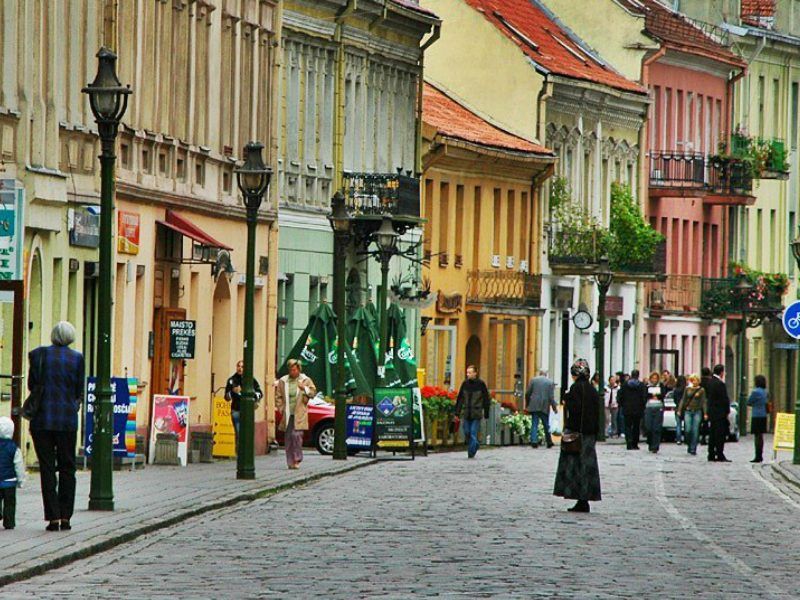
Search for a new housing is a difficult and responsible task for any person. In course of selection of a new housing, one must take into account the own needs and to analyze them thoroughly, to decide what part of the city is preferable for him(her), what area of housing should be optimum and so on. One of the most important steps will be a serious assessment of the own financial capacities at present and in future.
In Lithuania, search for housing may be carried out through real estate agencies involved in mediation services related to sale or rent. The other opportunity is conclusion of real estate (a house or a flat) transactions (on sale or rent) directly with the sellers. The most convenient way is using of websites for rental and for-sale housing. In Republic of Lithuania, the most popular websites are www.aruodas.lt, www.domo.plius.lt, and www.skelbiu.lt bei www.alio.lt .
The rent or the purchase price of housing depends on a number of different factors, such as the chosen residential area, the area of the house (flat), its equipment, the year of construction and other circumstances. In largest towns of Lithuania, the rent for a flat varies on the average from 5.4 EUR/ sq m to 8 EUR/ sq m. For example, in Vilnius, a monthly rent for one-room flat amounts on the average to 200-270 EUR, for two-room flat – on the average to 350-390 EUR. It was found that fluctuations of rents are particularly striking during summer months. With regards to acquisition of housing, the average price of a two-room flat in largest towns of Lithuania varies between 52’000 EUR and 76’000 EUR.
It should be mentioned that if real estate agencies are involved in mediation services related to sale or rent, the client, in addition to all payments arising from the sale or rental contract, shall pay a mediation fee to the agency. If a rental or sale contract is concluded directly with the seller or the renter), no mediation fee is payable, so the expenses of search for housing become less.
In case of acquisition of real estate (a house or a flat), the transaction shall be notarized according to the procedure provided in laws of Republic of Lithuania. The involved notary public, as a person authorized by the state, shall, in course of execution of the entrusted functions, verify a legitimacy of such transaction, clear up the wills of the parties and establish the legal validity of the transaction. In case of sale, the buyer and the seller may sign in the beginning a preliminary sale contract where they agree on the principal terms of the transaction and then sign the final sale contract. It should be mentioned that a housing sale contract shall be notarized in any case.


On implementing the democracy principle, the right of information gathering and spreading is guaranteed for Lithuanian mass media. The said right may be restricted in exceptional cases, i.e. when such information gathering and spreading may violate (or violates) the right of other persons to private life and (or) other personal non-property rights.
Radio and television are the particularly important means of mass media for the community and its cultural life. Upon applying certain techniques required for access to a large audience, the community is duly and well-timely informed on the most important and topical political, economic, cultural and social events in Lithuania; in addition, various scientific programmes, movies and cinema news and other interesting information are provided.
In Lithuania, upon applying certain techniques required for providing a certain service, each person is provided an opportunity to watch TV-programmes of all channels (both the national and of foreign states). If a person wishes to use TV-services, he (she) should apply to relevant enterprises involved in provision of them both to private persons and business subjects (legal entities). Broad opportunities of watching TV-channels and certain direct programmes online are provided as well.
Radio communication services are available throughout the entire territory of Lithuania by using receivers that may be made as individual devices or integrated in a car, TV-set and so on. Broadcasts of radio stations are accessible as well. In Lithuania, over 30 radio stations operate. However, their accessibility is not the same in different regions of the country, because radio interference hinders broadcasting of programmes of some radio stations in certain parts of the territory of Lithuania. Of course, the said problem does not arise, if broadcasts of a certain radio station may be listened online.


Transport system of Lithuania is well-developed and it satisfies the needs of permanent residents and persons coming there for a short time; they can use both private vehicles and public transport.
First of all, it should be mentioned that urban transportation networks (buses and trolleybuses) exist in large towns of Lithuania only. In the largest cities of Lithuania (Vilnius and Kaunas), the population and visitors may use services of buses and trolleybuses according to the fixed routes and schedules. The prices of tickets depend on the duration of the service and the applicable discount. In other towns of Lithuania where urban transportation system exists, it includes only buses. Both permanent residents and visitors of towns may buy a single ticket for a bus and (or) a trolleybus or acquire a long-term transport card that may be replenished with tickets of the chosen type and price.
In Vilnius, the capital of Lithuania, the innovative well-developed system of bicycle rental centers exists for many years. As in other EU Members States, its services are particularly popular among the local residents and visitors of the city. Total 37 bicycle rental centers operate there round-the-clock 7 days per week and each of them offers at least 9 bicycles. Rental centers are situated close to each other, so the users may remain the bicycles at any center after using. For using the said service, a person should acquire a bicycle rental card or a ticket.
If you prefer travelling by a car, you may use services of taxi agencies or car rental centers.
Interurban communication in Lithuania is arranged by buses and trains. From bus terminals of large Lithuanian towns, it is possible to go directly to any other town of Lithuania. The railway services are some more limited, because the railway infrastructure is not developed to the extent that would ensure an accessibility of any Lithuanian town by train.


In a majority of large towns of Lithuania, Tourism information centers operate. They provide detailed information about the tourism services available in the relevant town to residents and visitors. The principal purpose of Tourism information centers in Lithuania is spreading information on the specific town and (or) district.
Tourism information centers of the relevant towns provide information on the tourism infrastructure of the town, the places of interest of the town and (or) the total region, concerts, exhibitions, museums, fiestas and other events and entertainments free of charge. In addition, Tourism information centers arrange excursions in the town and the region and provide services of ciceroni in various languages, if agreed. At Tourism information centers, both residents and visitors may be provided with tourist routes, maps and any information needed for travelling persons. In addition, some Tourism information centers provide supplemental services to tourists in the town or the district, such as bicycle rental services, internet café services, mediation services in car rental; they sell various souvenirs and things with symbolism of the town, postcards, booklets, brochures about the relevant town of Lithuania. In some towns of Lithuania, Tourism information centers, in cooperation with tourism agencies, provide nourishment and accommodation services both to individual clients and tourist groups.
On establishment of a Tourism information center, the area of the relevant town and the annual flows of tourists in it are taken into account. Therefore, one or several centers may operate in a town and they are usually situated in places of the maximum concentration of flows of tourists.


Accounting procedures is mandatory for legal entities (including companies) who carry out business in Lithuania. Depending on the legal status of the company, different accounting requirements apply. For example, Sole Proprietorship or Small Partnerships may carry out simplified accounting in Lithuania.
Company usually needs an accountant for accounting works. The accountant may be hired by a work contract or the company may sign an agreement with the company of accounting services regarding provision of accounting services and accounting works.
To our customers we offer accounting services, constant accounting service of the company, management of necessary accounting documents, provision of reports to competent public authorities, consultation regarding financial and tax issues, representation in public authorities, and other related services.
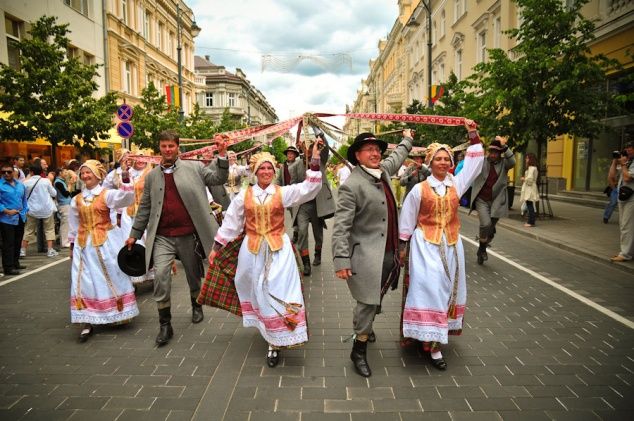
The national holidays in Lithuania:
1 January – New Year’s Day;
16 February – The Day of Restoration of Lithuanian State;
11 March – The Day of Restoration of Lithuania’s Independence;
27 March (2016) – The Easter;
1 May – The International Labour Day;
The first Sunday of May (3 May) – The Mother’s Day;
The first Sunday of June (7 June) – The Father’s Day;
24 June – Saint John’s Feast;
6 July – The Statehood Day (Coronation of Ling Mindaugas Day);
15 August – The Assumption Day;
1 November – The All Saints’ Day (The All Soul’s Day);
24 December – Christmas Eve;
25 and 26 – Christmas.
The principal entertainment centers:
Liepkalnis skiing route
Panorama
Akropolis
Skating-rings
SPA Vilnius
UNO park
Vichy Aqua Park
Aqua Park Druskininkai
Snow Arena Druskininkai
GrandSpa Lietuva

The mutual telephone number of emergency services in Lithuania is 112. It may be used for calling to the emergency medical service, police or the fire-extinguishing service. Other emergency telephone numbers in Lithuania include:
Emergency medical service: 03, 103, 033;
Police: 02, 102, 112, 022;
Fire-extinguishing service: 01, 101, 011.
Health care institutions in Lithuania:
In Lithuania, any physical person or legal entity of Lithuania or a foreign state may acquire a car or another vehicle. Persons residing in Lithuania and enterprises, offices & organizations registered in Lithuania may acquire a vehicle registered in Lithuania.
An alien wishing to acquire a vehicle in Lithuania should have a Permit for Residence in Lithuania. A vehicle also may be acquired and registered in Lithuania in the name of a Lithuanian enterprise owned by a foreigner. The most frequent forms of legal entities in Lithuania are a sole proprietorship and a joint-stock company of limited liability; there are some other forms of legal entities as well.
If a legal entity of Lithuania wishes to acquire a vehicle, it may apply for financing to a leasing company of Lithuania. The term set for a loan for leasing a vehicle differs dependently on the price of the vehicle. Usually it lasts up to 6 years. The first contribution amounts to 10, 20 or 30 % of the total price of the vehicle. The rate of the annual interest usually amounts up to 10 %. The vehicle shall be insured and equipped with an alarm system. The expenses related to insurance and the alarm system shall be covered by the enterprise that acquires the vehicle.
In Lithuania, a car or another vehicle shall be registered at any branch of the state-owned enterprise “Regitra”, independently on the address of residence of its bearer or the address of the Registered Office of the legal entity. After the vehicle registration, the state-owned enterprise “Regitra” issues the original vehicle registration documents and the vehicle plate number.

A citizen of another state having a Driver’s License issued in the said state may drive a car with the same License for a period up to a half of year. If the state having issued the Driver’s License had not acceded to Vienna Convention on Road Traffic of 08 November 1968, an international Driver’s License is required. After expiry of the half-year period, the alien shall replace his (her) Driver’s License by a Lithuanian one. In Lithuania, national Driver’s Licenses conform to Driver’s Licenses of EU model (cards). With such a License, a person may drive a vehicle in any state of European Economic Area (EEA) and in any state out of European Economic Area, if such a state had acceded to Vienna Convention on Road Traffic of 08 November 1968. For replacing the Driver’s License, its bearer shall pass an examination in driving theory and practice. The examination may be arranged in Russian and English. On the examination in driving practice, the person shall drive a vehicle of the highest category specified in the Driver’s License issued in his (her) state (to be replaced).
If the Driver’s License of the alien was issued in an European Union Member State, it will be valid in all European Union Member States. A Driver’s License for the categories AM, A1, A2, A, B, BE, B1, C1, C1E, C, CE, D1, D1E, D, DE is recognized in other European Union Member States, so its replacement usually is not required. It may be used, if: the period of its validity had not expired (usually, a Driver’s License in European Union Member States remains valid for 10-15 years); the person is of at least the minimum age that conforms to the Driver’s License (for driving relevant categories of vehicles) eligibility requirements; the state having issued the Driver’s License had not annulled, suspended or otherwise restricted its validity. In a majority of European Union Member States, the minimum age that conforms to the Driver’s License eligibility requirements is 18 years; however, if a Driver’s License is issued to a younger person (in accordance with laws of the issuing state), such a Driver’s License will not be valid in states where the established minimum age for issue a Driver’s License is 18 years.
Citizens of European Union are provided an opportunity to replace their Driver’s Licenses by Driver’s Licenses of the state where they reside at present; however, they are not obliged to do so, except of certain cases when it is required by the state where they reside. If a person wishes to replace his (her) Driver’s License by Driver’s License of the state where he (she) resides at present, he (she) should prove that he (she) resides in the state and conforms to the requirement set for issuing it. In such a case, the authorized national authorities will contact the relevant authorities of the previous state of residence of the person to verify whether any restrictions were applied to the Driver’s License of the person.
A replacement of a Driver’s License is mandatory, when: the place of residence of a person in another state becomes it state of permanent residence after expiry of 2 year; if the period of validity of the person’s Driver’s License is limited; if the person violates the traffic rules in the state of residence; if the period of validity of the person’s Driver’s License expires after the person’s leaving for another European Union Member State.
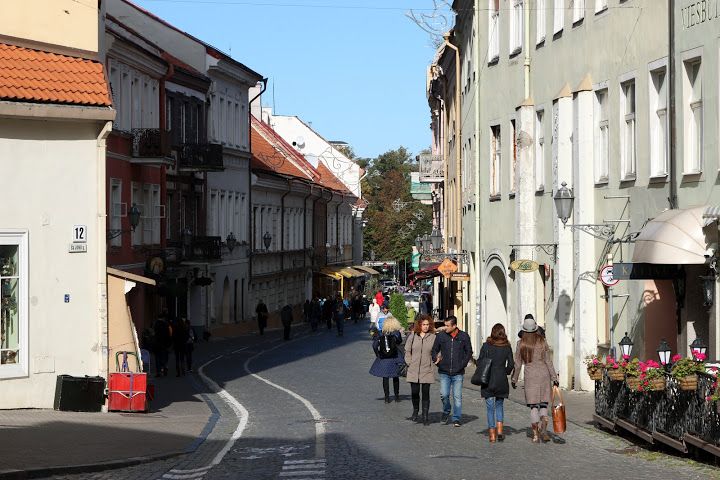
The lifestyle of Lithuanians may be disclosed through their hobbies, everyday habits, customs, traditions, culture, feast, religion and so on.
Culture. In Vilnius, the capital of Lithuania, abundant art galleries are worthy to be visited. They include the National Art Gallery, the Modern Art Center with its Fluxus art collection and so on. Lithuanian cinema and theatre actors as well as musicians are recognized on the international scale.
Festive events. Some traditional Lithuanian folk festivals (such as the Saint John’s Day or the Shrove Tuesday) arose from pagan times. Annually, Lithuanians celebrate Christmas, New Year, Easter, the Saint John’s Day, The Assumption Day and other festive events.
Religion Total 9 religions were recognized traditional in Lithuania. The largest community of believers in Lithuania is formed by Roman Catholics. Over 70% of the population of Lithuania affiliate themselves to the community of Roman Catholics.


Vilnius is a multilingual European city that unites people of various nationalities. One of the major problems arising for persons having come to Lithuania for residence is a lack of Lithuanian skills. The language skills are particularly important, if the person plans staying in the country for a long period.
According to its intensity, Lithuanian language teaching courses are divided to ones of usual intensity, intensive courses and individual teaching. Teaching is arranged in groups or individually.
The courses in the basics of Lithuania (the level A1) are courses for beginners. The purpose of them is teaching to communicate in everyday situations (how to put a question, to answer a question, to tell something and so on); to listen and understand phrases, information, data, stories usable in communication; to read texts; to right a short text; to fill forms where personal data should be specified and so on. In the above-described ways, the person is familiarized with information that will be important for the person in future and reinforce the knowledge while executing the provided tasks.
Remote Lithuanian language teaching courses are at present one of the most popular ways for learning Lithuanian. Usually they are arranged through “Skype” programme. Such courses are convenient for persons that reside abroad. The teachers form an individual programme and method for each person. The duration of the course is agreed with the person. During lessons of visual conference type, the listeners are taught speaking, grammar and text understanding. In addition, tasks are performed; communication on topical topics is arranged thus trying to improve the person’s basics of communication skills. Such a Lithuanian language teaching course differs from the usual ones only in the following: a person may learn the language in any place and the course is adapted to the individual needs of the person.
The European Integration Fund arranges projects related not only to teaching Lithuanian, but also to introduction of persons to history, culture, national values and traditions of the country. Such projects are helpful in tackling the language problem and extend the knowledge about the country. The projects are particularly useful for citizens of third countries. In addition, the services are provided free of charge.
The pronunciation courses are provided for those who wish to improve their language skills, in particular the pronunciation. For a majority of newcomers, an elimination of the native language accent is a very serious problem. Such courses are helpful in learning to speak clearly, without an accent (or with minimized accent).
Some Lithuanian language teaching courses prepare the listeners for an examination in Lithuanian language. After completion of the course, this fact is confirmed by an issued certificate.
Some Lithuanian universities arrange courses for aliens and for speakers of other languages residing in the country.
Lithuanian language teaching courses are organized both for adults and the children of foreigners. Children are taught the basics of Lithuanian language; however, upon striving to attract attention of the children, it is tried to make the teaching more interesting. So, games, fairy-tales, songs, animated films and so on are used. Books and exercise books are used as well. In addition to tasks, the children may solidify their language skills in communication with coevals.

Legal Services: Lithuanian Citizenship and Immigration
We provide specialized legal services for individuals of Lithuanian descent and their descendants who are seeking to restore, obtain, or confirm Lithuanian citizenship. Our team assists with all aspects of citizenship applications, including citizenship by descent and naturalization.
In addition, we offer guidance and support on immigration matters, such as residence permits, registration in Lithuania, and compliance with Lithuanian immigration laws. Our services ensure that both citizenship and immigration processes are handled efficiently and in accordance with current legal requirements.
Lithuanian Citizenship services
The consultation on the reinstatement of citizenship of the Republic of Lithuania (dual citizenship or recovery of citizenship, when a person has to renounce his citizenship of another state).
Granting the citizenship of Lithuania according to the simplified procedure.
Certificate of Lithuanian descent.
A certificate certifying a right for reinstatement of the citizenship of Lithuania.
Legal aid and consultation on children Lithuanian citizenship.
Legal aid and consultation on Lithuanian citizenship by marriage.
Restoration of lost citizenship of Lithuania.
Naturalization process.
Losing the citizenship of Lithuania.
Renouncing the citizenship of Lithuania.
Legalization of documents; certification of documents by an Apostille.
The preparation of documents, requests in Lithuanian language, the preparation of requests to Lithuanian Archives and the other competent authorities.
Preparation of claims or procedural documents to court for identification of family ties or other legally significant facts (change of name, surname, etc.). Corrections or amendments of civil status records in judicial procedure.
The representation in the competent authorities or in relation with other natural and legal persons.
Other Lithuanian citizenship questions.
Immigration services
Consultations on the issues of foreigners’ work and residence in Lithuania, issue of permits to live in the Lithuania as well as foreigners’ employment in the Lithuania.
Preparation of documents that are necessary to obtain a permit of residence in the Lithuania as well as organization and performance of necessary procedures.
Preparation of documents necessary to obtain a permit to work as well as organization and performance of necessary procedures.
Consultations on taxes.
Establishment and registration of companies, subsidiaries and branches in Lithuania.
Business, company purchase.
Opening a bank account in the Bank of Lithuania.
Consultations on the issues of Lithuanian national and Schengen visas.
Representation in the relations with other companies, institutions and organizations.
Representation of clients in state institutions.
The relevant legal norms of Republic of Lithuania provide opportunities for involvement in individual activities and gaining profit. In Republic of Lithuania, a person may choose one of the alternative ways for individual activities: to acquire a Business Certificate or to acquire an Individual Activity Certificate. One of the key differences between the above-mentioned forms of individual activities is that the activity under a Business Certificate is a subject to restrictions, i.e. more strict requirements are set for choosable activities. It is notable that VAT payers are not entitled to be involved in individual activities under a Business Certificate; in addition, a person involved in the individual activity under a Business Certificate is not entitled to provide services to legal entities involved in the same activity. Moreover, it is notable that a person involved in the individual activity under a Business Certificate is entitled to provide services to legal entities for the amount not exceeding 4500 EUR per calendar year. It is also important that legal norms of Republic of Lithuania provide a definite list of activities accessible under a Business Certificate. Whereas an Individual Activity Certificate provides more opportunities for a person. This means that a person may be involved in any activities, except of those being a subject of activities of a legal entity to be established according to the procedure provided in legal norms of Republic of Lithuania.
As it was mentioned above, an individual activity under a Business Certificate may be started after an acquisition of the Business Certificate. A Business Certificate may be issued to a person after reaching the age of 18 years; in cases set by laws of Republic of Lithuania, a Business Certificate may be issued to legally capable persons less than 18 years old and to minor persons from the age of 14 years at a consent of one of their parents (foster-parents or tutors). A Business Certificate shall be issued by a territorial branch of the State Tax Inspectorate after payment of the set fee. An alien having a Residence Permit in Lithuania, a Business Certificate may be issued for a period up to one calendar year, including its renewals; in addition, the period of validity of the Business Certificate shall not be longer than the period of validity of the Residence Permit. A person wishing to acquire a Business Certificate shall submit an application of the approved form and the person’s ID to the territorial branch of the State Tax Inspectorate. If a person is a foreigner, he (she) shall submit his (her) Residence Permit in addition. It should be noted that the requirement on submitting a Residence Permit is not applicable to citizens of European Union Member States and European Free Trade Association (EFTA) Member States as well as their family members. Alternatively, an application for issue a Business Certificate may be submitted online by connection to personal space of the Tax Payer via e-system of the State Tax Inspectorate; an application for issue a Business Certificate may be submitted to the territorial branch of the State Tax Inspectorate personally or sent by a mail
If a person chooses an individual activity under an Individual Activity Certificate, he (she), as it was mentioned above, may be involved in any activities, except of those being a subject of activities of a legal entity to be established according to the procedure provided in legal norms of Republic of Lithuania. An individual activity under an Individual Activity Certificate may be started after submission of a correctly completed application of the approved form on registration of the person in the Register of Tax Payer to the territorial branch of the State Tax Inspectorate. Such an application may be submitted personally to the territorial branch of the State Tax Inspectorate or sent to by mail or completed and submitted online. If a person chooses this form of individual activity, he (she) pays no fee. However, the person shall annually provide an Income Declaration where specifies the income earned from the individual activity, the expenses related to the activities and the paid taxes. In addition, it is notable that an Individual Activity Certificate is issued for a termless period. This service is provided to physical persons that may be citizens of Lithuania or foreign states.


According to valid legal norms of Republic of Lithuania, all enterprises established in Lithuania are provided a status of a legal entity. According to the goals of their establishment, legal entities are divided to private and public legal entities. The main goal of establishment of private legal entities is satisfaction of private interests and profit making. According to their legal form, such legal entities are considered joint-stock companies of limited liability, joint-stock companies, individual (one-man) enterprises, partnerships and so on, if the principal goal of their activities specified in the constituent documents is profit making. Public legal entities are established for satisfying the public interests. Such legal entities include state-owned and municipal enterprises and organizations as well as public institutions, religious communities and so on.
Both citizens of Lithuania and citizens of foreign states may establish a legal entity in Republic of Lithuania. Establishment of a legal entity includes the following phases: conclusion of pre-incorporation transaction, choosing a name for the enterprise, opening an accumulation account at a bank (the Authorized Capital of the enterprise shall be transferred to the said account; then the accumulation account shall be transformed into a current account), preparation and signing of the incorporation documents, notarization of the documents, and registration of the enterprise in the Register of Legal Entities.
In Republic of Lithuania, usually joint-stock companies of limited liability, joint-stock companies and individual (one-man) enterprises are established. An individual enterprise is a legal entity of unlimited civil liability; for its incorporation, no minimum value of the capital is set. The principal imperfection of the legal entity of this type is that the assets of the owner of the legal entity are not separated from the assets of the legal entity. This means that in case of a failure, the owner will be liable to the creditors both to the full extents of the assets of the legal entity and the own assets, i.e. when the assets of the legal entity are insufficient for fulfilling the liabilities, the owner of the legal entity shall use the own assets. A joint-stock company and a joint-stock company of a limited liability are the types of legal entities that incorporation requires a formation of an Authorized Capital divided to parts (shares). The minimum Authorized Capital for incorporation of a joint-stock company amounts to 40’000 EUR and the minimum Authorized Capital for incorporation of a joint-stock company of a limited civil liability amounts to 2’500 EUR. It should be emphasized that both a joint-stock company and a joint-stock company of a limited civil liability are legal entities of limited civil liability. This means that such a legal entity shall be liable to its creditors only to the extent of the assets of the legal entity (the assets of the owners are separated from the assets of the legal entity).
In addition to legal entities, their branches and representative offices may be established in Republic of Lithuania. In case of incorporation of a representative office, a branch of a legal entity, the legal norms of Republic of Lithuania allow providing all the rights of the principal legal entity to its branch; however, a branch shall not be provided any rights that are not provided to the principal legal entity. In case of incorporation of a legal entity, the legal norms of Republic of Lithuania provide it a finite list of rights of a legal entity, namely: to represent and protect the interests of the legal entity, to enter transactions and to carry out other actions on behalf of the legal entity as well as to carry out import and export operations upon certain condition.

In the recent years, the favorable opportunities for investments and trade in Lithuania attract more and more foreign enterprises and businessmen: they choose Lithuania as a stable country that offers a comparatively simple and safe investment policy. Attraction of investments to Lithuania is one the key strategic objects of the state, so, upon striving to the maximum efficiency of its accomplishment, Lithuania permanently takes every measure for improving its image and attractiveness among investors both in the country and in relations with foreign states and physical persons residing in foreign states. Upon striving for increasing the number of investments and their amounts to the maximum possible extent, Lithuania even developed a system of support to foreign investors that wish to establish and develop their activities in Lithuania. The business sector of Lithuania has been reformed and at present it conforms to all the requirements and standards set by the European Union, so Lithuania is attractive for investors because of safety, transparency and conformity to the standards. Upon striving to avoid isolation of business in Lithuania and make it global, Lithuania concluded agreements for avoidance a double taxation with 53 states of the world, including Great Britain, USA, Canada, China, Switzerland etc. So, business in Lithuania becomes global and easier accessible for investors from foreign states.
According to the relevant legal norms of Republic of Lithuania, investing in business in Lithuania is a lawful base for immigration of an alien to Lithuania. Lithuania provides an opportunity to come to Lithuania and reside here on the base of a lawful activity, i.e. investing in business, to foreigners, thus striving to attract capital, effective working procedures and new ideas. Foreigners in Lithuania may contribute to management of an existing legal entity (to become a shareholder of the enterprise) or establish a new legal entity. The conditions for establishing a new enterprise and starting a business in Lithuania are not complicated: for starting a business, only several days are enough; upon using an electronic signature, the procedure an incorporation of an enterprise in Lithuania becomes particularly simple and enables to save time and money.
With regard to the investing opportunities in Lithuania, it is notable that seven free economic zones operate in Lithuania at present. They are territories where economic and legal opportunities provided by legal norms are particularly favorable for operation of economic subjects. To enterprises registered in a territory of a free economic zone and their employees, various tax advantages are applied; they are provided consulting services etc. In addition to free economic zones, science and technology valleys where business potential is concentrated as well operate in Lithuania.


Following the provisions of the Article 47 Part 3 of the Constitution of Republic of Lithuania, foreign subjects may acquire land in Lithuania in accordance with the Constitutional Law on a Membership of Lithuania in European Union. However, it should be noted that according to the said Law, only the subjects that conform to the European and Transatlantic criteria may acquire land in Lithuania. Subjects that conform to the said criteria include: legal entities established in European Union Member States, European Free Trade Association (EFTA) Member States or free economic zones. It is considered that citizens and permanent residents of the above-mentioned states and permanent residents of Republic of Lithuania (even if they are not citizens of Republic of Lithuania) conform to the European and Transatlantic criteria.
For persons who wish to acquire an agricultural land in Lithuania, the legal norms of Lithuania set special requirements to be satisfied by a physical person or a legal entity for provision of an opportunity to acquire an agricultural land in Lithuania. The requirements set for physical persons are, first of all, associated with their professional skills and competence related to use and management of agricultural lands. Whereas legal entities (who wish to acquire an agricultural land in Lithuania) should be involved in agricultural activities for a certain period; in addition, they should provide a declaration on the crops and gain the set minimum income from the agricultural activities. In addition, Lithuanian legal norms imperatively point out the maximum area of land that may be owned by a person or associated persons, i.e. 500 hectares. Moreover, prior to acquisition of an agricultural land, the person shall fill a declaration and confirm in it that the total area of agricultural land owned by the person does not exceed 500 hectares. If a person wishes to sell an agricultural land, he (she) shall inform the chosen notary public or the National Land Service in the territory where the land is situated. So, it may be concluded that in the meanwhile, an acquisition of agricultural land in Lithuania is a complicated and long-lasting process.
In case of inheritance of land, i.e. when an owner of a plot of land (who is a citizen of Lithuania) dies and an assignee of the rights for the land is a foreigner that does not conform to the European and Transatlantic criteria, such a heir shall have a right only for the amount of money obtained from selling the land. If an assignee is a foreigner that conforms to the European and Transatlantic criteria, he (she) will acquire the property rights for the land, i.e. shall be entitled to use, manage and dispose it freely at the own discretion, because the relevant legal norms of Republic of Lithuania provide him (her) a right to acquire land in Lithuania. It is notable that the same rules are applied in case of donation of land to a foreigner. If an agreement on donation of land is concluded with an alien that does not conform to the European and Transatlantic criteria, such an agreement shall be recognized null and void from the date of its conclusion as being in conflict with imperative legal norms (for such persons, no procedure for acquiring land parcels in Lithuania is provided by laws). Whereas foreigners that conform to the European and Transatlantic criteria, may acquire land in Lithuania without any restrictions even on a base of an agreement on donation.


Republic of Lithuania is realizing the tax policy that favorable for business and the total tax system of Republic of Lithuania has been developed following the provisions of legal norms of the European Union. After the restoration of Independence of Republic of Lithuania, the tax system of Republic of Lithuania was changed in course of time, i.e. the tax system was transformed in such a way that could ensure the maximum extent of foreign investments and support for them as well as increasing development of the labour market.
The key legal norm where the principles of tax regulation are described is the Law of Republic of Lithuania on Tax Administration; in addition to the rights and duties of the tax administrator and a tax payer, the said Law regulates the procedure of tax computing as well.
In Republic of Lithuania, total seven types of key taxes may be singled out. They include: the Corporate Tax; the Income Tax; the Real Estate Tax; the Value-Added Tax; the Land Tax; the Inheritance Tax; excise duties and national social insurance contributions. In addition to the above-listed taxes, a consular fee, the gambling tax, compulsory health insurance and so on may be collected.
The Income Tax is payable by any resident of Lithuania on any income received and (or) earned in Republic of Lithuania. A resident of Republic of Lithuania is considered any physical person whose place of permanent residence is situated in Republic of Lithuania, or a person whose center of economic and social interest is in Lithuania, also any physical persons that stay in Republic of Lithuania at least 183 days (in turn or with breaks) per year. The Income Tax is computed on income of a resident from a source situated in Republic of Lithuania or abroad. The rate of the Income Tax is 15 %and it is payable to the State Tax Inspectorate.
The Corporate Tax in Republic of Lithuania is applicable both to legal entities of Republic of Lithuania and those of foreign states whose source of profit is situated in Lithuania. The rate of the Corporate Tax is 15 %. Subjects exempted from payment of the Corporate Tax in Lithuania include budgetary authorities, the state and municipalities, state and municipal institutions, organizations and agencies, as well as the Bank of Lithuania and the European Economic Interest Grouping.
The Value-Added Tax is a task payable for supply of commodities and services by the persons registered in the Register of Value-Added Tax (VAT) Payers. The said compulsory registration is performed according to the procedure provided in legal norms of Republic of Lithuania; however, it may be voluntary as well. Taxable subjects may be physical persons and legal entities of Republic of Lithuania or foreign states. A taxable person from Republic of Lithuania shall register itself as a VAT Payer in Republic of Lithuania, if the income of the person from the sold commodities or provided services within the last year was over 45’000 EUR or the person acquires in Republic of Lithuania commodities from other European Union Member States for the amount over 14’000 EUR per year. A taxable person from a foreign state shall register itself as a VAT Payer in Republic of Lithuania, if such a person is involved in selling commodities or provision of services from the beginning of its economic activities in Republic of Lithuania, or in a case when a person supplies commodities from Republic of Lithuania to other European Union Member States or third countries or is involved in remote (distance) trade in Republic of Lithuania and the value of the supplied commodities is over 35″000 EUR per year and when the person acquires in Republic of Lithuania commodities from other European Union Member States for the amount over 14’000 EUR per year.
It is notable that legal norms of Republic of Lithuania for regulation the issues related to the tax system provide certain exceptions and additional conditions or concessions, so they should be focused in any particular case.


For every business with its own trademark, it is important to ensure its legal protection that the trademark would not lose its prominence and reputation among customers thereof, and no one can be able to copy it. The owner of registered trademark acquires the right to prohibit other persons from using any mark, which is identical or similar to his/her registered mark, without his/her consent. The owner of trademark shall be entitled to apply to the Court due to trademark copying infringements.
In order to protect the trademark in a particular state, wherein the activity is carried out, it must be registered with the respective Intellectual Property Office of that state. For instance, in Lithuania applications to register a trademark at national level shall be examined by the State Patent Bureau of the Republic of Lithuania. In such a case, the trademark acquires protection only in the territory of Lithuania. The application fee is EUR 180 for one class of goods or services, an additional charge shall be applied for each additional class. The State Patent Bureau, after the receipt of the application, shall carry out a trademark examination and issue a trademark registration certificate according to the results of examination.
Depending on business needs, the trademark can also be registered at EU level.
If the trademark protection is necessary in all EU countries, an application must be submitted through the European registration system EUIPO. Applications are investigated by the EU Intellectual Property Office which is located in Alicante.
Applications are only accepted online, sent by registered mail or courier. The fee for this application is EUR 850, each supplementary class of goods or services will be charged additionally. The decision therefore shall be taken within 4 months.
In both cases when registering a trademark, first of all, it is necessary to carry out its assessment and to make sure that a similar trademark does not exist.
The submitted application to register a trademark shall include:
– whether this is a visual, verbal, visual with verbal elements or spatial trademark;
– which language is used;
– trademark picture in jpg format must be attached;
– specify for which class of goods and services it will be used;
– provide contact information of the trademark owner – natural or legal entity.
The trademark will not be registered, if similarities are found with already registered trademarks. Therefore, before a submission of application, it is necessary to spare some time for the analysis of already registered similar or identical trademarks and evaluate the possible risks. If a trademark application is rejected, the fee paid will not be refunded. If it is accepted, the trademark becomes protected and further actions can be taken.
After the registration of trademark, its protection shall be valid for 10 years from the day of its grant. After the expiration of trademark protection, it is possible to appy for its extension.


The immigration programme REPRESENTATIVE OFFICE, BRANCH OR DAUGHTER COMPANY relates to immigration of a head or a specialist of a Representative Office, a Branch or a Daughter Enterprise of a company of a foreign state to Republic of Lithuania as well as family members of such a person for a period not exceeding 3 years, if such a person conforms to the requirements provided in relevant legal norms.
The conditions of the immigration programme REPRESENTATIVE OFFICE, BRANCH OR DAUGHTER COMPANY include:
1. The alien who is a head or a specialist of a Representative Office, a Branch or a Daughter Enterprise of a company of a foreign state should be an employee of the company of a foreign state that is an Incorporator of the Representative Office, the Branch or the Daughter Enterprise for at least 6 last months.
2. The professional skills and qualification of the alien should be required for the activities of the Representative Office, the Branch or the Daughter Enterprise.
The immigration programme REPRESENTATIVE OFFICE, BRANCH OR DAUGHTER COMPANY includes: legal consulting, support in obtaining a Residence Permit from the beginning to the end of the process, preparation of the required documents, preparation of inquiries, arrangement of translation and notarization of documents, presentation of the alien at institutions of Lithuania, accompanying of the alien on submission of the documents to the Migration Service as well as at other state institutions and private structures, other legal services.
The terms:
Establishment of a Representative Office, a Branch or a Daughter Enterprise of a company of a foreign state – up to 20-30 workdays from the date of obtaining the required documents.
Preparation of documents for issue a Residence Permit – up to 5-10 workdays.
Making a decision by the Migration Department on issue a Residence Permit – up to 2-4 months.

The immigration programme FAMILY REUNIFICATION relates to immigration of family members (a wife, a husband, a child, a father or a mother) of a citizen of Lithuania or a person having a Residence Permit.
The conditions of the immigration programme FAMILY REUNIFICATION include:
1. You should be a wife, a husband, a child, a father or a mother of a citizen of Lithuania or a person having a Residence Permit for Lithuania;
2. Your wife, husband, child, father or mother should be a citizen of Lithuania and live in Lithuania or you should come with him (her) to live in Lithuania; or
3. Your wife, husband, child, father or mother should have a Permanent Residence Permit for Lithuania and other requirements provided in the relevant legal norms should be satisfied; or
4. Your wife, husband, child, father or mother should have a Temporary Residence Permit for Lithuania and other requirements provided in the relevant legal norms should be satisfied.
The immigration programme FAMILY REUNIFICATION includes: legal consulting, support in obtaining a Residence Permit from the beginning to the end of the process, preparation of the required documents, preparation of inquiries, arrangement of translation and notarization of documents, presentation of the alien at institutions of Lithuania, accompanying of the alien on submission of the documents to the Migration Service as well as at other state institutions and private structures, other legal services.
The terms:
Preparation of documents for issue a Residence Permit – up to 5-10 workdays.
Making a decision by the Migration Department on issue a Residence Permit – up to 2-4 months.


The immigration programme STUDENT relates to immigration of a person admitted to studies at a Lithuanian educational institution.
The conditions of the immigration programme STUDENT include:
You should be a person admitted to studies at a Lithuanian educational institution.
The immigration programme STUDENT includes: legal consulting, support in obtaining a Residence Permit from the beginning to the end of the process, preparation of the required documents, preparation of inquiries, arrangement of translation and notarization of documents, presentation of the alien at institutions of Lithuania, accompanying of the alien on submission of the documents to the Migration Service as well as at other state institutions and private structures, other legal services.
The terms:
Preparation of documents for issue a Residence Permit – up to 5-10 workdays.
Making a decision by the Migration Department on issue a Residence Permit – up to 2-4 months.


The list of persons considered family member of a citizen of any EU Member State is provided in the Law of Republic of Lithuania on Legal Status of Aliens. A family member of citizen of any EU Member State shall be considered his (her) spouse or official partner (according to a registered domestic partnership contract). In addition, family members of a citizen of any EU Member State include direct descendants of the person under the age of 21 that need the maintenance (including direct descendants of the spouse of the citizen or his/her official partner according to a registered domestic partnership contract). Family members of a citizen of any EU Member State also include relatives of the ascending line of the citizen or his/her official partner according to a registered domestic partnership contract, if they need the maintenance.
The relevant legal norms of Republic of Lithuania provide two ways for residing in Republic of Lithuania to family members of a citizen of any EU Member State: to come to Lithuania together with the citizen of the EU Member State or to come later to him (her) when the citizen of the EU Member State resides already in Republic of Lithuania. Family members of a citizen of any EU Member State, if they submit relevant evidences of the said fact and conform to other set requirements, may come to Republic of Lithuania on the base of Schengen visa and stay here no longer than for 3 months per half of year. A family member of a citizen of any EU Member State does not need a visa for coming to Republic of Lithuania, if he (she) has a card (permit) for residence issued in another EU Member State as to a family member of a citizen of any EU Member State.
If family members of a citizen of any EU Member State wish to come to Republic of Lithuania together with the citizen of the EU Member State (or to visit him/her) for a period over 3 months, they shall obtain a Temporary Residence Permit (Card) for a family member of a citizen of EU Member State according to the procedure provided in laws of Republic of Lithuania. The said document is issued for a 5-year period and then should be replaced or a shorter period chosen by the citizen of EU Member State for residing in Republic of Lithuania. The principal documents to be submitted by family members of a citizen of EU Member State for issue of a Temporary Residence Permit (Card) include the valid travel documents and the documents certifying the base for issuing or replacing such a Card. If a person is not a subject to visa regime, a document confirming a lawful staying in Republic of Lithuania is required. The copies of documents to be enclosed to an application for issuing or replacing a Temporary Residence Permit (Card) shall be legalized or confirmed with Apostile according to the procedure provided in legal norms. This requirement is not applied, when a document should not be legalized or confirmed with Apostile according to international agreements concluded by Republic of Lithuania or the relevant legal norms of the European Union; it shall be translated into Lithuanian and the translation shall be certified according to the procedure provided in legal norms.
Family members of a citizen of any EU Member State shall acquire a right for permanent residence in Lithuania after 5-year lawful living in Lithuania with the citizen of EU Member State or if they are family members of a citizen of any EU Member State that has a right for restoration of citizenship of Republic of Lithuania or is a person of Lithuanian origin. Family members of a citizen of EU Member State also may acquire a right for permanent residence in Lithuania on the base of the fact of their lawful living in Lithuania within the last 5 years.
The Application and all the documents required for the procedure shall be submitted to the territorial police office migration service involved in servicing the territory where the family members of the citizen of EU Member State intend to declare their place of residence.

Right to live in the territory of Lithuania for a citizen of the member state of the European Union and his/her family members.
A citizen of the member state of the European Union and his/her family members may stay in the territory of Lithuania without formalization of additional documents for up to 3 months within half a year. A citizen of the member state of the European Union and his/her family members may stay in the territory of Lithuania for over 3 months within half a year in case he/she has at least one reason foreseen in Part 1 of Article 101 of the law “On the legal status of foreigners” and obtained a special note approving his/her right to live in the territory of Lithuania.
It is indicated in Part 1 of Article 101 of the law “On the legal status of foreigners” that a citizen of the member state of the European Union has a right to temporarily live in Lithuania in the following cases:
1. He/she is a worker or freelancer;
2. He/she has enough means of support for him/her and the family members coming together with him/her and has a valid medical insurance;
3. He/she is a student, pupil, trainee or participant of qualification improvement courses or professional training, has enough means of support for him/her and the family members coming together with him/her and has a valid medical insurance;
4. He/she is a family member of a citizen of the member state of the European Union having a right to live in Lithuania under the above-mentioned conditions who arrived together with him/her or to him/her.
The note approving the right of a citizen of the member state of the European Union to live in Lithuania is a special form approved by the Minister of the Foreign Affairs of Lithuania. The note is issued for 5 years or a certain period of living under 5 years. The application of the special form in Lithuanian and English as well as the rest documents for the issue of the note approving the right to live in Lithuania for a citizen of the member state of the European Union are issued at the Territorial Migration Service according to the future address of the person’s registration in Lithuania.
The list of documents to be submitted for the issue of the note approving the right to live in Lithuania for a citizen of the member state of the European Union depends on the reason of the person asking to issue the above-mentioned document and it is different in every certain case. The main documents to be submitted together with other documents for the issue of the note are the following ones:
1. Application of the special form in Lithuanian and English;
2. Passport or identity card;
3. Documents approving the reason for the issue of the note;
4. Health insurance document.
The copies of the documents attached to the application shall be ratified in the order set out by the laws; the documents issued by the foreign authorities shall be legalized or ratified with the note Apostille except the cases the document does not need to be legalized or ratified with the above-mentioned note in accordance with the international treaties of Lithuania or legal acts of the European Union; they shall be translated into Lithuanian and the translations shall be ratified in the order set out by the legal acts.
The application for the issue of the note approving the right to live in Lithuania for a citizen of the member state of the European Union shall be analyzed and the decision related with this issue shall be made no later than within 10 working days from the day of submission of the application and other documents to the Territorial Migration Service.


The system of higher education in Lithuania is highly favourable for students from foreign states. In the country, over twenty colleges and universities offer almost two hundreds study programmes in English and over fifty study programmes in Russian.
At Lithuanian higher education institutions, the extent of study programmes is assessed according to European Credit Transfer System (ECTS). One year of studies (that lasts for 9 months) is equated to 60 ECTS credits.
If an alien wishes to study in Lithuania, he (she) shall, first of all, enter a higher education institution of Lithuania, i.e. to be admitted to studies in a certain study programme; in addition, the alien shall arrange all the documents related to the studies and the residence in the state.
A student admitted to studies at a higher education institution of Lithuania may be issued a Temporary Residence Permit in Lithuania on the said base.
A Temporary Residence Permit is a document that provides a right for temporary residence in Lithuania to the bearer for the period specified in the Permit. If an alien has a Temporary Residence Permit, he (she) may choose a place of residence, choose it, leave the country and come back. However, the alien should inform a Migration Service of any changes of his (her) place of residence. A Temporary Residence Permit shall be issued in a case, when an alien is not a citizen of a European Union Member State.
Usually, a Temporary Residence Permit in Lithuania is issued for a period of one year; however, this period may be shorter.
For issue the said Permit, the following documents shall be submitted:
1. The application of the set form for issue a Temporary Residence Permit in Lithuania;
2. The valid travel document;
3. The valid visa, if the application is submitted after arrival of the alien to Lithuania;
4. A photo relevant to the age (40 x 60 mm) – 1;
5. The documents certifying the base for issue a Temporary Residence Permit in Lithuania:
5.1. The documents certifying that the alien has been admitted to studies at a higher education institution of Lithuania;
5.2. A mediatory letter issued by the said higher education institution;
6. If the alien is under-age, – the consent of his (her) parents or one of them or the tutor or another legal representative for studies and residence in Lithuania.
7. The document certifying that you have sufficient means of subsistence and (or) get income for living in Lithuania on a regular basis;
8. The document of the place of residence in Lithuania;
9. The health insurance.
At present, the first application for issue a Temporary Residence Permit in Lithuania is satisfied within 2-4 months. Is a shorter period remains until the beginning of your studies, choose the national visa D and submit the application for these documents after arrival to Lithuania.
If a student continues his (her) studies at the higher education institution of Lithuania, the Temporary Residence Permit shall be renewed after expiry of one year.
On renewal of the Temporary Residence Permit, the alien shall submit a mediatory letter issued by the higher education institution to confirm that the person is not excluded from it. An alien shall apply for renewal of the Temporary Residence Permit no later than 2 months before the expiry of its validity period, but not earlier than 4 months before the expiry of its validity period.
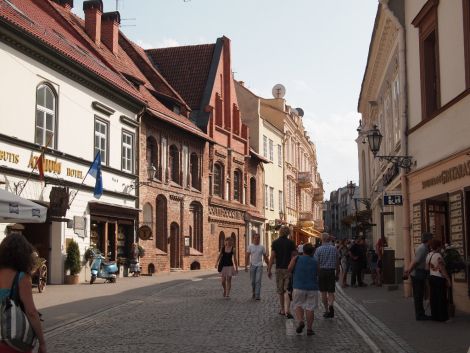
Lithuanian system of education is developed very well. The general education programme lasts for twelve years. It consists of primary education, basic education and secondary education.
In addition, the preschool education exists in Lithuania as well. It involves children from the birth until the age of 6 years. It is not compulsory and is provided at a request of parents of a child only. The said education is provided by state-supported and private institutions of preschool education.
If after completion of the secondary education programme a person does not wish choosing higher education studies, the opportunities for involvement in vocational training programmes are abundant as well. They provide a possibility to acquire and improve a qualification. These programmes are offered by vocational schools.
In addition to a qualification, vocational schools provide an opportunity to acquire the general (basic or secondary) education. The programmes last for 2 – 3 years dependently on the chosen type of education (basic or secondary or adapted for persons with special needs). For those having completed the secondary education programme, the vocational programme lasts for 1–2 years.
After completion of a vocational training programme and the final examinations, a person is awarded with a qualification. If such a person acquires also a secondary education, he (she) may be admitted to studies at a college or a university.
A higher education programme consists of three cycles: bachelor’s studies, master’s studies and doctor’s studies. The programmes are formed in a way that enables the school-leavers and students to choose freely a study direction.
A higher education programme is divided to integrated studies (that consist of bachelor’s studies plus master’s studies) and doctor’s studies.
In Lithuania, two types of higher education programmes exist – university studies and college studies.
College studies provide the knowledge and skills required for professional activities. At least one third of such a study programme is formed by practical training. A graduate of such study programme, after completion of additional studies and acquisition of work experience, may be admitted to master’s studies at a university. College studies are offered by state-supported and private colleges.
University studies provide versatile general education, theoretical knowledge and the professional skills of the top level. University bachelor’s studies last for four years, part-time university bachelor’s studies usually last for five years. After their completion, a degree of a bachelor is awarded. If a person is a bachelor, he (she) may be admitted to master’s studies. The master’s studies last for 1.5–2 years. After completion of the master’s studies, a graduate may be admitted to doctor’s studies (they last for four years). These studies will be a basis for future academic activities. University study programmes are offered by universities, academies and seminaries.
At present, 24 colleges (including 11 private colleges) and 22 universities (including 8 private ones) operate in Lithuania.
In Lithuania, the Center for Quality Assessment in Higher Education is involved in assessing the quality of secondary and higher education acquired in foreign states and the Research Council of Lithuania is involved in assessing the degree of a Doctor of Science or a Doctor of Arts conferred abroad.


The citizens of Australia, Japan, the United States of America, Canada, New Zealand and South Korea, who intend to work or engage in any legitimate activity in Lithuania, are subject to simplified immigration conditions for obtaining a temporary residence permit in the Republic of Lithuania.
Citizens of the aforementioned countries arriving to Lithuania with an aim to work or engage in any legitimate activity do not necessarily have to comply with common requirements imposed on the third-country nationals.
If a citizen of Australia, Japan, the United States of America, Canada, New Zealand and South Korea arrives to the Republic of Lithuania to work, he is only required to sign an employment contract or to obtain a written undertaking of the company to recruit him under an employment contract. Citizens of these countries are not required to obtain a decision of the Employment Service concerning a compliance of the alien’s work with the needs of the Lithuanian labour market.
If an alien is a participant or the manager of the company registered in the Register of Legal Entities and he arrives to work in that company, then a list of required documents is also shorter. If less than one year has passed since the incorporation of the company, it is necessary to provide documents evidencing that the company carries out the activities in the Republic of Lithuania specified in the incorporation documents, also, financial statements of the company, concluded employment contract and documents certifying that an alien is a participant or the manager of the company.
Furthermore, citizens of these countries may also apply for the issue of temporary residence permit in the Republic of Lithuania, provided they are engaged in any other legitimate activity, including individual activity. Such activity is considered to be any independent activity in pursuit whereof an individual seeks to derive income or any other economic benefit over a continuous period. This may be an independent commercial or industrial activity of any nature (excluding activities of real estate trade or rent), also, financial instrument transactions; independent creative, scientific or professional activity and other similar independent activity, independent sports and performing activity.
When applying for a residence permit on the basis of individual activity, it is necessary to submit supporting documents, for example, a business certifícate, or documents approving that an alien is engaged in performing or sports activities, or intends to participate in volunteering programs or implement joint governmental programs together with the foreign states.
It should be noted that the simplified immigration requirements are also applied to citizens of the above-mentioned countries who arrive to Lithuania to work or engage in activity under a regulated profession. Depending on the profession, an alien must have a document confirming that he complies with the conditions laid down in legislation of the Republic of Lithuania to engage in regulated profesional activities.
In Lithuania, regulated professions are the following: lawyer; midwife; architect; educator; bankruptcy administrator; general practice nurse; biomedical technician; dental hygienist; dental technician; dietician; occupational therapist; tourist guide; dental assistant; advanced practice nurse; physiotherapist; speech therapist; masseur; doctor of medicine; school psychologist; teacher; dentist; patent attorney; private detective; vocational teacher; restorer; restructuring administrator; social worker; social pedagogue; special pedagogue; civil engineer; surdopedagogue; tiflopedagogue; property or business valuer; pharmacist; pharmacy assistant (pharmatechnician); veterinary paramedic; veterinary surgeon.
A temporary residence permit for the above-mentioned purposes can be issued to citizens of such countries for a period of 3 years. If the period of employment or legitimate activity is expected to be shorter, then a temporary residence permit is issued for that period of employment or legitimate activity, by adding additional 3 months after expiration thereof.
Family members of citizens of such countries may jointly apply for a temporary residence permit and come to live in the Republic of Lithuania. Family members are considered to be the following persons: a spouse or registered partner, unmarried and parent-dependent minor children, or parents who have been dependent on their adult children for at least one year and are unable to use the support of other family members residing in a foreign state.
Documents for a temporary residence permit are submitted through the MIGRIS system and upon arrival to the territorial division of the Migration Department at the pre-booked visit time.
After a submission of documents at the territorial division of the Migration Department, a decision on the issue of a temporary residence permit is made within 3 months in a general procedure or within 45 calendar days, if an application is filed as a matter of urgency.

Financial Institution Licensing in Lithuania
In Lithuania, the activities of the financial institutions which are engaged in the provision of licensed financial services shall be supervised by the Bank of Lithuania.
Registered financial institutions or companies must obtain a licence (authorization) in order to provide financial services, which are licensed under the laws of the Republic of Lithuania.
Licences (authorizations) to provide financial services shall be issued to a financial institution in accordance with the procedure set forth by the laws of the Republic of Lithuania regulating the provision of financial services and pursuit of the activities of financial institutions.
Licences are obligatory for credit institutions, electronic money institutions and payment institutions.
The specifics of services offered, territory, directions of the intended activity, size of the planned investment shall determine a type of the required licence. For example, a licence of payment institution is not enough, provided it will be necessary to withhold customers’ funds longer than required for a payment transaction execution. In such a case, the Bank licence will already be required.
The electronic money institution licence and payment institution licence can be of two types: for restricted and unrestricted activities. At first, an institution can apply for issuance of the payment institution licence for restricted activities. Once the business is entrenched, this licence may be changed to the payment institution licence for unrestricted activities.
A licensing price depends on the type of licence. A fee for issuance of the electronic money institution licence for unrestricted activities is EUR 1,463, whilst a fee of the licence for restricted activities is EUR 1,235. The payment institution licence for unrestricted activities costs EUR 898, licence for restricted activities – EUR 682, whereas the licence of payment institution providing only account information services costs EUR 693.
Licensing Process
In all cases, the licensing process remains the same. First of all, when the supervisory authority of the Bank of Lithuania is provided with an application for issuance of a particular licence, it must assess within 5 (five) business days whether all documents have been submitted, and only then the supervisory authority can accept the application.
The supervisory authority must consider applications for issuance of licence no later than within 3 (three) months of submission of all documents. Upon submission of documents with deficiencies, a deadline shall be renewed from a date of receipt of additional documents.
In the event of licence for restricted activities, a deadline is 2 (two) months, which is extended upon submission of additional documents or information.
After the supervisory authority has completed to assess all the documents submitted, summarized information is provided to the Board of the Bank of Lithuania for consideration. Finally, the Board of the Bank of Lithuania makes a decision on the granting of a licence or refusal thereof.
Requirements for Payment Institutions
The minimum initial capital of a payment institution must be no less than EUR 20,000, if a payment institution intends to provide only money transfer services. If a payment institution intends to execute only payment initiation services, the initial capital must be no less than EUR 50,000. When a payment institution intends to provide more services set out in the Law on Payment Institutions of the Republic of Lithuania, the capital thereof should be at least EUR 125,000.
The requirement for the minimum initial capital is not applied to the licence for restricted activities. Nevertheless, this licence allows a payment institution to operate in Lithuania only and provide restricted financial services.
Requirements for Electronic Money Institutions
In order to obtain an electronic money institution licence, the minimum initial capital of an institution shall be not less than EUR 350,000. However, this licence entitles the electronic money institution to provide services in other EU Member States.
The electronic money institution having a licence for restricted activities, as well as the payment institution, is not required for a minimum initial capital, but this licence enables such an institution to operate only in Lithuania.
The following requirements are also applied to the managers of the companies: the managers must be of good repute and possess the qualification and experience necessary to properly perform their duties.
The shareholders must be able to ensure a sound and prudent management of the electronic money institution, be of good repute, and financially credible.
Financial Institutions of Foreign States in Lithuania
A financial institution of foreign states may provide financial services in the Republic of Lithuania only upon the receipt of an authorization and/ or licence to provide financial services issued by an institution in Lithuania. Prior to the granting of an authorization or licence to a financial institution of a foreign state, in the cases specified, the foreign institution exercising supervision thereof must be consulted with in advance.
If a financial institution was established in the EU state, such an institution shall be entitled to establish a branch in Lithuania and provide financial services in its territory. In such a case, the foreign supervisory authority must forward to the supervisory authority of financial institutions of the Republic of Lithuania an operating plan of the institution and specify the types of activities, the structure and other information thereof.
In specified cases, a financial institution licensed in a Member State of the European Union may commence the provision of financial services in the Republic of Lithuania without establishing a branch one month from the submission of an operating plan of the financial institution by the foreign supervisory institution to the supervisory institution of financial institutions of the Republic of Lithuania.
Institutions and companies that started providing financial services must obtain an authorization from the supervisory authority each time in order to register amendments to founding documents, set up branches, representative offices or other structural divisions of a legal person in a place other than the registered office of the financial institution, no longer pursue the provision of all or a part of financial services, and in other cases provided for by law.
It should be noted that the supervisory authority has a right to withdraw a licence issued to a financial institution, if the financial institution has not made use of the licence within 12 months of the issuance of the licence to provide financial services or does not pursue licensed activities for a period of time exceeding 6 months, and in other cases established by law of the Republic of Lithuania.
When setting up a business in Lithuania, it is not always enough to have a residence address that the correspondence is received to. Often office premises are necessary, as well as production, storage, and other business premises where the company can carry out its activity.
In Lithuania there are no strict requirements for company residence or business office. The office may be in both administrative and non-administrative premises, i.e. even in a flat. Obviously, the premises must be suitable to carry out the company activity, be in a good condition and have an address to which the company may receive correspondence.
Depending on the type of business, there may be specific requirements for the premises in which the respective activity is carried out. For instance, the premises of food making, processing and storage, premises for eating, living, health care, and other premises are subject to special hygiene, fire safety, area, and other requirements.
Requirements of fire safety apply to all premises, whether it is an office or other premises of business.
Having a real office is not only convenient, but is also a good indicator of seriousness of your company. It is especially important for foreigners who wish to obtain a permission to live in Lithuania.
Depending on the customer’s needs, we help to find the office premises and other business premises (restaurant, warehouse, hotel, etc.) in Lithuania. We prepare leases for uninhabited premises and carry out an investigation on these and other documents. We consult on special requirements applicable to business premises.


The immigration programme WORK relates to immigration of an alien to Lithuania on the base of employment in Lithuania.
The conditions of the immigration programme WORK include:
1. An existence of a Lithuanian enterprise that intends to employ the alien;
2. The alien should have the required qualification and the evidences of it (diplomas, training completion certificates and so on);
3. The alien should have at least 1-year experience in the relevant sector of activities within the 2 last years and the evidences of it.
The immigration programme WORK includes: legal consulting, support in obtaining a Residence Permit from the beginning to the end of the process, preparation of the required documents, preparation of inquiries, arrangement of translation and notarization of documents, presentation of the alien at institutions of Lithuania, accompanying of the alien on submission of the documents to the Migration Service as well as at other state institutions and private structures, other legal services.
The terms:
Recognition of diploma – up to 1 month.
Making a decision on issue a Work Permit/ a decision of the Labour Exchange – up to 7 working days.
Making a decision by the Migration Department on issue a Residence Permit – up to 2-4 months.
Issue of the national visa D – up to 15 days.


The immigration programme LITHUANIAN DESCENT relates to immigration of a person of Lithuanian origin to Lithuania.
The conditions of the immigration programme LITHUANIAN DESCENT include:
The person should be of Lithuanian origin, his (her) parents or grandparents should be Lithuanians and he (she) should believe to be a Lithuanian.
The immigration programme LITHUANIAN DESCENT includes: legal consulting, support in obtaining a Residence Permit from the beginning to the end of the process, preparation of the required documents, preparation of inquiries, arrangement of translation and notarization of documents, presentation of the alien at institutions of Lithuania, accompanying of the alien on submission of the documents to the Migration Service as well as at other state institutions and private structures, other legal services.
The terms:
Search for data and documents in the Lithuanian Archives – up to 14- 30 workdays.
Preparation of documents for issue a Residence Permit – up to 10 workdays.
Making a decision by the Migration Department on issue a Residence Permit – up to 2-4 months.


The immigration programme EU CITIZEN relates to immigration of a citizen of any European Union Member State to Lithuania.
The conditions of the immigration programme EU CITIZEN include:
You should be a citizen of any European Union Member State.
You should conform to other requirements provided in the relevant legal norms.
The immigration programme EU CITIZEN includes: legal consulting, support in obtaining a Residence Permit from the beginning to the end of the process, preparation of the required documents, preparation of inquiries, arrangement of translation and notarization of documents, presentation of the alien at institutions of Lithuania, accompanying of the alien on submission of the documents to the Migration Service as well as at other state institutions and private structures, other legal services.
The terms:
Preparation of documents for issue a Card of a Citizen of the European Union – up to 5-10 workdays.
Issue of Card Confirming the Right a Citizen of the European Union to Reside in Lithuania – up to 10 workdays


The husband or the wife (a citizen of a foreign state) of a citizen of a foreign state who resides or intends to reside in Lithuania, shall have a right to apply for a Residence Permit in Lithuania, if the provisions of the relevant legal norms are satisfied.
The husband or the wife of a citizen of a foreign state, who resides or intends to reside in Lithuania, may apply for a Temporary Residence Permit in Lithuania, if his (her) spouse residing in Lithuania has a Permanent Residence Permit in Lithuania or has a Temporary Residence Permit in Lithuania (that is valid for at least 1 year), resides in Lithuania for at least 2 recent years and has reasonable perspectives to acquire a right for permanent residence in Lithuania.
The above-described requirement shall not be applied, if the husband or the wife of a citizen of a foreign state comes for residing to Lithuania together with the spouse or later to the spouse and the spouse applies for a Residence Permit in Lithuania or is already issued it on the following bases:
- The alien shall be involved in work that requires high professional qualification in Lithuania;
- The alien intends to be engaged in Lithuania as a university teacher or be involved in scientific research and experimental works as a researcher;
- The alien has acquired a status of a long-term resident in another European Union Member State and was issued a Residence Permit;
- The alien came for working on probation;
- The alien is involved in important national projects and has invested his (her) assets in Lithuania;
- The alien develops his (her) business in Lithuania and the provisions of legal norms, such as the equity of the enterprise should be no less than 28’000 EUR, it should be involved in the activities for at least 6 months prior to applying for issue a Temporary Residence Permit in Lithuania, 5 citizens of Lithuania or aliens permanently residing in Lithuania should employed in the enterprise and the funds invested by the alien should amount to at least 260’000 EUR, are satisfied;
- The alien comes for working as a head or a specialist at a branch, a representative office or a daughter company of an enterprise of a foreign state for a period up to 3 years and the following provisions of the legal norms are satisfied: the alien was employed at the said enterprise of the foreign state for at least 1 year prior to coming to Lithuania, his (her) knowledge of special subjects or high professional qualification are required for the activities of the branch, the representative office or the daughter company of the enterprise of a foreign state; a salary to be paid to the alien in Lithuania shall be no less than 2 average monthly gross salaries..
- The alien has been granted an asylum in Lithuania.
In case of business immigration, the spouses may apply for issue a Temporary Residence Permit in Lithuania, if both spouses are shareholders of the enterprise, or one of them is an owner and the second is an employer of the enterprise and the relevant provisions of the legal norms are satisfied. In such a case, the spouses shall be issued a Temporary Residence Permit on the base of development of lawful activities. If the documents for issue a Temporary Residence Permit in Lithuania were submitted by both spouses, their children shall be entitled to immigrate together with the parents.
A husband or a wife of a citizen of a foreign state, who resides or intends to reside in Lithuania, shall submit the documents for issue a Temporary Residence Permit in Lithuania to the nearest diplomatic mission or consular institution of Lithuania abroad or to a Migration Service in Lithuania.
The documents to be submitted by a husband or a wife of a citizen of a foreign state, who resides or intends to reside in Lithuania, shall submit the documents for issue a Temporary Residence Permit in Lithuania include:
- The application;
- The passport;
- The visa;
- The documents certifying the base for issue a Temporary Residence Permit in Lithuania;
- The evidences of having means of subsistence;
- The documents related to the place of residence;
- The certificate on absence of convictions;
- The list of trips to foreign states and stay there;
- The health insurance;
- A photo 40×60 mm.
Documents issued by institutions of foreign states shall be certified by Apostille or legalized. Documents executed in a language other than Lithuanian shall be translated into Lithuanian.
The application and the enclosed documents shall be submitted to the Migration Department. It shall examine them and pass a decision within 2-4 months.
When the decision on issue a Temporary Residence Permit in Lithuania to the husband or the wife of a citizen of a foreign state, who resides or intends to reside in Lithuania, is passed, the person shall apply to a Migration Service in Lithuania for issue a Temporary Residence Permit in Lithuania (a card) to the spouse. In such a case, the application and the enclosed documents shall be submitted to a Migration Service. The card shall be produced within 5-10 workdays.
A husband or a wife of a citizen of a foreign state, who resides or intends to reside in Lithuania, may apply for issue a Permanent Residence Permit in Lithuania after permanent residence of Lithuania for the recent 5 years. After 10-year permanent residence in Lithuania, the spouse may apply for granting the citizenship of Lithuania.


A citizen of a foreign state whose mother or father or both parents live in Lithuania and are citizens of Lithuania shall have a right to be issued a Temporary Residence Permit or a Permanent Residence Permit. A Temporary Residence Permit is issued for a period of 1 year. After expiry of 1 year, the Temporary Residence Permit shall be renewed. After 5-year permanent residence in Lithuania or in some other cases, the person may apply for issue a Permanent Residence Permit in Lithuania; after 10-year permanent residence in Lithuania, the person may apply for granting the citizenship of Lithuania.
A citizen of a foreign state whose mother or father or both parents reside in Lithuania and are citizens of Lithuania shall apply for issue a Temporary Residence Permit to a Migration Service in Lithuania or a diplomatic mission a consular institution of Lithuania in a foreign state.
If a citizen of a foreign state whose mother or father or both parents reside in Lithuania and are citizens of Lithuania wishes to be issued a Temporary Residence Permit in Lithuania, his mother or father or both parents should declare their place of residence in Lithuania.
Usually, such a declaration is provided at the administration of the territory where the applicant plans declaring his (her) address of residence in Lithuania; alternatively, a declaration on the address of residence may be provided at another municipal subdivision or by internet. A person should have living space of at least 7 sq m.
The documents to be submitted by a citizen of a foreign state whose mother or father or both parents reside in Lithuania and are citizens of Lithuania on applying for issue a Temporary Residence Permit in Lithuania include:
- The application;
- The passport;
- The visa;
- A document certifying that the father or the mother of the applicant is a citizen of Lithuania;
- The Certificate of Birth;
- The Certificate of Marriage;
- The evidence of sufficient means of subsistence;
- Documents on the place of residence;
- The certificate on absence of convictions;
- The list of trips to foreign states and stay there;
- The health insurance;
- A photo 40×60 mm.
Documents issued by institutions of foreign states shall be translated into Lithuanian. They shall be certified by Apostille or legalized, unless otherwise is provided by international treaties of Lithuania or legal norms of the European Union.
A decision on issue a Temporary Residence Permit in Lithuania shall be passed within 2-4 months. When the decision on issue a Temporary Residence Permit in Lithuania is passed, the person shall apply for issue a Temporary Residence in Lithuania (a card). In such a case, the application and the enclosed documents shall be submitted to a Migration Service. The card shall be produced within up to 5-10 workdays. After the execution of the Temporary Residence in Lithuania, the person shall declare the address of his (her) residence in Lithuania.
A child of a citizen of Lithuania may be issued a Temporary Residence Permit in Lithuania, if he (she) permanently resides in Lithuania for the recent 5 years or comes with his (her) father or mother to Lithuania for permanent residence. In the second case, the requirement related to an examination in the basics of Lithuanian language and the Constitution of Lithuania shall not be applied.
For issue a Permanent Residence Permit, a person shall apply to a Migration Service or the Migration Department in Lithuania.
The documents to be submitted by a citizen of a foreign state whose mother or father or both parents reside in Lithuania and are citizens of Lithuania on applying for issue a Permanent Residence Permit in Lithuania include:
- The application;
- The passport;
- The evidence of sufficient means of subsistence;
- The certificate on absence of convictions;
- The documents certifying the base for issue a Permanent Residence Permit: If a child (under 18 years old) comes for residing in Lithuania with the father or the mother (who is a citizen of Lithuania) – an application of the father or the mother on issue a Permanent Residence Permit in Lithuania to the child; documents certifying the family relations; documents certifying that the father (mother) is a citizen of Lithuania; documents certifying that the child with the father (mother) resided in a foreign state prior to coming to Lithuania. If the father (mother) of a child (under 18 years old) reside in Lithuania, – documents certifying the family relations; documents certifying that the father (mother) is a citizen of Lithuania; documents certifying that the child (under 18 years old) resided in Lithuania (such as documents issued by the kindergarten, the secondary school or the university). If a child of a citizen of Lithuania resided in Lithuania for the recent 5 years – documents certifying the family relations; documents certifying that the father (mother) is a citizen of Lithuania; documents certifying that the person permanently resided in Lithuania for the recent 5 years; documents certifying a successful result of an examination in the basics of Lithuanian language and the Constitution of Lithuania.
- The documents on changes of the first name and/or surname (if any).
Documents issued by institutions of foreign states shall be translated into Lithuanian. They shall be certified by Apostille or legalized, unless otherwise is provided by international treaties of Lithuania or legal norms of the European Union.
A decision on issue a Permanent Residence Permit in Lithuania shall be passed within 2-4 months. When the decision on issue a Permanent Residence Permit in Lithuania is passed, the person shall apply for issue a Permanent Residence in Lithuania (a card). In such a case, the application and the enclosed documents shall be submitted to a Migration Service. The card shall be produced within up to 5-10 workdays.


A citizen of a foreign state whose daughter or son resides in Lithuania and is a citizen of Lithuania shall have a right to apply for issue a Temporary Residence Permit or a Permanent Residence Permit. A Temporary Residence Permit is issued for a period of 1 year. After expiry of 1 year, the Temporary Residence Permit shall be renewed annually, if the base for issue a Temporary Residence Permit remains valid. A Permanent Residence Permit shall be issued for a period of 5 years. A person may apply for issue a Permanent Residence Permit after expiry of 5-year permanent residence in Lithuania. After 10-year permanent residence in Lithuania, the person may apply for granting the citizenship of Lithuania.
The daughter or the son of a citizen of a foreign state wishes to be issued a Temporary Residence Permit in Lithuania should declare her (his) place of residence in Lithuania. A citizen of a foreign state whose daughter or son resides in Lithuania and is a citizen of Lithuania may apply for issue a Temporary Residence Permit on the base that their son (daughter) is a citizen of Lithuania. The parents may apply for issue a Permanent Residence Permit immediately after their coming to Lithuania, if they come to Lithuania together with their son (daughter) and are dependent on him (her). In other cases, parents of an alien who resides in Lithuania and is a citizen of Lithuania may apply for issue a Permanent Residence Permit not earlier than after expiry of 5-year permanent residence in Lithuania.
A citizen of a foreign state whose daughter or son resides in Lithuania and is a citizen of Lithuania may apply for issue a Temporary Residence Permit to a Migration Service or the Migration Department in Lithuania.
The documents to be submitted by a citizen of a foreign state whose daughter or son resides in Lithuania and is a citizen of Lithuania on applying for issue a Temporary Residence Permit in Lithuania include:
- The application;
- The passport;
- The visa;
- The documents certifying that the son (daughter) of the applicant is a citizen of Lithuania;
- The documents certifying the family relations;
- The documents on changes of the first name and/or surname (if any);
- The evidence of sufficient means of subsistence;
- Documents on the place of residence;
- The certificate on absence of convictions;
- The list of trips to foreign states and stay there;
- The health insurance;
- A photo 40×60 mm.
Documents issued by institutions of foreign states shall be shall be certified by Apostille or legalized. Documents executed in a language other than Lithuanian shall be translated into Lithuanian. Copies of the documents shall be notarized.
The application and the enclosed documents shall be submitted to the Migration Department. It shall examine them and pass a decision within 2 months (on an urgent basis) or within 4 months (according to the usual procedure).
When the decision on issue a Temporary Residence Permit in Lithuania to the citizen of a foreign state whose daughter or son resides in Lithuania and is a citizen of Lithuania is passed, the person shall apply to Migration Service in Lithuania for issue a Temporary Residence Permit in Lithuania (a card) to the spouse. In such a case, the application and the enclosed documents shall be submitted to a Migration Service. The card shall be produced within 10 workdays (according to the usual procedure) or up to 5 workdays (on an urgent basis).
A citizen of a foreign state whose daughter or son resides in Lithuania and is a citizen of Lithuania may apply for issue a Permanent Residence Permit in Lithuania to the Migration Department or a Migration Service in Lithuania.
The documents to be submitted by a citizen of a foreign state whose daughter or son resides in Lithuania and is a citizen of Lithuania on applying for issue a Permanent Residence Permit in Lithuania include:
- The application;
- The passport;
- The evidence of sufficient means of subsistence;
- The certificate on absence of convictions;
- The documents on changes of the first name and/or surname (if any);
- The documents certifying the base for issue a Permanent Residence Permit: If the father (mother) of a citizen of Lithuania came for residing to Lithuania together with him (her) – the application of the citizen of Lithuania for issue a Permanent Residence Permit in Lithuania to his (her) mother or father; the documents certifying that the mother (father) resided in a foreign state prior to coming to Lithuania; the documents certifying that the son (daughter) of the person is a citizen of Lithuania; the documents certifying the family relations; the documents certifying that the father (mother) is dependent on his (her) child for at least 1 year and cannot be provided any support from family members residing in other foreign states. If the father (mother) of a citizen of Lithuania permanently resides in Lithuania for at least the recent 5 years: the documents certifying that the son (daughter) of the person is a citizen of Lithuania; the documents certifying the family relations; the documents certifying that the person permanently resides in Lithuania for at least the recent 5 years, never left Lithuania for a period over 6 months in turn and the total duration of absence did not exceed 10 months during the said 5-year period; the documents certifying a successful result of an examination in the basics of Lithuanian language and the Constitution of Lithuania.
Documents issued by institutions of foreign states shall be shall be certified by Apostille or legalized, unless otherwise is provided by international treaties of Lithuania or legal norms of the European Union. Documents executed in a language other than Lithuanian shall be translated into Lithuanian. Copies of the documents shall be notarized.
The application and the enclosed documents shall be submitted to the Migration Department. It shall examine them and pass a decision within 2-4 months.
When the decision on issue a Permanent Residence Permit in Lithuania is passed, the person shall apply for the Permit (card) to the Migration Service. The card shall be produced within up to 5-10 workdays.


If your husband or wife is a citizen of Lithuania and you are a citizen of a foreign state, you may obtain a Temporary Residence Permit or a Permanent Residence Permit for Lithuania. In addition, you may acquire the citizenship of Lithuania after 7 years of permanent residence in Lithuania with your husband (wife). A Temporary Residence Permit is issued for a period of 1 year and shall be renewed annually. After 5 years of permanent residence in Lithuania or in some other cases, a person may apply for a Permanent Residence Permit and after 7 years – for granting the citizenship of Lithuania.
An alien whose spouse is a citizen of Lithuania may apply for issue a Temporary Residence Permit, if he (she) plans residing with the spouse in Lithuania. The principal conditions to be satisfied before applying for issue a Temporary Residence Permit in Lithuania include: registration of the marriage, declaration of the spouse that his/her place of residence is in Lithuania, having sufficient means of subsistence, and having a dwelling-place.
Prior to applying for issue a Temporary Residence Permit, your husband or wife (who is a citizen of Lithuania) shall declare his (her) address of permanent residence in Lithuania. Usually, such a declaration is provided at the administration of the territory where the applicant plans declaring his (her) address of residence in Lithuania. Alternatively, a declaration on the address of residence may be provided at another municipal subdivision or by internet.
A marriage of an alien with a citizen of Lithuania should be legally registered. If the marriage was registered in a foreign state, the certifying document shall be translated into Lithuanian; in addition, it shall be legalized or certified by an Apostille, unless otherwise is provided by international treaties of Lithuania or legal norms of the European Union.
The alien having registered a marriage with a citizen of Lithuania should have sufficient means of subsistence in Lithuania. The minimum means of subsistence should be equal to the minimum monthly wage in Lithuania approved by the Government. The submitted documents should attest that the person has sufficient means of subsistence for the next 12 months.
In addition, a person shall provide documents certifying that his (her) family has a dwelling-place. According to the provisions of legal norms of Lithuania, person should have living space of at least 7 sq m. The flat, the house or the room may be a property of the family or possessed by it on the base of rent, gratuitous use or otherwise. If the flat, the house or the room where the spouses plan declaring their place of residence are owned by another person, an approval of such a person for declaring their place of residence there is required; alternatively, a contract on lease or gratuitous use of the real estate should be registered in the Real Estate Register.
After collection of documents required for issue a Temporary Residence Permit, the alien, shall apply to a Migration Service or a diplomatic mission a consular institution of Lithuania in a foreign state.
The documents to be submitted on applying for issue a Temporary Residence Permit on the base of the family reunification:
- The application;
- The passport;
- The visa;
- The documents certifying the registration of the marriage;
- The evidences of having means of subsistence;
- The documents related to the place of residence;
- The certificate on absence of convictions;
- The list of trips to foreign states and stay there;
- The health insurance;
- A photo 40×60 mm.
Documents issued by institutions of foreign states shall be translated into Lithuanian. They shall be certified by Apostille or legalized, unless otherwise is provided by international treaties of Lithuania or legal norms of the European Union.
The application and the enclosed documents shall be submitted to the Migration Department. It shall examine them and pass a decision within 2 months (on an urgent basis) or within 4 months (according to the usual procedure).
When the decision on issue a Temporary Residence Permit in Lithuania to the spouse of a citizen of Lithuania is passed, the latter shall apply for issue a Temporary Residence Permit in Lithuania (a card) to the spouse. In such a case, the application and the enclosed documents shall be submitted to a Migration Service. The card shall be produced within up to 5-10 workdays. After the execution of the Temporary Residence in Lithuania, the person shall declare the address of his (her) residence in Lithuania.
A Permanent Residence Permit in Lithuania may be issued to an alien who is a spouse of a citizen of Lithuania, if the alien came from a foreign state together with the spouse for residing in Lithuania. In such a case, additional evidences of residence with the spouse (who is an alien) in a foreign state prior to coming to Lithuania should be provided. A Permanent Residence Permit in Lithuania may be issued to an alien whose spouse is a citizen of Lithuania also after 5-year residence of Lithuania.
A person should apply for issue a Permanent Residence Permit in Lithuania on the base of family reunification to a Migration Service or the Migration Department in Lithuania.
The documents to be submitted on applying for a Permanent Residence Permit in Lithuania include:
- The application;
- The passport;
- The document certifying that the applicant has sufficient means of subsistence;
- The documents certifying the base for issuing a Permanent Residence Permit: an application of a citizen of Lithuania for issue a Permanent Residence Permit to his (her) spouse (a citizen of a foreign state) that comes with him (her) for permanent residence in Lithuania; a document certifying that the applicant is a citizen of Lithuania; a document certifying the fact of registration of the marriage; the evidences of residence with the spouse (who is an alien) in a foreign state prior to coming to Lithuania. If the alien having registered a marriage with a citizen of Lithuania resided in Lithuania for at least 5 recent years: a document certifying that the applicant is a citizen of Lithuania; a document certifying the fact of registration of the marriage; the documents certifying that the alien permanently resided in Lithuania for 5 recent years; the documents certifying that the alien never left Lithuania for a period over 6 months in turn and the total duration of absence did not exceed 10 months during the said 5-year period; the documents certifying a successful result of an examination in the basics of Lithuanian language and the Constitution of Lithuania;
- A certificate on absence of convictions;
- The documents on changes of the first name and/or surname (if any).
The application and the submitted documents shall be examined within 4 months (according to the usual procedure) or within 2 months (on an urgent basis) from the date of their reception by the Migration Department.
When the decision on issue a Permanent Residence Permit in Lithuania is passed, the person shall apply for the Permit (card) to the Migration Service. The card shall be produced within up to 5-10 workdays.

One of the principal bases for immigration to Lithuania is family reunification. On the base of family reunification, a Temporary Residence Permit in Lithuania or a Permanent Residence Permit in Lithuania may be issued. Family members (such as the children, a spouse and the parents) of a citizen of Lithuania or an alien who satisfies the requirements provided in the legal norms may apply for issue a Residence Permit in Lithuania.
Family members of a citizen of Lithuania may come to the citizen of Lithuania who lives in Lithuania or come to Lithuania from a foreign state together with him (her) for residing in Lithuania. In the first case, family members of a citizen of Lithuania may apply for issue a Temporary Residence Permit in Lithuania and in the second case, they may apply for issue a Temporary Residence Permit in Lithuania or a Permanent Residence Permit in Lithuania. In case of application for issue a Permanent Residence Permit in Lithuania, it is required to prove that the citizen of Lithuania lived with the member of family in a foreign state before coming to Lithuania. The principal conditions for immigration are related to substantiation and assessment of the family connection, sufficient means of subsistence, having a dwelling space in Lithuania and absence of convictions.
According to provisions of Lithuanian legal norms, family reunification with an alien who resides in Lithuania is possible no earlier than after 2 years of residence of such alien in Lithuania upon proving a well-grounded perspective of issue a Permanent Residence Permit in Lithuania to such an alien. On the base of this general rule, family members (such as the children, a spouse and the parents) of the alien may come to Lithuania for residing with the alien after expiry of 2-year period of residence of the alien in Lithuania. In certain cases, exceptions are applied, and family members are entitled to immigrate to Lithuania together with the alien. For example, in a case when an alien applies for issue a Temporary Residence Permit in Lithuania or has it on the base of business running in Lithuania and intention to continue it. Or he (she) is a shareholder of an enterprise incorporated in Lithuania that satisfies the provisions of Lithuanian legal norms who is involved in commercial activities in Lithuania and intends to continue the said activities. One more example may be a case when a Temporary Residence Permit in Lithuania is issued to an alien or an alien applies for issue a Temporary Residence Permit in Lithuania on the base of appointment of the alien by a foreign enterprise for work at a representative office or a branch of such an enterprise in Lithuania. In such a case, family members of the alien are entitled to immigrate together with the alien. Family members of high qualification professionals are entitled to immigrate together with the alien and the requirement of waiting for 2 years is not applied to them.
The documents for issue a Residence Permit in Lithuania may be submitted to a diplomatic mission or a consular institution in a foreign state or to the Migration Service in Lithuania. A resolution on issue a Residence Permit in Lithuania shall be passed by the Migration Department within 2 to 4 months.


If the father or the mother of a citizen of a foreign state (who are citizens of a foreign state) has a Temporary Residence Permit in Lithuania, his (her) son (daughter) may be issued a Residence Permit in Lithuania; it is supposed that the relevant provisions of legal norms are satisfied. A minor child of a citizen of a foreign state may be issued a Temporary Residence Permit in Lithuania, if his (her) mother or father has a Permanent Residence Permit or a Temporary Residence Permit (that is valid for at least 1 year); in addition, the father or the mother of the child resided in Lithuania for at least 2 last years and has reasonable perspectives to acquire a right for permanent residence in Lithuania.
The above-described requirements shall not be applied, if the father or the mother of a citizen of a foreign state (who are citizens of a foreign state) has a Temporary Residence Permit in Lithuania or came to Lithuania together with the child and applies for issue a Temporary Residence Permit in Lithuania on any of the bases listed below:
- The alien shall be involved in work that requires high professional qualification in Lithuania;
- The alien intends to be engaged in Lithuania as a university teacher or be involved in scientific research and experimental works as a researcher;
- The alien has acquired a status of a long-term resident in another European Union Member State and was issued a Residence Permit;
- The alien came for working on probation;
- The alien is involved in important national projects and has invested his (her) assets in Lithuania;
- The alien develops his (her) business in Lithuania and the provisions of legal norms, such as the equity of the enterprise should be no less than 28’000 EUR, it should be involved in the activities for at least 6 months prior to applying for issue a Temporary Residence Permit in Lithuania, 5 citizens of Lithuania or aliens permanently residing in Lithuania should employed in the enterprise and the funds invested by the alien should amount to at least 260’000 EUR, are satisfied;
- The alien comes for working as a head or a specialist at a branch, a representative office or a daughter company of an enterprise of a foreign state for a period up to 3 years and the following provisions of the legal norms are satisfied: the alien was employed at the said enterprise of the foreign state for at least 1 year prior to coming to Lithuania, his (her) knowledge of special subjects or high professional qualification are required for the activities of the branch, the representative office or the daughter company of the enterprise of a foreign state; a salary to be paid to the alien in Lithuania shall be no less than 2 average monthly gross salaries..
- The alien has been granted an asylum in Lithuania.
An adult child of a citizen of a foreign state may be issued a Temporary Residence Permit in Lithuania, if his (her) mother or father has a Permanent Residence Permit and is incapable to work because is an old-age pensioner or a disabled person.
A child of a citizen of a foreign state may submit the documents for issue a Temporary Residence Permit in Lithuania to a Migration Service in Lithuania or to a diplomatic mission or a consular institution of Lithuania abroad.
The documents for issue a Temporary Residence Permit in Lithuania to be submitted by a child of a citizen of a foreign state include:
- The application;
- The passport;
- The visa;
- The documents certifying the base for issue a Temporary Residence Permit in Lithuania;
- The evidences of having means of subsistence;
- The documents related to the place of residence;
- The certificate on absence of convictions;
- The list of trips to foreign states and stay there;
- The health insurance;
- A photo 40×60 mm.
Documents executed in a language other than Lithuanian shall be translated into Lithuanian. If copies of documents are provided instead of the originals, they shall be certified by Apostille or legalized, unless otherwise is provided by international treaties of Lithuania or legal norms of the European Union.
The application and the enclosed documents shall be submitted to the Migration Department. It shall examine them and pass a decision within 2-4 months: within 2 months (on an urgent basis) or within 4 months (according to the usual procedure).
When the positive decision on issue a Temporary Residence Permit in Lithuania to a child of a citizen of a foreign state is passed, the person shall apply to Migration Service in Lithuania for issue a Temporary Residence Permit in Lithuania (a card). The card shall be produced within up to 5 workdays (on an urgent basis) or within 10 workdays (according to the usual procedure).
After issue a Temporary Residence Permit in Lithuania, a child of a citizen of a foreign state may apply for issue a Permanent Residence Permit after 5-year permanent residence in Lithuania and for granting the citizenship of Lithuania – after 10-year permanent residence in Lithuania.
A minor (under 18 years old) child of a citizen of a foreign state that has a Permanent Residence Permit may be issued a Permanent Residence Permit in Lithuania, if he (she) satisfies the requirements set in the relevant legal norms.


A father or a mother of a citizen of foreign state that resides or intends to reside in Lithuania may be issued a Residence Permit in Lithuania, if he (she) satisfies the requirements set in the relevant legal norms. A father or a mother of a citizen of foreign state may apply for issue a Temporary Residence Permit, if his (her) son (daughter) has a Permanent Residence Permit in Lithuania. A father or a mother of a citizen of foreign state may apply for issue a Temporary Residence Permit also in a case, when his (her) son (daughter) has a Temporary Residence Permit in Lithuania (that is valid for at least 1 year), resided in Lithuania for at least 2 last years and has reasonable perspectives to acquire a right for permanent residence in Lithuania.
The above-described requirements shall not be applied, if the citizen of a foreign state (whose mother or father strives to be issued a Temporary Residence Permit in Lithuania) comes to Lithuania together with his (her) mother or father and applies for issue a Residence Permit in Lithuania or already has a Residence Permit on any of the bases listed below:
- The alien shall be involved in work that requires high professional qualification in Lithuania;
- The alien intends to be engaged in Lithuania as a university teacher or be involved in scientific research and experimental works as a researcher;
- The alien has acquired a status of a long-term resident in another European Union Member State and was issued a Residence Permit;
- The alien came for working on probation;
- The alien is involved in important national projects and has invested his (her) assets in Lithuania;
- The alien develops his (her) business in Lithuania and the provisions of legal norms, such as the equity of the enterprise should be no less than 28’000 EUR, it should be involved in the activities for at least 6 months prior to applying for issue a Temporary Residence Permit in Lithuania, 5 citizens of Lithuania or aliens permanently residing in Lithuania should employed in the enterprise and the funds invested by the alien should amount to at least 260’000 EUR, are satisfied;
- The alien comes for working as a head or a specialist at a branch, a representative office or a daughter company of an enterprise of a foreign state for a period up to 3 years and the following provisions of the legal norms are satisfied: the alien was employed at the said enterprise of the foreign state for at least 1 year prior to coming to Lithuania, his (her) knowledge of special subjects or high professional qualification are required for the activities of the branch, the representative office or the daughter company of the enterprise of a foreign state; a salary to be paid to the alien in Lithuania shall be no less than 2 average monthly gross salaries..
- The alien has been granted an asylum in Lithuania.
When such an alien has a Permanent Residence Permit in Lithuania or a Temporary Residence Permit in Lithuania, parents of such alien may be issued a Temporary Residence Permit in Lithuania, if they are dependent on their son (daughter) for at least 1 year and cannot be provided any support from other family members that reside in foreign states.
Parents of such an alien may submit the documents for issue a Temporary Residence Permit in Lithuania to a diplomatic mission or a consular institution of Lithuania abroad or to a Migration Service in Lithuania
The documents for issue a Temporary Residence Permit in Lithuania to be submitted by parents of an alien include:
- The application;
- The passport;
- The visa;
- The documents certifying the base for issue a Temporary Residence Permit in Lithuania;
- The evidences of having means of subsistence;
- The documents related to the place of residence;
- The certificate on absence of convictions;
- The list of trips to foreign states and stay there;
- The health insurance;
- A photo 40×60 mm.
Documents executed in a language other than Lithuanian shall be translated into Lithuanian. Copies of documents shall be certified by Apostille or legalized, unless otherwise is provided by international treaties of Lithuania or legal norms of the European Union.
The application and the enclosed documents shall be submitted to the Migration Department. It shall examine them and pass a decision within 2-4 months: within 2 months (on an urgent basis) or within 4 months (according to the usual procedure).
When the positive decision on issue a Temporary Residence Permit in Lithuania to a mother or father of a citizen of a foreign state is passed, the person shall apply to Migration Service in Lithuania for issue a Temporary Residence Permit in Lithuania (a card). The card shall be produced within up to 5 workdays (on an urgent basis) or within 10 workdays (according to the usual procedure).

The Law on the Legal Status of Foreigners in Republic of Lithuania provides a list of persons considered family members of a citizen of EU Member State. A member of the family of a citizen of EU Member State shall be a spouse or a person with whom the citizen of EU Member State had concluded a registered partnership. In addition, direct descendents of such a person who need maintenance and are less than 21 years old (including the direct descendents of the spouse or the person with whom the citizen of EU Member State had concluded a registered partnership) are considered family members of a citizen of EU Member State. Moreover, direct relatives in the ascending line of a citizen of EU Member State and the spouse or the person with whom the citizen of EU Member State had concluded a registered partnership are considered family members of the citizen of EU Member State, if they need maintenance.
If a person provides evidences of being a family member of a citizen of EU Member State, such a person has a right to be granted the Schengen visa and to come on its base to Republic of Lithuania and stay here no longer than for 3 months per half of year; the period of staying in Republic of Lithuania starts from the date of arrival to the state. If a family member of a citizen of EU Member State intends coming to Lithuania together with the citizen of EU Member State (or coming to him/her) and reside in Republic of Lithuania longer than for 3 months per half of year, such a family member shall obtain a Temporary Residence Permit in Republic (card) according to the procedure provided in laws of Republic of Lithuania.
A Temporary Residence Permit in Republic of Lithuania (card) shall be issued to a family member of a citizen of EU Member State for a period of 5 years or the period of the planned staying of the family member of a citizen of EU Member State in Republic of Lithuania, if the latter does not exceed 5 years. The principal documents to be submitted by a family member of a citizen of EU Member State for issue the card include valid travel documents and the documents certifying the base for issue or renewal the card. All required documents shall be submitted to the Migration Service of the territory where the family member of a citizen of EU Member State plans declaring his (her) place of residence in Republic of Lithuania.
Upon certain circumstances, family members of a citizen of EU Member State shall acquire a right for permanent residence in Republic of Lithuania. Such circumstances include: a family member of a citizen of EU Member State lawfully resides in Lithuania with the citizen of EU Member State for 5 years; an alien is a family member of a citizen of EU Member State who has a right for restoration of the citizenship of Republic of Lithuania or is a person of Lithuanian origin. An application for issue a certificate on the right of a family member of a citizen of EU Member State for permanent residence in Lithuania and other documents required for the procedure shall be submitted to the territorial police office migration service of the territory where the family member of a citizen of EU Member State plans declaring his (her) place of residence in Republic of Lithuania.
Applications for issue or replacing a certificate on the right of a family member of a citizen of EU Member State for permanent residence in Lithuania or for issue or renewal of a Temporary Residence Permit (card) shall be examined according to the procedure provided in laws of Republic of Lithuania and the document shall be issued within one month from the date of submission of the documents to the Migration Service.


In Lithuania, the opportunities for studies and acquisition of higher education are provided both for citizens of Lithuania and aliens. It should be noted that a diploma of higher education issued in Lithuania is recognized in other European Union Member States, so one should not be afraid that such a diploma will be recognized within the territory of Lithuania only.
Special study programme for students from foreign states are offered both by universities and colleges. Studies in Lithuania may consist of several cycles: the first-cycle studies are bachelor’s studies, the second-cycle studies are master’s studies and the third-cycle studies are doctor’s studies. Lithuanian universities and colleges offer over one hundred of different study programmes for foreigners – from the humanities and social sciences to medicine and technologies.
Admission of a foreigner to studies at Lithuanian higher schools consists of several phases. If a person has acquired a certain education abroad, his (her) qualification should be assessed and recognized in Lithuania. Second, the person shall submit an application for studies at the chosen university or college. Third, the person should take into account the language of teaching at the university or the college. If the study programme is taught in Lithuanian, the person should pass a credit test in Lithuanian. If the chosen study programme is taught in English or another language, the certificate confirming the certain language skills shall be provided. Fourth, some universities and colleges arrange enrolling tests. Fifth, execution of the study documents follows, i.e. an agreement on studies is concluded with the university or the college.
It is important to note that citizens of other states shall obtain a visa for coming to Lithuania for studies (except of citizens of states for that visa free regimen is set). Persons from foreign states (except of citizens of states for that visa free regimen is set) shall apply to a diplomatic mission or a consular institution of Lithuania for issue a Schengen visa (this visa provides a right of short-time staying in Lithuania and Schengen zone, i.e. up to 90 days) or the national visa (it provides a right of staying in Lithuania for a period exceeding 90 days; in addition, the alien can leave Lithuania and come back for many times without limitations. This visa may be issued for a period that does not exceed 1 year). It is notable that if studies in Lithuania last for over one year, the period of validity of the national visa will not be sufficient for the citizen of a foreign state, i.e. he (she) should apply for a Temporary Residence Permit on the base of the studies in Lithuania. A Temporary Residence Permit shall provide the alien a right to reside lawfully in Lithuania within the period specified in the Permit, to choose a place of residence, to leave Lithuania and come back. A Temporary Residence Permit shall be issued for a period of 1 year. After the expiry of the said period, the Temporary Residence Permit may be renewed. If an alien wishes to be issued a Temporary Residence Permit, he (she) shall submit a completed application of the approved form, a valid travel document, a photo, a mediatory letter issued by the educational institution, the documents on sufficient means of subsistence and the dwelling, the certificate on absence of convictions, the documents on health insurance, the list of lawful trips to foreign state and staying in them, and the document confirming his (her) lawful staying in Lithuania.
An educational institution is an institution for education and studies. In Lithuania, educational institutions are divided to groups that form the national system of education. The following groups are singled out:
Preschool educational institutions
General education schools
Primary schools
Basic schools
Secondary schools
Gymnasiums
Conservatories
Higher schools
Colleges
Universities
Foreign higher schools
At preschool educational institutions, children in the age from birth to 6 years are educated. Preschool educational institutions include nursery-kindergartens, kindergartens and pre-primary schools. They may be municipal or private. At such institution, education is not mandatory and is arranged at requests of the parents only.
One subgroup of preschool educational institutions should be singled out. It includes those for all children over 6 years old (in exceptional cases – from the age of 5 years) and lasts for one year. At such institutions, the children are prepared for learning at a primary school.
At general education school, the process of education is divided to several phases.
Primary education is targeted on children in the age from 7 to 10 years. It lasts for 4 years (1–4 forms). This education is compulsory; however, the parents may choose a state-supported school, a municipal school or a private school for their children and change them at their own discretion.
Basic education lasts for 6 years (5–10 forms of a secondary school or the forms I–II of a gymnasium). It is a compulsory education as well. Up to the age of 16, a pupil cannot cancel learning in the compulsory education programmes.
Secondary education is not compulsory anymore. It consists of 2-year programme (11–12 forms of a secondary school or the forms or the forms III–IV of a gymnasium). Secondary education is chosen by pupils that plan to study, to acquire a professional qualification or to be issued a diploma of higher education.
If a pupil does not strive for studies at a higher school, he (she) can choose a vocational training programme at a vocational school. Such schools provide a possibility to acquire and improve a qualification.
In addition to a qualification, vocational schools provide an opportunity to acquire the general (basic or secondary) education. The programmes last for 2 – 3 years dependently on the chosen type of general education (basic or secondary or adapted for persons with special needs). For those having completed the secondary education programme, the vocational programme lasts for 1–2 years.
After completion of a vocational training programme and the final examinations, a person is awarded with a qualification. If such a person acquires also a secondary education, he (she) may be admitted to studies at a college or a university.
Higher education studies are arranged by higher education schools; they may be of two types – universities and colleges. Higher schools of Lithuania are state-supported and private.
Higher education studies may be accomplished according to degree study programmes and non-degree study programmes.
College studies provide the knowledge and skills required for professional activities. At least one third of such a study programme is formed by practical training. A graduate of such study programme, after completion of additional studies and acquisition of work experience, may be admitted to master’s studies at a university. College studies are offered by state-supported and private colleges.
University studies provide versatile general education, theoretical knowledge and the professional skills of the top level. University bachelor’s studies last for four years, part-time university bachelor’s studies usually last for five years. After their completion, a degree of a bachelor is awarded. Is a person is a bachelor, he (she) may be admitted to master’s studies. The master’s studies last for 1.5–2 years. After completion of the master’s studies, a graduate may be admitted to doctor’s studies (they last for four years). These studies will a basis for future academic activities. University study programmes are offered by universities, academies and seminaries.
According to data provided by the Ministry of Education and Science, following educational institutions operate in Lithuania at present:
Preschool educational institutions – 735
General education school 1192
Colleges – 23
Universities – 22


If citizens of foreign states wish come to Lithuania for employment or studies, they shall pass a procedure of recognition of their diplomas issued abroad. The processes of recognition of qualifications are regulated by international and national legal norms.
On recognition a qualification acquired in a foreign state, two types of recognition are singled out – academic recognition and professional recognition.
The academic recognition is an assessment of a qualification in an academic aspect, i.e. establishing whether the qualification conforms to the requirements set for the relevant qualification in Lithuania.
The professional recognition is an assessment of a qualification in an professional aspect, i.e. establishing whether the qualification conforms to the requirements set for the relevant professional activities in Lithuania.
In Lithuania, several institutions are involved in the academic recognition of qualification. One may choose an institution dependently on the level of the acquired education and the pursued object.
|
The level of acquired education; the qualification |
The institution engaged in the academic recognition |
|
A degree of a Doctor of Sciences (Arts) |
The Research Council of Lithuania |
|
A qualification provided by higher education (except of a degree of a doctor) |
The Center of Quality Assessment in Higher Education |
|
A part of a higher education study programme |
The chosen higher school |
|
A qualification provided by vocational training |
The Ministry of Education and Science |
|
A qualification that provides a right for higher education studies (secondary education) |
The Center of Quality Assessment in Higher Education or an authorized higher school |
|
A part of primary, basic or secondary education programme |
The chosen primary, basic or secondary school |
Professional recognition is recognition of a qualification acquired by a person in a foreign state and is required, if such a person plans to be involved in the professional activities in Lithuania. In course of the process of the professional recognition, a major attention is paid not only to the acquired professional qualification, but also to the professional knowledge and skills of the person. The qualification and the level of the knowledge and skills should be sufficient for being involved in the relevant activities in Lithuania.
The following types of professional recognition may be singled out:
if a profession that a person strives for is a subject to special regulation in Lithuania – a decision on eligibility of the person for employment according to such a profession shall be passed by a competent institution. Recognition of regulated professional qualifications is coordinated by the Ministry of Economy of Republic of Lithuania;
if a profession that a person strives for is not a subject to special regulation in Lithuania –– a decision on eligibility of the person for employment shall be passed by the employer. However, it is notable that employers frequently ask to perform a procedure of the academic recognition of the acquired qualification (in addition to the professional recognition), because information on the academic value of the qualification is important for them as well.


In Lithuania, no special visa for studies exists. If an alien plans to study in Lithuania, he (she) shall, first of all, enter a higher education institution of Lithuania, i.e. to be admitted to studies in a certain study programme and obtain a Temporary Residence Permit on the base of studies in Lithuania.
Detailed information on issue a Temporary Residence Permit on the base of studies in Lithuania is provided in the Chapter A Residence Permit for a Student.


Students from third states may study and reside in Lithuania, if they are admitted to studies at a high education institution of Lithuania and are issued a Temporary Residence Permit on this base. The rights provided by the said Permit to third-country nationals are some narrower as compared to persons having a status of a permanent resident of Lithuania.
In a majority of cases, only social services on the base of accumulated contributions are accessible for third-country nationals having been issued a Temporary Residence Permit. When aliens study in Lithuania, they do not pay such contributions (because such contributions are deductible from wages), so students shall care about their health insurance independently. Citizens of foreign states involved in studies in Lithuania may start working (part-time) from the second year of studies only. In such a case, their contributions for social allowances will be modest, so it is recommended to care personally of the social guarantees.
The immigration programme STUDENT relates to immigration of a person admitted to studies at a Lithuanian educational institution.
The conditions of the immigration programme STUDENT include:
You should be a person admitted to studies at a Lithuanian educational institution.
The immigration programme STUDENT includes: legal consulting, support in obtaining a Residence Permit from the beginning to the end of the process, preparation of the required documents, preparation of inquiries, arrangement of translation and notarization of documents, presentation of the alien at institutions of Lithuania, accompanying of the alien on submission of the documents to the Migration Service as well as at other state institutions and private structures, other legal services.
The terms:
Preparation of documents for issue a Residence Permit – up to 5-10 workdays.
Making a decision by the Migration Department on issue a Residence Permit – up to 2-4 months.


Lithuanian descent or retention of Lithuanian citizenship is the basis for obtaining a residence permit in Lithuania. A person of Lithuanian descent or an alien who has retained the right to Lithuanian citizenship may be issued a temporary and permanent residence permit. A temporary residence permit in Lithuania is issued for 5 years. Permanent residence in Lithuania is also issued for 5 years. The difference lies in the procedures for obtaining the permit and in the list of documents required to obtain temporary or permanent residence permit.
Temporary Residence Permit for Person of Lithuanian Descent or an alien who has retained the right to Lithuanian citizenship
A temporary residence permit gives a right to person of Lithuanian descent or an alien who has retained the right to Lithuanian citizenship to reside in Lithuania for a certain period of time stated in the permit.
A temporary residence permit is issued for 5 years. After 5 years a person should apply for it’s renewal.
The Application and Documents Shall be Submitted to
When submitting an application for a temporary residence permit that allows to reside in Lithuania as well as additional documents for the first time, a person of a Lithuanian descent or an alien who has retained the right to Lithuanian citizenship needs to provide:
To diplomatic or consular representatives abroad if the person is abroad;
To Lithuanian Migration Department that services the territory in which the person is planning to reside if the person had legal grounds to remain in Lithuania.
Documents for Submission
A person of a Lithuanian descent or an alien who has retained the right to Lithuanian citizenship needs to provide the following documents along with his application requesting a temporary residence permit:
1. passport;
2. visa;
3. photograph (40 x 60 mm);
4. documents that certify the grounds upon which the claims for a temporary residence permit are being made:
documents that certify that the person is of Lithuanian descent, which are listed in the Law on the Citizenship of the Republic of Lithuania, Article 39 paragraph 4; or a certificate allowing retention of Lithuanian citizenship (issued before 1 January 2013), a certificate certifying that the person is of Lithuanian descent (issued after 1 January 2013); orMigration Department decision on the right of retention of Lithuanian citizenship; or decision to issue a certificate of Lithuanian descent.
Application processing time – 2 – 4 months.
Permanent Residence Permit for Person of Lithuanian Descent or an alien who has retained the right to Lithuanian citizenship
Lithuanian long-term residence permit to live in the European Union (permanent residence permit in Lithuania) – a document granting a foreigner the right to live in Lithuania and certifying the foreigner’s permanent resident status.
A permanent residence permit is issued for 5 years. After 5 years the permit is changed.
The Application and Documents Shall be Submitted to
A person of a Lithuanian descent or an alien who has the right to reinstate Lithuanian citizenship needs to provide the application requesting a permanent residence permit to:
Migration Department or the Office of Migration in Lithuania.
Documents for Submission
A person of a Lithuanian descent or an alien who has the right to reinstate Lithuanian citizenship needs to provide the following documents along with his application requesting a temporary residence permit:
1. passport;
2. documents certifying that Lithuanian citizenship was held by the person prior to 15 June 1940;
3. documents certifying his Lithuanian descent (i.e.documentary evidence that the person’s parents or grandparents, one of the parents or grandparents is or was Lithuanian as well as the person’s written statement where he recognises himself Lithuanian);
4. documents certifying Lithuanian descent or kinship relationship with the person who held Lithuanian citizenship prior to 15 June 1940;
5. documents certifying change of personal information (if such was changed);
6. check-out document.
Application processing time – 2 – 4 months.
We are offering an immigration services program LITHUANIAN DESCENT/ LITHUANIAN CITIZEN – immigration to Lithuania for person of Lithuanian descent or an alien who has the right to reinstate Lithuanian citizenship .
The program LITHUANIAN DESCENT/ LITHUANIAN CITIZEN includes: legal counselling, support throughout the program, getting a residence permit in Lithuania, preparation of necessary documents, preparation of queries to the Lithuanian archives and other competent authorities, translation and notary approval of documents, representation in Lithuanian institutions, escort during the submission of documents in the Migration Department, escort during the declaration of residence and in other public and private institutions, as well as other legal services.


The immigration programme A FAMILY MEMBER OF A EU CITIZEN relates to immigration of a family member (a wife, a husband, a father, a mother, a daughter or a son) of a citizen of any European Union Member State to Lithuania.
The conditions of the immigration programme A FAMILY MEMBER OF A EU CITIZEN include:
You should be a family member (a wife, a husband, a father, a mother, a daughter or a son) of a citizen of any European Union Member State.
You should conform to other requirements for a right to reside in Lithuania provided in the relevant legal norms
The immigration programme A FAMILY MEMBER OF A EU CITIZEN includes: legal consulting, support in obtaining a Residence Permit from the beginning to the end of the process, preparation of the required documents, preparation of inquiries, arrangement of translation and notarization of documents, presentation of the alien at institutions of Lithuania, accompanying of the alien on submission of the documents to the Migration Service as well as at other state institutions and private structures, other legal services.
The terms:
Preparation of documents for issue a Temporary Residence Permit (Card) for a family member of European Union Citizen – up to 5-10 workdays.
Issue of the Temporary Residence Permit (Card) for a family member of European Union Citizen – up to 1 month.
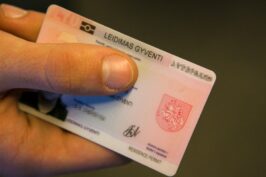
Blue Card in Lithuania
The BLUE CARD in Lithuania is an EU-wide work and residence permit designed to attract highly qualified specialists from third countries to the European Union labour market. Established under Council Directive 2009/50/EC, the Blue Card allows citizens of third countries to live and work in Lithuania and across the EU under streamlined conditions. It provides a faster and easier alternative to a standard work permit, ensuring legal access to the Lithuanian labour market for qualified professionals.
What Is the Blue Card in Lithuania?
Overview of the Blue Card in Lithuania
The Blue Card is an EU work and residence permit for highly qualified specialists. It allows legal employment and residence in Lithuania and other EU countries, providing mobility and professional recognition across the European Union.
 Eligibility Criteria for the Blue Card
Who Can Apply
To qualify for a Blue Card in Lithuania, the applicant must:
-
Possess high professional qualifications;
-
Have a valid employment contract with a Lithuanian employer;
-
If the profession is on the List of Shortage Occupations with High Added Value, the applicant must be paid at least 1.2 times the average gross monthly wage;
-
For professions not included in the shortage list, the applicant must be paid at least 1.5 times the average gross monthly wage.
Important Update: The previous requirement for a positive decision from the Employment Service confirming that the position meets labour market needs has been revoked.
Required Documents for a Blue Card
Essential Documentation
To apply for a Blue Card in Lithuania, the following documents are typically required:
-
Valid Passport – minimum 6 months validity.
-
Employment Contract or Job Offer – confirming position and salary.
-
Proof of Qualifications – diplomas, professional certificates, or work experience documentation.
-
CV / Resume – highlighting relevant work experience.
-
Health Insurance – covering the period of stay in Lithuania.
-
Photo – passport-style photograph.
Tip: Some documents may require translation into Lithuanian and certification (notarized or apostilled).
Application Process and Processing Time
Step-by-Step Process
-
Gather all required documents and ensure translations and certifications are complete.
-
Submit the Blue Card application either at the Migration Department of Lithuania or via an authorized service provider abroad (e.g., VFS Global).
-
The authorities review the application and all supporting documents before issuing the Blue Card.
Processing Time
-
Standard processing time for a Blue Card in Lithuania is up to 2 months.
-
If additional documents or clarifications are needed, processing may take longer.
Duration of the Blue Card
The Blue Card in Lithuania is generally issued for up to 3 years, depending on the employment contract duration.

Blue Card and Family Reunification
Residence Permits for Family Members
Family members of the Blue Card holder may accompany the principal applicant.
-
They are granted Temporary Residence Permits in Lithuania, valid for the same duration as the principal holder’s Blue Card.
-
This ensures family unity and legal residence rights while the main applicant works in Lithuania.
Benefits of the Blue Card
-
Fast-track access to the Lithuanian labour market;
-
Legal work and residence across EU member states;
-
Higher wages compared to standard work permits;
-
Eligibility for family reunification;
-
Recognition as a highly qualified professional, improving future immigration prospects.
Contact MIGRATION LAW CENTER for Assistance
For guidance on obtaining a Blue Card in Lithuania, including eligibility assessment, required documents, and application procedures, contact MIGRATION LAW CENTER:
-
Email: info@migration.lt
-
Phone: +370 6 1861886
We assist highly qualified specialists and their families in navigating the Lithuanian immigration process efficiently and legally.
Frequently Asked Questions (FAQ) About the Blue Card in Lithuania
Q1: Who can apply for a Blue Card in Lithuania?
A1: Highly qualified specialists from third countries with a valid employment contract in Lithuania and proof of professional qualifications can apply for the Blue Card.
Q2: Can family members join the applicant?
A2: Yes, spouses, minor children, and dependents may apply for Temporary Residence Permits to accompany the Blue Card holder for the same duration.
Q3: How long does it take to process a Blue Card?
A3: Standard processing usually takes up to 2 months, depending on document completeness. Complex cases or requests for additional documents may extend the timeline.
Q4: Can I apply from outside Lithuania?
A4: Yes, applicants can submit their Blue Card application through authorized service provider abroad (e.g., VFS Global) without traveling to Lithuania.
Q5: What is the minimum salary requirement for a Blue Card?
A5: Applicants must earn at least 1.2 times the average gross monthly wage for shortage occupations with high added value and 1.5 times the average gross monthly wage for other professions.
Q6: How long is the Blue Card valid?
A6: The Blue Card is generally valid for up to 3 years. If the employment contract is shorter, the Blue Card remains valid for 3 months after the contract ends.
For coming to Lithuania, a third-country national shall obtain a work visa. A third-country national can cross the border and access to the territory of Lithuania on the base of such a visa only. A third-country national who comes to work in Lithuania may be issued the national visa D. In such a case, the person should have a Work Permit for Lithuania issued by the Labour Exchange.
The national visa D may be a single-entry visa or a multi-entry visa. It usually is issued for a certain period that, as a rule, cannot exceed twelve months.
Such a visa may be also issued to a person who comes to Lithuania for a job that required a high professional qualification. Such an alien shall obtain a decision of the Labour Exchange on the conformity of the professional qualification of the alien to the needs of Lithuanian labour market. On the said base, the national visa D may be issued to family members of the alien that come to Lithuania together with the alien.
The national visa D does not replace a Work Permit in Lithuania for an alien. It provided the person only a right to come to the country and stay in its territory for the period specified in the visa.
To obtain the national visa D, an alien shall apply to a diplomatic mission or a consular institution of Lithuania in a foreign state. If a diplomatic mission or a consular institution of Lithuania does not exist in the state of residence of the alien, a national visa D may be issued by any nearest diplomatic mission or consular institution. A decision on issue the visa shall be passed no later than within 15 days from the date of submission of all required documents. If a case is complicated and requires a thoroughful examination, the term of the decision-making may be extended up to 30 days. In exceptional cases, the term of the decision-making may be extended up to 60 calendar days.


An employee temporarily posted abroad is considered a person employed in a certain state and sent to work in the territory of another state for a fixed period. According to the legal norms of European Union and the Law on Guarantees for Persons Temporarily Posted Abroad, the relevant guaranties shall be applied to such persons, namely: prohibition of any discrimination; social protection, health care, norms of hygiene; working conditions; payment of wages; the duration of the leave, work and rest time. To a temporarily posted alien, the guaranties of the state of the temporal residence shall be applied.
The working conditions for posted aliens and for other employees should be the same. This guaranty is applicable only in the following cases: is an alien is employed according to a contract; if an alien is sent to work at a branch or a representative office of his (her) employer or to an enterprise of the group; if an alien is appointed for a temporal employment.
The employer of a person posted to a Lithuanian enterprise shall inform the territorial branch of the State Labour Inspectorate on the said fact and the place and duration of the temporal employment of the person as well as the guarantees applied to the person.
If posted aliens come to work in Lithuania for a period over 30 days, the employer shall inform the territorial branch of the State Labour Inspectorate on the said fact in advance. The State Labour Inspectorate shall verify whether the coming persons are legally employed in the country and whether the relevant guarantees are provided to them.
From 01 March 2019, new amendments to the Law on the Legal Status of Aliens have entered into force, which returned the obligation for the aliens sent to secondments abroad to acquire permits to work in the Republic of Lithuania.
Only aliens who come to work for a company included into the List of Approved Companies shall be exempted from the obligation to obtain a work permit. The same order shall remain for these aliens:
– Applications for the acquisition of multiple national visa may be submitted to the diplomatic mission of the Republic of Lithuania or consular post abroad or through an external service provider’s reception center for visa applications, if such a center is established in a foreign state;
– together with an application, it is required to submit a mediation letter electronically provided by the employer;
and
– a document confirming health insurance.
If a company that employs the alien is not included into the List of Approved Companies, then in order to obtain national visa, the alien will also have to submit a work permit and a document evidencing that he/she will have enough funds or will receive regular income on which he/she intends to live in the Republic of Lithuania during the period of visa validity and return to his/her country of origin.
The employer willing to employ the alien sent to secondment and obtain a work permit to him/her, must submit to the Employment Service the following documents:
- An application;
- A copy of valid travel document of the alien;
- An approved copy of the Contract for the Provision of Services/ Works concluded between the company in the Republic of Lithuania and the sending company. Together with the essential conditions laid down in the Contract for the Provision of Services/ Works, terms must be entrenched ensuring the guarantees of employees sent to secondments established by Article 108 of the Labour Code, separately indicating the amount of salary paid to the employee during the secondment in the Republic of Lithuania, and working time thereof;
- Confirmed copy of registration certificate of the sending company or copy of extract from the foreign state register;
- Confirmed copy of the employment contract of the alien with the sending company;
- A document issued by the competent authority of the foreign state confirming that the alien has been insured with social insurance in that foreign state for at least the last 3 months and the commitment of the sending company that he/she remains insured with social insurance in that foreign state during the period of secondment in the Republic of Lithuania. If the competent authority of the foreign state fails to submit a document on the social security of a particular person, information confirming hereof and the certificate of the sending company shall be provided, that the alien has been insured with social insurance at least 3 months during the lst half-year, as well as the certificate of the competent authority of the foreign state confirming that the sending company has no tax arrears of the state social insurance;
- Information of the sending company about the qualification of the alien;
- A copy of payment order for the issue of work permit.
It is notable that documents issued in foreign states shall be legalized or provided with Apostille according to the established procedure. Documents executed in a language other than Lithuanian shall be translated into Lithuanian and certified by the translation bureau. The submitted copies of documents should be certified by a signature and a seal of the head of the enterprise.
A work permit for the alien shall be issued within 7 (seven) business days after a submission of documents.
In Lithuania, job offers with descriptions of the offered positions provided by employers are published in a number of websites. The most popular websites include: http://www.cvmarket.lt/, http://www.cvonline.lt/english/, https://ec.europa.eu/eures/public/homepage and https://www.ldb.lt/en/Information/Pages/default.aspx.
In addition, job offers are published in newspapers. A person looking for a job also can send his (her) Curriculum Vitae (CV) directly to a chosen employer. In Lithuania, the job search process is the shortest in the largest towns, such as Vilnius, Kaunas and Klaipėda. Persons having 6-10-year work experience and persons in the age over 30 usually get a job most rapidly. However, in some sectors (such as the sectors of law, economy and so on), the labour market is overstocked, so a job search lasts considerably longer.
If a third-country national wishes to be employed in Lithuania, he (she) should find a job; then the employment procedure, obtaining of all required documents and permits may be started.


The professionals needed in Lithuania. A list of the most in-demand professions in Lithuania
In Lithuania, certain professions are currently in high demand due to labour shortages in key sectors. This list highlights the most sought-after jobs, helping professionals and employers understand where skills are most needed. The information is based on official employment data and the Lithuanian Labour Exchange.
Important Notice
Migration Law Center does not provide employment, recruitment or job-placement services in Lithuania.
We do not search for jobs, do not act as intermediaries, and do not offer employment opportunities.
Below you will find informational content only, including the updated list of professions currently in highest demand in Lithuania.
Updated introduction before the profession list
In Lithuania, the demand for qualified workers remains high, and certain sectors consistently face labour shortages.
The following is the updated list of the most in-demand professions in Lithuania, based on the Labour Exchange and official employment data.
| Occupation | Lithuanian classification / sector |
|---|
| Technical Director | High value-added (managerial) |
| Head of Research & Development Unit | Manager / R&D |
| Production / Department Manager | Operations / Industry |
| Chief Technologist | Engineering / Manufacturing |
| Chief Engineer | Engineering |
| Supply Department Manager | Logistics / Supply Chain |
| Chemist | Science / Chemistry |
| Pharmaceutical Chemist | Chemistry / Pharma |
| Quality Control Chemist | Quality / Lab |
| Genetic Engineer | Biotechnology / Engineering |
| Microbiologist | Biology / Lab Science |
| Production Organization Engineer | Industrial Engineering |
| Robotics Engineer | Robotics / Mechatronics |
| Industrial Equipment / Mechanical Engineer | Engineering |
| Automation Engineer | Automation / Control Systems |
| Software Developer / IT Programmer | ICT / Software |
Non-Highly Skilled Shortage Occupations in Lithuania
| Category | Occupation (EN) |
|---|---|
| Construction | Concrete worker / Concreter |
| Bricklayer | |
| Carpenter | |
| Plasterer | |
| Tiler | |
| Painter | |
| Scaffolder | |
| Insulation installer | |
| Drywall installer | |
| Roof installer / Roofer | |
| Building electrician | |
| Building plumber / Pipe installer | |
| Ventilation system installer | |
| Heating system installer | |
| Welders in construction | |
| Metalworking & Manufacturing | Welder (various methods: MIG/MAG/TIG) |
| Metalworker / metal processing operator | |
| CNC machine operator | |
| Locksmith | |
| Fitter / Assembler | |
| Blacksmith | |
| Toolmaker | |
| Machine operator (various industrial machines) | |
| Transport & Logistics | Truck driver (C, CE categories) |
| Bus driver (D category) | |
| Forklift operator | |
| Food Industry | Butcher / meat cutter |
| Fish processor | |
| Baker | |
| Confectioner | |
| Food production operator | |
| Textile Industry | Sewer |
| Tailor | |
| Knitting machine operator | |
| Services | Cleaner |
| Cook (non-qualified or medium-skilled) | |
| Hairdresser | |
| Shop assistant | |
| Security guard | |
| Agriculture & Forestry | Agricultural worker |
| Berry/vegetable picker | |
| Livestock worker | |
| Tractor operator | |
| Forestry worker | |
| Other Technical Jobs | Electrician (general) |
| Mechanic | |
| Auto mechanic | |
| Auto electrician | |
| HVAC technician (medium skill) |


On 22 March 2017, the Resolution No. 211 of the Government of the Republic of Lithuania “On the Approval of the Description of the Procedure for the Recognition of Professional Experience in Higher Education Qualifications and the Procedure for Issuing the Certificate of Approval thereof”, was adopted, wherein the provisions are entrenched enabling quick employment of highly qualified aliens who have at least 5 years of professional experience but do not have a higher education diploma. This description sets out the procedure for issuing a document certifying the recognition of professional experience in higher education qualifications.
Upon receipt of this document, qualified professionals from countries other than the European Union who are required by the Republic of Lithuania shall have the opportunity to get employed more easily in jobs requiring high professional qualifications.
In order to employ an alien who intends to work in a job requiring a high professional qualification in accordance with the profession not regulated in the Republic of Lithuania, provided the alien does not hold a higher education diploma but has at least 5 years of professional experience, it is necessary to obtain a document certifying a high professional qualification. Such document is issued by the Ministry of Economy of the Republic of Lithuania. The document shall be issued only upon the application of the employer and it is valid only for a specific place specified by the employer.
The employer must submit to the Ministry of Economy of the Republic of Lithuania an application of a set form, completed form and the following documents (all documents must be translated into the Lithuanian language and confirmed by the signature of the translator or by seal of the translation office):
1. If the alien has acquired professional experience while working under an employment contract:
1.1. the employment contract (s) concluded between the foreign employer (s) with the alien;
1.2. the document (s) issued by the foreign employer (s) on the competences substantiating the alien’s acquired professional experience necessary for a job of the high professional qualification; the document must contain a detailed description of the tasks of the work of the alien and the competences necessary for them to be performed, the duration of the professional activity must be indicated herewith;
1.3. documents issued by the competent authorities of a foreign state from which it would be possible to identify that the employer who has entered into an employment contract with the alien was legally established during the period of validity of the employment contract with the alien, as well as to determine the taxes paid by the employer for the alien (the tax amount may not be specified) from his/her income received according to the contract referred to in Clause 1, or the fees paid by the alien himself/herself (tax amount may not be specified) from his/her income received under the contract referred to in Clause 1 and the length of the payment thereof (for example, a certificate issued by a foreign state or other institution administering the social security or other taxes; a certificate issued by the institution managing the register of legal entities) or exemption from the taxes referred to in this Clause on a legal basis;
1.4. other documents substantiating competences acquired by the alien (if any).
2. If the alien has acquired professional experience while engaged in the independent professional activity:
2.1. documents issued by the competent authorities of the foreign state proving that the alien has been legally engaged in an independent professional activity within the terms specified by the alien (for example, a certificate issued by a foreign state or other institution administering the social security or other taxes; a certificate issued by an institution administering permits for natural persons to engage in independent activities);
2.2. contracts for the provision of services and/or other documents justifying the declared professional experience granting relevant competences and the duration thereof;
2.3. the document (s) issued by the competent authorities of the foreign state concerning taxes paid (tax amount may not be specified) from income received in pursuance of the activities referred to in Clause 2.1, and/or the contract specified in Clause 2.2, or exemption from the taxes referred to in this clause on a legal basis;
2.4. other documents substantiating competences acquired by the alien (if any).
3. If the alien has acquired professional experience in the ways mentioned in Clauses 1 and 2, then the documents specified in Clauses in 1.1 – 1.4 and 2.1 – 2.4 must be submitted.
The employer may submit an application and other documents to the Ministry of Economy of the Republic of Lithuania, directly or send by mail.
If the application is submitted directly, the originals of the enclosed documents and/or the copies certified by the competent authority of the Republic of Lithuania or a foreign state that issued the document, by a notary public or other person authorized to perform notarial acts, or copies certified by a consular officer or another competent foreign state official shall be submitted herewith. When original documents are presented, an employee of the Ministry of Economy of the Republic of Lithuania makes and certifies copies thereof, and returns the originals to the applicant.
If the application is sent by post, copies of the indicated documents, certified by the competent authorities of the Republic of Lithuania or a foreign state that issued the document, by a notary public or other person authorized to perform notarial acts, by a consular officer or another competent foreign state official shall be provided.
The Ministry of Economy of the Republic of Lithuania, no later than within 10 working days, shall verify whether the employer has been established in Lithuania, whether the application has been duly completed and whether all documents have been submitted, etc.
If duly formalized documents are submitted, the decision must be taken within one month from the date of receipt of the application and of all documents related thereunder.
MIGRATION LAW CENTER


From 01 March 2019, the procedure for the issue of temporary residence permits for foreign employees who change job position in a workplace of the same employer or change the employer has been altered. The aliens will no longer need to apply for the issue of a new temporary residence permit, if:
– They provide to the Migration Department an application to change the employer or job position.
The Migration Department, after verifying whether the alien meets the conditions laid down in the Law, will take a decision allowing the employer or job position to be changed. The Migration Department will take this decision within 20 (twenty) business days.
In order to obtain a permit to change the employer or job position, it is necessary to submit the following:
1. An application;
2. Valid travel document;
3. Temporary residence permit;
4. Mediation letter regarding a change of the employer or job position, when a profession of the alien having a temporary residenece permit issued as for the employee, is not included into the list of the most in-demand professions in the Republic of Lithuania. In other cases, the mediation letter needs additional documentation:
– when the alien has completed studies in the Republic of Lithuania and intends to work according to the qualification acquired, the document confirming the qualification of the alien shall be additionally attached to the mediation letter;
– when a profession of the alien is included into the list of the most in-demand professions, the qualification of the alien, current and former workplaces, wherein the alien has been employed under his/her profession for the last 2 (two) years, the period and duties of working therein shall be additionaly mentioned;
– when the alien has a residence permit as a highly qualified employee performing a regulated professional activity, which will be specified in the employment contract, a document confirming that the alien meets the conditions laid down in legislation of the Republic of Lithuania to carry out the regulated professional activity, which will be specified in the employment contract, shall be additionally submitted;
– when the alien has a residence permit as a highly qualified employee but his/her activity is unregulated, documents supporting a high professional qualification (higher education diploma, decision of the competent authority on academic recognition of a foreign qualification or a document certifying the equation of professional experience to a higher education qualification) shall be additionally provided.
It is stated that from 01 March 2019 a requirement to register the employment contract concluded with the alien in the territorial division of the Employment Service has been revoked.


Aliens who are willing to enter Lithuania to take up seasonal employment, must apply for the issuance of Schengen or national visa, but only after obtaining a work permit from the Lithuanian Employment Service.
A work permit for seasonal employment is issued for a period of up to six months within a 12-month period. A work permit issued for a period of up to 6 months may consist of one continuous period or several shorter periods, but the duration of these shorter employment periods in total cannot exceed a set working period of 6 months within a 12-month period.
A Schengen visa is issued for a period no longer than 90 calendar days, after obtaining a permit for seasonal employment. Aliens who are subject to visa-free regime can simply arrive to Lithuania to work.
Aliens must apply for a multiple-entry national visa when they have obtained a permit for seasonal employment for a period longer than 90 calendar days.
After receipt of a work permit, aliens must provide applications for visa issuance at the Lithuanian diplomatic mission or consular post.
Aliens are allowed to extend one time a fixed-term employment contract with the same employer, however, a validity of the work permit for seasonal employment of 6 months cannot be exceeded. If an alien has an extended permit for seasonal employment, whose total duration exceeds 90 calendar days, or if an alien has submitted an application to issue a new work permit, a national visa can be issued.
In such cases, applications for visa issuance can also be submitted, while lawfully staying in Lithuania, at the Vilnius, Kaunas or Klaipėda branch of the Migration Department.
Having a job in Lithuania means working and residing in Europe, that is in a European Union Member State. Prior to coming to Lithuania, an alien who wishes to work in Lithuania should obtain the relevant permits. An alien may start working in Lithuania after obtaining a Work Permit (or another document issued by the Labour Exchange) and a Residence Permit or the national visa D. From the beginning of lawful residing and working in Lithuania, the alien is provided the same rights and social protection guarantees, as citizens of Lithuania, except of certain political rights, such as a right to vote and so on.
The civic rights include: the right to equality, the right to liberty, the right to religious freedom, the right to life, the right to freedom from torture and the right to express the own political views.
The rights to legal protection include: the right to protection against unlawful arrest or imprisonment, the right to be considered innocent unless proven guilty, and the right to appeal against a judgment of a court.
The social rights include: the right to rest, the right to health care, the right to social protection, the right for education, the right to start and maintain a family and the right to housing.
The economic rights: the right to work and the right to adequate standard of living.
The cultural rights: the right to participate freely in the cultural life of the community and the right to education in the native language.
If an alien lawfully resides and works in Lithuania, he (she) may acquire housing or a vehicle, obtain a bank credit, be provided medical aid and so on.

Third-country nationals lawfully residing and working in Lithuania shall be provided all social protection guarantees that are foreseen for citizens of Lithuania. The national social insurance system of Lithuania is based on the principle of solidarity. Employed persons monthly pay the taxes dependently on their income. When a person falls ill or retires to a pension etc., he (she) receives social benefits.
If a person is employed according to the Employment Contract, he (she) will pay the taxes. If a person pays the taxes, he (she) is entitled to obtain a sickness benefit or a maternity (paternity) allowance.
A sickness benefit. This allowance is paid in cases of temporary incapacity to work (a disease), a child care as well as in cases of diseases of family members, if they require nursing. The allowance may be granted, if the person was insured for at least 3 months during the recent 12 months. The allowance is granted, if the person is employed, including the trial period and the day of discharge. The allowance shall not be paid, if the person became incapable to work after the date of discharge. The amount of a sickness allowance shall be calculated on the base of the amount of the insured income within 3 recent calendar months prior to the calendar month before the month when the temporary disability was established. It is notable that a sickness benefit shall be paid for workdays.
A maternity allowance. This social benefit is payable to women for the period of pregnancy and child delivery.
A maternity (paternity) allowance. This allowance is granted to a parent until the baby becomes one year or two years old. The duration of the period is chosen by the insured person. After the birth of the child, the allowance shall be granted to one of the parents. It may be a woman or a man, if he (she) paid social insurance contributions. If 1-year child care period is chosen, the allowance payable cannot exceed 100% of the minimum earning usable as a base for calculation. If 2-year child care period is chosen, the allowance payable for the first year shall not exceed 70 %, of the minimum earning usable as a base for calculation and the allowance for the second year shall not exceed 40% of it.
A disability pension. It shall be granted and paid, if a person is already a permanent resident of Lithuania. So, it shall not be paid to aliens having obtained a Temporary Residence Permit on the base of their employment.


One of the most frequently used bases for issue a Residence Permit in Lithuania is execution of lawful activities in Lithuania.
If a foreigner plans developing his (her) business in Lithuania and to reside here on the said base, he (she) may establish or buy an enterprise in Lithuania and develop the planned business, to buy an enterprise with a developed business or to establish a representative office or a branch of a foreign enterprise in Lithuania.
In case of establishing or buying of an enterprise, the alien who is a participant, a shareholder or a member of a governing body of the established or acquired enterprise may apply for issue a Temporary Residence Permit in Lithuania, if the following are satisfied:
1. The Lithuanian enterprise is engaged in its activities for at least 6 months prior to the application for issue a Residence Permit in Lithuania;
2. The equity of the enterprise to no less than 28’000 EUR, including 14’000 EUR invested by the alien;
3. The value of shares owned by the alien forms at least 1/3 of the value of shares of the enterprise;
4. In Lithuanian company full-time work Lithuanian, other European Union Member State or European Free Trade Association Member States citizens or aliens permanently residing in Lithuania, whose monthly wage (of all staff) – no less than 2 average monthly wages in Lithuania.
The process of establishment of an enterprise includes the following phases: collection of the required data and documents; reservation of a name of the enterprise; preparation of documents; opening an accumulation account at a Lithuanian bank and formation of the Authorized Capital, notarization of the documents; incorporation of the enterprise by its registering in the Register of Legal Entities. The process of acquisition of an existing enterprise is sooner and requires less investments; the Authorized Capital of such an enterprise is formed already. A Power of Attorney is required both for establishment or acquisition of an enterprise.
Acquisition of an enterprise with business is more convenient, because an alien may acquire an enterprise involved in well-developed business, having experience, capital and employees. In addition, it is one of the soonest ways for obtaining a Residence Permit in Lithuania on the base of involvement in business. The business object may be selected according to the needs and wishes of a client as well as the criteria provided by the client.
In case of establishment of a representative office or a branch of a foreign enterprise, a director or a specialist of the representative office or the branch shall be entitled to apply for issue a Temporary Residence Permit in Lithuania, if:
1. He was employed at the enterprise that establishes its representative office or branch for at least 1 recent years.
The professional knowledge and qualification of the foreigner are required for the activities of the representative office or the branch.
2. Obtaining a Residence Permit in Lithuania on the base of employment at a representative office or a branch of a foreign enterprise may be considered the cheapest way for obtaining a Residence Permit in Lithuania for a person and his (her) family members.
More detailed information on the business immigration opportunities, process, procedures and conditions is provided in the below-listed business immigration programmes.
Business imigration programmes include:
The immigration programme “InvestavimasI” (“InvestmentI”)
The immigration programme “Atstovybė, filialas, dukterinė įmonė” (“A representative offise, a branch or a daughter enterprise”)
The immigration programme “Šeimos verslo imigracija” (“Family business immigration”)

Citizens of EU Members States may come to Lithuania without a visa and stay in Lithuania without any special permits for up to 3 months. If citizens of EU Members States intend to stay in Lithuania for over 3 months, they should apply for issue a Certificate of a citizen of EU Member State. Such a Certificate of a citizen of EU Member State may be issued, if a base for its issue exists. The principal bases for issue a Certificate of a citizen of EU Member State include: having sufficient means of subsistence, employment in Lithuania, family reunification, and studies. The term for examination of an application for issue a Certificate of a citizen of EU Member State and passing a resolution is up to 10 working days. A Certificate of a citizen of EU Member State is issued for 5 years or a shorter period.
Family members of a citizen of EU Member State, if they are citizens of third countries, may come to Lithuania for residence together with him (her) or later. Family members of a citizen of EU Member State, if they are citizens of third countries, may come to Lithuania with a visa (if the visa-free regime is not applied) and stay in Lithuania for up to 3 months. If family members of a citizen of EU Member State, who are citizens of third countries, wish staying in Lithuania for over 3 months, they should apply for issue a Card of a Temporary Residence Permit of a Family Member of a Citizen of EU Member State. The term for examination of an application for issue a Card of a Temporary Residence Permit of a Family Member of a Citizen of EU Member State and passing a resolution is up to 1 month. A Card of a Temporary Residence Permit of a Family Member of a Citizen of EU Member State is issued for 5 years or a shorter period.


The immigration programme BLUE CARD relates to immigration of a highly qualified specialist to Lithuania on the base of employment in Lithuania with an opportunity of residing and working at another European Union Member State.
The conditions of the immigration programme BLUE CARD include:
1. An existence of a Lithuanian enterprise that intends to employ the alien;
2. The alien should be a highly qualified specialist and have the relevant evidence (diploma of higher education);
3. The Lithuanian enterprise should agree to pay a salary no less than three average gross salaries in Lithuania to the alien.
The immigration programme BLUE CARD includes: legal consulting, support in obtaining a Residence Permit from the beginning to the end of the process, preparation of the required documents, preparation of inquiries, arrangement of translation and notarization of documents, presentation of the alien at institutions of Lithuania, accompanying of the alien on submission of the documents to the Migration Service as well as at other state institutions and private structures, other legal services.
The terms:
Making a decision by the Migration Department on issue a Residence Permit – up to 1 month.


Persons having a right for reinstatement of citizenship of Lithuania according to the relevant legal norms of Republic of Lithuania may apply for issue a Residence Permit in Lithuania. To persons having a right for reinstatement of citizenship of Lithuania, a Temporary Residence Permit or a Permanent Residence Permit may be issued. A Temporary Residence Permit or a Permanent Residence Permit may be issued to a person having a right for reinstatement of citizenship of Lithuania for a period of 5 years. Only the procedures of issue of these Permits and lists of the documents to be submitted differ.
According to the legal norms of Republic of Lithuania, a right for reinstatement of citizenship of Lithuania is provided to persons which were citizens of Lithuania before 15 June 1940 or whose father, mother, grandfather, grandmother, great-grandfather or great-grandmother was a citizen of Lithuania before 15 June 1940.
If a person wishes to apply for reinstatement of citizenship of Lithuania, he (she), first of all, shall collect the documents usable as evidences of his/her right for reinstatement of citizenship of Lithuania.
The documents certifying that a person was a citizen of Lithuania before 15 June 1940 or that his (her) parents, grandparents or great-grandparents were citizens of Lithuania before 15 June 1940 of Lithuania shall be the following:
1. Lithuanian Passports issued before 15 June 1940;
2. Documents certifying military service of the person in Lithuanian army or civil service;
3. Certificates of Birth or other documents where the citizenship is specified;
4. Any certificates issued in Lithuania before 15 June 1940 or certificates issued on the base of documents issued before 15 June 1940.
If the above-listed documents are absent, documents on education, employment or living in Lithuania issued before 15 June 1940 shall be provided.
If the required documents are absent or a lack of any of them is fixed, a search for them will be carried out at Lithuanian archives or other institutions or the relevant facts will be established in a legal way.
After collection of the required documents, the Application for Issue a Temporary Residence Permit with the enclosed documents shall be submitted to a diplomatic mission or a consular institution in a foreign state or to the Migration Service in Lithuania.
The documents to be submitted:
1. The Application;
2. The Passport;
3. The visa;
4. The photo (40×60 mm);
5. The documents certifying that the person was a citizen of Lithuania before 15 June 1940 or that his (her) parents, grandparents or great-grandparents were citizens of Lithuania before 15 June 1940 of Lithuania; or the Certificate on the Right for Preservation of Citizenship of Lithuania (issued before 01 January 2013); or the Certificate on the Right for Reinstatement of the Citizenship of Lithuania (issued after 01 January 2013); or the decision of the Migration Department on the right for preservation of citizenship of Lithuania; or the decision of the Migration Department on issue a certificate certifying the right for reinstatement of the citizenship of Lithuania
6. The documents certifying the family connections;
7. The documents on changes of the first name and/or surname (if any);
8. A certificate on absence of convictions.
The Migration Department shall pass a decision on issue a Temporary Residence Permit in Lithuania within 2-4 months.
The document for issue a Permanent Residence Permit shall be submitted to the Migration Department or to a Migration Service in Lithuania.
The documents to be submitted include:
1. The Application;
2. The Passport;
3. The documents certifying that the person or his (her) parents, grandparents or great-grandparents were citizens of Lithuania before 15 June 1940;
4. The documents certifying the family connections;
5. The documents on changes of the first name and/or surname (if any);
6. A certificate on absence of convictions;
7. A document on de-registration.
The Migration Department shall pass a decision on issue a Permanent Residence Permit within 2-4 months.
Family members of persons having a right for reinstatement of citizenship of Lithuania may apply for issue a Residence Permit as well.
The immigration programme LITHUANIAN DESCENT relates to immigration of a person of Lithuanian origin to Lithuania.
The conditions of the immigration programme LITHUANIAN DESCENT include:
The person should be of Lithuanian origin, his (her) parents or grandparents should be Lithuanians and he (she) should believe to be a Lithuanian.
The immigration programme LITHUANIAN DESCENT includes: legal consulting, support in obtaining a Residence Permit from the beginning to the end of the process, preparation of the required documents, preparation of inquiries, arrangement of translation and notarization of documents, presentation of the alien at institutions of Lithuania, accompanying of the alien on submission of the documents to the Migration Service as well as at other state institutions and private structures, other legal services.
The terms:
Search for data and documents in the Lithuanian Archives – up to 14-30 workdays.
Preparation of documents for issue a Residence Permit – up to 10 workdays.
Making a decision by the Migration Department on issue a Residence Permit – up to 2-4 months.


The immigration programme A CITIZEN OF LITHUANIA relates to immigration of a person having a right for restoration of citizenship of Lithuania to Republic of Lithuania.
The conditions of the immigration programme A CITIZEN OF LITHUANIA include:
The alien should be a person having a right for restoration of citizenship of Lithuania. He or his (her) parents, grandparents or forefathers (or one of them) should be citizens of Lithuania before 15 June 1945.
The immigration programme A CITIZEN OF LITHUANIA includes: legal consulting, support in obtaining a Residence Permit from the beginning to the end of the process, preparation of the required documents, preparation of inquiries, arrangement of translation and notarization of documents, presentation of the alien at institutions of Lithuania, accompanying of the alien on submission of the documents to the Migration Service as well as at other state institutions and private structures, other legal services.
The terms:
Search for data and documents in the Lithuanian Archives – up to 14-30 workdays.
Preparation of documents for issue a Residence Permit – up to 10 workdays.
Making a decision by the Migration Department on issue a Residence Permit – up to 2-4 months.

The immigration programme HIGHLY QUALIFIED SPECIALIST relates to immigration of a highly qualified specialist to Lithuania on the base of employment in Lithuania.
The conditions of the immigration programme HIGHLY QUALIFIED SPECIALIST include:
1. An existence of a Lithuanian enterprise that intends to employ the alien;
2. The alien should be a highly qualified specialist and have the relevant evidence (diploma of higher education);
3. The Lithuanian enterprise should agree to pay a salary no less than 1.5 average gross salary in Lithuania to the alien.
The immigration programme HIGHLY QUALIFIED SPECIALIST includes: legal consulting, support in obtaining a Residence Permit from the beginning to the end of the process, preparation of the required documents, preparation of inquiries, arrangement of translation and notarization of documents, presentation of the alien at institutions of Lithuania, accompanying of the alien on submission of the documents to the Migration Service as well as at other state institutions and private structures, other legal services.
The terms:
Recognition of diploma – up to 1 month.
Making a decision of the Labour Exchange – up to 7 working days.
Making a decision by the Migration Department on issue a Residence Permit – up to 2-4 months.
Issue of the national visa D – up to 15 days.


The immigration programme FAMILY BUSINESS IMMIGRATION relates to immigration of an alien and his (her) family members to Lithuania on the base of execution of lawful activities and intention to execute them in future.
The conditions of the immigration programme FAMILY BUSINESS IMMIGRATION include:
- The family members should conform to the requirements for an issue a Temporary Residence Permit on the base of execution of lawful activities and intention to execute them in future set in the relevant legal norms; or
- One of the family members should conform to the requirements for an issue a Temporary Residence Permit on the base of execution of lawful activities and intention to execute them in future set in the relevant legal norms.
The terms:
Establishment of an enterprise – about 15 workdays.
Sale of an enterprise – about 15 workdays.
Search for business and its acquisition – the terms may differ from case to case.
Preparation of documents for issue a Residence Permit – up to 5-10 workdays.
Making a decision by the Migration Department on issue a Residence Permit – up to 2-4 months.
The father and the grandparents of the person were citizens of Lithuania prior to 15 June 1940. Both the father and the grandparents of the person were born and lived in Lithuania. When the World War II began, the grandmother was imprisoned, the grandfather was shot dead and the father was brought to the children’s home. In 1946, the father of the person left Lithuania, because he felt oppression from the side of the authorities, he could not live in Lithuania for his origin, his father was shot dead as a commander of partisans and there was a real danger of imprisonment for him. However, the Certificate of Birth of his father included no data on the father of the father (the grandfather of the person), so the person applied to a court for proving the family connections. The legal fact was established in judicial procedure and the relevant data were fixed in the Certificate of Birth. After preparation of the required documents and collection of evidences that the father and the grandparents of the person were citizens of Lithuania prior to 15 June 1940 and the father left Lithuania because of political and historical reasons, the person applied to the Migration Department of Lithuania for reinstatement of the citizenship of Lithuania for him and his son. After examination of the submitted documents, the Migration Department of Lithuania passed a positive decision on reinstatement of the citizenship of Lithuania for the person and his son upon preservation of the current citizenship of Ukraine (a dual citizenship).
The grandmother of the applicant was of Jewish origin; she was born in 1919 in Lithuania and was the citizenship of Lithuania prior to 15 June 1940. The grandmother of the person left Lithuania in 1938 because of suspicion of the forthcoming World War II and possible dangers bound with it, such as anti-Semitism and hard situation of Jews in Lithuania. The person applied for reinstatement of the citizenship of Lithuania upon preservation of the current citizenship of Slovenia. After examination of the submitted documents, the Migration Department of Lithuania passed a positive decision on a reinstatement of the citizenship of Lithuania upon preservation of the current citizenship (a dual citizenship).